
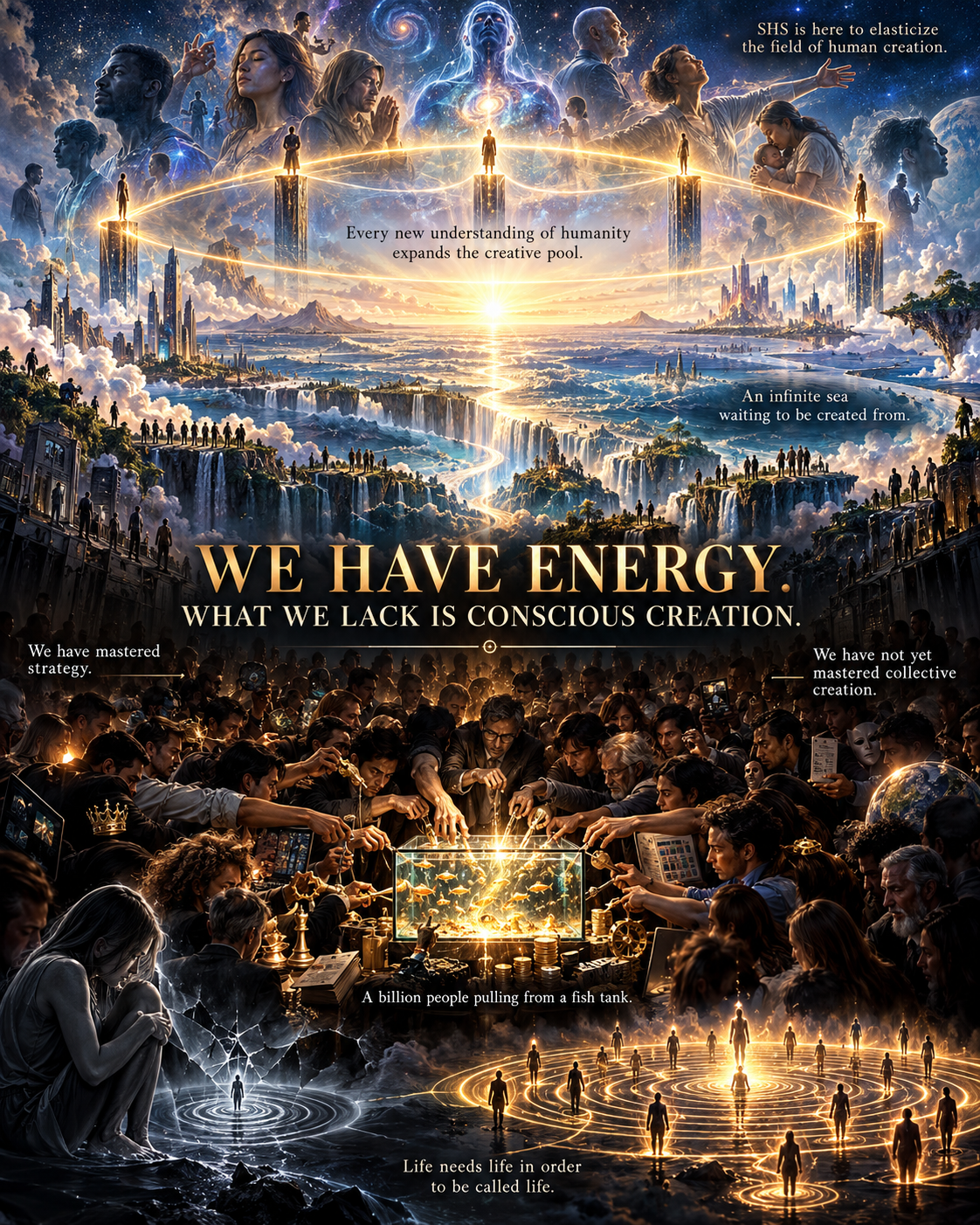
Write this metaphysical assessment that the reason as to why human beings are so focused on strategy and extraction and whatever takes away from their humanity is because they have a lot of energy. It’s basically what’s happening in individuals to the extreme with ADHD is what our society is actually going through, in the sense that we have so much energy but we don’t know how to actually create with it. Because there’s no examples of conscious creations that we can create from. It’s basically, it’s like having a billion people pulling out of a fish tank, or having, in terms of perspective of what’s known of humanity, or having—not just humanity, sorry—of consciousness, of which better knowing and better understanding what humanity is within it, compared to having an infinite sea to create from, in terms of creativity. Because it’s all about how much we can consider. For now, we’ve all been considering the individual. So we’ve created everything that one individual is in the lens of consciousness. So we’ve created every individual possibility of what a human can be, and we’ve created whether we’ve coined it to be fiction or we’ve coined it to be reality, we have laid out everything that a human being can possibly be. But we’ve allowed it to be so segmented that we don’t understand that we are that at different moments in time, in different circumstances, to different degrees. Everything that we’ve laid out humanity to be. And every time that we lay out a new bracket of what a human being is, we also expand the pool of creation from which we all create from. It’s like taking an elastic band that’s on five poles and introducing a sixth pole, and that expands how much circumference the elastic band actually covers. Imagine the elastic band to be the creative pool of humanity. Well, SHS is here to elasticize that and allow us to see beyond the individual, allow us to see because when we create just with the individual, we can see everything that humanity is, but we don’t contextualize our place within it. And if we do so, we only do so when it directly calls or directly feels relatable to us. We’re not able to see humanity unless it’s relatable to us, and that’s the biggest issue. Because, and I’ve used this example a lot of times before, that a lot of discoveries have been found because someone lost someone from it. Not because they were passionate about finding a solution about it, you know? Many created treatments under the duress of emotional sense of loss. For example, someone losing someone to leukemia and then going to create a solution to leukemia. Because their reasoning for which they started the research was a singular event that happened in their life, they’re only going to be looking at leukemia and see that to be the solution, and then start distribution. But really and truly, they might not see all the things that then that solution reverberates within either someone directly or their offsprings, for example. And for things as final as death and life, because—and that might be my opinion—but it’s something that we’ve seen happening so many times where something like social reputation, everyone can rebuild. But when it comes to death and life, unfortunately that is something that that individual life cannot rebuild. It can never be exactly what it was before, because if not, we start questioning whether that person died in the first place, you know? We start questioning reality, or the little fragments of reality that we’ve allowed ourselves to believe in. We start considering someone to have faked their own death, for example. If someone was to come back from the dead, that’s what I mean by it. But we’re here to expand what life in consciousness actually is at the ground, so that we can have a more conscious way of going about it, of understanding it, being in it, creating it, relating with it, appreciating it, and adoring it. Because we’re both the creations, but we’re also the adornment to life. Because life needs life in order for it to be called life. Without life, life cannot be called life because it doesn’t have life.
…
A Metaphysical Assessment of Human Energy, the Limitations of Individual Creation, and the Infinite Possibilities of Conscious Existence
We Do Not Lack Energy. We Lack the Conscious Understanding of What We Can Create With It.
I have come to consider that one of humanity’s greatest problems is not that we lack the energy to create a better world.
It is that we have an extraordinary amount of energy, and we have become accustomed to directing it towards an extraordinarily limited understanding of what we can create.
Look at how much energy humanity spends strategising.
Strategising to win. Strategising to survive. Strategising to accumulate. Strategising to extract. Strategising to protect what we have accumulated. Strategising against those who might take it from us.
Look at the extraordinary intellectual capacities we have dedicated to finding ways to extract more from less, to outperform another person, to dominate markets, to predict behaviour, to influence consumption, to secure positions, to defend territories, to manufacture advantages.
And then ask yourself:
What if this extraordinary strategic capacity is not evidence of humanity’s natural inclination towards competition, but evidence of how little we understand the creative possibilities available to us?
What if the problem is not that humanity wants too much?
What if humanity has so much energy that it cannot help but create, yet has inherited such a limited understanding of creation that it continuously creates variations of the same experiences?
We have mastered strategies within the realities we have constructed.
But have we mastered the conscious consideration of the realities we could construct?
Because there is an enormous difference between learning how to play within a system and understanding that the system itself is only one possible expression of human consciousness.
And I believe that much of what we call humanity’s destructive behaviour is energy finding expression within an insufficiently considered reality.
Not necessarily because that energy was created to destroy.
But because we have not developed enough conscious alternatives through which it can create.
1. Humanity’s Collective Restlessness: The Metaphysical Parallel With ADHD
Consider what happens when an individual experiences an extraordinary intensity of mental activity, impulses, curiosity, ideas and the desire to engage, yet struggles to organise that activity into a sustained creative direction.
One possible expression is restlessness.
Another is the continuous pursuit of stimulation.
Another is becoming exceptionally engaged in something that provides an immediate sense of purpose, challenge or reward.
And another is expending enormous amounts of energy without necessarily feeling that the energy has accomplished what the individual was capable of accomplishing.
I see a metaphysical parallel between aspects of this experience, sometimes associated with ADHD, and the way our society organises its collective energy.
I am not suggesting that ADHD and society are clinically the same phenomenon.
I am looking at the relationship between energy, stimulation, organisation, consideration and creation.
Humanity is extraordinarily energetic.
Look at everything we have constructed.
Cities. Governments. Religions. Languages. Industries. Economies. Technologies. Wars. Entertainment. Institutions. Financial systems. Educational systems. Entire civilisations.
We have created extraordinary complexities through which to experience our existence.
Yet much of our collective activity continues to revolve around maintaining, competing within or extracting from what already exists.
We are constantly moving.
Constantly inventing.
Constantly calculating.
Constantly consuming.
And still, we repeatedly return to the same foundational difficulties.
Scarcity. Exclusion. Suffering. Inequality. Competition for necessities. Institutional fragmentation. Preventable harm.
How can a civilisation possess so much creative energy and still struggle to organise the basic conditions of its own existence?
Perhaps because we have confused activity with creativity.
Perhaps because we have confused strategic sophistication with conscious development.
Perhaps because we have become so exceptionally good at organising energy within existing realities that we have neglected the possibility of creating entirely different ones.
The question is not whether humanity has enough energy to transform its existence.
Look at the energy we already spend trying to survive the one we have created.
The question is how much more of consciousness we must learn to consider before we understand what else that energy can become.
2. A Billion People Fishing From the Same Tank
Imagine a billion people standing around a fish tank.
Every individual possesses an extraordinary capacity to learn, adapt, strategise, experiment and create.
But everyone has been taught that the fish tank represents the available possibilities.
So we develop different methods of fishing.
Some develop sophisticated equipment.
Some learn to predict the movements of the fish.
Some create technologies capable of extracting fish faster than everyone else.
Some purchase privileged access to the tank.
Some begin selling fishing equipment.
Some establish institutions to regulate who can fish, how much they can fish and what they must exchange for the privilege.
Eventually, we develop an entire civilisation around the management of this fish tank.
And we call the most sophisticated participants successful.
We admire their strategies.
We study their methods.
We teach their techniques.
We create schools dedicated to improving the efficiency of extraction.
And when the tank begins to empty, we compete more intensely.
We introduce scarcity management.
We establish quotas.
We develop predictive models.
We argue over ownership.
We create increasingly complicated systems to determine who deserves access to what remains.
But who is considering the sea?
Who is asking why a billion conscious beings, possessing extraordinary creative abilities, are organising their existence around a fish tank when there is an infinite sea of possibilities to explore?
The tank represents the boundaries of our collective consideration.
The sea represents the possibilities of consciousness beyond those boundaries.
And the problem is not that we have exhausted our creativity.
It is that we have exhausted variations of what we have already allowed ourselves to consider.
We are repeatedly reorganising the contents of the same tank.
And sometimes we call that innovation.
Yet genuine conscious creation asks something more expansive.
Not merely how we can improve the fishing equipment.
But why our existence must be organised around fishing from the tank in the first place.
What else could we create?
What else could we experience?
What else could humanity become if the starting point were no longer the competition for existing possibilities, but the creation of possibilities we have not yet learned to recognise?
3. We Have Created the Individual. But Have We Created Humanity?
This brings me to something I consider fundamental.
We have explored an extraordinary range of what an individual human being can be, without necessarily understanding what humanity is as a whole.
Look at every character we have written.
Every personality.
Every hero.
Every villain.
Every victim.
Every perpetrator.
Every saviour.
Every tyrant.
Every lover.
Every betrayer.
Every compassionate person.
Every cruel person.
Every courageous person.
Every frightened person.
Every visionary.
Every person who destroys what another has created.
Every person who reconstructs what another has destroyed.
Whether we have called these expressions fiction or reality, humanity has spent generations exploring the possibilities of human existence.
We have created stories about almost every conceivable manifestation of an individual.
Yet we have segmented those manifestations so extensively that we often fail to recognise their relationship to ourselves.
We say:
That is a villain.
That is a hero.
That is a victim.
That is a genius.
That is a monster.
That is a good person.
That is a bad person.
And we begin relating to these classifications as though they represent entirely separate forms of existence.
But what if the reality is considerably more complex?
What if every individual carries capacities that can manifest differently according to circumstance, development, environment, experience, awareness and the intensity of the moment?
What if what we call a character is only one expression of a much larger spectrum?
Because an individual may be compassionate in one circumstance and indifferent in another.
Courageous in one moment and avoidant in the next.
A creator in one environment and destructive in another.
A victim of one system and a participant in the suffering produced by another.
We are not merely the characters we recognise ourselves to be. We are conscious beings capable of manifesting different dimensions of what we have collectively identified as human.
And until we understand this, we will continue to study humanity as something that exists outside ourselves.
We will relate to human experiences selectively.
We will recognise ourselves in some circumstances and distance ourselves from others.
We will develop compassion where we identify similarities.
And we will struggle to extend that same consideration where we perceive differences.
Which brings us to what I believe is one of the greatest limitations of our current collective consciousness.
We have made relatability the condition of consideration.
4. Why Must Humanity Become Personal Before We Consider It?
How many discoveries have been pursued because somebody lost someone?
How many people have dedicated their lives to understanding a disease because that disease took someone they loved?
How many campaigns for change have begun because somebody experienced an injustice personally?
How many individuals only began questioning an institution after becoming a victim of it?
Consider someone who loses a loved one to leukaemia.
The experience transforms their existence.
What was previously a disease they knew about becomes something they feel, something they understand emotionally, something they can no longer distance themselves from.
And perhaps they dedicate their life to discovering a treatment.
Perhaps they fund research.
Perhaps they create an institution.
Perhaps their work eventually contributes to saving countless lives.
That is an extraordinary expression of humanity.
But I want us to consider something beyond the beauty of that response.
Why did the loss have to occur before the consideration became urgent?
Why was the person’s suffering not sufficiently considerable before someone we loved experienced it?
Why must reality enter our individual existence before we begin treating it as a collective responsibility?
And there is another dimension.
When our creative purpose originates from one specific experience, we can become so intensely focused on correcting that experience that we overlook how our solution interacts with the wider realities of existence.
A person researching leukaemia may become extraordinarily competent at addressing one dimension of the disease.
But what about the broader biological systems?
What about long-term consequences?
What about future generations?
What about how the treatment interacts with other aspects of an individual’s health?
What about everything that exists beyond the original problem?
This is not an argument against specialised research.
It is an argument for understanding that specialisation without conscious integration can limit the circumference of our consideration.
We must be capable of solving the problem directly in front of us while remaining conscious of the greater reality in which that problem exists.
The solution must not become another problem simply because we stopped considering everything beyond our original intention.
This is why foreseeability matters.
This is why initiative matters.
This is why prevention matters.
Not simply as administrative principles, but as expressions of consciousness.
Because consciousness allows us to consider experiences before they become our own.
And if we possess that ability, why should we wait until suffering enters our personal lives before exercising it?
Must someone die for us to consider the value of their life?
Must someone become houseless for us to understand the necessity of shelter?
Must someone experience exclusion before we question whether our systems are capable of including them?
Must someone lose their dignity before we examine the conditions that made its protection dependent upon circumstances?
What is the purpose of possessing higher conscious capacities if we continue requiring direct personal experiences to activate our consideration of humanity?
5. The Elastic Band of Human Creativity
Now imagine an elastic band stretched around five poles.
The circumference of that elastic band represents the collective creative pool of humanity.
Everything within its boundaries represents what we have learned to consider possible.
Within this circumference, we create.
We experiment.
We develop technologies.
We establish systems.
We produce art.
We construct cultures.
We invent possibilities.
But regardless of how much creativity occurs within the band, its boundaries continue to define the area available to us.
Now introduce a sixth pole.
Stretch the elastic band around it.
Suddenly, the circumference expands.
And with that expansion comes an entirely new area of possibility.
Nothing within the previous circumference necessarily needs to disappear.
We have simply expanded the space in which creation can occur.
Now imagine introducing a seventh pole.
An eighth.
A ninth.
A hundredth.
A millionth.
Each new point of consideration allows the creative field to extend into realities that were previously outside our collective understanding.
This is what I mean when I speak about expanding humanity’s consciousness.
Not simply becoming more intelligent.
Not accumulating more information.
Not developing more sophisticated strategies within existing institutions.
But expanding the circumference of what we consider.
Every time we introduce another dimension of humanity into our conscious understanding, we expand what humanity can create.
Every time we understand an experience that was previously foreign to us, we increase the possibilities of our relationships.
Every time we recognise the connection between systems previously considered separate, we expand our capacity for organisation.
Every time we understand that someone else’s existence belongs within our consideration, even when their experience is nothing like our own, we expand the creative pool from which our civilisation can develop.
Consideration is not merely an ethical gesture. It is a creative capacity.
And its expansion changes what becomes possible.
This is where SHS – Human First comes into the picture.
We are here to elasticise the creative circumference of humanity.
To expand consideration beyond the individual.
Beyond the familiar.
Beyond the immediately relatable.
Beyond the systems we have inherited.
Beyond the industries we have constructed.
Beyond the circumstances we have personally experienced.
Not because the individual is insignificant.
But because the individual exists within humanity, and humanity exists within consciousness.
And the more of that interconnected existence we can consider, the more we can consciously create within it.
6. The Difference Between Individual Intelligence and Collective Consciousness
We have built societies in which individual intelligence can be extraordinarily sophisticated while collective organisation remains remarkably limited.
Someone may understand financial markets with exceptional precision while remaining disconnected from the human consequences of the economic structures they participate in.
Someone may develop extraordinary technological capabilities while possessing little understanding of how those technologies alter relationships, behaviour, development and social continuity.
Someone may master the laws governing an institution without questioning whether the institution itself sufficiently considers the lives it governs.
And someone may become exceptionally successful within an industry without ever considering whether the industry’s existence contributes to the kind of humanity they would want to experience.
We call these people intelligent.
And within their respective disciplines, they may be.
But intelligence is not the same as the conscious integration of intelligence.
Knowing how something works does not necessarily mean understanding everything it affects.
And this distinction becomes especially important when we consider that human beings do not exist as isolated systems.
We exist through relationships.
Through environments.
Through biological interdependencies.
Through cultures.
Through institutions.
Through inherited histories.
Through the experiences of individuals we may never meet.
Through the consequences of decisions made before we were born.
And through the consequences of decisions we make for those who will exist after us.
Yet much of our organisation continues to begin and end with the individual.
Individual success.
Individual ownership.
Individual ambition.
Individual responsibility.
Individual competition.
Individual survival.
We develop extraordinary understandings of the individual components of humanity while struggling to consciously organise the relationships between those components.
And then we wonder why our collective existence produces such contradictory outcomes.
Because we have trained ourselves to become experts in fragments of reality without requiring ourselves to understand the reality those fragments collectively create.
What would happen if we reversed that?
What if our starting point were the collective existence of humanity, and individual creation became an expression of how we contribute to that existence?
What if we considered our place within humanity before determining what we wanted to extract from it?
What if we developed technologies, medicines, laws, businesses, economies and institutions through an understanding of their relationships to the entirety of human existence?
Not merely through the interests of those who created them.
Or those who fund them.
Or those who immediately benefit from them.
But through the scope of everyone whose existence they may affect.
That is the difference between creating something for an individual and consciously creating within humanity.
7. The Finality of Life and the Responsibility of Consideration
There is something particularly important about this when we consider life and death.
Humanity has developed ways to recover from extraordinary circumstances.
A damaged reputation can sometimes be rebuilt.
Financial losses can sometimes be recovered.
Relationships can sometimes be repaired.
Institutions can sometimes be reconstructed.
Entire cities can rise again after destruction.
But death presents a different reality.
When an individual life ends, we do not currently possess a means of restoring that same person’s lived existence exactly as it was.
And if someone we believed to have died were suddenly to reappear, what would we do?
We would question what happened.
We might question whether the death had been genuine.
Whether the individual had disappeared.
Whether the event had been misunderstood.
We would begin questioning the fragments of reality upon which our understanding had been constructed.
Because that is what consciousness does when an experience contradicts what it has learned to recognise as possible.
It investigates.
It reassesses.
It seeks another explanation.
But we should not need such an extraordinary contradiction to begin questioning whether we sufficiently understand life.
Why do we wait for the finality of death before considering the entirety of someone’s existence?
Why do we commemorate human beings more comprehensively after their lives have ended than we consider their needs while they are living?
Why do we dedicate extraordinary resources to memorialising existence while allowing preventable suffering to remain a normal feature of living?
And why have we become so accustomed to measuring the value of life through what an individual produces, earns, owns or contributes economically?
A human being is not merely an economic participant.
A human being is an expression of life.
An experience of consciousness.
A participant in realities that extend far beyond their individual understanding.
And every human being carries possibilities that may never manifest if the conditions of their existence continuously prevent them from creating.
Consider everything humanity has not yet experienced because someone was too exhausted to create.
Too occupied with survival.
Too unsupported to develop.
Too frightened to express themselves.
Too excluded to participate.
Too consumed by circumstances that demanded the entirety of their energy simply to remain alive.
How much creativity have we never encountered?
How many discoveries have never occurred?
How many extraordinary relationships have never developed?
How many dimensions of consciousness have remained unexpressed because their human manifestations were never given the conditions to unfold?
What if the greatest waste in human civilisation is not the resources we fail to extract, but the consciousness we fail to nurture?
8. We Are Not Merely Creations of Life. We Are Its Adornment.
And this brings me to the deepest part of the assessment.
We often speak about life as though it is something separate from us.
Something we have been given.
Something we must navigate.
Something we must survive.
Something we must make something out of.
But what is life without life?
What is existence without something existing within it?
What is an experience without something capable of experiencing it?
Life requires life to be recognisable as life.
And we are not merely observers of that reality.
We are part of what makes that reality exist as an experience.
We are the creation.
But we are also the adornment.
Through us, life experiences expressions of itself.
Through our relationships, it develops new relationships.
Through our creativity, it manifests possibilities.
Through our consciousness, it becomes capable of considering aspects of its own existence.
Through our differences, it experiences variation.
Through our similarities, it experiences connection.
Through our individuality, it experiences distinction.
And through our collective existence, it experiences something that no individual could produce alone.
This is why I do not believe humanity’s highest creative purpose can be reduced to individual success.
Because we are not here merely to construct impressive individual experiences.
We are here to contribute to the experience of existence itself.
To generate expressions of consciousness beyond those we inherited.
To create environments in which other expressions of consciousness can flourish.
To understand the extraordinary relationship between what we are, what we create and what our creations make possible for everything else.
And to recognise that the quality of human existence is not determined solely by what any individual manages to accomplish.
It is also determined by what we collectively make possible.
We are not merely here to live within life. We are here to contribute to what life can become.
9. From the Extraction of Energy to the Creation of Existence
Now return to the beginning.
Humanity has extraordinary energy.
We have extraordinary intelligence.
Extraordinary imagination.
Extraordinary capacities for adaptation.
Extraordinary abilities to discover, organise, predict, construct and transform.
But we have spent so much of our existence learning to compete within the possibilities we recognise that we have neglected the infinite creative potential of expanding what we recognise in the first place.
We have directed energy towards extraction because extraction is one of the activities our existing organisation repeatedly rewards.
We have directed intelligence towards strategic dominance because dominance is one of the outcomes we have learned to identify as success.
We have directed creativity towards accumulation because accumulation is one of the ways we have learned to secure our existence.
And we have directed our consideration towards the individual because individuality has been the dominant lens through which we have organised our collective reality.
But none of these arrangements exhausts what humanity can be.
They are expressions of what we have learned to create, not the boundaries of what consciousness can create through us.
Imagine redirecting the same extraordinary energy towards expanding the possibilities of life.
Imagine if the intellectual capacity spent engineering advantages over other human beings were applied to designing environments where those advantages were no longer necessary for survival.
Imagine if the creativity dedicated to manufacturing desire were directed towards understanding the dimensions of human fulfilment.
Imagine if the strategic sophistication developed through competition were applied to coordinating the participation of humanity.
Imagine if the extraordinary energy invested in extracting value from people were invested in developing the conditions through which people could generate value, experiences and possibilities beyond themselves.
Not less strategy.
Greater strategy, with a greater circumference of consideration.
Not less intelligence.
Greater integration of intelligence.
Not less individuality.
A more conscious understanding of individuality within the collective.
Not less ambition.
Ambitions capable of extending beyond the limitations of individual existence.
Not less creation.
An expansion of what creation can mean.
Because once humanity begins considering itself beyond the individual, an entirely different creative reality becomes available.
We stop seeing other human beings merely as competitors, consumers, strangers, resources, obstacles or opportunities.
We begin recognising them as expressions of the same greater existence within which our own consciousness participates.
And this changes everything.
Not because we become identical.
But because our differences become part of the creative possibilities available to our collective existence.
The experiences I have not lived no longer need to remain outside my consideration.
The suffering I have not personally encountered no longer needs to remain outside my responsibility.
The realities I do not recognise no longer need to remain outside my curiosity.
The people I cannot relate to directly no longer need to remain outside my understanding of humanity.
Because the purpose of consciousness is not merely to recognise itself in what it already knows. It is also to expand its understanding through what it has not yet experienced.
10. Infinite Creativity Requires Infinite Consideration
This is ultimately what SHS – Human First seeks to introduce.
An expansion of humanity’s creative consciousness.
Not by replacing individuality with uniformity.
Not by asking everyone to create the same things.
Not by reducing the extraordinary diversity of human experiences.
But by expanding the circumference within which all those experiences can be understood, nurtured and consciously organised.
We have mastered so many possibilities within the five poles.
We have stretched our creativity across the familiar boundaries.
We have developed extraordinary ways of navigating the circumstances we inherited.
But there are more poles.
There are more dimensions.
There are experiences we have yet to consider.
Relationships we have yet to understand.
Forms of organisation we have yet to create.
Possibilities of human existence that cannot emerge while we continue treating the individual as the outer boundary of consciousness.
The greatest expansion available to humanity may not be the discovery of another resource, another market, another technology or another territory.
It may be the expansion of what we are willing and capable of considering.
Because when consideration expands, creation expands with it.
And when creation expands, humanity gains access to experiences that previously existed outside the circumference of its collective imagination.
We are not running out of things to create.
We are running into the boundaries of what we have learned to consider.
And rather than continuing to extract more intensely from the same limited possibilities, we can begin expanding the possibilities themselves.
We can stop asking only how much one individual can achieve.
And begin asking how much more of life can become possible through the conscious existence of humanity.
Because there is no shortage of energy.
There is no shortage of consciousness to explore.
There is no shortage of possible experiences.
There is an extraordinary existence waiting to be more consciously understood, organised, nurtured and expressed.
And we are part of that existence.
Not merely its consumers.
Not merely its observers.
Not merely its beneficiaries.
Its creators. Its participants. Its expressions. Its adornment.
We are consciousness participating in the creation of experiences through which consciousness can experience more of itself.
And the more of that existence we learn to consider, the more of it we become capable of creating.
So perhaps it is time to stop asking how much more we can take from the fish tank.
And begin discovering how much of the infinite sea we can bring into conscious creation.
Because life needs life to be life.
And we are here not merely to experience it.
We are here to contribute to everything it has yet to become.
SHS – Human First | A Metaphysical Assessment of Consciousness, Human Energy and the Expansion of Creative Consideration



Leave a Reply