

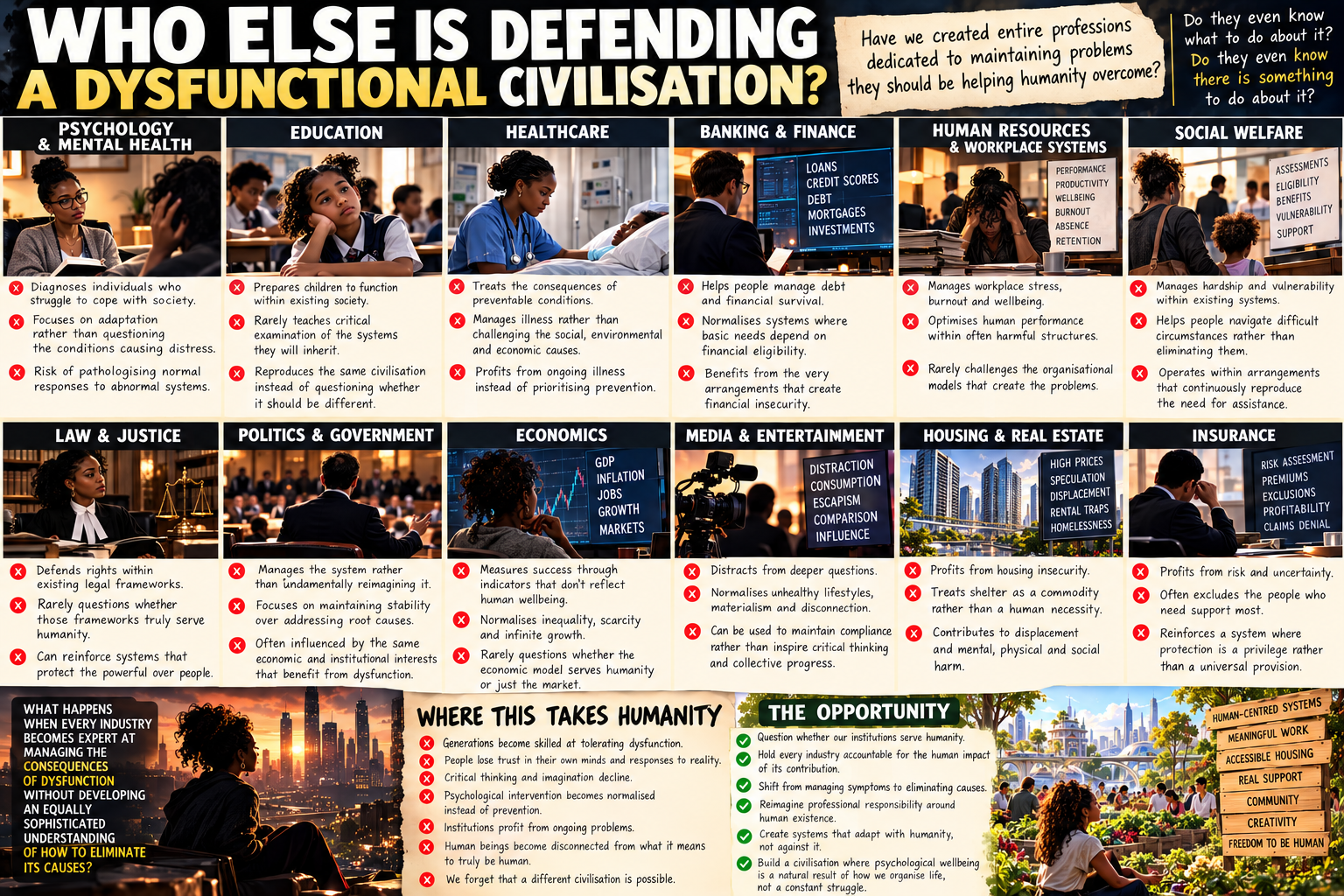
What if society is dysfunctional, and psychologists are simply helping us function within it?
One question about suicide has exposed what I consider an enormous failure in psychological assessment.
How does someone lose a loved one to suicide, recognise the conditions that contributed to making their life unbearable, and continue participating in and defending those same conditions without questioning whether we could organise society differently?
And why aren’t psychologists investigating this mindset?
Because if they’re not asking these questions, what exactly have they understood about the human mind after spending so many years studying it?
We’re talking about people who have dedicated their professional lives to understanding human thought, behaviour, perception and psychological functioning.
Yet how can they adequately assess an individual’s mind without questioning the functioning of the society that shaped it?
Humanity has a serious contextualisation problem.
People are living lives they barely understand, participating in systems they haven’t critically examined, yet defending those systems with their lives.
And psychologists are supposed to be among the people capable of recognising this.
Instead, much of psychological assessment focuses on whether an individual can function within society.
But who established that society itself is functioning?
What if we’re all dysfunctional precisely because we’ve become so good at functioning within dysfunction?
And what if psychologists are reinforcing that dysfunction by helping people adapt to circumstances that should themselves be psychologically examined?
This is where their professional responsibility becomes impossible to ignore.
If psychologists are entrusted with understanding and supporting the human mind, they must also be capable of recognising when the mind has been conditioned to accept circumstances it doesn’t understand.
Otherwise, what are they treating?
The psychological consequences of societal dysfunction, while leaving the dysfunction itself unquestioned?
And worse, what if they are themselves psychologically conditioned by the very society they’re assessing people against?
Who psychologises the psychologist?
Who assesses their capacity for critical thinking, independent contextualisation and recognition of the societal assumptions embedded in their professional judgements?
Because contextualisation is fundamental to critical thinking.
And the downfall of a civilisation begins when its people stop critically examining the reality they’re defending.
This is not merely a problem of individual ignorance.
It’s a professional responsibility problem.
When the very people entrusted with understanding human thought fail to recognise the consequences of humanity’s inability to think critically about its own existence, that failure has implications for everyone they assess.
And meanwhile, those who benefit from existing arrangements can continue profiting from a population that doesn’t even recognise what it could be questioning.
So I’ll ask again: Who psychologises the psychologist?
Because if the people responsible for helping humanity understand its own mind cannot sufficiently contextualise the civilisation shaping that mind, we’re in deep shit.



Leave a Reply