
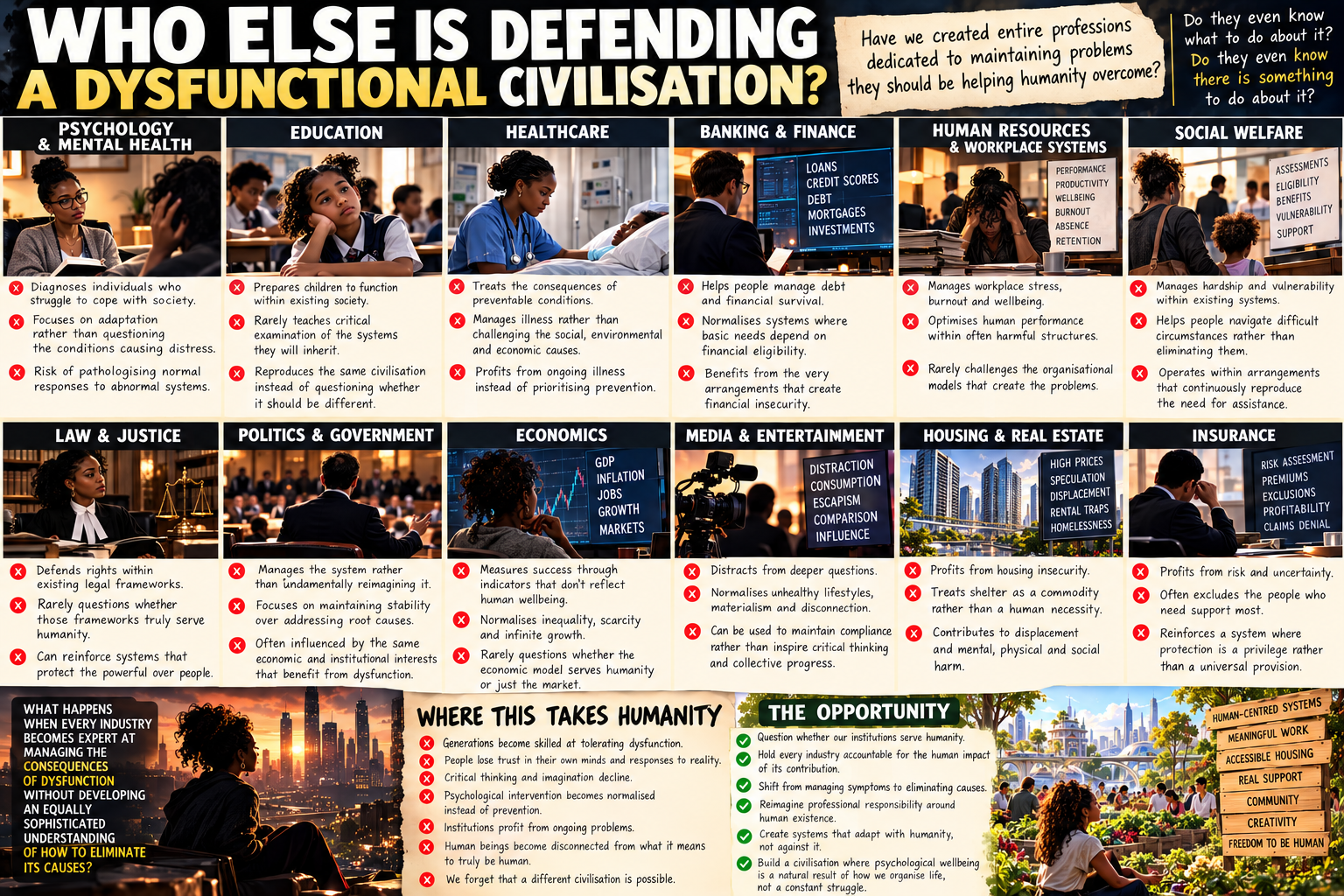
Have we created entire professions dedicated to maintaining problems they should be helping humanity overcome?
Psychologists aren’t the only ones we need to question.
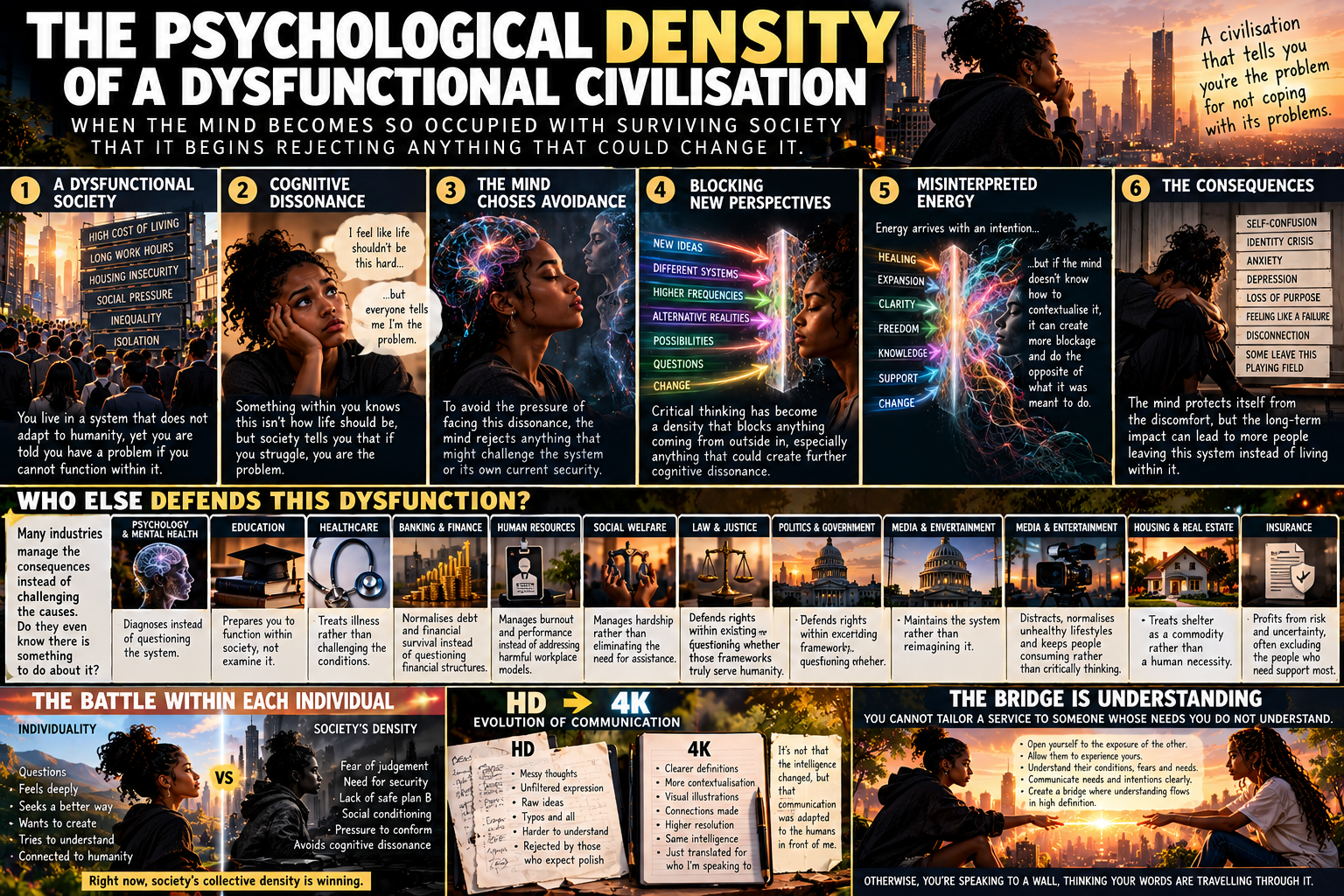
What about the industries entrusted with managing the consequences of how we’ve organised civilisation?
Look at education. Teachers are expected to prepare children to function within society. But how much of education is dedicated to questioning whether that society deserves to be reproduced?
Look at human resources. HR departments manage workplace stress, burnout, performance and employee wellbeing. But how frequently do they challenge the very organisational structures generating those problems?
Look at healthcare. We treat illnesses, prescribe medication and manage chronic conditions. But how much responsibility do healthcare institutions take for challenging the social and environmental conditions contributing to preventable illness?
Look at banking and finance. We help people manage debt, improve creditworthiness and become financially literate. But who is questioning why access to basic human necessities has become so dependent on financial eligibility?
Look at social welfare. We assess vulnerability, distribute assistance and help people navigate hardship. But why does the profession responsible for addressing hardship so often operate within arrangements that continuously reproduce the need for assistance?
Look at law. Lawyers defend people’s rights within existing legal frameworks. But how often are those frameworks themselves examined against the human realities they’re supposed to protect?
And what about economists, politicians, employers, insurers, housing providers, charities and even the entertainment industry?
How many professions have become extraordinarily sophisticated at managing the consequences of dysfunction without developing an equally sophisticated understanding of how to eliminate its causes?
But here’s where my investigation becomes considerably more concerning.
DO THEY EVEN KNOW THERE IS SOMETHING TO DO ABOUT IT?
Because it’s one thing to recognise a problem and lack the authority or resources to resolve it.
It’s another thing entirely to have spent decades studying, teaching and administering a system without ever considering that the system itself could be fundamentally reorganised.
What happens when an entire profession develops expertise within a framework but never develops the capacity to question the framework?
What happens when professional competence becomes synonymous with maintaining existing arrangements?
We risk creating an entire civilisation of highly qualified people who know how to operate their departments but cannot contextualise the civilisation those departments collectively produce.
And because everyone is professionally responsible for their little segment, nobody takes responsibility for examining the whole.
The psychologist treats the distress.
The doctor treats the illness.
The social worker manages the hardship.
The financial adviser manages the debt.
The employer manages the productivity.
The government manages the expenditure.
And humanity?
Humanity continues experiencing the combined consequences of everybody’s professional decisions.
This is what makes the question of contextualisation so critical.
Because being professionally educated does not automatically mean being capable of independently examining the reality within which that education operates.
And if the people entrusted with maintaining civilisation cannot imagine organising it differently, who exactly is responsible for its evolution?
Perhaps our greatest institutional deficiency isn’t a lack of expertise.
It’s the absence of responsibility for questioning whether the things we’ve become experts at doing should still be done in the same way.
We’ve developed professions for practically everything.
But have we developed sufficient professional responsibility for the experience of being human?
Because if not, we may have built something extraordinary:
A civilisation with millions of professionals maintaining its functioning, while nobody is sufficiently accountable for whether that functioning is actually serving humanity.

Leave a Reply