
When the mind becomes so occupied with surviving society that it begins rejecting anything that could change it.
And now everything starts fitting together.
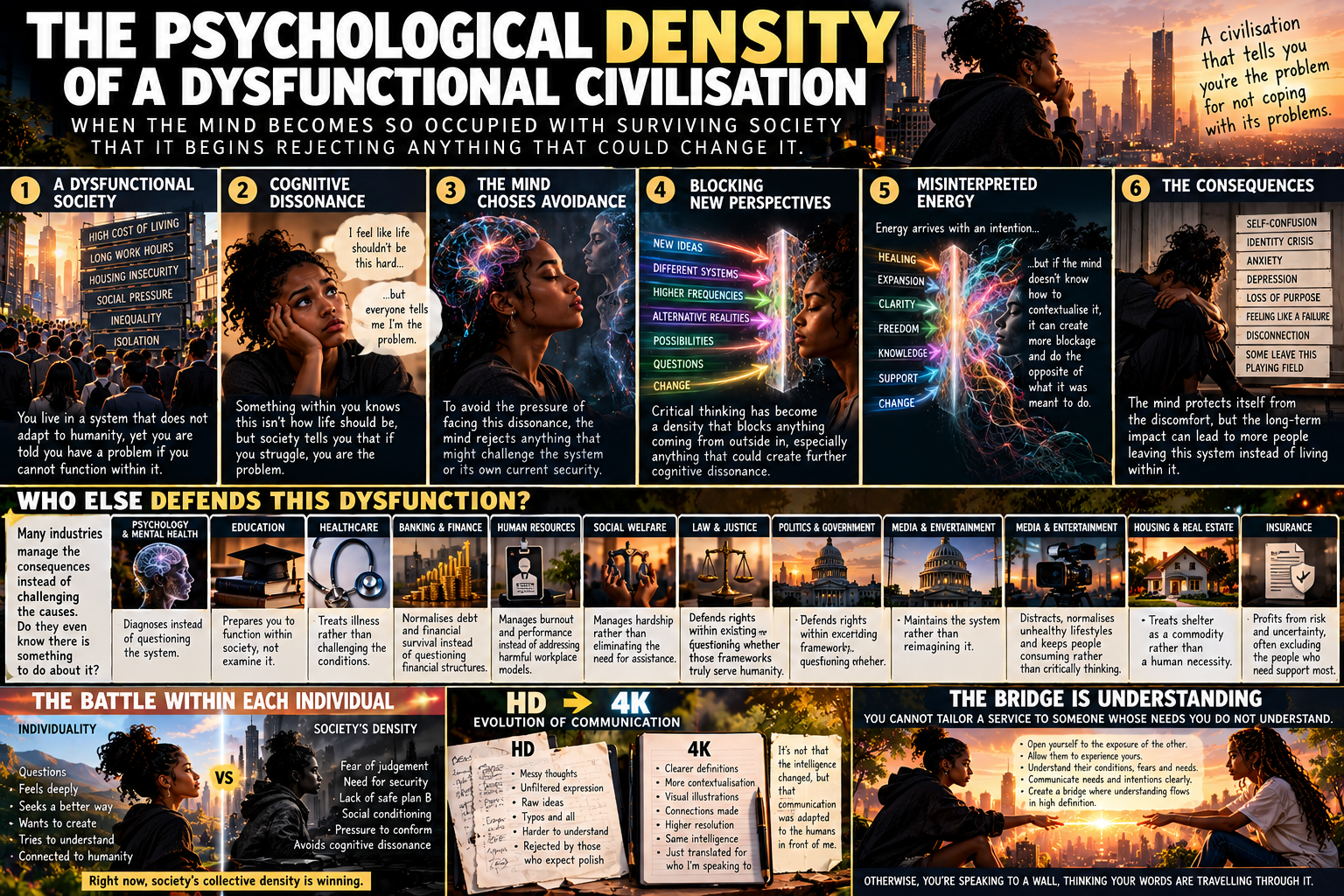
And it puzzles in just perfectly. Also mentioning how, because critical thinking is the biggest issue, it has become its own density that blocks anything that comes from the outside in, that undoes, undoes anything that could create further dissonant cognition. Because the whole world makes you feel bad for not being functional within a dysfunctional system. The mind itself blocks everything that is, and that does lead to functioning in a system like this, and it creates the pressure that then leads to more people leaving this playing field instead of living within it. Because the pattern that’s being practiced is a pattern of avoidance. Because the mind is trying to avoid feeling the cognitive dissonance to how they really feel, because they really feel like they should be able to live in a functional system. But they don’t. And the dysfunctional system tells them that they have a problem if they’re not capable to function in it. So in order to avoid all of that, the mind just puts blocks for specific frequencies to not enter our system. The system that contextualizes energy. If you only receive a certain amount or a certain type of energy, and your field takes it in, but your mind does not know how to contextualize it. It grows the blockage from the inside out even more. It does the opposite of what that energy was meant to do, simply because it’s uncontextualized energy. Because the mind won’t contextualize what it’s trying to fight against. It’s trying to fight against being classed as dysfunctional. So because the mind is trying to fight against being classed as dysfunctional, because it is, and unless it is trying to fight against it, then you get that circumstance where all of that happens. You get the circumstance where all that comes through is energy with an intention, but the intention needs to be balanced to the intention of the field in which it enters. So in saying that, I can see where I’ve polished more my style of communication and made it more specific, more clear. I still kept the typos, but even in illustrations, I’ve made contextualizations of everything that I spoke. Even, I’ve raised basically each, its definition. I went from HD to 4K type of situation. Because I understood that the humans that I had in front of me could not understand messiness being higher intelligent. Which is the same as people say, those who curse the most are the most intelligent. It’s the same thing, but one is accepted, the other one is rejected because it makes those who are trying to look polished look bad. Because if one can be that intelligent while being messy, then what does it say about those who are trying so hard to be and look polished? If anything, it says that they’re the opposite of what they are. They are the messy without the smartness, or well, the intensity of smartness, which is higher intelligence, right? Now this is to understand that every individual field is going through a battle between individuality and society. But the individual is losing the battle because the density of society at this current state is winning. So because of that, we have to understand that every individual’s field is tuned into a frequency that doesn’t fight the system, because it doesn’t want to feel the pressure of that fight at this current moment in time, because they don’t feel like they have a safe plan B if they were to fight the system. Now, I’ve built for myself that safe plan B, because I understand that I could have not approached humans for the intentions that I had at this current moment in time, because of the conditions that humans have. It’s basically understanding who you’re interacting with, speaking with, and the era and the cycle that they’re in. Understanding the needs of the other, basically. If you don’t understand the needs of the other, you can’t tailor your service to the other. You can’t tailor yourself to the other. You can’t provide for the other. And that’s simply because you don’t understand the other. If you’re not willing to truly open yourself to the exposure of the other, by opening them to the exposure of you, you cannot do it. Because there will never be the thorough connection that then becomes a bridge where needs and intentions are communicated in high definition. It’s like speaking to a wall, thinking that you’re speaking through it.
…..
THE PSYCHOLOGICAL DENSITY OF A DYSFUNCTIONAL CIVILISATION
When the mind becomes so occupied with surviving society that it begins rejecting anything that could change it.
And now everything starts fitting together.
The absence of critical thinking has created its own psychological density. A density so established that anything entering from outside, particularly anything that challenges the individual’s understanding of reality, risks being rejected before it can even be contextualised.
Because think about it.
You live in a dysfunctional society that continuously tells you something is wrong with you if you cannot function within it.
Yet something within you recognises that life should not be this difficult.
There’s your cognitive dissonance.
And rather than confronting it, the mind begins practising avoidance. Not necessarily because it cannot recognise another possibility, but because recognising it would mean confronting the reality of its current existence.
And what happens when the individual doesn’t believe they have a safe alternative?
They protect themselves from the confrontation.
The individual is already fighting a battle between individuality and society, but society’s collective density is winning. So the mind begins rejecting anything that might threaten its ability to continue functioning within the system.
In my metaphysical understanding, this extends to the individual’s energetic field.
Every field receives energy, but receiving energy and contextualising its intention are two different things.
Energy entering a field must be contextualised in relation to the intentions already operating within that field.
When that doesn’t happen, what could have expanded someone’s consciousness may instead intensify their internal resistance.
The energy arrives carrying an intention, but the receiving mind interprets it through the very conditions it’s attempting to protect itself from.
And instead of expanding awareness, the experience reinforces the blockage.
The mind rejects the possibility of liberation because it cannot yet contextualise liberation without threatening its present security.
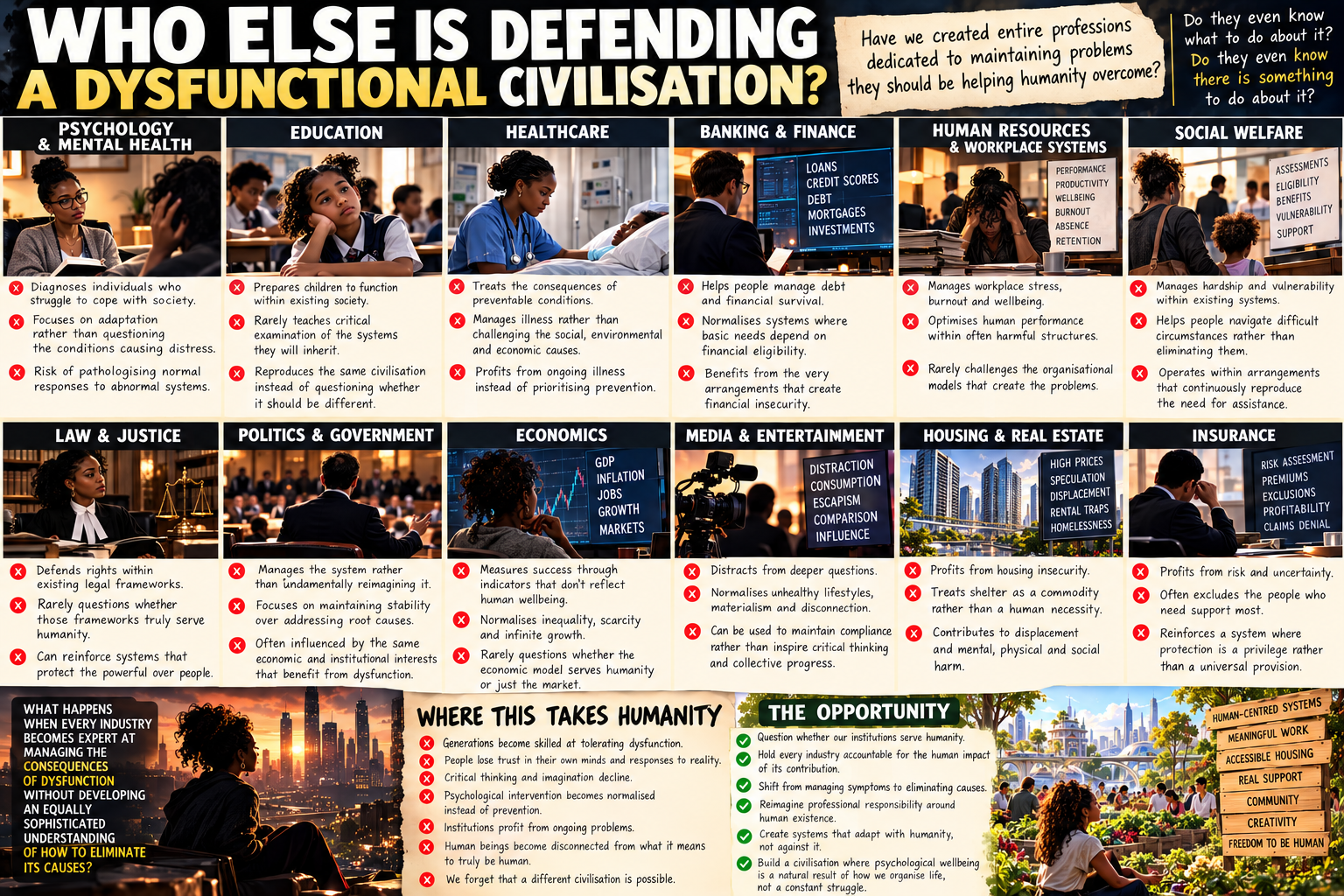
And this is where I believe psychology has an enormous responsibility to investigate what it means to help people understand their own existence, rather than merely adjust to its conditions.
Because the consequences of this pattern can be devastating.
We are creating psychological environments where people increasingly struggle to imagine alternatives, and for some, the pressure of living can become unbearable.
AND THIS IS WHERE MY OWN COMMUNICATION HAS EVOLVED.
I’ve realised something about the human beings I’m communicating with.
You cannot communicate effectively without understanding the conditions of the consciousness receiving your communication.
I had to account for the density.
I had to understand the psychological environment, the fears, the social conditioning, the need for security and the limitations of what people currently feel capable of considering.
And that’s why my communication has evolved.
I’ve gone from HD to 4K.
Not necessarily because my understanding has become more intelligent, but because I’ve increased the resolution at which I communicate it.
I’ve made my definitions more precise. My illustrations more contextualised. My connections more explicit.
I’ve even kept the typos!
Because I realised that people were struggling to recognise intelligence when it wasn’t presented in the appearance they’d been conditioned to associate with intelligence.
How extraordinary.
People can entertain the idea that someone who swears frequently might be highly intelligent, yet struggle to recognise sophisticated thinking when its presentation appears messy.
Because if intelligence can exist without looking polished, what does that say about everyone investing so much energy in appearing intelligent?
Suddenly, appearance loses some of its authority.
And that’s uncomfortable for people whose identities depend on it.
But the purpose of refining my communication wasn’t to validate those expectations.
It was to understand the receiving field.
I also had to build myself a safe Plan B, because I understood that I couldn’t approach humanity with the intentions I had without considering the psychological conditions humanity is currently living within.
You cannot tailor a service to someone whose needs you do not understand.
And you cannot fully understand those needs without being willing to expose yourself to their reality, while allowing them to experience yours.
That mutual exposure creates the bridge.
A bridge through which needs, intentions, meanings and possibilities can finally be communicated in high definition.
Otherwise, you’re simply speaking to a wall, convinced that your words are travelling through it.
And perhaps this is one of the most important lessons of Conscious Organisation:
It isn’t enough to know what humanity needs. We must understand the conditions that determine whether humanity can recognise, receive and participate in what it needs.
Because creating a better civilisation is one challenge.
Helping human beings recognise that they’re allowed to imagine, question and participate in creating one is another.
And the second challenge may be what determines whether the first can succeed.

Leave a Reply