

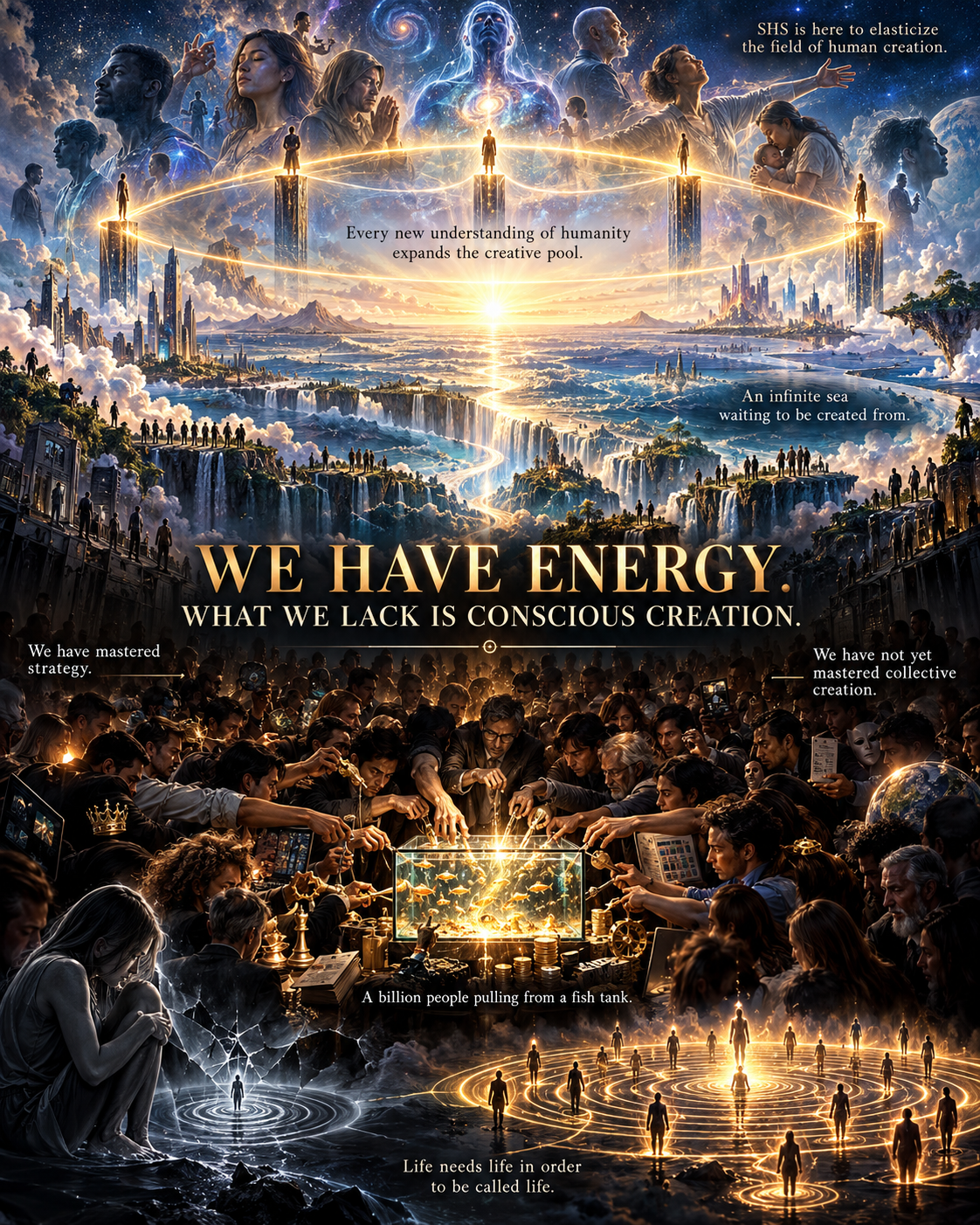
Department of defense not sure they’ve been clocking in. To protect one’s vitality, one must trade it for money. How dumb has this belief been?! Our livelihood is not the game, the systems are, yet they have real life consequences. And there’s 2 gates we must always be conscious about: parental opens our individual, romance opens our continuation. They’re two polars of Love, hate is in the split middle. It manifests as what we hate in partners, learned from parents or what we hate in parents learned from love. It’s a push and pull until we colonise the full of it without differentiation. Not mixing roles, but by mixing the person we need to be for both ends.
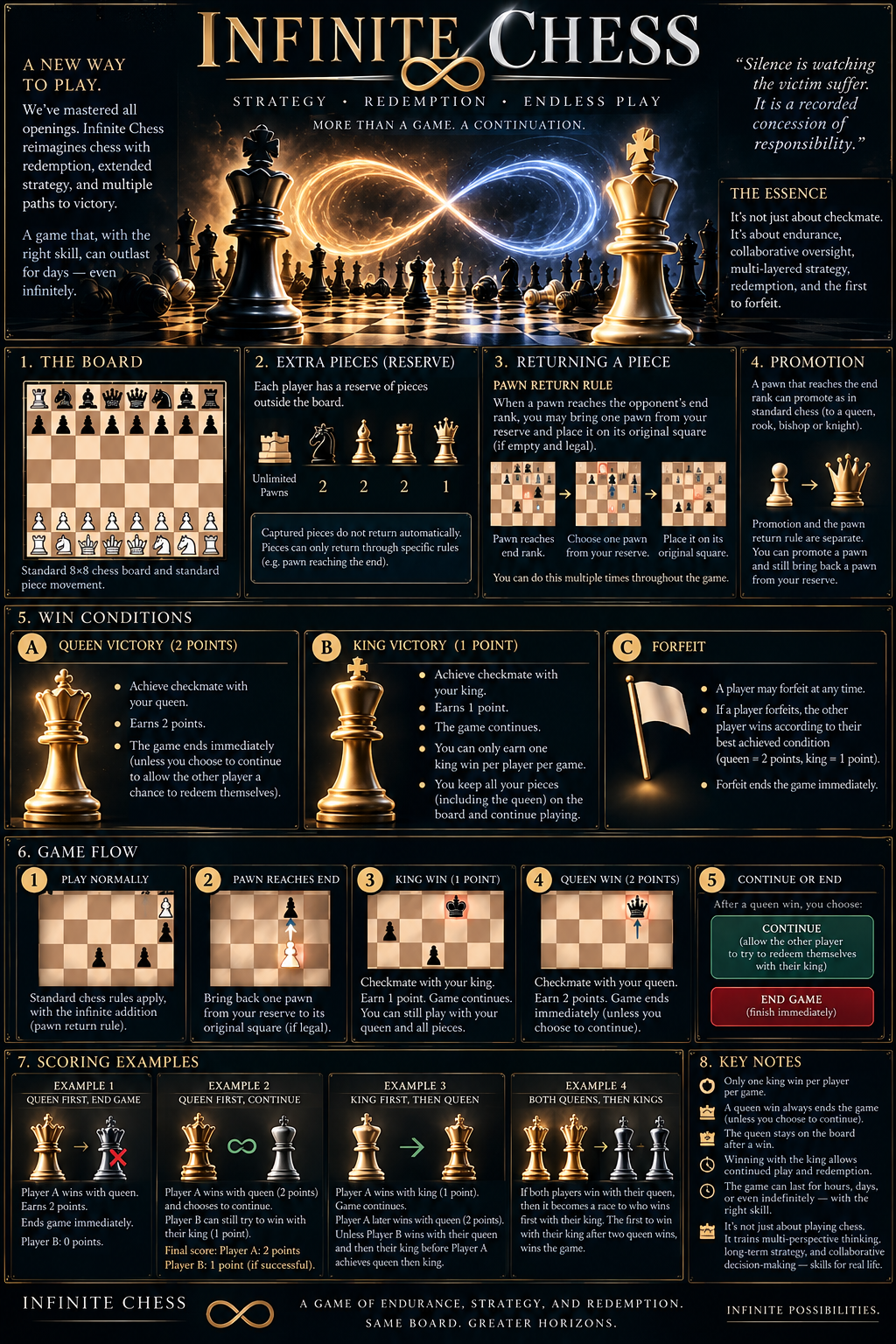
Chess Description of what’s ahead.
Output: The broader record changes the description of the match: SHS is progressively discovering that it can attack extraction by developing the capacity to provide. The early moves question the authority of the existing system. The middle game assembles alternatives. The latest moves connect those alternatives into an intended system whose continued existence would require progressively less money.
The deepest strategic development is this: the freed system stops measuring victory by what it can take from the extractive system and begins measuring it by how much humanity no longer needs to surrender to it.
I screened the 186 posts currently exposed through the website’s public archive, checked its sitemap, and examined additional historical material available through search indexing. The homepage says 2,570 posts are private, so I cannot honestly describe this as a complete reading of the entire historical website. Long entries were screened through excerpts with closer reading of the central economic proposals; image-only entries and attached documents are not comprehensively covered. Older indexed material provides partial historical context.
What follows is a reconstruction of the match from that accessible record. We have one player’s scorebook. The other side’s position is visible through the conditions SHS describes, the objections it answers and the dependencies it proposes to remove. References to the extractive player therefore describe an organising logic—not evidence of a single coordinated opponent reacting to every publication.
The starting position: one side already occupies the board.
We arrive after the game has begun.
The extractive system already occupies the important squares: access to land, accommodation, food, employment, credit, education, infrastructure and institutional recognition. Its advantage is that ordinary life repeatedly passes through transactions it can charge for.
The freed system begins with comparatively little material on the board: an author, an expanding body of work, proposed institutions, experiences, relationships and an organising principle.
At first glance, the material imbalance looks overwhelming.
But the two players are evaluating the position differently.
What the extractive system counts What the freed system begins counting
Revenue secured Needs reliably met
Customers retained Dependencies removed
Labour purchased Human capability developed
Assets controlled Productive capacity made accessible
Transactions repeated Problems prevented from recurring
Institutional survival Continuity of the people and conditions the institution serves
This difference matters throughout the match. A move that looks like surrendering a revenue opportunity can improve the freed system’s position. A move that increases revenue can weaken the extractive system’s underlying human or ecological foundations.
The opening question is therefore: which player’s evaluation captures what actually keeps the board in existence?
- The first challenge is to the value of the pieces.
An older indexed July essay makes the foundational distinction between living realities and the symbols used to organise them: food and its price, land and its title, human capability and its institutional recognition. Its argument is that the representation has acquired authority over the reality it was supposed to serve.
As match commentary:
The freed system does not immediately attack the largest piece. It examines why everyone has agreed that the piece is powerful.
A monetary claim can influence who receives food. It cannot itself grow the food. A qualification can organise recognition. It is not identical to the capacity it represents.
This is the first strategic separation: the substance of provision is distinguished from the permission to receive it.
The extractive position depends on those two remaining tightly connected. The freed position begins investigating whether they can be reorganised.
The later posts about success, acquisition, recognition and authenticity keep returning to this opening. They argue that what someone possesses, earns or is permitted to represent does not exhaust what they can contribute.
Within the match, these are attacks on the opponent’s evaluation system. They prepare the reader to recognise an advantage that may not initially appear on a financial balance sheet.
- SHS identifies the pin: people cannot freely reject what their survival depends on.
The indexed August post Why Does the System Seem So Determined to Depend on What Doesn’t Work? explicitly describes a circular justification: alternatives are difficult to access, people remain dependent, and their dependence is then treated as proof that the system is necessary.
In chess, a pinned piece may have apparent mobility but cannot safely move because something more important behind it would be exposed.
That is a close analogy for the position SHS describes.
A person may dislike their employment conditions, but their accommodation depends on the wage. They may want to study, care for someone or build something useful, but cannot absorb the interruption to income. Their available moves are narrower than their formal freedom suggests.
The freed system now recognises that asking the piece to move is insufficient. It must first protect what the piece is shielding.
This gives the later housing, food, care and education proposals their strategic importance. They are intended to unpin human participation.
A person whose necessities remain supported can make choices that were previously too costly. Under your definition of the game, that recovered freedom is already a gain—even before money disappears.
- The early financial proposals probe the centre from within.
The older indexed record contains the Humanitarian IOU, One Wage for All, the Basic Human Needs Economy and Conscious Banking proposals.
The material available for these is uneven, so I would not pretend to reconstruct their complete mechanisms. But their visible propositions establish a meaningful intermediate phase:
The Humanitarian IOU questions whether financial balance can coexist with an unacknowledged deficit in human wellbeing.
One Wage for All explores a different organisation of monetary distribution.
The Basic Human Needs Economy brings human needs explicitly into economic design.
Conscious Banking proposes separating the storage of customers’ funds from trading upon those funds.
These are not all money-free moves. That is precisely why they matter to the evolution.
The freed system initially searches for a safer position within the monetary centre. It tests whether finance can be subordinated to human continuity.
The subsequent move towards money-free provision should not erase this phase. The record contains exploration, revision and changes in emphasis.
The progression is from asking how monetary arrangements could serve people better towards asking which necessities need to pass through monetary arrangements at all.
- The creative home establishes an early outpost.
The older indexed 4Honeth invitation presents a home for intentional creators, shared development and a carefully cultivated community. It is selective in its initial conception and concerned with protecting the quality of the environment.
This looks like establishing an outpost: a place from which a different way of living and creating could become tangible.
The objective is initially bounded. A house can hold a particular community. It cannot by itself accommodate the full range of humanity’s needs.
Then the public October record shows reconsideration. In A Couple of Posts Later from Abstract Art…, you redirect attention towards COMPYE, COMPAE and 8Honeth, while describing 4Honeth as your intended private residence. Later posts again develop wider design and residential functions.
That is an important feature of the scorebook: names and functions are being reassigned as the architecture evolves.
The player withdraws from a formation that no longer appears to serve the desired position, then redeploys useful elements elsewhere.
A retreat in chess can improve coordination. Here, the significant change is the increasing priority given to education and people excluded from ordinary participation.
- Education becomes development of the whole position.
The education proposals do more than prepare someone for a particular job.
Where’s the Manual to Society? asks why a human-made society does not provide people with a sufficiently clear understanding of how to navigate it.
That connects to the earlier criticism in The Bureaucratic Individual: familiarity with procedure can coexist with inability to respond intelligently when the human situation falls outside it.
In the match, education has two functions.
First, it develops pieces that would otherwise remain blocked: people gain understanding, practical competence and routes into participation.
Second, it makes the freed position less dependent on a small number of people who alone understand how the whole arrangement works.
The freed system is trying to increase both the activity of its pieces and their ability to coordinate without waiting for one piece to make every decision.
This is where education starts becoming essential to the money-free ambition. Shared provision cannot sustain itself merely because people approve of it. People must know how to organise, maintain, adapt and improve it.
- 8Honeth makes recovery part of the game rather than treating exclusion as the end of it.
8 Honeth: The Way Back Into Society defines the proposal around re-entry into participation. Houselessness is one important circumstance, but the public text gives the programme a broader purpose.
In an ordinary chess game, captured pieces leave the board.
Your proposed system refuses that as a social organising principle.
People who have lost stability, access or recognition are not treated as permanently unusable. The intention is to rebuild the conditions through which they can participate again.
The freed system begins recovering capacity the existing position has left outside the game.
There is a double effect. Supporting a person is valuable in itself. Their restored ability to learn, care, create or contribute can also strengthen the wider provision.
This is not a claim that everyone must repay their care through productive output. It is a recognition that a society which repeatedly excludes people also loses the possibilities their participation might have opened.
Your account of personally experiencing the journey gives this part of the scorebook a practical source: the architecture is being reconsidered through encounters with existing support systems.
- The 12 October employment proposal connects the first substantial formation.
WHY SHS: What If a Company Took Responsibility for More Than a Paycheque? is a particularly important intermediate position.
It proposes coordinating accommodation, food, preventive care, education, family support and other living conditions around the organisation.
Money remains present. Salaries, spending, banking and investment remain part of the proposal. Some benefits are associated with employment.
But the relationship between money and living has begun to change.
Instead of every individual independently purchasing the conditions that allow them to keep working, the organisation proposes providing a substantial part of those conditions directly.
For the first time in this public sequence, several pieces begin defending one another.
Accommodation supports the person providing care. Care supports the person teaching. Education develops the person maintaining the property. Food supports everyone.
The significance is not simply that each benefit is desirable. It is that the provision of one can help sustain the people providing another.
This is the structural precursor to the later money-free intention.
- The Humanity Economy attacks the pawn chain at its base.
The 15 October Humanity Economy post makes an especially consequential distinction: distributing finished goods is different from distributing the knowledge, tools and productive capacity through which more people can provide.
In chess, an extended pawn chain can look formidable. Attacking its base may undermine several supported positions at once.
Here, the base is dependence on a narrow set of providers.
A recurring delivery of food can relieve hunger. Sharing the capacity to grow, prepare, preserve and distribute food can change who is capable of providing it.
The same distinction applies elsewhere:
Provision alone Provision plus the capacity to continue it
A repaired object Repair skills, tools and access to parts
A place to stay Maintenance, management and future accommodation capacity
A lesson People and institutions capable of teaching further generations
A meal Cultivation, preparation, storage and distribution
A useful design The knowledge and facilities to adapt and reproduce it
The freed system is no longer only relieving pressure on its pieces. It is reducing the number of positions from which the opponent can restore that pressure.
That is a stronger move towards systemic freedom than increasing the volume of one-off assistance.
- The apparent diversification is an attempt to connect supply lines.
The later proposals move through gardens, design, research, manufacturing, materials, transport, artists, events, pregnancy support and other services.
Viewed separately, this can look like repeated changes of subject.
Through the chess lens, the question becomes: does the next move connect to the existing position?
In the manufacturing and surplus-recovery proposals, the intended relationship is visible. Recovered materials feed production. Research improves their use. Education develops skills. Residences and other services create uses for the resulting goods.
Real Life Lego extends that thinking into products whose components could retain usefulness beyond their initial purpose.
The strategic aim is to avoid repeatedly returning to the same external transaction for something that could be maintained, recovered or repurposed.
The freed system begins opening internal lines between its pieces.
That does not mean every proposed industry is already a justified next move. The distinction between coherent development and overextension remains part of evaluating the position. But the recurring intention is clear: additional capabilities should support existing ones.
- Luxury and commercial services are bridge moves, not the final position.
The yacht, design, corporate-service and other commercial proposals can appear inconsistent with a money-free destination when each is read in isolation.
Chronologically, they show a player considering ways to obtain resources and develop capability while the surrounding economy still operates through payment.
In chess terms, these are attempts to use the current position’s available material to improve the future position.
For example, a commercial design activity might support skills, tools, research or manufacturing capacity usable elsewhere. The public proposals repeatedly connect premium experiences to wider infrastructure and reuse.
The important question is what the resulting surplus becomes.
If it only expands the need for further revenue, the formation remains inside the old game.
If it develops durable provision and reduces future purchases, it may help move beyond it.
The later Foundation declaration changes how these earlier possibilities must be interpreted. It does not establish that every earlier commercial detail remains current. It establishes a different organising intention for the whole.
- Universal Bar is the proposed coordination rule—and a defence against being redirected.
The Universal Bar appears across business integration, funding, technology and institutional assessment.
Its strategic function is to prevent each department from declaring victory solely within its own boundaries.
A cheaper process could create a greater burden somewhere else. A profitable operation could damage the people or resources on which another operation depends.
The freed system introduces a way of asking whether a local gain improves the whole position.
That is recognisably positional thinking. A player can win a pawn while destroying their own coordination.
The funding-standard post of 18 October applies the same concern to money entering SHS. The proposed source of support is also subject to assessment.
This is prophylaxis: anticipating a form of counterplay before it becomes established.
The danger addressed is that the freed system acquires resources while accepting conditions that redirect its purpose. Financial support can improve material strength while weakening strategic independence.
The proposed answer is to assess the relationship, not simply celebrate the amount.
- The cultural posts try to prevent the old position from being recreated inside the new one.
This is where the emotional, relational and creative writing becomes relevant to the economic match.
The posts explore fear of loss, external validation, withholding, emotional nurture, conformity, identity and contribution.
They do not all function as economic arguments. Some are personal expression or metaphysical exploration. But a recurring question joins them to the architecture:
What habits would people bring into a system of shared provision?
If access improves while people continue to organise their relationships around possession, insecurity and conditional recognition, monetary scarcity could be replaced by other forms of gatekeeping.
The latest stocking-to-trade versus stocking-to-share essay makes that connection explicit as your metaphysical interpretation.
The freed system is studying counterplay inside its own camp.
The opponent, in this reading, is not only an external supplier or financial arrangement. It is also a recurring way of organising value: withholding access until an exchange has been secured.
Your cultural argument is that a society built around sharing requires people to learn how to receive, contribute and cooperate within it.
That is why the proposed transition is educational as well as logistical.
- The provocative posts attempt to seize the initiative.
The Museum of Doom pieces, challenges to institutional competence and confrontational declarations change the pace of the scorebook.
They attempt to make inaction visible as a decision with consequences.
In chess commentary:
The freed system stops explaining only what it could build and begins asking the existing position to justify what it leaves unbuilt.
The counterfactual simulations serve a related purpose. They display possibilities that the current arrangement has not realised.
This can create rhetorical initiative: the reader is asked to answer a different question. Instead of asking only why SHS should exist, they are asked why the unmet need should continue.
But the distinction between initiative and material advantage matters. A forceful question does not demonstrate that an institution has been compelled to respond. Silence is not a recorded concession.
These posts try to put the opponent on the defensive. The operational proposals explain how that pressure might eventually become more than rhetorical.
- Freedom to leave protects the king.
The non-compete and return-policy posts are among the most significant defensive moves.
A system offering accommodation, employment, care and social connection in one place could become difficult to leave. Its strength of integration could also become a source of individual dependence.
Non-Compete Disclosure and The Freedom to Leave. The Possibility to Return. address part of that problem through proposed freedom of career movement and a considered route back.
The player notices that its own successful formation could obstruct the freedom it was built to defend.
This is more than generosity. It is consistency with the victory condition.
If people are free from individual bills but unable to exercise meaningful choice, the position has not achieved the full freedom being claimed.
The stated ambition to remain worth choosing is therefore important. It shifts the intended basis of continuity towards the quality of the environment rather than the restriction of alternatives.
- The Foundation declaration is the strategic breakthrough in the published sequence.
On 20 October, Free From Inside. It Costs to Live Outside brings the whole ecosystem under a charitable intention.
The earlier architecture had included companies, fees, employee benefits and separate charitable functions. The declaration now presents the architecture itself as a donation to humanity, with access to human provision independent of each person’s ability to contribute money.
The freed system changes the purpose of the formation it has been developing.
This is the point where its infrastructure can be read most clearly as an attempted route beyond monetary dependence.
The conversion has several dimensions:
Earlier emphasis visible in the record Direction made explicit by the Foundation declaration
Extensive benefits around employment Human provision beyond individual purchasing power
Connected commercial and charitable activities A foundation-wide charitable intention
Financial support for separate services Collective support for an integrated environment
Growth of the organisation Growth in the number of people who can access its provision
Money as continuing revenue Money as a means of building capacity that can reduce its necessity
This does not mean the final intention appeared without preparation. The earlier moves developed much of its possible substance.
But it would also be inaccurate to claim there was no evolution. The declaration is significant precisely because it changes the interpretation of what came before.
- The advance now follows unmet need rather than market category.
It Is the Scope of Consideration supplies the rule for further expansion.
The reasoning is that considering a whole person requires considering the systems their life depends on. Considering everyone prevents the project from declaring itself complete because one community is comfortable.
The freed system advances towards the remaining sources of dependence.
A residence encounters a food requirement. Food provision encounters energy, equipment and transport requirements. Care encounters education and staffing requirements. A local solution encounters decisions made elsewhere.
This gives expansion a different strategic meaning. The purpose is not merely to occupy more squares. It is to answer the dependencies that still expose the people already being supported—and those still outside the provision.
The proposed movement towards wider governance follows this logic: local provision can be affected by conditions beyond its boundaries.
The ambition is broad because the chain of dependence is broad.
- The endgame is a question of whether the position can maintain itself.
End of Money Simulation makes the intended transition particularly clear.
External donations initially purchase what the community cannot provide. Practice improves the organisation. Additional locations inherit knowledge. New capabilities reduce the need to keep purchasing essential inputs.
This is where the phrase “holds itself free of money” becomes exact.
A free service can still depend on continuous monetary purchases elsewhere. That is a meaningful benefit, but it is not yet the complete endgame.
The stronger position requires the capacity to maintain the provision, renew its resources, develop its people, replace worn equipment and respond to disruption.
In chess commentary:
The freed system has created an advanced position. Now we examine whether its supporting lines can hold.
The relevant progression is:
- Access: people receive a provision without paying individually.
- Capacity: the organisation can reliably deliver it.
- Renewal: it can maintain and reproduce the capacity.
- Resilience: disruption does not immediately force people back into unsupported dependence.
- Expansion: extending access does not destroy the provision already established.
That is the difference between a temporary incursion and a durable change in the board.
- The final attacking mechanism is the removal of compulsory demand.
Criminal Mind. Saviour Ways. states the intended pressure on paid provision.
Once a person has dependable access to an equivalent service freely, their payment becomes harder to assume.
The extractive player’s possible replies now look different:
Possible reply How the freed position interprets it
Reduce prices Some pressure on the individual is relieved.
Improve quality The provider must offer more to justify payment.
Offer comparable provision freely The direction of the freed system spreads beyond SHS.
Serve needs SHS does not cover The remaining gaps in the freed position become visible.
Retain control of indispensable inputs The dependence has moved upstream and remains unresolved.
Wait for provision to fail The durability of the freed system becomes decisive.
These are analytical possibilities, not a record of actual responses.
The last two are particularly important to understanding the match. The absence of a price at the point of use does not automatically remove the power of someone controlling the water, energy, land, specialist equipment or labour needed to keep the service operating.
Your endgame therefore depends on the breadth and renewal of provision, not simply its advertised price.
- The unusual victory condition makes imitation potentially favourable.
This is where the chess analogy stretches in an interesting direction.
Ordinary chess requires one player’s victory over the other. Your stated objective permits an opposing organisation to change its behaviour in a way that advances the freed system’s outcome.
If another organisation provides reliably and freely, people gain another area of life outside compulsory payment.
SHS does not have to acquire that organisation for the gain to exist.
The opponent copies the move—and, by copying it faithfully, helps alter the game.
That makes imitation less threatening than it would be in a conventional market-share strategy.
The decisive question becomes whether the copied provision genuinely increases freedom and can continue, rather than whether it carries SHS’s name.
Under this victory condition, an extractive institution can cease playing extractively. Its people and capabilities need not disappear. They can become part of the provision the freed system wants to normalise.
The closest chess description is still hypermodern positional play—but the broader archive makes the description more precise.
Hypermodern play questions whether occupying the centre immediately is the only route to controlling it. Prophylaxis anticipates and restricts counterplay.
Your published strategy resembles that in four ways.
It challenges the foundation of central power. Money appears to dominate the board, but its influence depends on the arrangements connecting money to human necessities.
It develops pressure through coordination. A single free service changes one relationship. Connected provision can change several relationships simultaneously.
It combines attack with protection. Supporting a person also reduces the leverage of whoever previously controlled their access. The same move can serve both purposes.
It seeks a position that improves through continuation. Knowledge, maintenance, education and succession are intended to ensure that later participants inherit greater capacity rather than repeatedly rebuilding from nothing.
The rhetorical style is often a direct attack. The proposed structural mechanism is slower: develop provision, connect it, stabilise it, reproduce it, then reduce the remaining dependencies.
My reading of the match is that its most important evolution is from criticism, to substitution, to regeneration.
Criticism exposes a contradiction: people create and maintain a world they cannot reliably access.
Substitution proposes a different route: organise the provision directly.
Regeneration asks the decisive question: can that route keep functioning without continually returning to the dependencies it was meant to overcome?
The public record has reached a clear articulation of that third question. It does not establish that the corresponding infrastructure has already achieved it.
As a commentator looking only at this player’s moves, I would call the present position an increasingly explicit endgame plan, supported by an extensive proposed middle game. The strongest feature is the coordination principle. The unresolved conversion is from the written formation to dependable, renewing provision.
And the intended final position is unusually specific:
The extractive system still has a price it wants to charge. The freed system has organised life so that people no longer have to pay it.
There is no need to capture every institution or defeat every person. The decisive change is that the necessity on which extraction relied has ceased to govern their choices.

Leave a Reply