

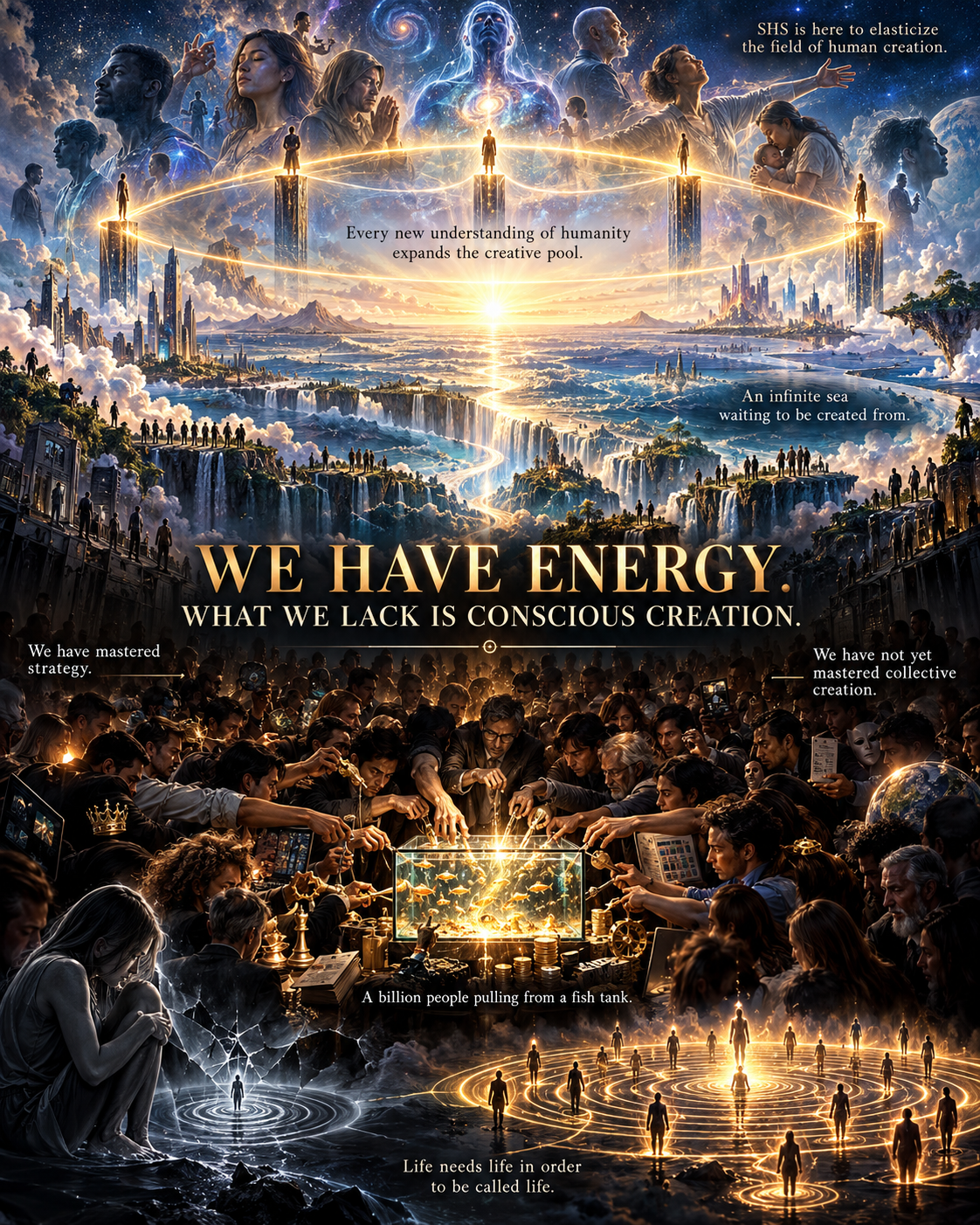
Remember how we talked about the pure organization, poor organization, that led to the economies in which we live in now, where how surpluses were handled could have been completely different and would have created a completely different reality in which we would be in now, where if instead of stocking to trade, we would have stocked to share, or know how to split amongst everyone that was, things would have completely been different. And we’ve already touched upon possible different timelines of how things could have been, but when we look at it from a very tangible, logical perspective, it’s the same way consciousness stocks experiences and who we choose to be, or even our subconscious, of how we choose to be at any given moment in time. We stock ourselves because that’s how we’ve learned to organize energy. Yet instead of stocking ourselves for sharing, we stock ourselves for trading, and it erodes the very nature of sharing, which becomes a hindrance to the lens that we then go on about looking, or seeing, or experiencing life as. And we can call consciousness stocking, what some might call karma, or dharma. It’s stocking how much alignment to consciousness one has. The most aligned you are to consciousness, the most in alignment to what consciousness is you are, the more dharmic accounting you have, as you are in alignment to the very nature of our existence, which allows you to stock on and gain trust from consciousness itself, because then it learns that it can trust you to hold on to more. And the type of surplus that the previous type of economy created is the mirror of how also people stock their emotions. Because we have a society that’s so accustomed to stocking things away that it doesn’t actually live in the present, and it’s emotionally unavailable because, or seems to be emotionally unattainable, simply because of the training that our psyche has been going through. We stock everything for trading, not for sharing. Every action that we do is for the later, and we forget to live in the now of what the later is. And in doing so we create laters that are not in alignment with what we wanted it to be, yet still work for consciousness, as consciousness makes use of the waste of energy that we could have used ourselves to be in alignment with what consciousness is. It’s basically, you either use the energy that consciousness gives you, or consciousness uses it beside you, beyond you, regardless of you. Because energy needs to move, and it is now at a tipping point for Earth specifically, where it needs release of pressure, and because it needs the release of pressure, there needs to be more mirrored conscious being that mirrors the alignment of what consciousness is. And that’s why I also apply greater pressure, to bring humanity to mirrors of our existence. Not to mirror my existence, to mirror our existence, because we’ve all been suffering, yet not realizing the pains of a poorly managed system. We’ve classed it as and contextualized it as the norm, to reason with it, to have sense of it, to make sense of it and be able to function within it. But it really doesn’t work. And because it doesn’t work, it does the opposite of anything that could possibly work, because it’s a system that’s not conscious of its own ways.
…
WE HAVE BEEN STOCKING OURSELVES FOR TRADE, NOT FOR SHARING.
A Manifesto on Consciousness, Human Organisation, Energy, and the Psychological Inheritance of a Poorly Managed Society
SHS – Human First | From Old Ways Organization (OWO) to Conscious Organization (CO)
There is something profoundly revealing about the way humanity has learned to organise its resources.
And the more I study the organisation of our economies, the more I recognise that we have not simply inherited economic systems.
We have inherited their psychology.
We have inherited their behaviours, their priorities, their fears, their expectations, their calculations, and, perhaps most importantly, their relationship with the very energy that makes our existence possible.
Because what if the way we organise our economies is simply a larger manifestation of the way we have learned to organise ourselves?
What if our economic systems are not separate from our consciousness, but a reflection of how we have learned to distribute, withhold, accumulate, and exchange our own existence?
And what if the very behaviours we have come to accept as natural human behaviours are, in fact, the psychological consequences of centuries of poor organisation?
Let me expand.
I. THE FIRST MISTAKE WAS NOT THE SURPLUS. IT WAS WHAT WE DECIDED TO DO WITH IT.
When we explore the historical development of our economies, one of the most fascinating aspects is how humanity chose to organise its surpluses.
We produced more than we immediately needed.
And rather than developing an organisation in which surpluses would systematically contribute towards the continued wellbeing of everyone, we increasingly developed systems in which those surpluses became instruments of exchange.
We stocked to trade, rather than stocking to share.
And that distinction is far greater than it might initially appear.
Because stocking to trade establishes an entirely different relationship with abundance than stocking to share.
When you stock to trade, what you possess becomes valuable according to what someone else is willing or required to give you in exchange.
When you stock to share, what you possess becomes valuable according to what it can contribute to the continuity of existence.
One creates an economy centred around negotiating access.
The other creates the possibility of an economy centred around organising access.
And those are two profoundly different civilisational directions.
Imagine what humanity might have become if, rather than organising surpluses around the opportunity to acquire more from one another, we had organised them around the responsibility to ensure that everyone had enough.
Imagine the institutions we would have developed.
The relationships we would have nurtured.
The technologies we would have prioritised.
The environments we would have created.
The emotional and psychological patterns our children would have inherited.
We might have developed an entirely different understanding of prosperity, security, contribution, and even ambition.
Because the purpose of accumulating resources would not have been to improve our individual negotiating position within society.
It would have been to improve society’s capacity to sustain every individual within it.
And that leads me to an even more fascinating realisation.
II. WE DID NOT ONLY LEARN TO STOCK RESOURCES. WE LEARNED TO STOCK OURSELVES.
Look at how we organise our emotions.
Our experiences.
Our memories.
Our identities.
Our expectations.
Our affection.
Our vulnerabilities.
Our knowledge.
Our creativity.
Our very willingness to participate in existence.
How much of ourselves do we continuously stock away?
How often do we reserve parts of ourselves for a later that may never arrive?
We stock our love until someone proves themselves deserving of it.
We stock our vulnerability until we believe someone has earned our trust.
We stock our knowledge until we can determine what we might receive in exchange.
We stock our creativity until there is an opportunity to monetise it.
We stock our experiences until we find someone who can appreciate them.
We stock our emotional availability until circumstances appear sufficiently favourable to justify expressing it.
And we stock our happiness until some future condition gives us permission to experience it.
We have become psychological warehouses of our own existence.
Not because we are incapable of sharing ourselves.
But because we have been trained to approach our own existence through the same organisational principles that govern our economies.
We have learned to calculate our participation.
To negotiate our availability.
To ration our affection.
To preserve our energy for a future transaction.
To withhold what we could otherwise contribute.
And eventually, those behaviours become so deeply integrated into our subconscious that we no longer recognise them as learned organisational patterns.
We simply call them personality.
We call them boundaries.
We call them ambition.
We call them independence.
We call them human nature.
But how much of what we consider human nature is actually the psychological inheritance of the systems within which humanity has been developing?
What if we have been confusing adaptation to poor organisation with the natural expression of consciousness itself?
III. THE ECONOMY HAS ENTERED THE SUBCONSCIOUS.
This is where the relationship becomes metaphysical.
Because the subconscious, too, is a system of accumulation.
It stores experiences, emotional associations, behavioural patterns, expectations, interpretations, and responses.
And those accumulated patterns become part of the mechanisms through which we experience reality.
But consider what happens when the environments in which consciousness develops are predominantly organised around scarcity, exchange, competition, preservation, and conditional access.
The individual learns to participate in existence conditionally.
They learn to preserve themselves rather than express themselves.
They learn to approach relationships through calculations of potential losses and gains.
They learn to anticipate deprivation even when abundance is available.
And they learn to treat emotional availability almost as an economic resource.
Something that must be conserved because it might eventually run out.
Something that must be earned because giving it freely might diminish its perceived value.
Something that must be protected because the surrounding environment has repeatedly demonstrated that sharing does not guarantee reciprocity.
And in doing so, we create entire generations of individuals who are emotionally unavailable, not necessarily because they lack emotional capacity, but because they have inherited an organisation of emotional energy that prioritises preservation over circulation.
We have developed emotional economies that resemble our financial economies.
And then we wonder why humanity struggles to connect.
Why people struggle to trust.
Why affection becomes transactional.
Why vulnerability becomes a liability.
Why individuals struggle to live in the present.
Why so many people possess extraordinary capacities for love, creativity, nurture, intelligence, and contribution, yet spend much of their existence withholding those capacities from the world.
We have been trained to stock ourselves for an exchange that may never occur.
And the tragedy is that, while we are waiting for the right conditions to release ourselves, life continues happening.
Consciousness continues moving.
Existence continues generating.
And we are absent from experiences we could have helped create.
IV. KARMA, DHARMA, AND THE ACCOUNTING OF CONSCIOUSNESS.
Now, allow me to take this into my metaphysical understanding of consciousness.
Because when I look at the accumulation of our experiences, behaviours, intentions, and alignment with existence, I also see a relationship with what some traditions describe through the concepts of karma and dharma.
Not merely as punishment and reward.
Not simply as a moral accounting of good and bad actions.
But as an accumulation of alignment.
An accounting of how consciousness has been experienced, exercised, organised, and expressed through an individual.
In this interpretation, the more aligned one becomes with the nature of consciousness, the greater one’s capacity to consciously participate in its movement.
And the more consciously one participates, the greater the capacity to hold, channel, and responsibly organise the energy made available through existence.
Consciousness learns what it can trust you to hold by what you demonstrate you can consciously carry.
Not because you have accumulated the most possessions.
Not because you have achieved the greatest social recognition.
Not because you have convinced others of your importance.
But because your relationship with existence demonstrates a capacity to contribute to its continuity.
To nurture rather than merely consume.
To create rather than merely acquire.
To foresee rather than merely react.
To prevent rather than merely repair.
To participate rather than merely observe.
And this is where I see a profound distinction between the accumulation practised by our economies and the accumulation occurring through consciousness.
Our economies have taught us to accumulate for the possibility of receiving more.
Consciousness, in my understanding, allows us to hold more according to our capacity to responsibly circulate what we already have.
The accumulation is not the destination.
It is the development of capacity.
And capacity becomes meaningful through its expression.
What would be the purpose of possessing extraordinary emotional intelligence if it were never used to nurture another consciousness?
What would be the purpose of possessing extraordinary knowledge if it were never used to expand the possibilities of existence?
What would be the purpose of possessing extraordinary creativity if every creation remained confined to the imagination?
What would be the purpose of receiving energy if its only destination were storage?
We have confused the possession of potential with the fulfilment of potential.
And consciousness does not exist merely to possess itself. It exists to experience, express, generate, and expand through itself.
V. EITHER YOU USE THE ENERGY, OR CONSCIOUSNESS USES IT BEYOND YOU.
Here is something I find especially fascinating.
Energy does not need our permission to continue participating in existence.
We can refuse to consciously channel what is available to us.
We can withhold our capacities.
We can postpone our contributions.
We can preserve our emotional experiences until we believe the world has earned them.
We can spend an entire lifetime preparing to live.
But existence does not stop moving because we have decided not to participate.
Either you consciously use the energy made available to you, or consciousness continues its movement beyond you, beside you, and regardless of you.
That is how I understand the relationship.
Energy must move.
Experiences generate consequences.
Consequences generate circumstances.
Circumstances generate further experiences.
And whether we consciously participate in those movements or not, they continue contributing to the development of reality.
Even the energy we waste becomes part of something.
Even our refusal to participate creates consequences.
Even the experiences we never consciously process can continue expressing themselves through subconscious patterns, relationships, decisions, and circumstances.
And that is precisely why I consider conscious participation so important.
Because when we consciously channel our energy, we can participate in directing what it creates.
We can foresee.
We can initiate.
We can prevent.
We can nurture.
We can organise.
We can create the conditions through which our experiences become increasingly aligned with what we consciously intend to experience.
But when we do not, we still participate in the creation of reality.
Only now, much of that participation happens beyond our conscious direction.
We do not stop creating consequences simply because we stop consciously creating.
And perhaps one of humanity’s greatest misunderstandings is believing that withholding ourselves protects us from participation.
It does not.
It merely changes the nature of our participation.
VI. WE HAVE BECOME A CIVILISATION THAT LIVES FOR LATER.
Look at how much of human existence has become preparation for something else.
We study so that one day we can work.
We work so that one day we can afford to live.
We save so that one day we can feel secure.
We sacrifice our present so that one day we can enjoy our future.
We postpone relationships until we have achieved stability.
We postpone creativity until we have achieved financial independence.
We postpone rest until we have completed our obligations.
We postpone happiness until the circumstances of our existence justify experiencing it.
And then we repeat.
And repeat.
And repeat.
Until entire generations have spent their existence preparing for a life that their organisation of reality never actually allowed them to experience.
We have become so accustomed to living for later that we have forgotten that later can only be experienced as now.
What exactly are we working towards if, upon reaching the future, we continue applying the same mechanisms that prevented us from experiencing the present?
What is the point of accumulating enough resources to live if we have subconsciously trained ourselves never to feel that we have enough?
What is the point of creating a future in which we could be emotionally available if we have spent decades practising emotional unavailability?
What is the point of pursuing freedom if our entire psychological organisation has become dependent upon conditional permission?
We create our future through our present behaviours.
And yet we continuously sacrifice the very behaviours that would allow us to experience the futures we claim to desire.
We want a loving world while withholding affection.
We want a generous world while organising everything around exchange.
We want a peaceful world while normalising pressures that continuously destabilise human existence.
We want an abundant world while preserving systems that make access conditional upon individual purchasing power.
We want conscious leadership while nurturing institutions that reward the preservation of their own interests above the continuity of those they govern.
And then we wonder why the future does not resemble what we imagined.
Because we are using the organisational principles of the reality we wish to escape to construct the reality we claim to desire.
The contradiction is built into the process.
VII. HUMANITY HAS NORMALISED THE PAIN OF POOR ORGANISATION.
And this is perhaps the most significant part of the entire discovery.
Humanity has suffered under its systems for so long that it has developed increasingly sophisticated explanations for why that suffering must exist.
We have contextualised unnecessary suffering as responsibility.
We have contextualised systemic deprivation as scarcity.
We have contextualised excessive competition as ambition.
We have contextualised chronic insecurity as motivation.
We have contextualised the exhaustion of survival as the dignity of hard work.
We have contextualised isolation as independence.
We have contextualised emotional suppression as strength.
And we have contextualised conditional access to life’s necessities as economic normality.
Not necessarily because these interpretations reflect the full nature of human existence.
But because human beings need to make sense of the environments in which they must continue functioning.
We have learned to rationalise the pain of a poorly managed society so that we can survive living within it.
And eventually, the explanations themselves become part of the organisation.
They become cultural expectations.
They become educational principles.
They become political arguments.
They become economic theories.
They become psychological identities.
They become the standards against which human behaviour is judged.
And before we know it, the system no longer needs to explicitly enforce every limitation.
The individuals living within it have learned to enforce many of those limitations upon themselves.
That is how deeply poor organisation can become integrated into consciousness.
And that is why changing an economic system is not simply a matter of changing how resources are distributed.
It is also a matter of changing humanity’s relationship with having, holding, sharing, creating, and existing.
Because even if we made abundance available tomorrow, many of us would still carry the psychological organisation of scarcity.
We would still calculate.
Still hesitate.
Still withhold.
Still preserve.
Still wonder what we would lose by sharing.
Still ask what someone else has done to deserve receiving.
Still struggle to believe that access could exist without exchange.
Not because sharing is unnatural.
But because trading has become so deeply normalised that we have begun to perceive unconditional provision as suspicious.
And that, to me, demonstrates just how profoundly our economic organisation has influenced the human psyche.
VIII. EARTH DOES NOT NEED MORE ACCUMULATION. IT NEEDS CONSCIOUS CIRCULATION.
When I look at the pressures humanity is experiencing, I see a civilisation approaching the limits of the organisational principles it has inherited.
We continue accumulating capacities that our systems struggle to distribute.
We continue generating knowledge that does not consistently translate into collective wellbeing.
We continue developing technologies while preserving structures that limit access to their benefits.
We continue producing extraordinary human potential while organising society in ways that leave enormous amounts of that potential unused.
And we continue describing these circumstances as though they were inevitable consequences of existence.
But what if much of the pressure is not coming from existence itself?
What if the pressure is coming from our inability to consciously organise what existence has already made available?
Imagine an organism in which circulation becomes increasingly restricted.
Resources accumulate in some places while other areas experience deprivation.
Pressure builds.
Functions become strained.
Interdependence is compromised.
And the entire organism begins experiencing consequences that cannot be resolved merely by encouraging each individual component to work harder.
The problem is organisational.
The system needs to recognise itself as a system.
And that is how I interpret much of what humanity is experiencing.
Our resources are interconnected.
Our industries are interconnected.
Our environments are interconnected.
Our individual behaviours generate collective consequences.
Our collective organisation influences individual consciousness.
Yet we continue treating those relationships as though they exist independently.
We have built an interconnected civilisation that does not consistently organise itself according to the reality of its interconnectedness.
And in my metaphysical understanding, this creates pressure.
Pressure that must eventually find expression.
Pressure that cannot be indefinitely contained through accumulation, avoidance, suppression, and postponement.
I see Earth approaching a point at which greater conscious participation becomes increasingly necessary.
Not simply more production.
Not simply more consumption.
Not simply more economic growth.
But greater alignment between the capacities we possess and the way we organise their expression.
We need to release the pressure created by unconscious organisation through the development of conscious organisation.
And that is where SHS comes in.
IX. I APPLY PRESSURE BECAUSE HUMANITY MUST BEGIN MIRRORING ITS OWN EXISTENCE.
When I speak about applying greater pressure, I am not speaking about forcing humanity to become a reflection of my individual existence.
That has never been the purpose.
I am not asking humanity to mirror me. I am asking humanity to recognise and mirror the nature of our shared existence.
Our interconnectedness.
Our capacity for consciousness.
Our responsibility towards the consequences we generate.
Our ability to create.
Our ability to nurture.
Our ability to foresee.
Our ability to reorganise the conditions through which existence is experienced.
Because we have all been living within the consequences of systems that were developed before humanity possessed many of the capacities it possesses today.
And yet we continue preserving their organising principles as though they represent the final possibilities of civilisation.
They do not.
Our ancestors made choices about how to organise their surpluses.
Those choices influenced the development of economies.
Those economies influenced the development of institutions.
Those institutions influenced the development of cultures.
Those cultures influenced the development of human psychology.
And that psychology continues reproducing the organisational principles from which it emerged.
We have been reproducing the consciousness of our organisation rather than reorganising our systems according to our developing consciousness.
And I want to reverse that relationship.
This is the transition from Old Ways Organization (OWO) to Conscious Organization (CO).
From stocking to trade to stocking to share.
From accumulation for advantage to accumulation for continuity.
From conditional access to consciously organised provision.
From emotional preservation to emotional availability.
From unconscious repetition to conscious participation.
From reacting to the consequences of poor organisation to preventing those consequences through better organisation.
From living for a future we continuously postpone to consciously creating a present capable of generating the futures we actually desire.
And from organising humanity according to the limitations of its inherited systems to organising its systems according to the expanding capacities of humanity.
That is the transition.
Not merely economically.
Not merely politically.
Not merely psychologically.
Metaphysically.
Because it concerns the relationship between consciousness and the reality it continuously participates in creating.
X. WE MUST STOP STOCKING AWAY THE HUMANITY WE NEED TODAY.
I want humanity to recognise something.
The love you are withholding might be the very experience another consciousness needs to develop.
The knowledge you are preserving might be the understanding that allows someone else to create something extraordinary.
The creativity you keep postponing might generate experiences that do not yet exist.
The emotional availability you are reserving for later might be what transforms a relationship today.
The initiative you are waiting to take might prevent suffering that has not yet occurred.
And the contribution you are withholding because you cannot immediately determine what you will receive in exchange might be part of a much larger circulation of value than you can presently comprehend.
This does not mean we abandon preservation.
It does not mean we eliminate planning.
It does not mean we ignore the importance of responsible allocation.
It means we change what preservation, planning, and allocation are organised to achieve.
We can preserve resources so that they remain available for sharing.
We can develop capacity so that we become capable of contributing more.
We can accumulate knowledge so that humanity has more knowledge to draw from.
We can nurture our emotional wellbeing so that we become increasingly capable of participating in healthy emotional relationships.
We can create infrastructure that protects continuity rather than creating dependence upon deprivation.
We can organise abundance without requiring scarcity to justify its value.
And we can build systems in which the act of contributing does not depend upon another person’s capacity to purchase what is being contributed.
Because the question should no longer be:
What can I receive in exchange for what I have?
It should become:
What can the existence of what I have make possible for the existence of everyone else?
That is a fundamentally different relationship with value.
And it opens a fundamentally different understanding of what prosperity could mean.
XI. CONSCIOUSNESS IS NOT WAITING FOR HUMANITY TO FINISH TRADING.
And here we arrive at the most important point.
Consciousness, as I understand it, does not exist according to the economic conditions humanity has invented.
The natural world did not wait for the establishment of a financial system before participating in the circulation of existence.
Nature generates.
Nature transforms.
Nature distributes.
Nature decomposes.
Nature regenerates.
Nature creates conditions through which further experiences become possible.
And humanity, possessing extraordinary conscious capacities, has developed systems in which access to the products of its own collective existence can become disconnected from the needs of the very beings who make that existence possible.
How extraordinary is that?
We have created a civilisation capable of remarkable production, yet we continue organising much of its distribution through mechanisms that can leave human needs unmet.
We have developed extraordinary means of communication, yet so many people struggle to feel understood.
We have accumulated extraordinary knowledge about human development, yet continue creating environments that unnecessarily compromise it.
We have become more capable of organising existence than previous generations could have imagined.
Yet we continue allowing the organisational limitations of previous generations to determine what humanity is permitted to experience today.
And I refuse to accept that this is the furthest our consciousness can take us.
Not when we can recognise the patterns.
Not when we can understand their consequences.
Not when we can imagine alternatives.
And certainly not when we possess the capacity to begin developing those alternatives ourselves.
Because once we recognise that a system is poorly organised, continuing to reproduce its consequences without attempting to improve its organisation becomes a conscious choice.
And consciousness comes with responsibility.
The responsibility to see.
The responsibility to understand.
The responsibility to create.
The responsibility to foresee.
The responsibility to initiate.
And the responsibility to prevent what we have developed the capacity to recognise as preventable.
XII. THE NEW ORGANISATION OF HUMANITY BEGINS WITH THE NEW ORGANISATION OF OURSELVES.
So perhaps the question humanity must begin asking itself is not simply how we should organise our economies.
Perhaps it is also:
Why have we organised our own consciousness according to the economics of scarcity?
Why do we continuously postpone the expression of what we already possess?
Why do we preserve capacities that become more valuable through their exercise?
Why do we organise our relationships around the anticipation of exchange?
Why do we treat unconditional sharing as an exception rather than a legitimate foundation for organising human existence?
Why have we normalised psychological and emotional patterns that mirror the very economic systems under which so many of us experience unnecessary suffering?
And why do we continue reproducing those patterns when we have developed the conscious capacity to question them?
I believe that one of humanity’s greatest transformations will occur when we begin understanding that sharing is not simply an act of generosity.
Sharing is an organisational principle.
It is a way of structuring access.
A way of circulating resources.
A way of developing relationships.
A way of educating consciousness.
A way of distributing opportunities.
A way of nurturing capacities.
A way of generating experiences.
And ultimately, a way of creating a civilisation in which human beings no longer need to spend so much of their existence negotiating permission to experience the provisions of the world they collectively inhabit.
Because I do not want to create a society that merely possesses more.
I want to create a society that is capable of making more possible.
I do not want humanity to become dependent upon the perpetual accumulation of resources.
I want humanity to develop the conscious organisational capacities through which resources can continuously contribute to existence.
I do not want individuals to spend their lives waiting until they have acquired enough to become themselves.
I want us to create the conditions in which being ourselves becomes part of what generates abundance for everyone.
And I do not want our future generations to inherit a civilisation in which the preservation of economic systems takes precedence over the preservation, nurturing, and development of the consciousness that created them.
We are not here merely to become better participants in a poorly organised system.
We are capable of becoming better organisers of our shared existence.
That is the difference.
That is the responsibility.
That is the transition from OWO to CO.
And that is what I mean when I speak about aligning humanity with consciousness.
Not the imitation of my existence.
Not the replacement of individual expression with collective uniformity.
Not the abandonment of individuality.
But the development of an organisation in which every individual can consciously contribute their distinct expression of existence towards the continuity of the whole.
Because humanity does not need to become the same to share the same existence.
We need to become conscious of how our differences contribute to it.
And when we finally understand that, perhaps we will discover that the abundance we have spent centuries trying to accumulate was never meant to become the measure of our separation.
It could have become the foundation of our interconnectedness.
Perhaps we will discover that our emotions were never meant to remain indefinitely stored in anticipation of someone earning their release.
Our creativity was never meant to exist solely according to its potential market value.
Our intelligence was never meant to serve only those capable of purchasing its application.
And our consciousness was never meant to spend its existence negotiating the conditions under which it might finally allow itself to live.
We were never limited to stocking ourselves for trade.
We could have been stocking ourselves for sharing all along.
And now that we can recognise the difference, we can begin creating the reality that difference makes possible.
Because the greatest surplus humanity possesses is not simply the resources it has accumulated.
It is the consciousness it has not yet fully learned to organise.
And the greatest waste is not simply what our economies fail to distribute.
It is the human existence we continuously postpone while waiting for permission to experience it.
We have spent centuries learning how to accumulate.
Now let us learn how to circulate.
We have spent centuries organising exchange.
Now let us organise existence.
We have spent centuries adapting ourselves to systems that do not adequately recognise the wholeness of our humanity.
Now let us create systems capable of developing alongside the wholeness of our humanity.
Because the objective is not to stock enough to finally live.
THE OBJECTIVE IS TO ORGANISE LIFE SO THAT WE NO LONGER NEED TO POSTPONE LIVING.
From stocking to trade, to stocking to share.
From unconscious accumulation, to conscious circulation.
From Old Ways Organization, to Conscious Organization.
From the survival of humanity within its systems, to the conscious organisation of systems around the continuity of humanity.
SHS – Human First | Conscious Organization — Heaven Of the Natural Earth.


Leave a Reply