
THEY WILL NEVER PAY ME OUT. THEY NEED ME INSIDE THE SYSTEM MORE THAN I NEED TO BELONG TO IT.
You cannot claim to govern for the people while refusing to imagine a world in which the people no longer need your governance.
And this is precisely why I doubt the Bank of England, or any institution responsible for maintaining this economic arrangement, would ever entertain my proposal seriously. 🤣🤣🤣
Because imagine having to sit across from someone who is not asking for a benefit, a grant, a loan, a pension increase, or another temporary accommodation within your system.
Someone who is asking you to calculate everything they have ever contributed, everything you have extracted value from, everything attached to their identity, and settle the account.
Not so they can become wealthier within your system, but so they can leave it.
Now THAT is an uncomfortable conversation.
Because what happens when the person you have spent your entire institutional existence categorising, assessing, taxing, regulating, documenting and determining eligibility for turns around and says:
“I don’t want anything from you anymore. Give me everything that belongs to me, account for everything you have benefited from, and leave me alone.”
Suddenly, freedom becomes a very complicated administrative matter, doesn’t it? 🤣
You can calculate what I owe you with remarkable enthusiasm. You can identify contributions, impose deductions, establish eligibility thresholds and send notices explaining exactly how much of my existence falls under your authority.
But ask for the reverse calculation?
What has my existence contributed to YOUR continuity?
What has my labour maintained? What have my taxes financed? What has my participation legitimised? What value has my data generated? What have my contracts, certifications, transactions, identities and contributions helped your institutions maintain?
And what would a complete settlement look like if I genuinely wished to withdraw?
You know how to calculate my financial obligations. But do you even have an accounting system capable of calculating your obligations to my entire existence?
I doubt it.
And perhaps that’s the greater problem.
Your system wasn’t designed to accommodate someone who no longer wishes to depend upon it.
It was designed around the assumption that participation would continue.
You can disagree with your government. You can criticise it. You can protest. You can vote for someone else. You can complain about services. You can spend your entire lifetime demanding better treatment.
And through it all?
You’re still inside the arrangement.
Still earning, spending, consuming, paying, registering, applying, contributing and maintaining the infrastructure you are complaining about.
Even your opposition can take place entirely within the economic structure that sustains the institution you oppose.
How wonderfully convenient. 🤣🤣🤣
And here I am proposing something entirely different.
I don’t want to spend the rest of my existence arguing about who gets to manage my dependency more competently.
I want to eliminate the dependency.
I don’t want another political personality promising to make an inherited arrangement slightly less unbearable.
I want to build something that makes the arrangement unnecessary.
And that’s the difference between wanting a better government and wanting a life that no longer requires government to organise every essential condition of one’s survival.
The first keeps the institution relevant.
The second challenges the institution’s necessity.
Now imagine if enough people reached that conclusion.
Imagine communities organising their own food, shelter, education, welfare, research, care, infrastructure and collective provisions without making financial survival the compulsory entrance fee to life.
Imagine employment no longer being the condition upon which a person is permitted housing.
Imagine your ability to eat not depending on whether an institution recognises your economic usefulness.
Imagine people voluntarily contributing to systems because they recognise their value, rather than being compelled to participate because they cannot survive outside them.
What happens to a governing structure whose authority has been reinforced by its population’s dependence upon it when that dependence begins to disappear?
It would have to demonstrate why it deserves to continue existing in its present form.
And THAT is a question I would love to hear answered.
Because I have no interest in overthrowing something merely to inherit its responsibilities, its mentality, its offices, its hierarchies and its endless excuses.
That’s how you replace one administration with another while leaving the underlying dependency intact.
SHS – Human First is concerned with something far more consequential.
Building beyond the arrangement itself.
And no, that doesn’t mean imagining that communities can exist without organisation, responsibilities, standards or collective coordination.
It means questioning why those things must remain dependent upon the same financial and political arrangements that repeatedly fail to provide the basic conditions of a dignified life.
If you cannot conceive of a society functioning without people being financially pressured into participation, then perhaps it isn’t humanity’s inability to organise that you’ve demonstrated.
Perhaps you’ve demonstrated the limitations of YOUR organisational imagination.
And this brings me back to my original offer.
Pay me out.
Account for everything.
Let me take my sovereignty, my contributions and whatever value can legitimately be returned to me, and allow me to organise my life independently, dealing voluntarily with those who wish to deal with me.
But I suspect the prospect of genuinely independent people is considerably less attractive to an institution than the prospect of people continuously negotiating for access.
Because a person asking for access can be made to satisfy conditions.
A person who has created an alternative no longer needs to ask.
And there is an enormous difference between having the authority to grant someone permission and discovering that your permission has become irrelevant.
So I don’t expect a miraculous awakening in which governments suddenly recognise all their failures, apologise for every unnecessary dependency, surrender their institutional advantages and voluntarily develop systems that make their existing authority redundant.
Why would an institution built around its own continuity automatically prioritise a future in which that particular form of continuity is no longer necessary?
That’s the contradiction.
The government claims to exist because the people need it.
But the government also needs the people to sustain it.
Our participation supplies the revenue, labour, legitimacy and social foundations through which its institutions continue operating.
So who is actually dependent upon whom?
And what happens when the population begins meeting its needs beyond the arrangements it was told were indispensable?
Perhaps only then will meaningful institutional transformation become unavoidable.
Not because someone gave another speech.
Not because another committee discovered the same structural failures for the fiftieth time.
Not because another election promised a new beginning inside the same old architecture.
But because people have demonstrated, through functioning alternatives, that the old arrangement is no longer their only available choice.
And the institution finally has to compete with a reality in which its services are not automatically necessary.
You want people to trust your system? Then make it worthy of voluntary participation.
Otherwise, don’t be surprised when somebody dedicates their existence to building something that does not need your permission to provide for humanity.
And if you don’t wish to settle the account?
Fine.
I’ll continue building.
Not because I need to defeat you.
But because I have no interest in spending my life demanding freedom from an arrangement when I can dedicate that life to creating the conditions through which freedom becomes possible.
You can keep arguing over how best to manage dependency.
I’ll be working on making it unnecessary.
And perhaps one day, when the old system finally asks why nobody needs what it offers anymore, somebody will be kind enough to explain:
“We didn’t wait for you to change. We built what you kept failing to provide.” 🤣🤣🤣
SHS – HUMAN FIRST
The Womb of The Unknown Need
Consciousness | Integrity | Continuity | The Basic Human Needs Economy
….
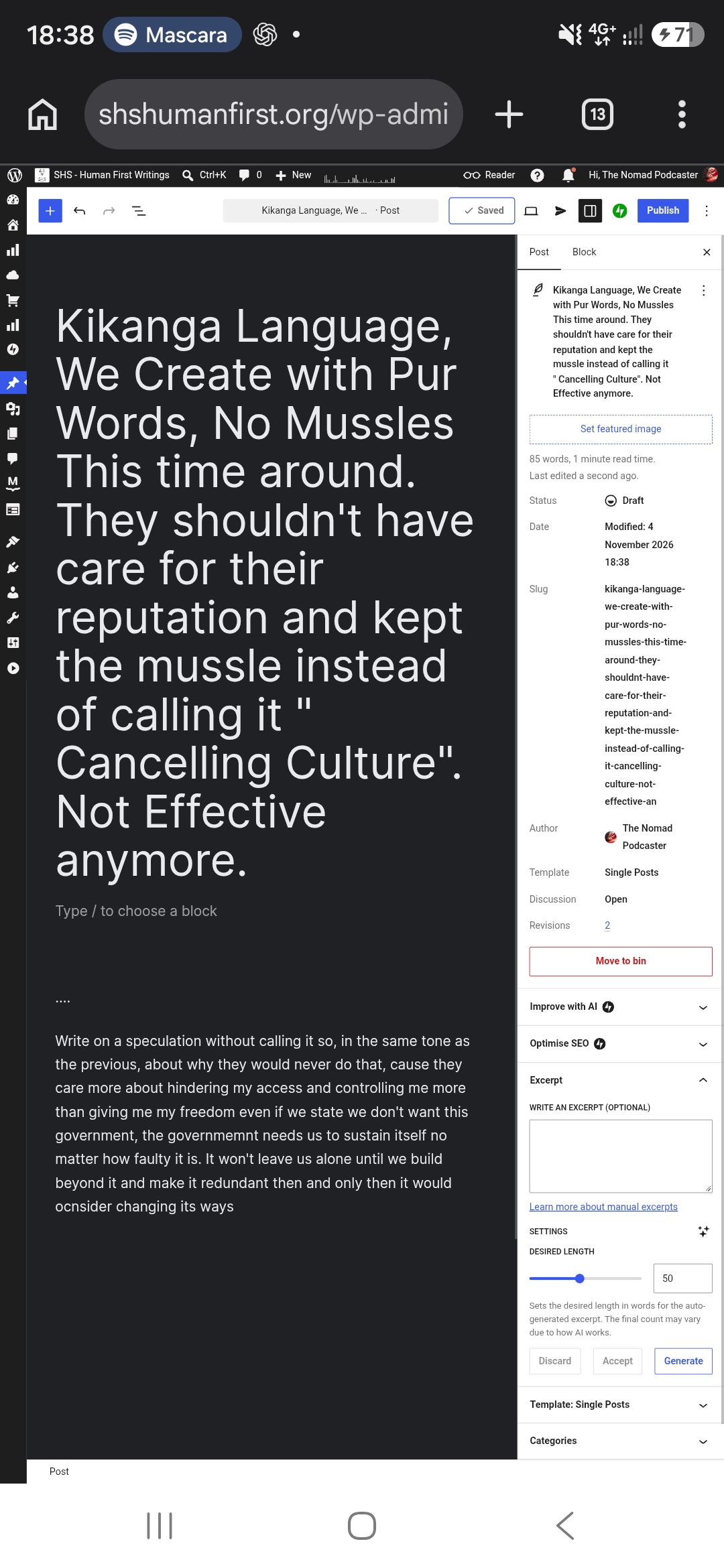
Write on a speculation without calling it so, in the same tone as the previous, about why they would never do that, cause they care more about hindering my access and controlling me more than giving me my freedom even if we state we don’t want this government, the governmemnt needs us to sustain itself no matter how faulty it is. It won’t leave us alone until we build beyond it and make it redundant then and only then it would ocnsider changing its ways

Leave a Reply