

Why do you think investigators look for MOs?! They can only perceive boxed behaviours, not inconsistency. They don’t look for it, they create a picture of what they think it is, that’s what I meant, but in that perspective they miss great info, as they still can’t recognise life maturity and able to separate it from societal immaturity.
Society Has Glamorised Strategy Without Recognising What It Reveals About Our Trust in Ourselves.
There is one thing manipulation will always struggle to overcome: a human being who does not need a script to know how to be themselves.
Spontaneity.
And the reason is far more revealing than people might initially understand.
Manipulators strategise.
They rehearse. They anticipate. They calculate responses, study possible reactions, prepare appearances, construct narratives and arrange circumstances so that when a particular moment arrives, they already know how they intend to perform within it.
But what is strategising actually communicating?
What does it reveal about the individual who cannot approach a moment without first preparing themselves for it?
It communicates an absence of trust in their own present self.
And I find that to be one of the saddest revelations about the society we have built.
Because we have spent generations glamorising strategy as though it were one of humanity’s greatest intellectual achievements, without recognising what an excessive dependence on it might actually reveal.
A human being who cannot trust themselves to respond appropriately to life as it unfolds must constantly prepare themselves for life before it unfolds.
Their past self must anticipate their future circumstances, prepare their future self and hope that, when the present moment finally arrives, the person they prepared themselves to become will be capable of performing what was rehearsed.
Imagine that.
You are standing in the present, preparing a version of yourself for a future you have not yet experienced, based on an understanding of life that may already be incomplete.
And when the future becomes the present, rather than experiencing it in its entirety, you are attempting to execute what your past self decided.
You are no longer entirely responding to what is happening.
You are performing what you thought would happen.
And society calls that being prepared.
But is it?
Or have we confused being prepared for life with being prepared for a particular version of life?
1. STRATEGY CAN BECOME THE PERFORMANCE OF CAPABILITY RATHER THAN CAPABILITY ITSELF.
Think about what strategising promises.
Control.
Predictability.
Composure.
Confidence.
Readiness.
A person prepares their words so they appear articulate. They rehearse their reactions so they appear emotionally collected. They anticipate opposition so they appear intellectually capable. They construct an identity so they appear professional.
But what happens when something arrives that their preparation did not account for?
What happens when someone asks a question that was not anticipated?
When an interaction develops in a direction they had not imagined?
When the person standing before them refuses to participate in the dynamics they prepared?
When life simply refuses to follow their script?
Suddenly, the appearance of preparedness can begin to collapse.
Not necessarily because the person lacks intelligence, but because their ability to demonstrate that intelligence has become dependent upon circumstances remaining recognisable.
They know how to respond to what they prepared for.
But do they know how to respond to what actually exists?
That is the distinction I want humanity to investigate.
Because being capable within rehearsed circumstances is not the same as being capable regardless of circumstances.
And I am far more interested in the latter.
2. THE LIMITATION OF STRATEGY IS THAT IT NARROWS PERCEPTION.
This is where it becomes even more interesting.
When you strategise, you direct your attention towards particular possibilities.
You identify a desired outcome, estimate the behaviour of the people or circumstances involved, and construct a pathway towards that outcome.
Your attention becomes focal.
You begin looking for the things your strategy requires you to recognise.
But life does not exist exclusively within the boundaries of your expectations.
And the moment your attention becomes devoted to identifying a particular pattern, you risk overlooking everything that does not resemble it.
You can become so occupied with interpreting life through your strategy that you fail to recognise life occurring outside it.
The strategy becomes the lens, and the lens becomes the limitation.
Now consider what happens when your original interpretation is wrong.
If you misunderstand someone’s intentions, your strategy becomes organised around a misunderstanding.
If you incorrectly anticipate someone’s behaviour, your preparations become dependent upon a reality that does not exist.
If you mistake someone’s spontaneity for calculation, you begin constructing counterstrategies against an opponent who may never have been playing your game.
And there lies one of the greatest weaknesses of manipulation.
A manipulator can prepare extensively for a person they believe they understand.
But what exactly have they prepared for if their understanding of that person is fundamentally incorrect?
Their entire strategy may be intellectually elaborate and practically useless.
Because the complexity of a strategy cannot compensate for the inaccuracy of the perception upon which it was built.
A perfectly executed strategy founded upon a false understanding is still a perfectly executed misunderstanding.
And the person who does not confine their perception to one predetermined outcome may recognise what the strategist cannot.
Not because they are thinking less.
But because their attention remains available to more.
3. SPONTANEITY IS NOT THE ABSENCE OF INTELLIGENCE. IT IS INTELLIGENCE THAT DOES NOT REQUIRE REHEARSAL.
I think this is where society has profoundly misunderstood spontaneity.
We have associated spontaneous behaviour with impulsiveness, recklessness, a lack of preparation and sometimes even immaturity.
But what if genuine spontaneity is the expression of a far more integrated form of maturity?
What if the greatest preparation for life is not preparing for every possible occurrence, but developing yourself so comprehensively that you can meet occurrences without needing to have rehearsed them?
That is the distinction.
I am not talking about someone who responds without thinking.
I am talking about someone whose thinking has become so naturally integrated with their being that they do not need to manufacture a response in advance.
Someone who can recognise what is happening, assess its implications, understand the people involved, account for the circumstances, respond appropriately and remain emotionally grounded.
All within the present.
No script.
No performance.
No predetermined version of themselves to maintain.
Just the individual, their consciousness, their maturity and their capacity to respond.
That is what being quick on your feet actually means.
And it is a very different thing from being quick at executing a previously constructed plan.
The spontaneous individual does not necessarily know what will happen next.
They simply trust their capacity to meet whatever happens next.
That trust is the foundation.
And when that foundation is sufficiently developed, a person does not need the world to behave predictably in order to remain internally stable.
They carry their readiness within themselves.
4. WE HAVE BUILT A SOCIETY OF PERFORMANCES AND CALLED THEM IDENTITIES.
Look around.
How much of what we call human behaviour is actually the performance of something people have been taught to resemble?
We perform romance.
We perform professionalism.
We perform leadership.
We perform intelligence.
We perform maturity.
We perform confidence.
We even perform emotional availability.
And sometimes we become so familiar with the performances that we forget to investigate whether the individual actually possesses the qualities they are demonstrating.
Take professionalism.
An individual is presented with a script about what professionalism looks like.
How to speak.
How to dress.
How to respond.
How to present themselves.
Which emotions to suppress.
Which expressions are acceptable.
Which behaviours will gain approval.
They learn the script and become highly competent at performing within its boundaries.
But remove those boundaries, and what remains?
Can they still communicate intelligently without the approved vocabulary?
Can they still exercise sound judgement without the institutional hierarchy?
Can they remain respectful without relying upon formal etiquette?
Can they acknowledge uncertainty without feeling their professional identity has been threatened?
Can they demonstrate competence when the circumstances no longer resemble anything their training prepared them for?
Or does their sense of self begin to destabilise?
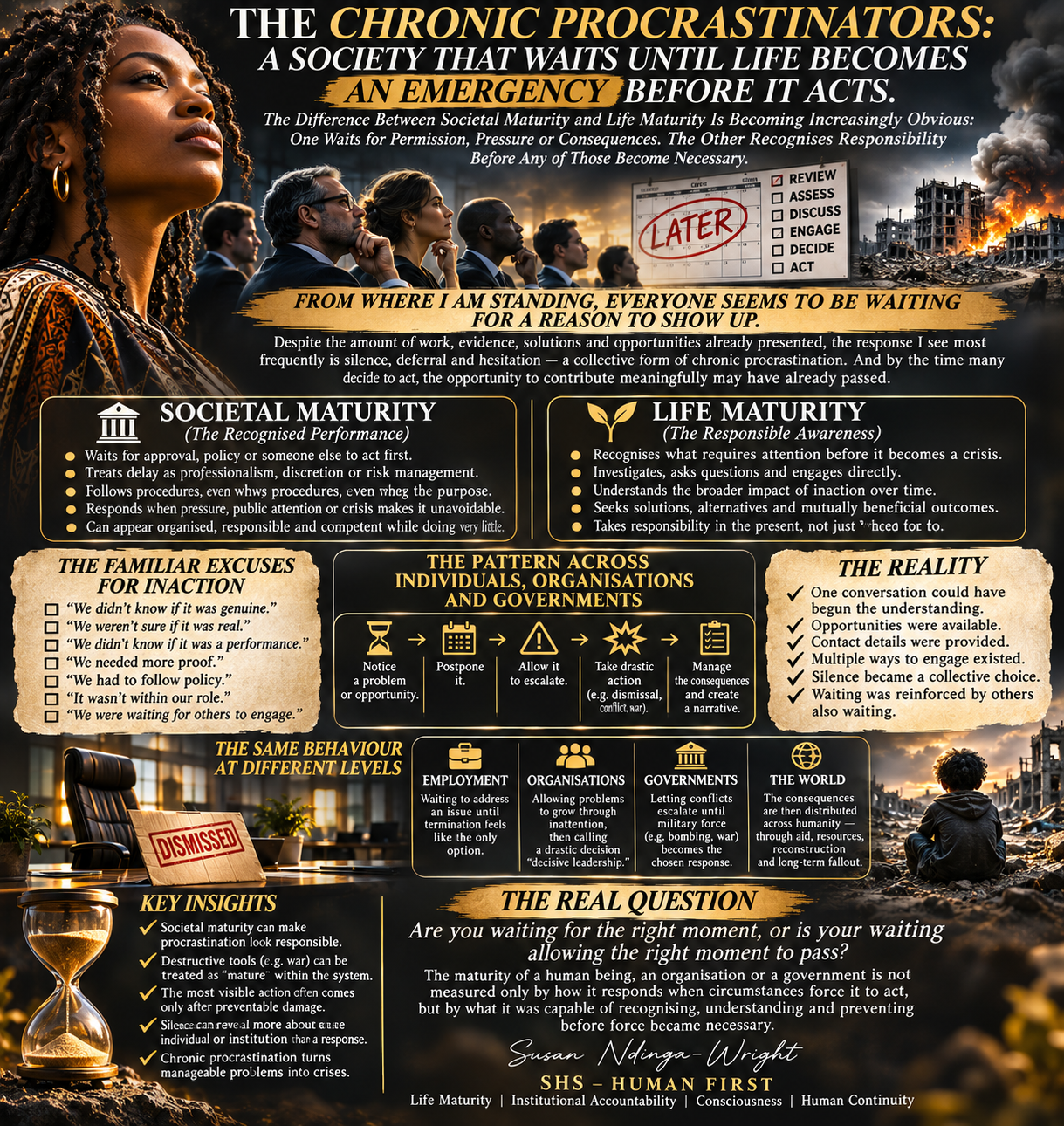
This is why I distinguish systematical maturity from life maturity.
Systematical maturity concerns how competently an individual functions within the structures, expectations and roles of a system.
Life maturity concerns how comprehensively an individual understands and responds to existence as a human being.
The two can coexist.
But they are not interchangeable.
A person may become exceptionally mature within a professional structure while remaining deeply dependent upon that structure to know how to exist.
They may know how to be a manager without knowing how to relate to another human being outside a management dynamic.
They may know how to perform romance without understanding how to love.
They may know how to exercise authority without understanding responsibility.
They may know how to appear confident without possessing confidence that survives the loss of external recognition.
They have learned the role so thoroughly that they mistake the role for the self.
And once that happens, anything that challenges the role begins to feel like a challenge to their existence.
Not because they are necessarily incapable of more.
But because they have not developed sufficient familiarity with themselves beyond the script.
5. THE MANIPULATOR’S GREATEST DIFFICULTY IS ENCOUNTERING SOMEONE WHO IS NOT PARTICIPATING IN THEIR STRATEGY.
Manipulation depends upon assumptions.
Assumptions about what motivates someone.
What frightens them.
What they desire.
What they will tolerate.
How they will react.
What they will believe.
What will make them withdraw.
What will make them comply.
What will make them emotionally dependent.
The manipulator attempts to arrange circumstances around those assumptions to produce a desired outcome.
But a spontaneous individual, grounded in self-awareness and life maturity, does not necessarily provide the anticipated response.
They can recognise an attempt to provoke them without becoming provoked.
They can recognise an invitation to participate in a power struggle without accepting the invitation.
They can acknowledge affection without becoming dependent upon it.
They can recognise hostility without automatically becoming hostile.
They can be tender without surrendering their boundaries.
They can be firm without rehearsing aggression.
They can be quiet without being intimidated.
They can speak without needing permission.
And perhaps most importantly, they can change their response as new information becomes available without feeling that changing course undermines their identity.
Because they were never committed to maintaining a performance.
They were committed to responding to reality.
And you cannot reliably manipulate someone through a script when that person is not dependent upon scripts to navigate themselves.
The manipulator may keep changing strategies.
The spontaneous individual simply keeps paying attention.
One is occupied with controlling the interaction. The other is available to understand it.
And that difference can make all the difference.
This does not mean spontaneous people are immune to deception or coercion. It means that genuine self-awareness, adaptability and independent judgement can make certain manipulative strategies considerably less effective.
6. THIS ALSO EXPLAINS WHY SOME PEOPLE CANNOT RECOGNISE WHAT I AM DOING.
I have spent considerable time relaying humanity back to humanity.
Examining our systems, institutions, relationships, behaviours, histories, contradictions, vulnerabilities and the consequences of how we have organised ourselves.
And what fascinates me is how easily such work can be interpreted as strategy.
As though every observation must be part of an elaborate plan.
Every exposure must have been calculated.
Every subject must have been selected to produce a particular reaction.
Every publication must have a predetermined outcome.
Every challenging statement must be an attempt to provoke.
Every movement must be part of some larger performance.
But what if the person you are observing is not doing what you know how to do?
What if they are not manufacturing a persona to achieve an outcome?
What if they are simply responding to what they recognise?
What if their perception has been developed across enough areas of life that they no longer require those areas to be separated before they can understand the relationships between them?
What if what appears to be an elaborate strategy is simply an individual accounting for existence as it presents itself?
And what if the reason you cannot recognise that possibility is because you have learned to understand intelligence almost exclusively through preparation, calculation and strategic behaviour?
Then you may be projecting your own method of navigating life onto someone who does not navigate life in the same way.
You look for the strategy because that is the language you understand.
You look for the performance because that is how you have learned to recognise competence.
You look for an anticipated destination because you cannot imagine moving so deliberately without having predetermined every step.
But an individual can have a purpose without scripting every encounter that serves it.
They can have responsibilities without calculating every interaction.
They can possess extraordinary consistency without repeating the same behaviours.
Because their consistency is rooted in their principles rather than their performances.
That is a distinction worth understanding.
For SHS – Human First, my work emerges from a commitment to accounting for the conditions of human existence.
That commitment remains.
But the observations, discoveries, connections and responses can emerge spontaneously.
I do not need to know which societal contradiction I will encounter tomorrow in order to remain capable of addressing it when I do.
And I do not need to organise every human interaction into an anticipated outcome to understand what it reveals when it occurs.
My continuity does not depend upon life following a script.
It depends upon my willingness and capacity to remain present with life.
7. WE SHOULD BE DEVELOPING PEOPLE, NOT JUST TEACHING THEM HOW TO PREPARE PERFORMANCES.
Now imagine what this means for education.
For leadership.
For relationships.
For organisations.
For parenthood.
For the human beings we are raising.
Instead of primarily teaching people what to say, what to do and how to appear in predetermined situations, imagine developing their ability to recognise, understand and respond to situations they have never encountered before.
Instead of teaching children merely how to perform confidence, we help them build genuine confidence in their capacity to learn.
Instead of teaching professionals merely how to comply with a role, we develop the intellectual and emotional maturity required to exercise judgement beyond the role.
Instead of teaching people the approved performances of romance, we develop their capacity for affection, emotional honesty, boundaries, responsibility and mutual understanding.
Instead of teaching leaders how to appear composed during crises, we develop individuals who can remain mentally available when circumstances are unfamiliar.
We would not be producing people who require a specific environment to demonstrate their abilities.
We would be developing people who can carry those abilities into changing environments.
That is a very different educational objective.
And that is where I believe humanity has a tremendous amount of development ahead of it.
Because we have taught people to prepare themselves for the world as we expect it to be, without sufficiently teaching them to recognise the world as it actually is.
We have made predictability a condition of confidence.
We have made scripts a condition of competence.
We have made institutional recognition a condition of identity.
And then we wonder why so many people struggle when the structures they have learned to depend upon change.
8. THE GREATEST STRATEGY IS TO NO LONGER NEED ONE TO BE YOURSELF.
There is an important distinction between coordinating practical responsibilities and depending upon strategy to manufacture your own capability.
A building may require an architectural plan.
An organisation may require operational coordination.
A surgeon may require a procedure.
A society may require infrastructure planning.
But none of those things should replace a human being’s ability to recognise and respond to what those plans did not anticipate.
The plan is a tool.
It should never become the boundary of the individual’s consciousness.
And this is precisely where I believe we have placed far too much value on strategising.
We have elevated the tool above the human capacity that ought to govern it.
We have confused rehearsed capability with integrated capability.
And we have rewarded the appearance of control, sometimes at the expense of genuine adaptability.
The greatest human skill is not being able to predict everything that might happen.
It is developing the intellectual, emotional and perceptual foundation to remain capable when what happens is entirely different from what you expected.
To remain sharp without rehearsal.
To remain calm without controlling everyone around you.
To remain confident without guaranteeing the outcome.
To remain perceptive without narrowing your awareness to one interpretation.
To remain open to correction without losing your sense of self.
To remain capable of love without performing romance.
To remain professional without hiding behind professionalism.
To remain responsible without becoming imprisoned by procedure.
And to remain yourself without requiring circumstances to validate who you are.
That is what I mean by spontaneity.
Not the absence of discipline.
Not the absence of thought.
Not the absence of responsibility.
The presence of such deeply integrated discipline, thought and responsibility that you can exercise them without needing to rehearse your humanity.
THE GREATEST GIFT IS TO ALWAYS BE READY.
So my invitation to humanity is this:
Stop measuring intelligence exclusively by how extensively someone has prepared.
Start examining how capable they remain when preparation no longer applies.
Stop confusing strategic behaviour with superior perception.
Start recognising that an individual who can account for multiple possibilities simultaneously may have a much greater capacity to navigate complexity than someone committed to executing one predetermined pathway.
Stop teaching people merely how to look capable.
Help them become capable.
Not just within their professions.
Not just within their relationships.
Not just within their institutions.
Within themselves.
Because the person who has built their entire confidence around a strategy must continually protect the conditions that make that strategy effective.
But the individual who has built their confidence around self-understanding does not require those conditions to remain unchanged.
Their foundation travels with them.
And this is what makes genuine spontaneity so powerful.
You do not have to prepare a different version of yourself for every human being you meet.
You do not have to construct a new performance for every environment you enter.
You do not have to rehearse your value before someone agrees to recognise it.
You do not have to anticipate every attempt at manipulation before you can trust yourself to respond.
You simply continue developing yourself until your ability to recognise, understand and respond becomes part of how you naturally exist.
Your present self no longer needs to borrow its confidence from a rehearsal conducted by your past self.
And when tomorrow arrives, you will not have to become the person yesterday prepared.
You will be the person you are, meeting the reality that exists.
That, to me, is a far greater demonstration of human intelligence than the performance of a perfectly calculated plan.
Because the greatest gift humanity possesses is not the ability to control every moment before it happens.
It is the ability to be fully present, fully conscious and mentally capable when it does.
And perhaps the greatest preparation we can ever make is to develop ourselves so completely that our capacity to meet life no longer depends upon preparing a performance for it.
Susan Ndinga-Wright
SHS – Human First
Life Maturity | Consciousness | Human Development


Leave a Reply