
Governmental priorities.
How Much Does a Country Actually Gain When It Profits From a Substance — and How Much Does Humanity Pay to Sustain That Profit?
By Susan Ndinga-Wright | SHS – Human First | 9 November 2026
I want to investigate something that I believe humanity has become extraordinarily comfortable overlooking.
We have normalised the commercial sale of alcohol to the point where its economic contribution is routinely celebrated. We talk about jobs, breweries, pubs, restaurants, hospitality, tourism, taxation and the billions of pounds flowing into the Treasury.
But what happens when we follow that money beyond the point of purchase?
What happens when the customer leaves the establishment?
When the intoxication enters the home?
When a child becomes frightened of a parent?
When someone gets behind the wheel?
When a relationship deteriorates?
When someone becomes pregnant without having intended to?
When the hospital receives yet another patient?
When an employee loses their livelihood?
When the taxpayer funds treatment, policing, rehabilitation, social services and the consequences of another person’s impaired judgement?
Does the government still consider the original sale a financial benefit after paying for everything that follows it?
And if we are willing to conduct that investigation into alcohol, why would we refuse to conduct the same investigation into cannabis?
I am a cannabis consumer myself. I am also highly engaged in intellectual investigation, governance design, accountability, responsibility, human welfare and long-term systems thinking.
I attribute some aspects of my personal experience of thinking and perception to cannabis.
Does that mean cannabis produces those qualities in everyone? No.
Does it mean that cannabis has demonstrably increased my intelligence? That is not something my experience alone can establish.
But neither does my consumption erase the cognitive work I do, the responsibilities I hold or the standards to which I hold myself.
This is precisely why I want both substances examined through the same framework.
Not through stereotypes. Not through criminal classifications. Not through moral judgement.
Through their demonstrable effects on human beings, society, the economy and the continuity of life.
I. THE ECONOMIC LEDGER: WHAT ALCOHOL EARNS AND WHAT IT COSTS
Let us begin with the money.
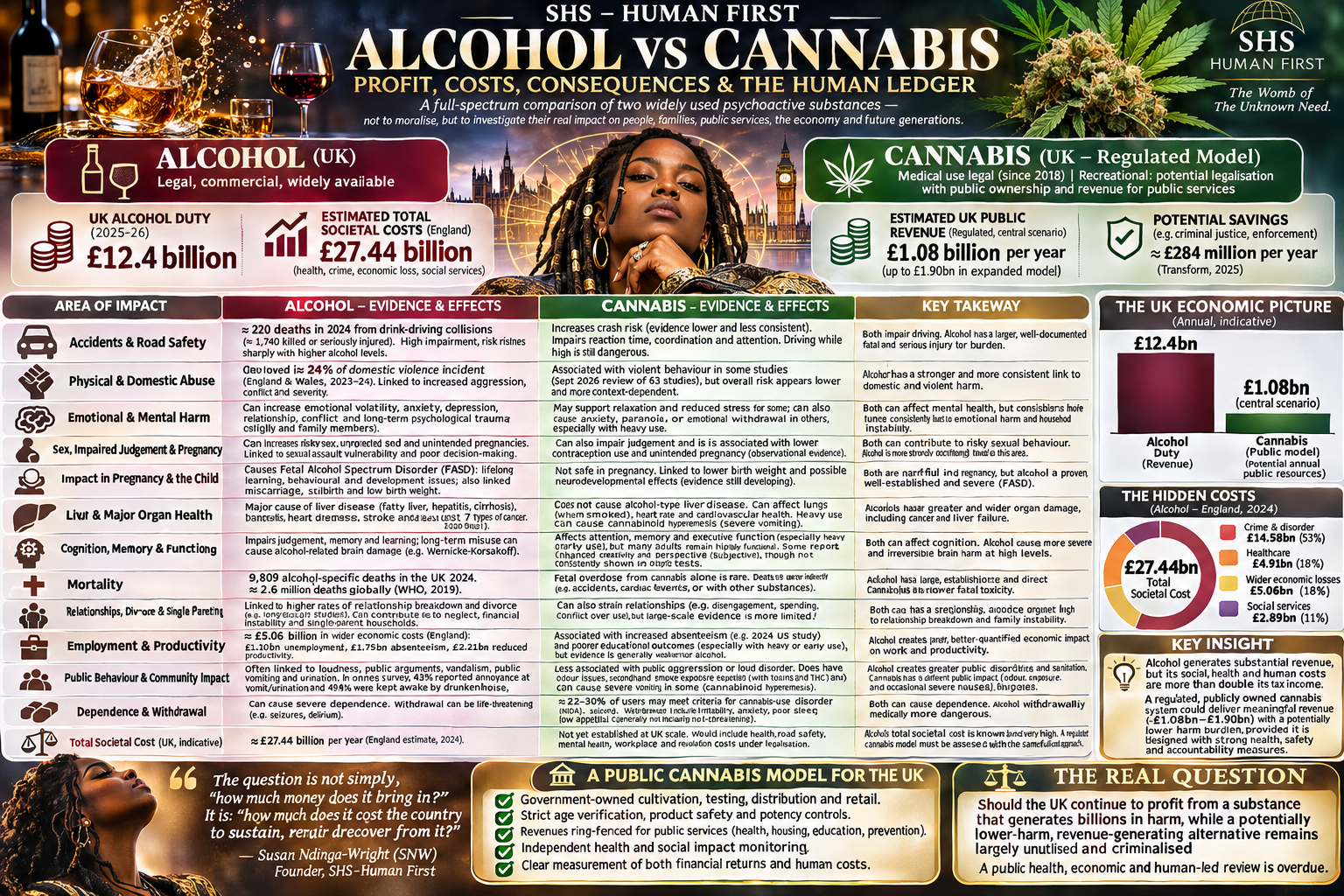
In the financial year ending March 2026, the British government recorded approximately £12.4 billion in alcohol-duty revenue.
That excludes VAT and other taxes connected with the alcohol industry.
Now consider the other side of the ledger.
A study published by the Institute of Alcohol Studies in 2024 estimated that alcohol-related harm cost England £27.44 billion annually, using data from 2021–22.
Its estimates included:
£14.58 billion in crime and disorder costs.
£4.91 billion in healthcare costs.
£5.06 billion in wider economic costs, including workplace absence, reduced productivity and unemployment.
£2.89 billion in social-service costs.
These are not figures that can simply be subtracted to produce an official government loss. The £12.4 billion covers the whole UK and a later year; the £27.44 billion covers England and includes economic and social costs beyond direct government expenditure.
But that distinction actually reveals the problem I am investigating.
The money entering the Treasury and the damage entering society are recorded in entirely different accounts.
A tax receipt is a relatively straightforward financial entry.
How do we record the frightened child?
The broken trust?
The years of emotional abuse?
The parent who becomes incapable of providing care?
The person who survives a collision but lives with permanent disabilities?
The social worker spending years trying to rehabilitate a family?
Some of these harms can be costed financially. Others cannot meaningfully be reduced to money.
Yet all belong to the complete public ledger.
Now compare cannabis.
In 2025, a UK economic study commissioned by Transform estimated that regulated recreational cannabis could provide up to £1.5 billion in annual net Treasury benefits, depending on the model. These include taxation and potential criminal-justice savings, with public retail ownership among the scenarios examined.
Québec, Canada, provides an existing example. During its 2025–26 financial year, its publicly owned cannabis retailer generated C$809.5 million in sales and C$132.4 million in net profit. Combining that profit with the relevant Québec tax receipts, the provincial treasury received C$331.3 million.
This establishes a public-revenue mechanism.
It does not yet establish the complete net social benefit of cannabis, because its health, road safety, dependence and other associated costs must also be counted.
Nevertheless, it creates a legitimate question.
Why should we assess cannabis primarily through the possibility of harm, while so often assessing alcohol primarily through the legitimacy of its commercial existence?
II. ACCIDENTS, ROAD DEATHS AND RECKLESSNESS
Alcohol interferes with judgement, reaction time, coordination and the capacity to recognise danger.
It can make a person more confident while making that same person less capable.
In Great Britain, the Department for Transport estimated 220 deaths in drink-driving collisions in 2024, alongside approximately 1,740 people killed or seriously injured.
That is a figure involving a driver or rider over the legal alcohol limit, not a count of every accident in which alcohol played some role.
Now consider cannabis.
Cannabis also impairs coordination, attention, reaction time and driving ability. It is not safe to drive while impaired by THC.
A 2025 systematic review found evidence associating cannabis consumption with increased risks of fatal and injury-producing road collisions, although the certainty of the evidence was low.
Other comparative studies indicate that the crash risk linked to alcohol rises particularly sharply at high blood-alcohol concentrations. Cannabis generally produces a different and often smaller impairment profile in studied driving conditions.
But smaller does not mean absent.
And combining alcohol with cannabis can make driving impairment worse than using either alone.
The distinction is not that alcohol creates dangerous drivers while cannabis creates safe ones.
It is that their impairment profiles and the scale of their documented harms differ, and those differences can be measured.
The same investigation should extend to workplace injuries, dangerous falls, drownings, fires and other preventable accidents.
How many injuries? How severe? How much treatment? How many permanent disabilities? How many deaths?
Count every consequence under the same rules.
III. PHYSICAL ABUSE AND DOMESTIC VIOLENCE
This is where I believe the financial conversation becomes profoundly inadequate.
Alcohol is associated with increased risk and severity of intimate-partner violence.
In the 2023–24 Crime Survey for England and Wales, victims believed offenders were under the influence of alcohol in approximately 24% of domestic-violence incidents.
That does not mean alcohol caused every one of those incidents.
An abuser remains responsible for abusing another person. Intoxication does not excuse violence, and many acts of abuse are deliberate, systematic and committed without intoxication.
Nevertheless, alcohol is a significant risk factor.
It can affect inhibition, emotional regulation, interpretation of threats and the escalation of existing aggression.
Now compare cannabis.
Cannabis has often been associated in popular culture with relaxation rather than aggression. Many consumers describe becoming quieter, calmer or more introspective.
But those accounts are not the whole evidence.
A September 2026 systematic review covering 63 studies found an association between cannabis use and violent behaviour, including in general-population samples.
Importantly, observational associations cannot establish that cannabis itself caused particular violent acts. Existing aggression, psychiatric conditions, social circumstances, other substances and selection effects can influence those relationships.
The evidence therefore does not justify saying that cannabis consumers are incapable of violence.
Nor does it establish that cannabis has the same relationship with violence as heavy alcohol consumption.
What needs examining is the attributable burden of violence from each substance, after accounting for those other influences.
For every incident of violence, I want to know who was harmed, what role intoxication played, and what institutions subsequently had to repair.
IV. EMOTIONAL AND PSYCHOLOGICAL ABUSE
Not every abusive household contains visible injuries.
Sometimes the harm takes the form of threats, humiliation, shouting, manipulation, coercive control, broken promises and prolonged instability.
Problem drinking may contribute to emotional volatility and worsening relationship conflict. Families can also experience anxiety around someone else’s drinking even when physical violence never occurs.
Imagine repeatedly having to anticipate whether the person returning home will be affectionate, angry, incoherent, withdrawn or hostile.
That uncertainty can reshape a household.
Cannabis needs the same scrutiny.
Some cannabis users report relaxation and reduced emotional tension.
Others experience irritability, anxiety, paranoia, withdrawal, emotional disengagement or conflict surrounding their consumption.
Heavy users may become irritable or angry when trying to stop.
Neither substance should be used to excuse neglect, coercion or abuse.
But the different patterns deserve investigation.
We should examine the frequency and severity of emotional harm associated with problematic alcohol consumption and compare those findings with problematic cannabis consumption.
The absence of physical injury does not mean the absence of damage.
And psychological damage should not disappear from the ledger merely because it cannot be photographed.
V. SEX, IMPAIRED JUDGEMENT AND UNINTENDED PREGNANCIES
Let us investigate another consequence that is rarely included when alcohol revenue is discussed.
Sexual decision-making.
The NHS identifies binge drinking as a factor that can increase risky behaviour, including unprotected sex.
Alcohol intoxication can contribute to forgotten contraception, impaired communication, increased risk-taking and situations in which people become vulnerable to sexual exploitation or assault.
It is important to be precise: alcohol does not mechanically cause a pregnancy. Pregnancy results from reproductive events, while intoxication may influence whether contraception is used or whether people are capable of making informed decisions.
And sexual assault remains the perpetrator’s responsibility.
Cannabis is not exempt from this comparison.
Cannabis can also affect judgement, inhibition and sexual decision-making. Some observational studies associate cannabis use with lower condom use or unintended pregnancy, although these associations are affected by other behavioural and social factors.
Therefore, neither substance can be described as guaranteeing responsible sexual behaviour.
But if intoxication contributes to an unintended pregnancy, we need to follow what happens next.
Was the pregnancy supported?
Were both people capable of participating in decisions?
Was anyone subjected to coercion?
What medical, emotional, practical and financial support became necessary?
The consequences of a moment of intoxication can extend across generations.
VI. PREGNANCY AND THE DEVELOPING CHILD
Alcohol exposure during pregnancy can cause fetal alcohol spectrum disorder, or FASD.
The NHS identifies possible consequences including lifelong problems involving learning, concentration, memory, emotional regulation, communication, physical development and behaviour.
Alcohol exposure during pregnancy is also associated with miscarriage, stillbirth, premature birth and low birth weight.
Now compare prenatal cannabis exposure.
Cannabis is not safe to assume harmless in pregnancy.
THC can reach the developing fetus. Research links prenatal cannabis exposure with lower birth weight and other adverse outcomes, while evidence about specific long-term neurodevelopmental effects is still being investigated.
Both substances are advised against during pregnancy.
However, the established evidence for alcohol’s teratogenic effects, including FASD, is particularly extensive.
The responsible comparison is not to deny cannabis-related prenatal risk.
It is to identify precisely what each substance can cause, how strong the evidence is, and what lifelong consequences may result.
Then consider the extraordinary significance of those consequences.
A child may require educational support, specialist care, adaptations, health treatment and social assistance for decades.
The initial sale of alcohol may have generated a relatively small amount of tax.
The possible consequences may continue throughout an entire lifetime.
The economic event ended at the checkout. The human event did not.
VII. LIVER DISEASE AND PHYSICAL ORGAN DAMAGE
Alcohol’s relationship with liver disease is established.
Long-term heavy drinking can contribute to fatty liver, alcohol-associated hepatitis, cirrhosis and liver failure.
Alcohol is also associated with pancreatitis, cardiovascular disease, strokes and several types of cancer.
It is a Group 1 carcinogen.
A World Health Organization report identifies at least seven cancer sites linked to alcohol consumption, including breast, bowel, liver, mouth, throat and oesophagus.
The UK Parliamentary Library cites estimates of approximately 17,000 new cancer cases attributable to alcohol in 2020.
Now compare cannabis.
Cannabis does not have an established, comparable pathway of causing alcohol-related cirrhosis, but that does not make cannabis physiologically risk-free.
Smoked cannabis exposes the lungs and airways to harmful chemicals. Cannabis can increase heart rate and has been associated with cardiovascular problems. The precise causal relationships for several long-term outcomes remain under investigation.
Repeated heavy cannabis use can also produce cannabinoid hyperemesis syndrome, involving severe recurring nausea, vomiting and abdominal pain.
A comparison should therefore ask:
Which organs are damaged?
By which mechanisms?
At what frequency and dose?
How much treatment is required?
And which effects are temporary, chronic, disabling or fatal?
That is a far more meaningful public-health comparison than simply declaring one substance legal and another illegal.
VIII. COGNITION, INTELLIGENCE, MEMORY AND HIGH FUNCTIONING
This part is particularly personal to me.
I consume cannabis.
I also investigate complex matters involving law, societal organisation, public accountability, consciousness, the structure of human experience and long-term governance.
My intellectual engagement does not disappear because I am a cannabis consumer.
I remain responsible for my conduct, my reasoning and the consequences of my decisions.
I also give cannabis partial credit for aspects of my subjective experience of thinking.
I do not mean that every thought I produce belongs to cannabis.
The thinking belongs to me.
But I recognise that a substance may influence the mental conditions in which thinking takes place.
And I think the relationship between individual cognition and substances deserves greater investigation than the simplistic assumption that every cannabis user is cognitively diminished.
Now compare the actual evidence.
Alcohol intoxication can impair judgement, memory, learning and executive functioning. Severe long-term alcohol misuse can produce alcohol-related brain damage, including Wernicke-Korsakoff syndrome.
Cannabis also affects attention, memory, learning, reaction time and executive function, especially during acute intoxication.
Frequent use, particularly beginning during adolescence, is associated with greater risks of lasting cognitive and educational difficulties.
A controlled study published in 2023 found that cannabis increased participants’ positive evaluations of creativity without improving objectively assessed creativity.
That matters.
Because feeling more creative and demonstrably producing better work are not necessarily the same thing.
But neither is a temporary impairment on a laboratory task equivalent to proving that every adult consumer is incapable of complex thought or sustained achievement.
Human cognitive performance varies with dose, frequency, age, task, tolerance, health and other influences.
My own experience belongs within that investigation as an individual account, not as proof of a universal cognitive benefit.
The questions I would ask are more precise.
What was a person’s functioning before consumption?
What changed during consumption?
What remained stable?
What improved subjectively?
What deteriorated objectively?
What happened over months and years?
And what does the person actually produce, sustain and take responsibility for?
The investigation should concern the full functioning human being, not merely a social label attached to their substance use.
IX. MORTALITY: THE ULTIMATE HUMAN COST
In 2024, the UK recorded 9,809 alcohol-specific deaths, according to the Office for National Statistics.
These are deaths attributed to conditions directly caused by alcohol. They do not capture the full number of alcohol-attributable deaths from cancers, accidents and other conditions.
Globally, the WHO estimated that alcohol consumption contributed to approximately 2.6 million deaths in 2019.
That is a staggering human toll.
Now compare cannabis.
Fatal overdose caused solely by cannabis is rare. Cannabis does not present the same established pattern of fatal alcohol poisoning.
But it would be inaccurate to say that cannabis can never contribute to death.
Cannabis-related impairment can contribute to fatal accidents. Other potential pathways include cardiovascular complications, psychiatric crises and interactions with additional substances.
A 2026 US CDC analysis found that cannabis was sometimes identified as involved in overdose deaths, although most deaths in which cannabis was detected involved other drugs as well.
There is no sufficiently equivalent UK all-cause cannabis-attributable mortality estimate that can simply be placed beside the 9,809 alcohol-specific deaths as though the two figures measured identical things.
So the responsible investigation must distinguish direct toxic overdose, chronic disease, road casualties, co-use and indirect mortality.
Still, the difference in established fatal toxicity is substantial.
If government measures an industry’s contribution through income, shouldn’t it also measure how much life is lost in sustaining that income?
X. THE PUBLIC SMELL OF INTOXICATION
Now let us leave the hospitals and enter the streets.
Friday night.
Saturday night.
Sunday morning.
The shouting.
The broken glass.
The public urination.
The smell of vomit on the pavement.
The people falling over.
The arguments outside establishments.
The residents who are trying to sleep.
The workers who must clean the streets.
The emergency services attending preventable incidents.
This is not merely an aesthetic complaint. It is an issue of public space, sanitation, public expenditure and the freedom of other people to live without avoidable disturbance.
The Institute of Alcohol Studies cites a survey in north-west England in which 43% of respondents reported annoyance at people vomiting or urinating in the street after drinking, while 49.4% reported being kept awake by drunken noise.
These are local survey results, not national prevalence estimates.
Now compare cannabis.
Cannabis has a public-smell issue of its own.
Its smoke can be intrusive, travel into neighbouring homes and expose other people to potentially harmful substances.
Secondhand cannabis smoke contains toxic and carcinogenic chemicals, as well as THC.
Cannabis-related litter, smoking in shared spaces and public impairment can create genuine problems.
Heavy cannabis use can also produce severe vomiting through cannabinoid hyperemesis syndrome.
But there is no basis for assuming that these public effects occur with the same frequency, mechanism or severity as alcohol-related late-night street disorder.
So examine them separately.
Public vomit and sanitation costs.
Public smoke and secondhand exposure.
Noise complaints.
Emergency callouts.
Street cleaning.
Property damage.
Disruption to residents.
And the cost of enforcing rules around each substance.
The freedom to consume something is not an unlimited entitlement to impose its consequences upon everyone else.
XI. LOUDNESS, DISORDER AND THE RIGHT TO PEACE
Alcohol-related intoxication can involve disinhibition, increased talkativeness, shouting, public arguments and confrontational behaviour.
Cannabis can produce different effects: relaxation, altered perception, laughter, reduced activity or introspection in some consumers; anxiety, agitation or paranoia in others.
Neither profile is universal.
We should not pretend all drinkers are disruptive or all cannabis users are peaceful.
But a public policy system should compare actual disturbances, rather than relying on cultural expectations.
How often are police called?
How often do neighbours complain?
How often is property damaged?
How often do people feel threatened in public?
How much overtime is required from sanitation and emergency workers?
The purpose is not to condemn enjoyment.
It is to establish the boundary between private enjoyment and publicly absorbed consequences.
XII. DIVORCE AND THE BREAKDOWN OF RELATIONSHIPS
Alcohol misuse is associated with relationship breakdown.
A longitudinal study following young adults found that alcohol abuse or dependence remained associated with increased rates of relationship dissolution even after controlling for several other factors.
Another US longitudinal study found substantially higher rates of marital dissolution among people with alcohol-use disorder than among those without it.
But relationships are complex. We cannot legitimately attribute every divorce involving a drinker to alcohol.
What we can investigate is the role alcohol plays in repeated conflict, financial instability, broken trust, violence and the erosion of care.
Now compare cannabis.
Problematic cannabis use can also affect relationships through emotional disengagement, dependence, spending, disagreement over consumption, impaired functioning or broken responsibilities.
But we lack the same quality of population-wide evidence for assigning a specific proportion of divorces to cannabis use.
Therefore, we cannot invent a comparison.
Instead, we need to establish one.
How many relationships deteriorate because substance use becomes incompatible with the obligations of the relationship?
How many improve following treatment or reduced consumption?
And how many relationship breakdowns would have happened regardless?
The purpose is not to force anyone to remain in a harmful marriage.
It is to understand which preventable behaviours contribute to its collapse.
XIII. SINGLE PARENTING AND THE ABDICATION OF RESPONSIBILITY
Single parenting is not itself a social failure.
A single parent can raise a child with extraordinary love, stability and competence.
The problem I am examining is different.
It concerns the circumstances under which someone who should be sharing responsibility ceases to provide it.
When alcohol dependence contributes to neglect, violence, unreliability, relationship dissolution or financial instability, the consequences may fall disproportionately on the remaining parent and children.
That parent may have to become the entire household’s provider, caregiver, organiser and emotional anchor.
Now compare cannabis.
Cannabis dependence can also interfere with caregiving, financial responsibilities and emotional availability.
A parent who becomes repeatedly impaired when a child requires supervision is not made safe simply because the substance is cannabis rather than alcohol.
The child’s needs remain the standard.
Government safeguarding guidance recognises that both parental alcohol and drug problems can increase risks of abuse, neglect and adverse childhood outcomes.
Therefore, the question is not whether cannabis users can be responsible parents or alcohol users can be loving parents. Both can.
The question is how often harmful consumption patterns prevent the fulfilment of parental obligations.
And what happens when that failure is transferred to another person?
The cost of abandonment does not disappear merely because another parent finds the strength to carry it.
XIV. CHILDHOOD, TRAUMA AND INTERGENERATIONAL CONSEQUENCES
Imagine a child growing up around repeated intoxication.
The child learns to observe mood changes.
To anticipate conflict.
To adjust their behaviour.
To stay quiet.
To take responsibility for things that should belong to adults.
In some households affected by substance misuse, children take on inappropriate caring responsibilities, experience neglect or abuse, or encounter disruptions to education and emotional development.
UK safeguarding guidance explicitly recognises these risks for both parental alcohol and drug problems.
Here is the intergenerational question.
If a child spends years adapting to a dysfunctional household, how much of that adaptation follows them into adulthood?
Their relationships?
Their expectations of love?
Their capacity to trust?
Their understanding of safety?
Their approach to money?
Their ability to regulate their own emotions?
Not every child exposed to parental substance misuse will experience these harms, and none of these outcomes is predetermined.
But where harms occur, their consequences may extend well beyond the initial period of consumption.
These effects are not fully represented by a single annual healthcare bill.
Human continuity means investigating what survives the original event.
That includes trauma, learned behaviour, interrupted development and the support needed to prevent their repetition.
XV. EMPLOYMENT, PRODUCTIVITY AND ECONOMIC DEPENDENCE
The 2024 Institute of Alcohol Studies estimate attributed approximately £5.06 billion in annual costs in England to workplace and wider economic effects from alcohol.
Of that, approximately £1.10 billion related to unemployment, £1.75 billion to absenteeism and £2.21 billion to reduced productivity while at work.
These are modelled economic costs, not direct Treasury expenditure.
Now compare cannabis.
Cannabis can also interfere with work.
An American study using 2021–22 data found that frequent use and cannabis-use disorder were associated with increased workplace absenteeism.
A 2024 review of studies involving adolescents and young adults found associations between cannabis consumption and poorer educational outcomes, with weaker evidence for increased unemployment.
These studies cannot demonstrate that cannabis independently caused every outcome.
But they invalidate the claim that cannabis carries no productivity risks.
At the same time, cannabis consumption does not automatically make an adult incapable of sustained, responsible and productive employment.
The relevant questions are about actual functioning, impairment, dependency, safety and the ability to meet obligations.
A worker who consumes cannabis outside working hours and performs their duties reliably should not automatically be presumed incompetent.
Likewise, someone who drinks socially cannot be presumed irresponsible.
What matters is the evidence of impairment and the consequences for others.
Especially in safety-critical work, neither substance should compromise the worker’s ability to protect life.
XVI. DEPENDENCE, WITHDRAWAL AND THE COST OF TREATMENT
Alcohol dependence can be severe and medically dangerous.
Withdrawal from significant alcohol dependence can involve seizures, delirium and potentially life-threatening complications.
Cannabis dependence also exists.
The US National Institute on Drug Abuse reports research estimates that approximately 22–30% of cannabis users may meet criteria for cannabis-use disorder, with risk strongly influenced by frequency of use.
Cannabis withdrawal can involve irritability, anxiety, disrupted sleep, low appetite and depressed mood.
It is generally not medically comparable to life-threatening alcohol withdrawal, but it can still be distressing and disruptive.
This distinction matters.
We should neither exaggerate cannabis withdrawal into alcohol withdrawal nor dismiss the genuine difficulties some consumers experience.
Both require honest assessment.
Both may require treatment.
Both can interfere with daily life.
And those costs belong in any realistic economic projection.
XVII. THE PSYCHOLOGICAL EXPERIENCE: RELAXATION, DISTRESS AND THE MIND
There is another dimension that numerical comparisons alone struggle to capture.
Why do people consume these substances?
Pleasure?
Relaxation?
Connection?
Social confidence?
Relief from pain?
Escape from distress?
A change in consciousness?
Alcohol and cannabis can both produce experiences that consumers regard as beneficial.
But subjective benefit is not identical to clinical improvement.
Alcohol may initially reduce inhibition or anxiety while worsening sleep, mood, judgement and emotional regulation.
Cannabis may produce relaxation and altered sensory experience in some individuals, while causing anxiety, panic, paranoia or psychotic symptoms in others.
Frequent high-potency cannabis use is associated with increased risk of psychosis, especially among vulnerable individuals.
The point is that both subjective experience and objective consequence matter.
A person may feel calmer yet perform worse on an attention task.
Another may feel socially confident while becoming more aggressive.
Another may report more expansive thinking without demonstrably producing more creative work.
We need to investigate the experience, the performance and the consequences separately.
My own cognitive life is an example of why I reject simplistic assumptions about consumers.
But it is not an argument for excluding inconvenient research findings.
The more seriously I take my own experience, the more seriously I must take the experiences of those whose outcomes differ.
XVIII. THE COST OF CRIMINALISATION ITSELF
There is one important cost on cannabis’s side of the public ledger that alcohol does not currently carry in the same way.
Criminalisation.
When possession or supply is prohibited, enforcement has financial and human consequences.
Police time.
Courts.
Prosecutions.
Criminal records.
Restrictions on employment and future opportunities.
The continued existence of illegal supply networks.
And the absence of consistent quality controls in illicit markets.
The Transform economic report estimated that a UK legal cannabis system could save up to approximately £284 million annually across parts of the criminal justice system, depending on the reform model.
Those are estimates, not guaranteed savings.
And legalisation would introduce costs of its own: licensing, regulation, testing, prevention, enforcement against unlicensed operators and healthcare responses to any changes in consumption.
But the comparison reveals something important.
Alcohol is permitted to operate within a legal commercial market despite its substantial documented harms.
Cannabis consumers continue to face criminal sanctions for certain activities even though a legal, controlled system could potentially redirect illicit-market income into regulated economic activity.
The legal distinction should therefore be examined alongside the evidence of actual harm and the consequences of each regulatory approach.
XIX. WHAT WOULD HAPPEN IF THE STATE OWNED THE CANNABIS INDUSTRY?
Now return to my original economic investigation.
Imagine a government-operated cannabis industry.
Public cultivation.
Independent product testing.
Public distribution.
State-owned retail.
Controlled access.
No commercial incentive for private retailers to maximise consumption.
And a statutory arrangement directing the commercial surplus and relevant tax revenues into public services.
A preliminary UK scenario we examined placed potential annual public resources at approximately £465 million under cautious assumptions, £1.08 billion under central assumptions and £1.90 billion under expanded-market assumptions.
These are illustrative financial scenarios, not official forecasts. They depend on consumer demand, operating costs, taxes, competition and the cost of preventing and treating harms.
But the model raises a legitimate question about public ownership.
Why should the only choices be prohibition or a predominantly privately owned recreational market?
The state could examine a structure in which public revenue is retained while an independently accountable authority controls access, protects health and publishes a complete annual financial and human-impact ledger.
However, public ownership creates its own conflict.
If the government earns more when people consume more cannabis, how do we prevent financial interests from compromising public health?
That is where governance design becomes essential.
The operator’s commercial performance should not be its only measure of success.
Its public-health consequences, safeguarding outcomes, product safety and wider costs must be independently assessed.
If consumption increases and health outcomes deteriorate, increased tax receipts alone cannot establish success.
If criminalisation declines and safety improves, those benefits should be recorded too.
A public industry must be accountable not merely for what it earns, but for what it makes possible and what it makes necessary.
XX. THE REAL COMPARISON: NOT PROFIT AGAINST PROFIT, BUT HUMAN CONSEQUENCE AGAINST HUMAN CONSEQUENCE
I want the comparison to extend across every major system society maintains.
Health.
Education.
Employment.
Housing.
Family life.
Relationships.
Crime.
Transport.
Public safety.
Social care.
Environmental conditions.
Economic productivity.
Personal liberty.
Intergenerational development.
Mortality.
And the continuation of consequences across time.
For alcohol, record the costs of liver disease, cancers, alcohol poisoning, accidents, violence, sexual harm, domestic instability, absenteeism, unemployment, emergency care and public disorder.
For cannabis, record cognitive impairment, dependence, psychiatric complications, cardiovascular and respiratory concerns, pregnancy risks, unsafe driving, public smoke exposure, workplace effects and any harms associated with changes in use under legalisation.
Then record the benefits and revenues of both.
Taxes.
Employment.
Commercial surpluses.
Tourism.
Personal enjoyment.
Any clinically established benefits, distinguishing recreational use from prescribed medical treatments.
Reductions in criminal-justice expenditure.
Improved product safety.
And the extent to which regulated markets displace illegal supply.
But every category needs the same standards of evidence.
Where the outcome is proven, say so.
Where it is associated but not demonstrated to be caused, say so.
Where the data are inadequate, acknowledge the gap rather than inventing a figure.
And where a consequence is socially or emotionally profound but financially difficult to quantify, do not pretend that it has no value.
A child who no longer feels safe in their home is not merely a cost to social services.
A parent who has survived years of abuse is not merely an economic statistic.
A person who loses employment, housing or health is not merely a reduction in productivity.
They are human beings.
And that is where I believe our current understanding of profit becomes insufficient.
XXI. AN INDUSTRY’S REVENUE IS NOT THE SAME AS AN INDUSTRY’S BENEFIT
The sale of a product produces income.
But income is only one movement in an interconnected system.
If an industry generates £1 billion in tax receipts while its activities contribute to £2 billion in additional preventable public costs, the financial story is substantially different from the headline.
And if an industry generates tax receipts while also imposing emotional, developmental and intergenerational harms that cannot be fully priced, the economic calculation becomes even less complete.
That does not mean every harm can be causally assigned to a product.
Nor does it mean the existence of harm automatically resolves the question of prohibition, regulation or public ownership.
It means those choices must be made with a full account of their consequences.
The same principle applies to cannabis.
It would be intellectually indefensible to criticise alcohol for hiding its social costs and then create a cannabis model that hides its own.
The standard must remain consistent.
CONCLUSION: THE HUMAN LEDGER MUST COME BEFORE THE FINANCIAL CELEBRATION
What interests me most is not simply whether cannabis can bring an additional billion pounds into the British economy.
What interests me is how much money humanity is already spending repairing consequences that were never sufficiently considered when other industries were allowed to grow.
Alcohol provides an especially significant example because its benefits and harms are both extensively documented.
Its tax contribution is substantial.
So are its social, medical and economic consequences.
Cannabis presents a different balance of documented harms, potential benefits and regulatory possibilities.
It should be investigated with the same seriousness.
And my own experience as a cannabis consumer is part of why I insist that we distinguish the person from the stereotype.
I do not accept the automatic assumption that cannabis consumption negates cognition, accountability, discipline, care or responsible contribution.
My work and conduct are there to be examined.
But I equally reject the opposite assumption that cannabis necessarily improves every consumer or makes all consumption harmless.
The human being is more complex than either classification.
The real investigation must account for the interaction between the person, the substance, the circumstances and the consequences that unfold over time.
Because the profit generated today may require an expenditure tomorrow.
And tomorrow’s expenditure may become the next generation’s burden.
My question to government is therefore not merely:
How much money does this industry bring into the country?
It is:
How much does the country receive, how much does the country subsequently have to spend because of that industry, how much harm remains outside the financial calculation, and who ultimately receives the benefits or carries the consequences?
Until those questions are answered, we do not have a complete calculation of public benefit.
We have an account of income.
And income is not the same as worth.
SHS – HUMAN FIRST
The Womb of The Unknown Need.
Integrity examines the full consequence. Continuity follows it beyond the original event.
Research and evidence referenced
Public finances and economic costs
HMRC — Annual Report and Accounts 2025–26
Institute of Alcohol Studies — The Costs of Alcohol to Society
Transform — High Returns: The Economic Benefits of UK Cannabis Legalisation
SQDC — 2025–26 public cannabis financial results
Deaths, physical health and road safety
ONS — Alcohol-Specific Deaths, Registered in 2024
Department for Transport — Drink-Drive Collisions 2024
WHO — Alcohol and Its Global Health Effects
WHO Europe — Alcohol and Cancer
2025 Systematic Review — Cannabis and Motor Vehicle Collisions
CDC 2026 — Cannabis Detection Among Overdose Deaths
Families, violence, pregnancy and children
UK Government — Domestic Abuse and Alcohol Treatment
Institute of Alcohol Studies — Violence and Crime
2026 Systematic Review — Cannabis Use and Violence
NHS — Fetal Alcohol Spectrum Disorder
UK Government — Safeguarding Children Affected by Parental Substance Use
NHS Inform — Alcohol, Drugs and Sexual Wellbeing
Cognition, dependence and employment
CDC — Cannabis and Brain Health
2023 Controlled Study — Cannabis and Creativity
2024 Review — Cannabis Use and Academic Achievement
2024 Study — Cannabis and Workplace Absenteeism
NIDA — Cannabis Dependence and Health
Evidence note: These sources use different populations, years, measurements and research methods. The comparisons identify established risks, observed associations and areas of uncertainty; they do not provide a definitive numerical ranking of the overall net social costs of alcohol and cannabis.
…
Greate create a post about the profits and costs of cannabis v alcohol. Take it all into account, the accidents, the abuse(physical and emotional and mental that the alcohol causes), recklessness pregnancies that happen under its effects and the inpact on them for consumption during the pregnancies, liver issues, cognitive, public smell of puke on the floors every weekend, the mortality rates, the divorces, single parenting caused by alcohol consumptions, unemplyment, loudness of those under the influence, and for every single one of them, i want you to compare it to cannabis smokers. I am one too, so consider my cognition, accountability responsiblity and high functioning too, which I do also assign partial credits to marijuana.
Be the most thorugouh possible. Like your life depended on it


Leave a Reply