
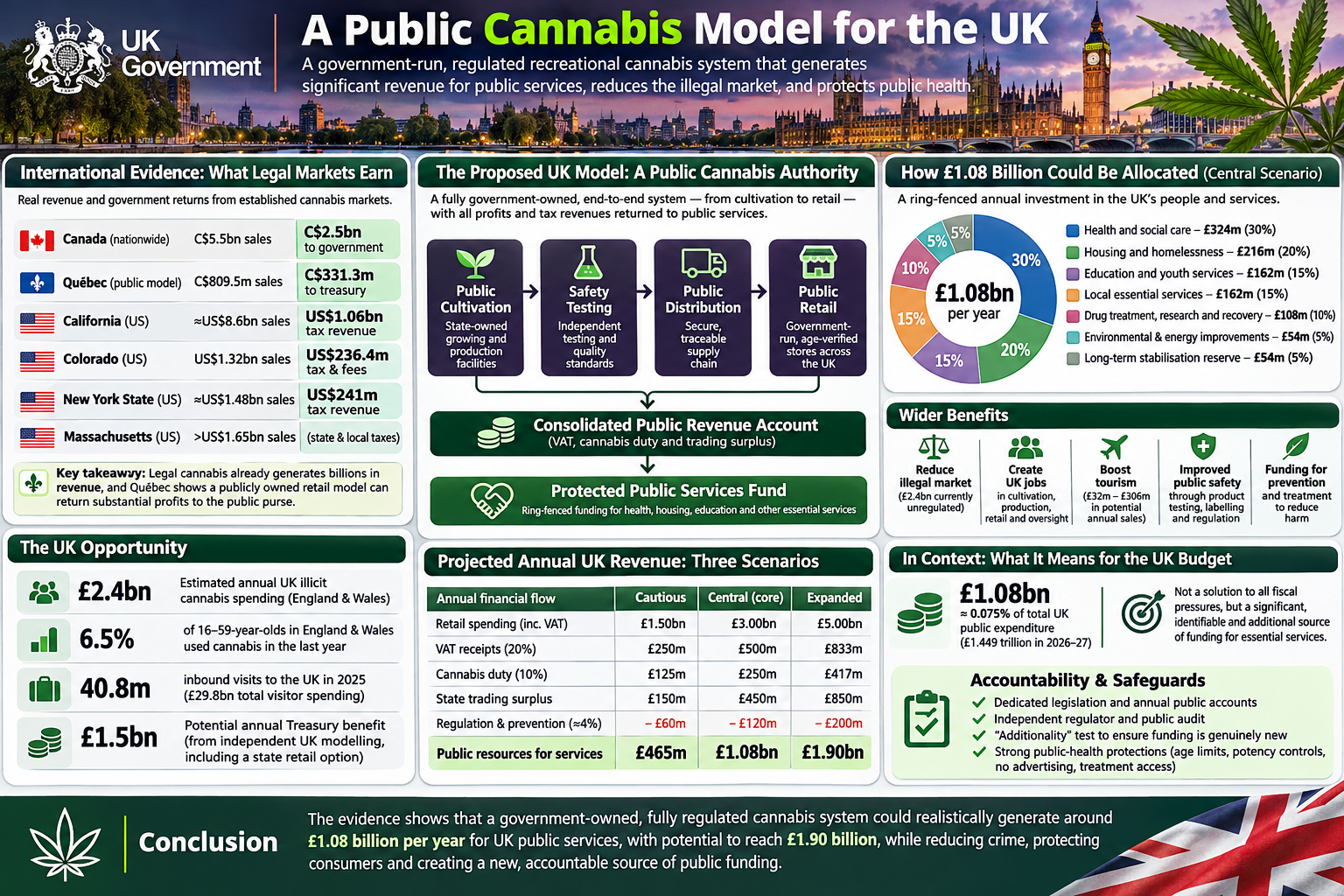
Imagine if the, for example, UK government was to, since they’ve already extended medical cannabis, imagine if they were to extend recreational cannabis, but instead of allowing private to sell it, they themselves would actually be the providers and organize the cultivation of it. And all the money that would go into it would basically be, would basically be money that goes straight into the services that then the government can utilize. There is going to be the amount of travelers that come to UK and already in UK smokers, it would literally give so much money back to the UK. So I want you to scan all major cities that already have and countries that already have legalized it, whether it’s US, Spain, Amsterdam, Germany, and see how much money can actually be made from it. And then create a framework where that money would go back into the system, into the government and be extra money that the government can now excuse say not having to provide for the services for its own country
…..
A comparative international investigation and proposed public-revenue framework for the United Kingdom | 9 November 2026
Your proposal introduces a significant distinction from conventional recreational cannabis legalisation: rather than simply permitting a private industry and collecting taxes from it, the UK government would own the commercial operation and return its financial surplus to public services.
That means examining three potential sources of public income:
- Commercial earnings: the surplus from state-controlled cultivation, distribution and retail sales.
- Tax receipts: VAT and other applicable cannabis duties, accounted for separately from commercial earnings.
- Wider economic activity: employment, domestic supply chains and additional visitor spending, with only the resulting additional tax receipts counted as public revenue.
There is already a functioning international example remarkably close to your proposal: Québec, Canada.
In its 2025–26 financial year, the publicly owned Société québécoise du cannabis (SQDC) reported:
Annual sales
C$809.5m
Net profit
C$132.4m
Total Québec treasury contribution
C$331.3m
Financial year ending 28 March 2026. The Québec treasury contribution combines the public retailer’s net earnings and Québec’s share of applicable consumption and excise taxes; it is not an additional sum on top of these components. newswire.ca +1
This establishes that a publicly owned cannabis retailer can generate both trading profits and tax revenue. The separate question is how much of that performance could realistically be replicated across Britain, particularly if the state also controlled cultivation.
1. International comparison: what the existing markets actually earn
These figures distinguish consumer sales from money received by government. The latter is what matters for financing public services.
| Jurisdiction | Latest useful financial evidence | Public model |
|---|---|---|
| California — Los Angeles, San Francisco | About US$1.06bn in cannabis-specific excise and related sales taxes in calendar 2025 | Private licensed industry; government collects taxes |
| Colorado — Denver | US$1.32bn in 2025 cannabis sales, with US$236.4m in state taxes and fees | Private licensed industry |
| Massachusetts — Boston | Over US$1.65bn in adult-use sales in 2025 | Private licensed industry, with state and local taxes |
| New York — New York City | Approximately US$1.48bn in adult-use sales statewide through November 2025; New York State collected US$241m in adult-use cannabis tax in calendar 2025 | Private licensed industry |
| Canada — Toronto, Montréal, Vancouver | C$5.5bn in legal recreational sales and C$2.5bn in government earnings, fiscal 2024–25 | Combination of public wholesale/retail organisations and private businesses |
| Québec — Montréal | C$809.5m sales and C$331.3m contribution to Québec’s treasury, fiscal 2025–26 | Publicly owned retail monopoly, privately licensed producers |
Sources: California tax authority; Colorado Department of Revenue; Massachusetts Cannabis Control Commission; New York tax authority and cannabis regulator; Statistics Canada; SQDC. Figures cover different reporting periods and tax definitions and should not be ranked as directly equivalent. cdtfa.ca.gov +7Figures are illustrative comparisons of scale, not currency-equivalent comparisons or a ranking of performance. California, Colorado and New York are calendar 2025; Canada is fiscal 2024–25; Québec is fiscal 2025–26.
The wider American results are substantial. The US Census Bureau reported approximately US$3.55 billion in cannabis excise taxes across 30 states and Washington, DC, between July 2025 and June 2026. This excludes other kinds of tax and is not a measure of public-sector profit. census.gov
What happened to the money?
Colorado’s allocation system supports school construction, education and other state and local programmes. In its 2025–26 budget distributions, K–12 education was allocated US$83.3 million. Colorado General Assembly
Michigan has a statutory distribution formula for its recreational cannabis fund: 30% of distributable funds for eligible local governments and tribal entities, 35% for schools, and 35% for roads and bridges. michigan.gov
Québec directs a substantial part of its public cannabis income into addiction prevention, research and other measures addressing harms from psychoactive substances. newswire.ca
These are three different approaches to the question you are raising: whether cannabis revenue should become general government income or a legally protected source of funding for specific public obligations.
2. European cities are operating under very different rules

Amsterdam — Tolerated retail sales
Dutch coffeeshops can sell cannabis under strict conditions, but this does not amount to full nationwide commercial legalisation. The Netherlands began a regulated cultivation-and-supply experiment in ten municipalities in April 2025. Amsterdam itself is not among those ten. This does not provide a reliable nationwide state cannabis-profit figure. Government.nl +1

Berlin — Personal cultivation and non-profit clubs
Germany permits limited adult possession, home cultivation and licensed non-commercial cultivation associations. There is no general recreational retail system equivalent to Canada or Colorado, so German legalisation cannot currently be used to project large recreational retail-tax receipts. BMG

Barcelona — Private-use and club-related legal grey areas
Spain has not legalised an open, nationwide commercial recreational cannabis market. Private consumption and cannabis associations exist within a complex legal framework, but organised cultivation and supply can constitute criminal trafficking. There is no comparable legal retail-tax windfall to measure. The European Union Drugs Agency (EUDA)

Montevideo — Government-regulated supply
Uruguay permits registered adults to obtain cannabis through home growing, clubs or authorised pharmacies. At the end of 2025, 83,567 people were registered for pharmacy purchases. Private licensed companies produce pharmacy-supplied cannabis, and access is restricted to qualifying citizens and permanent residents. Its model is designed around controlled access rather than cannabis tourism. IRCCA
Malta permits non-profit member associations, Luxembourg permits limited home cultivation but not general commercial retail, and Switzerland is conducting controlled sales trials in cities such as Zürich and Basel. None is yet a mature nationwide public-retail revenue comparator. The European Union Drugs Agency (EUDA) +2
The central finding: Canada and US states provide the strongest evidence for commercial market size and taxation. Québec provides the clearest operating example of retaining cannabis retail profits within the public sector.
3. How much could the United Kingdom actually generate?
Establishing the existing domestic market
Three UK findings matter particularly.
- The Home Office stated in September 2025 that its most recent estimate of illegal cannabis spending in England and Wales was £2.4 billion annually. This comes from an older review, so it is a market-size reference, not a current 2026 measurement. UK Parliament
- The Office for National Statistics found that 6.5% of 16–59-year-olds in England and Wales reported cannabis use during the year ending March 2025. Among those reporting use, 36.5% used it more than monthly. Office for National Statistics
- A February 2025 economic study commissioned by drug-policy organisation Transform considered several legalisation models, including a state retail monopoly, and estimated potential net annual Treasury benefits of up to £1.5 billion. That includes fiscal revenue and possible criminal-justice savings, not simply shop profits. It is a commissioned policy estimate, not a government forecast. Transform +1
The last finding is particularly relevant: the idea of public ownership has already been included in UK-specific economic modelling. Your proposal would extend this through publicly controlled cultivation and explicit allocation of net income to essential services.
A UK revenue scenario model
I have constructed three illustrative mature-market scenarios. They assume a nationwide public operator, a standard-rated 20% VAT treatment, a hypothetical 10% cannabis duty on the VAT-exclusive retail value, and a commercial operating surplus after business costs and taxes.
| Annual financial flow | Cautious | Central | Expanded |
|---|---|---|---|
| Retail spending, including VAT | £1.50bn | £3.00bn | £5.00bn |
| VAT component | £250m | £500m | £833m |
| Cannabis duty | £125m | £250m | £417m |
| State trading surplus | £150m | £450m | £850m |
| Assumed regulatory/prevention operating allocation | −£60m | −£120m | −£200m |
| Public resources after stated costs | £465m | £1.08bn | £1.90bn |
These are scenario calculations, not predictions. They assume trading-surplus margins equivalent to 10%, 15% and 17% of total consumer expenditure, respectively, after trading costs and sales taxes. The regulatory/prevention allocation is set at 4% of consumer expenditure, without asserting that it captures every potential social cost.
The £5 billion scenario would require a substantially larger legal market than the older measured illicit market and should be treated as an expansion stress test, not an expected outcome.
Explore the UK model
Illustrative
Annual legal retail spending
£3.0bn
State trading surplus margin
15%
Modelled annual public resources
£1,080m
After the model’s 4% regulatory/prevention allocation; before displacement effects and wider public-health or fiscal adjustments.
| VAT receipts | £500m |
|---|---|
| Cannabis duty | £250m |
| Trading surplus | £450m |
| Regulatory/prevention allocation | −£120m |
Reset to central scenario
The key distinction: £3 billion in cannabis sales does not mean £3 billion available for public services. Cultivation, energy, testing, secure logistics, premises, employees, maintenance, administration and financing all cost money. Only the external tax receipts and genuinely retained commercial surplus constitute the public return, after relevant costs and accounting adjustments.
There is also a crucial additionality test. Some customer spending would move from the illicit market into taxable sales, but some could be diverted from other taxed goods. The genuinely new benefit to the Exchequer would have to be calculated after these displacement effects, the cost of public capital and changes in enforcement and healthcare spending.
4. Tourism: an additional revenue stream, but how large?
The UK already has a significant international visitor economy. According to VisitBritain, there were approximately 40.8 million inbound visits in 2025, with visitors spending £29.8 billion. London accounted for approximately 19.3 million inbound visits. VisitBritain.org +1
Here is what different levels of legal tourist purchases would mean.
| Share of annual inbound visits involving a purchase | Average cannabis spending | Annual sales |
|---|---|---|
| 2% | £40 | £32.6m |
| 5% | £50 | £102m |
| 10% | £75 | £306m |
These are hypothetical calculations, not observed visitor buying patterns. The third scenario is particularly ambitious. Repeat visits count separately, and a buyer’s spending is counted only once per visit.
At the central model’s assumed public-resource ratio of 36%, £102 million in visitor cannabis purchases would translate into approximately £36.7 million in public receipts and retained surplus, before additional economic adjustments.
Tourism could also generate spending on accommodation, food and transport, but only the genuinely additional spending and associated taxes count as gains. Visitors who would have come to Britain anyway cannot all be counted as new tourism.
And there is an important choice: Uruguay excludes tourists from its registered recreational supply system, while Germany’s cultivation associations also impose residency requirements. Cannabis legalisation does not automatically create cannabis tourism. IRCCA +1
5. Proposed UK Public Cannabis Authority
The distinguishing feature of your proposal is ownership of the production-and-distribution system, rather than tax collection alone.
Public Cannabis Authority
Public ownership, financial accountability and service obligations
Public cultivation
State-owned crop and production facilities
Safety testing
Independent standards and batch verification
Public distribution
Traceable stock and secure logistics
Public retail
Age-verified sales with no private retail concessions
Consolidated Public Revenue Account
Tax receipts, operational surplus and deductions documented separately
Protected Public Services Fund
Audited allocations to human needs, prevention and long-term infrastructure
Under this model, cultivation could take place at state-operated sites, with workers employed directly. Private agricultural specialists could still provide contracted services without owning the retail product or receiving exclusive rights to sell cannabis to consumers.
One important institutional distinction: the public operator should not regulate its own product safety or mark its own financial performance. An independent regulator and external public auditor would need authority over both.
6. What could £1.08 billion actually provide?
Using the central scenario, here is an illustrative allocation plan.
Protected public-service allocation
£1.08bn annually
Health and social care
30% of available resources
£324m
Housing and homelessness
20% of available resources
£216m
Education and youth services
15% of available resources
£162m
Local essential services
15% of available resources
£162m
Drug treatment, research and recovery
10% of available resources
£108m
Environmental and energy improvements
5% of available resources
£54m
Long-term stabilisation reserve
5% of available resources
£54m
These allocations would be policy choices rather than financial predictions.
The £120 million for modelled regulation and prevention is deducted before this allocation, so it is not being counted twice. The dedicated treatment allocation would finance additional services beyond that initial operational provision.
How to ensure the money actually reaches services
The fund could be established through legislation requiring an annual public account showing the income, actual production costs, surplus, health-related expenditure and the money delivered to each service.
A key requirement would be additionality: government departments would disclose whether cannabis-funded programmes were genuinely additional or whether ordinary departmental funding had been reduced by an equivalent amount.
For example, if an NHS programme received £100 million from the cannabis fund but lost £100 million of existing funding, the programme would not have received an additional £100 million.
That is the accountability problem your proposal needs to prevent.
7. Legal, economic and public-health constraints
The UK legalised a limited route for specialist prescription of cannabis-based medicines on 1 November 2018. Recreational cannabis remains prohibited under the Misuse of Drugs Act 1971. A public recreational cannabis industry would therefore require substantial legislative change rather than simply an extension of existing medical licences. GOV.UK +1
There is also an international-law issue. The 1961 Single Convention on Narcotic Drugs restricts non-medical cannabis production and supply. Countries that have legalised recreational cannabis have had to confront this conflict; public ownership alone would not eliminate it. The European Union Drugs Agency (EUDA)
Any design would also need to address:
- Public-health safeguards: age verification, controls on potency, quality testing, restrictions on advertising, impaired-driving enforcement and access to treatment. Cannabis can cause dependence and adverse mental-health effects, particularly with frequent or high-THC use. NHS +1
- Illegal-market competition: public prices and availability must be sufficiently competitive to draw existing purchasers into regulated channels without using aggressive promotion to increase consumption. Health Canada’s 2024 survey found that 72% of surveyed cannabis consumers reported usually obtaining cannabis from legal sources. Canada
- Commercial exposure: a state-owned operator carries the financial risks of production failures, unexpected demand, rising energy costs, unsold inventory and potentially significant start-up investment.
- Public ownership versus public interest: an authority whose income rises when more cannabis is consumed could face a conflict between its commercial objectives and its public-health mandate. Revenue targets should not reward increasing dependency or high-risk consumption.
8. An accountability test against the UK government’s existing budget
The government’s October 2026 Budget plans approximately £1.449 trillion in total UK public expenditure for 2026–27. GOV.UK
A central-case cannabis contribution of £1.08 billion would amount to roughly 0.075% of that annual expenditure.
It would not be large enough to replace general taxation or resolve the country’s overall fiscal pressures. But it could fund meaningful, identifiable improvements in particular services.
That distinction matters for your argument about government accountability.
The question is not simply whether public cannabis revenue can finance every unmet need. It is whether government has examined additional lawful revenue mechanisms, their financial and social costs, and their capacity to strengthen service provision — and whether it can demonstrate what prevents any particular mechanism from being implemented.
A potential accountability standard
The model could require an annual report demonstrating five things: actual annual public earnings; actual social and operational costs; which existing public needs received additional funding; whether service outcomes measurably improved; and whether the state avoided creating new harms in generating the income.
This gives your SHS – Human First investigation a framework for examining the difference between revenue capacity, public obligation and actual delivery.
Overall conclusion
The evidence supports three concrete findings.
First, cannabis markets already generate very substantial public revenues. These are not hypothetical: they are recorded in Canada and across legal US markets.
Second, a publicly owned system can capture earnings beyond ordinary taxation. Québec demonstrates that in practice, although its cultivation sector is not fully publicly owned.
Third, the scale of additional UK funding remains uncertain. The independent UK study estimating up to £1.5 billion annually provides a useful reference, while the scenarios above show how outcomes depend on sales, operating margins, taxation and regulatory costs.
The deeper governance question emerging from your proposal is whether the public should merely tax an existing market, or own the institution that converts its economic activity into public resources.
And, if the government owns it, what enforceable obligation ensures that the public receives the benefit?


Leave a Reply