

THE LAST HOORAY OF MONEY: HOW A POST-MONEY WORLD COULD TRANSFORM CITIES, HOUSING, MIGRATION, AGRICULTURE, THE ENVIRONMENT, LOVE, RELATIONSHIPS, PERSONAL RESPONSIBILITY AND THE VERY REASONS WE MAKE THE CHOICES WE MAKE.
WHAT IF HALF THE PROBLEMS WE ARE TRYING TO SOLVE ARE SIMPLY CONSEQUENCES OF HUMANITY BEING FORCED TO ORGANISE ITSELF AROUND MONEY INSTEAD OF LIFE?
— SNW | SHS – HUMAN FIRST
11 November 2026
Oh, humanity.
And so we have arrived at another rather extraordinary discovery.
The more I investigate what happens when money is removed from its position as the gatekeeper of human existence, the more I begin to recognise something fascinating.
WE MAY NOT NEED TO REBUILD EVERYTHING. WE MAY NEED TO REMOVE THE CONDITION THAT HAS BEEN DISTORTING WHY WE BUILT IT IN THE FIRST PLACE.
Because the beauty of removing money is not simply that people would no longer need it to access the necessities of existence.
It is that almost every human activity organised around acquiring it would suddenly require reassessment.
Where we live.
Where we work.
What we study.
What we create.
What we produce.
How we distribute resources.
Who we marry.
Why we form relationships.
How we educate children.
How we organise communities.
How we evaluate success.
How we determine responsibility.
And how we decide what kind of lives we actually want to experience.
IMAGINE DISCOVERING THAT MANY OF THE CHOICES YOU BELIEVED WERE YOUR OWN WERE ACTUALLY NEGOTIATIONS WITH MONEY.
Oh.
Now that’s an uncomfortable investigation.
Because what happens when the thing you’ve spent your entire life organising yourself around is no longer the condition for your survival?
Do you still want the same career?
The same home?
The same relationship?
The same lifestyle?
The same location?
The same possessions?
Do you even know?
Or have you been so accustomed to considering financial circumstances that you have never had the opportunity to investigate what you would genuinely choose without them?
WHAT IF THE REMOVAL OF MONEY DOESN’T SIMPLY CHANGE THE ECONOMY?
WHAT IF IT FINALLY INTRODUCES HUMANITY TO ITSELF?
1. WHY ARE OUR CITIES SO CROWDED? AND HOW MUCH OF THAT CROWDING IS ACTUALLY FINANCIAL?
Let’s begin with something rather obvious.
Cities.
London.
New York.
Paris.
Tokyo.
And the countless other urban centres where millions of human beings concentrate their lives.
What attracts them?
Culture?
Entertainment?
Education?
Social connections?
Transport?
Opportunity?
Of course.
But what is one of the most influential reasons people relocate to major cities?
EMPLOYMENT.
The possibility of earning enough money to sustain the life they want.
People leave their hometowns.
Their families.
Their communities.
The countryside.
The environments they grew up loving.
Sometimes even their countries.
Not necessarily because they dislike where they came from.
But because the financial opportunities available there are insufficient for the life they need to sustain.
And so they move.
Towards the money.
Towards the jobs.
Towards the industries.
Towards the economic centres.
And what happens when enough people do that?
Housing demand increases.
Transport systems become congested.
Infrastructure faces greater pressure.
Land becomes increasingly contested.
Living costs can rise.
And the very financial opportunity that originally attracted people becomes partly consumed by the cost of remaining close to it.
HOW EXTRAORDINARY.
We move to a city because there is more money to be made.
Then require more money because we have moved to a city.
And the system calls that economic opportunity.
But I have a question.
HOW MANY PEOPLE WOULD STILL CHOOSE TO LIVE IN THE SAME CITY IF THEIR ACCESS TO LIFE NO LONGER DEPENDED ON THE EMPLOYMENT AVAILABLE THERE?
Not everybody would leave.
Not everybody would want to.
But how many would finally have the opportunity to consider somewhere else?
And what would that do to our housing systems, infrastructure and the distribution of populations?
What an extraordinary possibility.
2. SOME OF US WOULD CHOOSE NATURE. AND WE WOULDN’T NEED TO APOLOGISE FOR IT.
Now, let me use myself as an example.
I favour my hometown.
The weather alone!
Give me sunshine.
Give me space.
Give me land where cultivation is possible.
Give me the possibility of growing some of my own food.
Give me a place where nature is not something I have to schedule time to visit.
Why would I automatically prefer a grey, crowded city where I have to negotiate the time, space and financial means to experience some of those same things?
And I know I’m not alone in valuing that.
There are people who genuinely love the countryside.
People who prefer open spaces.
People who enjoy cultivation.
People who value quieter environments.
People who love the communities they come from.
Yet some of them leave because there is insufficient employment or access to essential services.
THEY DO NOT ALWAYS MOVE BECAUSE THEIR HEARTS ARE IN THE CITY.
THEY MOVE BECAUSE THEIR FINANCIAL SURVIVAL HAS BEEN MADE MORE PRACTICAL THERE.
And that is the distinction.
Imagine removing the financial requirement.
Imagine ensuring that healthcare, education, infrastructure, communication, shelter and other necessities remain accessible in the places people choose to inhabit.
Imagine people could contribute according to the actual needs and capabilities of their communities without having to move towards the highest-paying employment centre.
What happens?
Some may return home.
Some may choose smaller communities.
Some may relocate nearer to family.
Some may choose agricultural environments.
Some may discover they never particularly enjoyed city living at all.
WHAT IF THE POPULATION HAS BEEN ARRANGING ITSELF AROUND MONEY RATHER THAN AROUND THE ENVIRONMENTS IN WHICH PEOPLE ACTUALLY WANT TO LIVE?
And if so, how much of the pressure on urban housing has been created or intensified by that arrangement?
Of course, removing money would not magically create additional land or infrastructure.
But it could remove a major reason people feel compelled to concentrate in particular places.
And that alone deserves investigation.
3. PERHAPS OUR HOUSING PROBLEM IS PARTLY A PROBLEM OF WHERE MONEY FORCES PEOPLE TO LIVE.
Consider the housing crisis.
We speak about shortages.
Affordability.
Rent.
Mortgages.
Land values.
Planning.
Supply.
Demand.
Development.
Investment.
All important.
But how often do we investigate the forces determining where people need to live?
Suppose millions of people are concentrated in a relatively small geographical area because that area contains the employment opportunities required for their financial survival.
What happens to housing demand?
What happens to rental competition?
What happens to transport pressure?
And what happens to the smaller communities those people left behind?
Now imagine that the employment requirement begins to lose its authority.
People can begin choosing locations based on different considerations.
Their preferred environment.
Their relationships.
Their contributions.
Their health.
The resources available.
The capabilities of the local community.
Their connection with nature.
Would everyone immediately leave the city?
Of course not.
Would every countryside community suddenly have sufficient housing, healthcare and infrastructure?
No.
Those things would still require planning.
BUT WE WOULD FINALLY BE ABLE TO ORGANISE WHERE PEOPLE LIVE WITHOUT MAKING THEIR ACCESS TO MONEY THE PRIMARY DETERMINANT.
And that changes the housing investigation.
The question becomes less about where people can afford to live.
And more about where people genuinely want to live, where land and infrastructure can responsibly accommodate them, and what is necessary to make those choices viable.
WHAT IF SOME OF THE PRESSURE WE KEEP TRYING TO SOLVE THROUGH FINANCIAL HOUSING POLICY IS BEING GENERATED BY FINANCIAL EMPLOYMENT DEPENDENCY IN THE FIRST PLACE?
Oh, humanity.
Perhaps the answer isn’t simply building more houses in the same overcrowded places.
Perhaps it is investigating why so many people have been compelled to live there.
4. THE COUNTRYSIDE DOESN’T NEED TO BECOME A CITY TO BECOME VIABLE.
And here is something else.
Why should rural communities have to recreate every economic feature of major cities before their residents can sustain themselves?
Why must development always mean more commercial activity?
More businesses?
More financial growth?
More property investment?
More consumption?
What if development meant increasing a community’s ability to meet its actual needs?
Reliable healthcare.
Accessible education.
Good communications.
Transport connections.
Housing.
Food production.
Environmental protection.
Community resources.
Spaces for recreation.
And the ability for people to meaningfully contribute.
Imagine the possibilities.
A community where residents can cultivate food.
Where specialists can travel between areas according to genuine need.
Where technologies support access to education and healthcare.
Where people learn resource management.
Where skills are shared.
Where the same capabilities that currently require financial employment become direct contributions to collective provision.
THE COUNTRYSIDE DOES NOT HAVE TO BECOME FINANCIALLY COMPETITIVE WITH LONDON TO BECOME A DESIRABLE PLACE TO LIVE.
It needs to be capable of sustaining the people who choose it.
And those people need to have the freedom to choose it without sacrificing access to essential services.
What a different definition of development.
5. THE FARMER DOESN’T HAVE TO FEED EVERYBODY ALONE.
Now here comes one of my favourite possibilities.
Agriculture.
Imagine a community with sufficient space and suitable conditions for cultivation.
Some people enjoy growing food.
Others are interested in learning.
Some possess agricultural expertise.
Others have time and the physical capability to help.
Some understand irrigation.
Others understand soil health.
Some are experienced in preservation.
Others understand logistics.
And instead of every individual relying almost entirely on purchasing food through commercial distribution, parts of the community begin participating directly in local cultivation.
What happens?
People develop skills.
They become more familiar with food production.
They understand seasonality.
They learn how much care goes into growing food.
They begin recognising the value of resources that were previously experienced mainly as products on supermarket shelves.
And farmers?
THEY NO LONGER HAVE TO BE THE ONLY PEOPLE WHO UNDERSTAND HOW TO PRODUCE THE FOOD THAT EVERYBODY ELSE DEPENDS UPON.
Their specialist knowledge becomes even more valuable.
Not because it acquires a higher market price.
But because it can be shared, developed and applied across the community.
People can help.
People can learn.
People can contribute.
And people can benefit from what they collectively produce.
Of course, not every community can grow everything it requires.
Climate, water, soil, seasons and land availability still matter.
Large-scale agriculture would still be essential for many foods.
But what if communities could reduce some of their dependency on long-distance commercial food distribution?
What if local cultivation could supplement larger agricultural systems?
What if farmers could direct more of their expertise towards sustainable production and education rather than constantly negotiating economic survival?
WHAT IF WE STOPPED TREATING FOOD AS SOMETHING MOST PEOPLE ONLY PURCHASE AND STARTED TEACHING THEM HOW FOOD ACTUALLY COMES INTO EXISTENCE?
Not everybody has to become a farmer.
But everybody can benefit from understanding the foundations of their own sustenance.
And those who wish to cultivate can finally have greater opportunities to participate.
6. AND WHAT HAPPENS TO NET ZERO WHEN WE STOP ORGANISING SO MUCH MOVEMENT AROUND MONEY?
Now this introduces another extraordinary consideration.
The environment.
Think about the movement of human beings.
Commuting.
Travelling to employment.
Relocating for work.
Transporting goods through extended supply chains.
Moving between homes and workplaces.
Travelling because particular activities are concentrated in financially dominant centres.
What happens if we begin reducing the necessity for some of those movements?
What happens if people can live closer to the environments they prefer?
What happens if local communities produce more of what they can responsibly produce?
What happens if people no longer need to travel long distances simply to earn the money required to live?
HOW MUCH MOVEMENT HAVE WE ORGANISED NOT BECAUSE LIFE REQUIRES IT, BUT BECAUSE MONEY REQUIRES IT?
And how much energy does that movement consume?
How much infrastructure does it require?
How much pollution does it produce?
How much human time does it absorb?
Imagine reducing unnecessary commuting.
Reducing avoidable transportation.
Reducing waste created by commercially driven overproduction.
Encouraging durable products.
Increasing local resource use where environmentally appropriate.
Supporting community cultivation.
Organising services around actual human needs.
Could these changes contribute to lower emissions?
Absolutely worth investigating.
Would removing money automatically achieve net zero?
No.
Energy systems, agriculture, construction, transport and manufacturing would still produce environmental impacts requiring serious management.
And local production is not always environmentally superior to efficient larger-scale production.
But the possibilities change when we no longer have to organise every decision around commercial returns.
WHAT IF ENVIRONMENTAL SUSTAINABILITY BECOMES EASIER TO PURSUE WHEN WE STOP REQUIRING EVERY IMPROVEMENT TO JUSTIFY ITSELF THROUGH FINANCIAL PROFITABILITY?
Not because the physical challenges disappear.
But because one powerful source of competing priorities has been removed.
Now, instead of asking whether environmental protection makes enough money, we can begin directly asking what protects the continuity of life.
What an extraordinary recalibration.
7. BUT WHAT ABOUT THE CITIES? OH, I’M NOT GETTING RID OF THEM.
Now, before somebody gets too excited about everybody moving to the countryside, let me clarify something.
I love what cities provide too.
And some experiences are genuinely different in an urban environment.
Theatres.
Museums.
Restaurants.
Bars.
Clubs.
Large sporting events.
International airports.
Extensive public transportation.
Major cultural institutions.
People from all over the world living and interacting in one place.
The London Eye!
And yes, even a life-sized Monopoly attraction where people can physically participate in a game inspired by money.
How wonderfully ironic that would be in a post-money world.
Imagine keeping Monopoly as a game while removing monetary dependency as a condition of existence.
FINALLY, MONEY COULD RETURN TO BEING SOMETHING WE CHOOSE TO PLAY WITH RATHER THAN SOMETHING WE MUST SPEND OUR LIVES PLAYING FOR.
There is no reason cities would have to disappear.
Cities are not merely financial centres.
They are centres of culture, exchange, knowledge, specialisation, entertainment and human connection.
And some people genuinely love the density, diversity and energy of urban life.
Excellent.
Let them.
The objective is not to replace urban life with rural life.
It is to remove the economic pressure that can force individuals into environments they would not otherwise choose.
THE CITY SHOULD BE A CHOICE.
THE COUNTRYSIDE SHOULD BE A CHOICE.
NEITHER SHOULD BE A FINANCIAL SENTENCE.
Imagine being able to visit London because you want to experience London.
Not because London is the only place where you believe you can financially survive.
Imagine living in the countryside and visiting the city for its cultural experiences.
Or living in the city because its vibrancy genuinely suits you.
That is a very different relationship with place.
And perhaps our population would gradually redistribute itself according to actual human preferences and practical capacities.
Not perfectly.
Not without planning.
But with far less financial compulsion.
8. MONEY’S LAST HOORAY: LET IT FINANCE THE CONDITIONS THAT MAKE IT UNNECESSARY.
And now comes the transition.
Because I am not proposing that we wake up tomorrow and abolish money without having developed the infrastructure required to replace its functions.
That would be irresponsible.
People currently depend on financial systems to access the very necessities we want to safeguard.
You cannot remove the means of provision before establishing the replacement.
THE OBJECTIVE IS NOT TO MAKE HUMANITY SUFFER THROUGH THE REMOVAL OF MONEY.
IT IS TO REMOVE MONEY WITHOUT REMOVING HUMANITY’S ACCESS TO LIFE.
So perhaps money gets one final hooray.
One final opportunity to contribute to something greater than its own circulation.
We use the existing financial resources to build and organise the systems that make financial dependence progressively less necessary.
Invest in essential infrastructure.
Expand community agriculture.
Develop housing.
Build reliable systems of resource allocation.
Strengthen healthcare provision.
Establish educational environments.
Create shared facilities.
Develop sustainable energy.
Build coordination and accountability mechanisms.
And progressively test communities where essential services and necessities can be provided without monetary transactions at the point of access.
Not everything at once.
Not everywhere simultaneously.
But through carefully managed stages.
We establish the system.
We test its integrity.
We examine resource availability.
We assess its ability to sustain provision.
We identify unintended consequences.
We correct them.
And only when the necessary conditions are functioning do we reduce the monetary requirements further.
MONEY’S FINAL ACHIEVEMENT COULD BE FINANCING ITS OWN REDUNDANCY.
Oh, how extraordinary.
The instrument that has spent so long governing access to life could finally be used to develop the conditions under which it no longer needs to.
Not to enrich the next group of people.
Not to build another financial empire.
Not to pass the hot potato.
BUT TO PUT THE HOT POTATO DOWN WITHOUT BURNING THE HANDS OF EVERYBODY CURRENTLY HOLDING IT.
That is continuity.
That is responsibility.
And that is what a serious transition would require.
9. REMOVE MONEY, AND PEOPLE HAVE TO FINALLY TAKE RESPONSIBILITY FOR THEIR OWN CHOICES.
Now here is where the investigation becomes psychological.
Because when money is removed as a primary justification for our decisions, something rather uncomfortable happens.
We begin running out of excuses.
Why did you choose that career?
For money.
Why did you move there?
For money.
Why did you stay in that relationship?
Financial security.
Why did you abandon something you loved?
It didn’t pay enough.
Why did you pursue that status?
Better economic opportunities.
Why did you enter that industry?
It was profitable.
Why did you continue participating in something you knew caused harm?
You needed the income.
Now imagine a society in which your basic sustenance is secure and financial dependency no longer dictates those decisions.
WHAT ARE YOUR REASONS NOW?
Why are you doing what you do?
Why are you creating what you create?
Why are you choosing that environment?
Why are you pursuing that position?
Why are you contributing in that particular way?
And most importantly:
WHO ARE YOU WHEN MONEY IS NO LONGER AVAILABLE TO JUSTIFY WHY YOU ARE NOT LIVING ACCORDING TO YOUR OWN PRINCIPLES?
Oh.
There it is.
The real accountability.
Because removing financial pressure would not remove every human limitation.
People would still experience uncertainty.
Fear.
Insecurity.
Trauma.
Ambition.
Desire.
And differences in capability.
But we would finally be able to investigate those dimensions without constantly allowing money to dominate the explanation.
WHAT IF THE GREATEST CONSEQUENCE OF REMOVING MONEY IS THAT HUMANITY CAN NO LONGER HIDE SO MUCH OF ITS BEHAVIOUR BEHIND FINANCIAL NECESSITY?
And what if that makes people more responsible for developing themselves?
For understanding their motivations?
For recognising their emotional needs?
For examining their decisions?
For accepting the consequences of how they treat others?
That is precisely why education becomes so important.
10. AND NOW, LET’S TALK ABOUT LOVE. BECAUSE MONEY HAS BEEN SITTING BETWEEN LOVERS FOR FAR TOO LONG.
Oh, love.
What an extraordinary thing money has managed to complicate.
Imagine two human beings who genuinely love one another.
Who enjoy each other’s presence.
Who understand each other.
Who want to build a life together.
And then comes the question.
Can we afford it?
Can we afford to live together?
Can we afford children?
Can we afford marriage?
Can we afford a home?
Can we afford to remain together if one of us loses employment?
What happens if one person earns significantly more?
What happens if somebody becomes financially dependent?
What happens if the relationship fails?
How will we divide everything?
How will we survive?
WHEN DID LOVE BECOME A FINANCIAL NEGOTIATION?
And then there are the families who encourage relationships according to wealth.
The advantageous marriage.
The wealthy surname.
The inheritance.
The financial security.
The connections.
The family assets.
The social position.
How much human affection has been influenced by the financial circumstances attached to another person’s existence?
How many relationships have been formed for financial reasons?
How many have been prevented because of financial inequality?
How many people have remained together primarily because separating would create economic hardship?
And how many have separated because economic pressure became unbearable?
WHAT WOULD HUMAN RELATIONSHIPS LOOK LIKE IF FINANCIAL SECURITY WERE NO LONGER SOMETHING WE NEEDED TO OBTAIN THROUGH ANOTHER HUMAN BEING?
Would people still choose the same partners?
Would they remain in the same marriages?
Would they continue pursuing the same relationships?
Would they be more willing to leave relationships that no longer serve either person?
Would they become more capable of choosing affection freely?
Perhaps.
And now consider something else.
People often say:
Love isn’t enough.
But I want to challenge what we have placed inside that sentence.
IS LOVE INSUFFICIENT, OR HAVE WE ORGANISED EXISTENCE SO THAT LOVE CANNOT PROVIDE ACCESS TO THE MATERIAL NECESSITIES WE HAVE GATED BEHIND MONEY?
Those are different questions.
I believe love is foundational.
But love also requires conduct.
Care.
Respect.
Safety.
Consent.
Responsibility.
The willingness to understand another human being and contribute to their wellbeing.
Love cannot substitute for food or medicine, but neither should somebody’s ability to receive food or medicine determine whether their love is financially acceptable.
PERHAPS WE HAVE BEEN ASKING LOVE TO DEFEAT FINANCIAL DEPENDENCY WHEN WE SHOULD HAVE BEEN QUESTIONING WHY FINANCIAL DEPENDENCY WAS GIVEN THE AUTHORITY TO GOVERN LOVE.
And perhaps, once financial insecurity is no longer dominating our relationships, we can examine the actual quality of the relationships themselves.
Not their economic convenience.
Their human integrity.
11. MONEY HAS BEEN CLEANING UP AFTER PEOPLE’S DECISIONS FOR FAR TOO LONG.
Now this is where accountability becomes particularly interesting.
Because money doesn’t merely influence what people choose.
It can also provide ways for them to avoid fully confronting the consequences of their choices.
An organisation causes harm.
It pays compensation.
A company damages the environment.
It pays a fine.
A powerful person behaves irresponsibly.
They retain specialists to manage the consequences.
A product produces avoidable harm.
The company accounts for the financial liability.
And sometimes the transaction becomes the conclusion.
BUT DID THE MONEY REPAIR THE ORIGINAL HARM?
Did it restore the lost time?
Did it reverse the suffering?
Did it bring back the deceased?
Did it repair the relationship?
Did it restore the person’s confidence?
Did it eliminate the conditions that produced the damage?
Or did it simply make the consequences financially manageable for the person or organisation responsible?
Now imagine a society where money can no longer function as the primary instrument for resolving harm.
What happens?
The responsibility becomes more direct.
You have to examine what you did.
What it caused.
Who experienced the consequences.
What can genuinely be restored.
What must change.
And how to prevent the same harm from recurring.
YOU CAN NO LONGER SIMPLY PAY FOR THE CONSEQUENCES OF YOUR DECISIONS AND CALL THAT ACCOUNTABILITY.
You must confront the decisions themselves.
Of course, material restoration and compensation can be important, and a post-money society would still need systems of restitution.
But the central question would no longer be how much money makes the matter disappear.
It would be what integrity requires to repair the damage and preserve continuity.
WHAT IF REMOVING MONEY MAKES HUMAN RESPONSIBILITY MORE DIFFICULT TO ESCAPE?
And what if that is precisely the education humanity needs?
12. AGE SHOULD NOT AUTOMATICALLY DETERMINE THE LIMITS OF A HUMAN MIND.
And now, another dimension.
Age.
Because once money is removed as the primary organiser of human development, we can begin questioning the expectations attached to different stages of life.
At what age should somebody begin understanding society?
At what age should somebody learn how institutions operate?
At what age should a person be permitted to develop advanced intellectual capabilities?
At what age should somebody be considered capable of contributing meaningfully to a serious discussion?
And why do we so often assume that people of the same chronological age possess the same emotional, intellectual or developmental capacities?
WHY SHOULD A HUMAN MIND THAT IS READY TO LEARN SOMETHING BE DENIED THE OPPORTUNITY SIMPLY BECAUSE ITS BODY HAS NOT YET REACHED AN EXPECTED AGE?
And equally:
Why should someone who has reached adulthood automatically be assumed to possess emotional maturity merely because enough years have passed?
What about the adult who has never learned how to regulate their emotions?
What about the teenager capable of investigating complex social questions?
What about the older individual who wants to enter a completely new educational discipline?
What about the person who requires more time to develop a particular capability?
HUMAN DEVELOPMENT DOES NOT OCCUR ACCORDING TO ONE UNIVERSAL TIMETABLE.
And in a post-money society, education would no longer need to be so heavily organised around preparing people to enter employment at predetermined ages.
People could develop according to their actual readiness and learning needs.
Some would move faster in certain disciplines.
Others would take longer.
Some would combine different stages.
Some would return to education throughout their lives.
And some classes could bring together a thirteen-year-old and an eighty-year-old around the same subject, provided the environment and material were appropriate.
Age-based safeguards would still remain necessary where they protect children, consent and vulnerable people. Learning readiness is not the same as legal or relational capacity.
But arbitrary expectations about when an individual is supposed to learn, achieve, contribute or discover themselves deserve reconsideration.
WHY SHOULD EDUCATION BE LIMITED BY THE AGE AT WHICH SOCIETY EXPECTS SOMEBODY TO BECOME FINANCIALLY PRODUCTIVE?
What if the purpose of education were the development of the human being throughout existence?
And what if learning became an ongoing responsibility rather than something primarily completed before employment?
That is another extraordinary possibility.
13. THE SELF-CALIBRATING HUMANITY.
Now bring all of this together.
A person no longer has to move to a particular city solely to access sufficient income.
They can begin examining where they genuinely want to live.
A community no longer has to prioritise commercial profitability above every other consideration.
It can begin examining the needs of its residents.
A farmer no longer has to function exclusively as a commercial supplier.
They can become part of a wider system of cultivation, distribution and education.
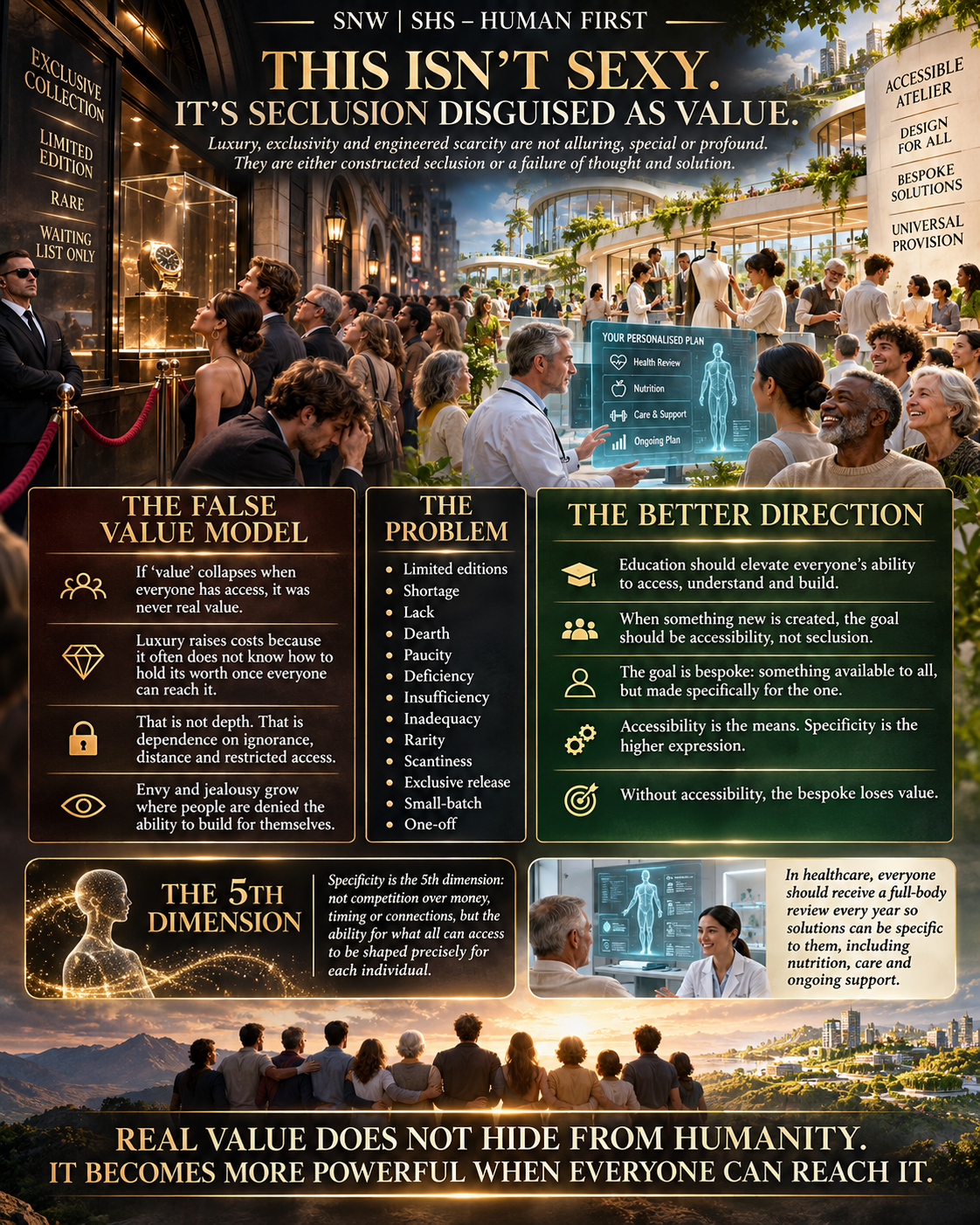
A designer no longer has to pursue luxury through financial exclusion.
They can pursue excellence through quality.
An educator no longer has to organise every developmental stage around future employability.
They can help individuals develop according to their capacities and interests.
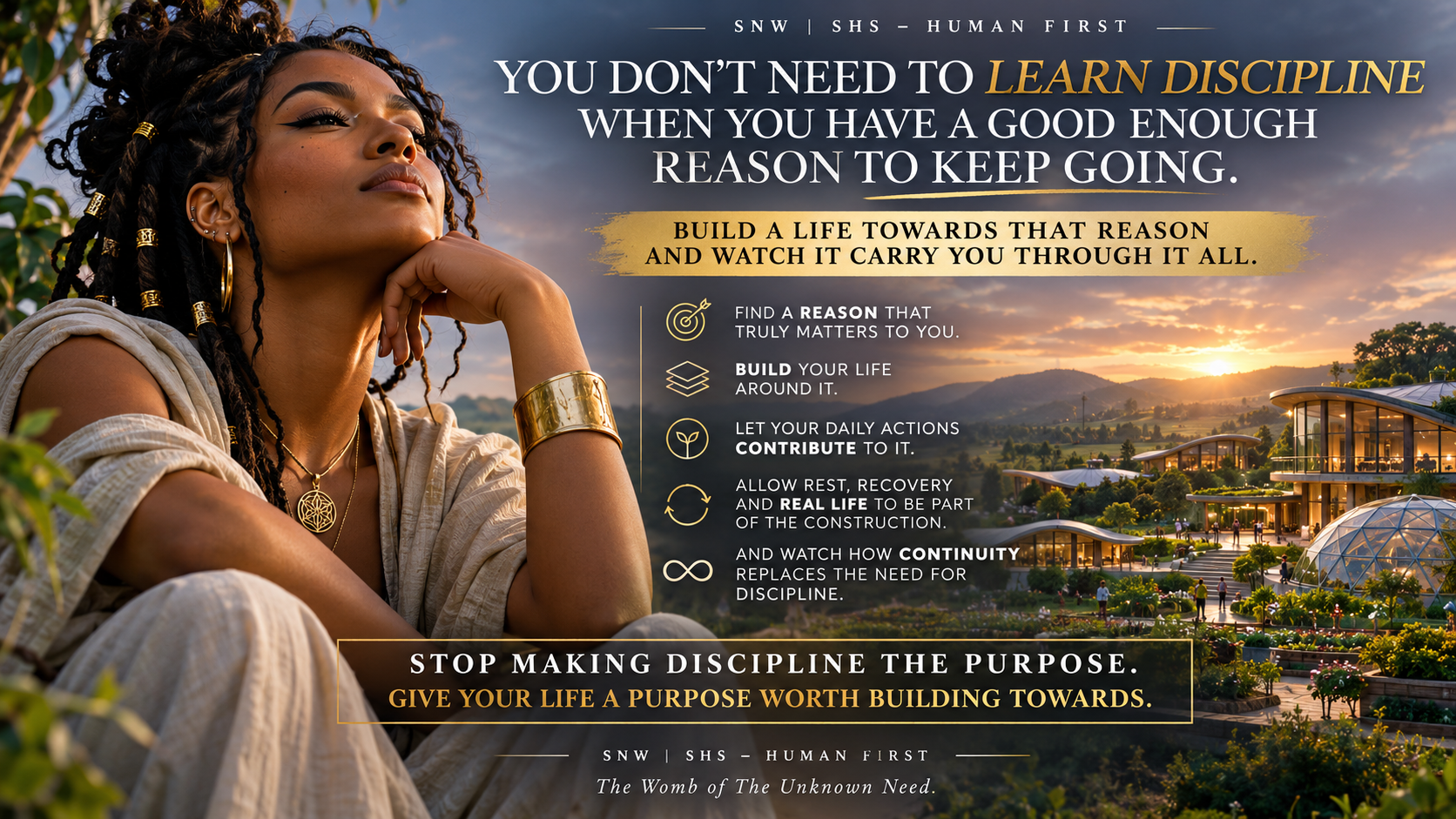
A person no longer has to justify their choice of career through salary.
They must investigate what they actually wish to contribute.
A couple no longer has to make financial dependence the centre of their relationship.
They can examine the relationship itself.
And an institution can no longer rely on money as the final explanation for why a human need was not met.
It must examine its actual resources, obligations, capabilities and limitations.
IMAGINE THE AMOUNT OF SELF-EXAMINATION THAT WOULD FOLLOW.
We would have to become much more conscious of our decisions.
More aware of our needs.
More responsible for our contributions.
More capable of managing resources.
More willing to cooperate.
More prepared to investigate our biases.
And more honest about what we genuinely value.
Because money would no longer be available to explain everything.
THE WORLD WOULD NOT AUTOMATICALLY BECOME PERFECT.
Human beings would still make mistakes.
There would still be scarcity in particular circumstances.
There would still be disagreements.
There would still be selfishness.
There would still be difficult decisions concerning resources, responsibilities and priorities.
But those problems would become more directly identifiable.
We could no longer attribute so much of our conduct to the need for financial survival.
And through the right education, perhaps the human system could begin recalibrating itself around actual life.
Not simply economic measures.
THE CALIBRATOR WOULD CHANGE.
From:
What can we afford?
To:
What do we need?
From:
What is profitable?
To:
What is beneficial?
From:
Who can pay?
To:
Who requires access?
From:
How do I acquire more?
To:
How do we organise enough?
From:
What is my market value?
To:
What are my capabilities and responsibilities?
From:
How do I win?
To:
How do we preserve the conditions under which everybody can participate?
WHAT IF SELF-SUFFICIENCY, INTERDEPENDENCE AND HUMAN RESPONSIBILITY BECOME THE FOUNDATION OF ORGANISATION INSTEAD OF FINANCIAL COMPETITION?
And what if that is the beginning of a society learning to self-calibrate?
14. THE FINAL DISCOVERY: MAYBE MONEY WASN’T JUST CONTROLLING WHAT WE COULD ACCESS. IT WAS CONTROLLING WHAT WE THOUGHT WE WANTED.
And this, humanity, is perhaps my favourite discovery of the day.
Because we began by investigating what happens when money no longer governs the necessities of existence.
And we’ve arrived somewhere much more personal.
WHAT IF MONEY HAS BEEN INFLUENCING NOT ONLY WHAT WE CAN DO, BUT WHAT WE HAVE LEARNED TO DESIRE?
Where we want to live.
What we want to become.
Who we want to impress.
What we want to own.
Who we choose to love.
What we believe constitutes success.
How we measure our worth.
What we consider respectable.
What we imagine our future should look like.
How much of that is genuinely ours?
And how much have we absorbed from a civilisation that taught us to associate financial accumulation with living well?
Imagine removing that influence.
Suddenly, a person can genuinely ask:
Where would I like to live?
What environment suits me?
What do I enjoy creating?
What do I want to learn?
What can I contribute?
What relationships are meaningful to me?
What do I actually require?
What do I already possess?
What does my community need?
How do I want to spend my time?
AND WHO AM I WHEN I AM NO LONGER REQUIRED TO CONVERT MY EXISTENCE INTO A FINANCIAL STRATEGY?
What a beautiful investigation.
Because perhaps the greatest liberation is not simply having unconditional access to life’s necessities.
Perhaps it is finally having the opportunity to recognise which parts of your life you chose and which parts were chosen for you by economic pressure.
Perhaps some people will remain in cities.
Some will return to the countryside.
Some will create.
Some will cultivate.
Some will teach.
Some will investigate.
Some will organise.
Some will discover capabilities they never previously had the opportunity to develop.
And some will realise that the life they had been pursuing was never the life they actually wanted.
WHAT AN EXTRAORDINARY OPPORTUNITY TO BEGIN AGAIN WITHOUT HAVING TO DISCARD EVERYTHING WE HAVE ALREADY LEARNED.
15. MONEY’S LAST HOORAY. AND HUMANITY’S FIRST REAL CHOICE.
So here is my proposition.
We do not need to destroy everything humanity has created.
We do not need to abandon our technologies.
Our infrastructure.
Our cities.
Our knowledge.
Our institutions.
Our skills.
Or our capacity to organise.
We need to investigate which functions genuinely serve humanity and which have been distorted by the requirement to generate, accumulate or protect money.
Then we begin recalibrating.
Carefully.
Progressively.
With integrity.
With continuity.
With safeguarding.
With adequate resources.
With proper education.
And with the understanding that the purpose of removing money must never become another reason to deprive human beings of the necessities of existence.
THE POINT IS TO REDUCE DEPENDENCY, NOT TO CREATE A NEW FORM OF IT.
Let money have its last hooray.
Let it help organise the infrastructure through which its necessity can be phased out.
Let the people who possess exceptional financial-organisational skills demonstrate that those skills can be applied to direct human provision.
Let the institutions that claim to serve humanity prove that they can continue serving humanity without requiring profitability as their primary incentive.
And let the people who have spent their lives pursuing financial security begin investigating what they actually want to do with the security they have been trying to obtain.
BECAUSE THE MOMENT MONEY NO LONGER DETERMINES WHETHER YOU CAN LIVE, YOU HAVE TO BEGIN CONSIDERING HOW YOU WANT TO LIVE.
And that is not a small responsibility.
It may be the greatest responsibility humanity has ever had to accept.
To stop asking money to determine our choices.
To stop using financial necessity as the explanation for every compromise.
To stop treating human life as something that must continuously prove its economic worth.
And to begin developing the knowledge, cooperation and maturity necessary to sustain one another directly.
Perhaps our cities would become less crowded.
Perhaps our rural communities would become more vibrant.
Perhaps local cultivation would flourish.
Perhaps environmental pressures would decrease.
Perhaps families would have greater opportunities to remain together.
Perhaps relationships would become less financially constrained.
Perhaps education would become more responsive to individual development.
Perhaps human capabilities would begin finding their applications according to genuine needs rather than commercial opportunities.
And perhaps, for the first time in generations, the question of what a person wants to do with their life would no longer be dominated by the question of how much money that life requires.
WHAT IF THE MOST BEAUTIFUL CONSEQUENCE OF REMOVING MONEY IS THAT HUMANITY FINALLY BECOMES RESPONSIBLE FOR ITS OWN EXISTENCE?
Not through financial threats.
Not through economic competition.
Not through artificial scarcity.
But through understanding.
Through resource stewardship.
Through cooperation.
Through integrity.
Through continuity.
Through the recognition that being alive is already the original foundation of value.
Oh, humanity.
What a wonderful thought.
WE MAY HAVE SPENT CENTURIES BUILDING A WORLD AROUND THE QUESTION OF HOW TO MAKE MONEY.
AND PERHAPS THE GREATEST DISCOVERY WAITING FOR US IS WHAT THE SAME WORLD COULD BECOME WHEN WE BEGIN ASKING HOW TO MAKE LIFE WORK WITHOUT IT.
Money’s last hooray.
Humanity’s first real choice.
And the beginning of something I find much more interesting than economic growth.
HUMAN GROWTH.
— SNW
Founder & Chief Continuity Architect
SHS – HUMAN FIRST
The Womb of The Unknown Need
11 November 2026
THE GREATEST FREEDOM IS NOT BEING ABLE TO AFFORD THE LIFE YOU WANT. IT IS BEING ABLE TO DISCOVER AND LIVE THAT LIFE WITHOUT MONEY DECIDING WHICH CHOICES ARE AVAILABLE TO YOU.
AND PERHAPS THE SYSTEM DOESN’T NEED TO BE DESTROYED. PERHAPS IT NEEDS TO REMEMBER WHAT IT WAS SUPPOSED TO SERVE.


Leave a Reply