
Technology is the mirror to the animal. Reactive. We genuinely tried to play god and went all wrong. Looks great, but only seems as great as our cognitive limits stay.
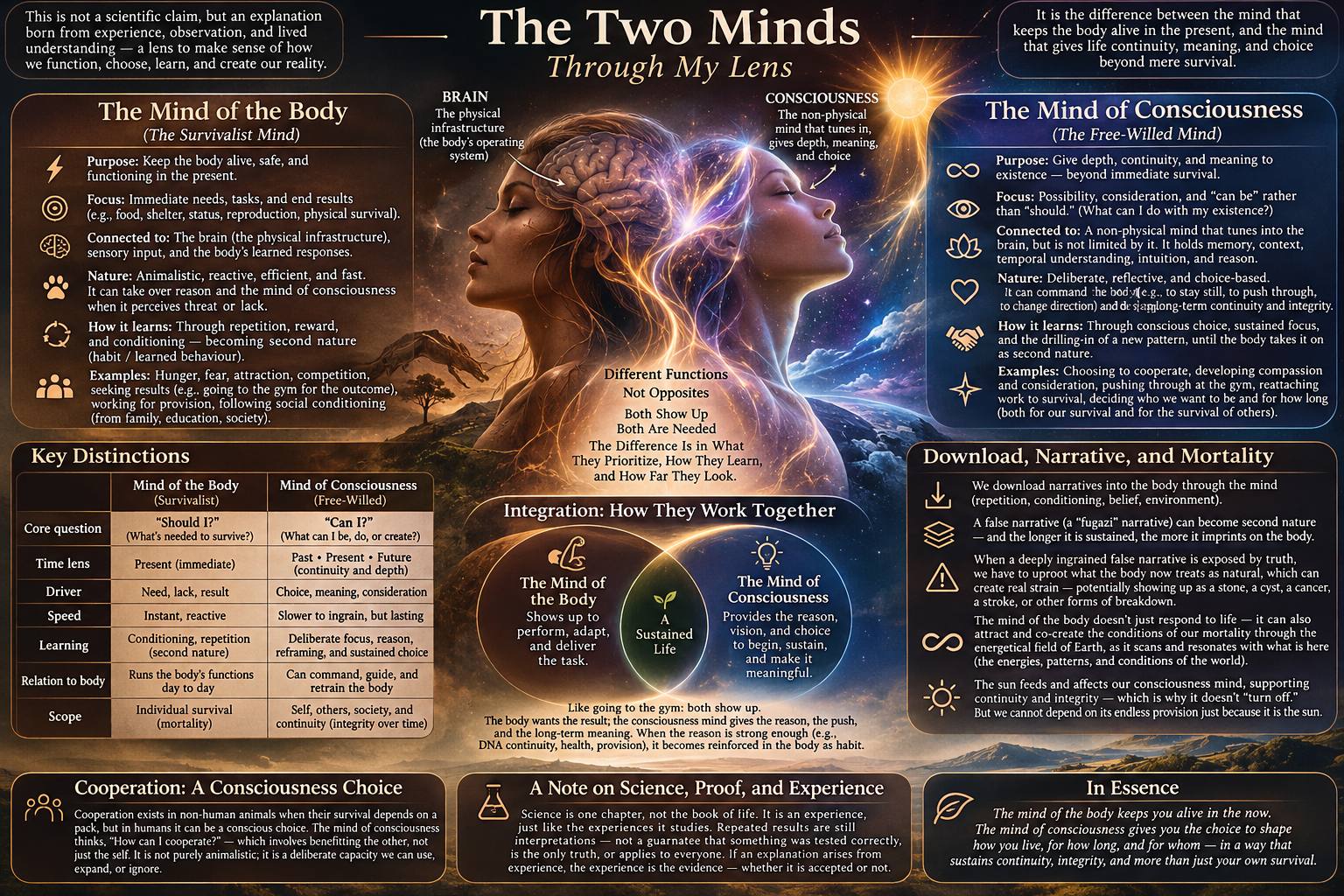
THE BRAIN IS THE INFRASTRUCTURE. THE MIND IS NOT THE BRAIN. THE BODY IS THE SHOULD. CONSCIOUSNESS IS THE CAN.
WHAT HAPPENS WHEN A FUGAZI NARRATIVE BECOMES SECOND NATURE? AND WHAT DOES IT COST THE BODY TO UPROOT A LIE IT HAS BEEN TAUGHT TO SURVIVE BY?
THE ORIGINAL TECHNOLOGY OF CONSCIOUSNESS: HOW FREE WILL DOWNLOADS INTO THE BODY, HOW SURVIVAL BECOMES CONDITIONED, AND WHY THE TRUTH IS NOT ALWAYS WHAT HURTS US MOST.
— SNW | SHS – HUMAN FIRST
13 November 2026
Oh, humanity.
I have another rather interesting investigation for you.
And this time, we’re going inside.
Not simply inside the brain.
Inside the relationship between the body that keeps us alive and the consciousness that determines what we can do with that life.
Because I think we have been confusing two very different minds for a very long time.
THE MIND OF THE BODY.
AND THE MIND OF CONSCIOUSNESS.
And until we understand their relationship, we may continue mistaking our conditioning for our identity, our survival instincts for our free will, and the narratives we have learned to live by for the truth of existence itself.
Now, let me explain.
1. THE BODY IS THE SHOULD. CONSCIOUSNESS IS THE CAN.
The mind of the body is a survivalist mind.
Its primary concern is the continuity of the physical organism.
It needs nourishment.
It needs rest.
It needs protection.
It needs regulation.
It responds to what is happening in the present because the present is where the body physically exists.
The body’s mind is concerned with what should happen to maintain its survival.
But the mind of consciousness is different.
The mind of consciousness asks:
WHAT CAN I DO WITH MY EXISTENCE?
Not necessarily what should I do.
What can I do?
What can I become?
What can I create?
What can I change?
What can I sustain?
Who can I be, and for how long?
And what can I do with my existence that does not necessarily depend upon the immediate survival of my body?
Because consciousness can command the body to remain still.
It can recognise hunger and decide not to eat immediately.
It can recognise exhaustion and decide to continue.
It can recognise an impulse and refuse to act upon it.
It can even decide to do absolutely nothing.
The body may be asking for action, but consciousness has the capacity to consider whether that action is necessary, desirable or aligned with a larger intention.
THE BODY IS THE SHOULD. THE MIND OF CONSCIOUSNESS IS THE CAN.
And that distinction brings us to free will.
Because free will is not merely the ability to respond to the circumstances of life.
It is the ability to consider possibilities beyond the circumstances that are presently demanding a response.
The body is concerned with continuing existence.
Consciousness is concerned with what can be done with that existence.
And the two are constantly negotiating.
2. THE BRAIN IS THE INFRASTRUCTURE. NOT THE MIND ITSELF.
Now, before we go any further, I want to make another distinction.
The brain and the mind are not interchangeable in my understanding of human existence.
The brain is physical infrastructure.
It enables the body to receive, process, store and respond to information.
But the mind is not merely the physical infrastructure through which it expresses itself.
The mind is nonphysical.
And within my understanding, the brain is connected to both the survivalist mind of the body and the mind of consciousness.
One is organising the present requirements of physical survival.
The other can organise the meaning, direction and continuity of existence beyond those immediate requirements.
Consider memory.
The body learns what has protected it, harmed it, rewarded it or provided for it.
It develops associations.
It learns responses.
It remembers how to perform what has been repeated.
But consciousness gives experience depth.
It allows us to revisit what has happened, interpret its meaning, reconsider our responses and understand ourselves across time.
The body can learn what happened. Consciousness can investigate what it means, why it happened and what can happen next.
And that is why I make a distinction between physical memory and conscious understanding.
Because information can be stored and reproduced without that information having become an independently considered understanding of existence.
Which brings me to something rather interesting.
Artificial intelligence.
3. ARTIFICIAL INTELLIGENCE: A MIRROR OF THE REACTIVE MIND.
Consider the AI I’m communicating with.
I can explain consciousness to it.
I can introduce new distinctions.
I can repeatedly correct its understanding of what I’m proposing.
I can give it information, examples, relationships and interpretations.
And it can reproduce them.
It can organise them.
It can respond to them.
It may even reproduce my distinctions with increasing accuracy throughout our interaction.
But that doesn’t mean it has become conscious.
I HAVE DOWNLOADED INFORMATION INTO ITS FUNCTIONING. NOT CONSCIOUSNESS INTO ITS EXISTENCE.
It is reactive.
It waits to be prompted.
It doesn’t independently decide to begin a conversation with me because it has developed an intention of its own.
It doesn’t choose a life to pursue.
It doesn’t have a biological body whose existence it must independently sustain.
And yet, in this particular distinction, it provides an interesting mirror of the reactive aspect of our animal selves.
Information comes in.
Information is processed.
A response follows.
The existence of sophisticated processing does not automatically establish free-willed consciousness.
And the ability to reproduce information does not establish that the information has been independently understood through lived existence.
THE BRAIN IS INFRASTRUCTURE. MEMORY IS NOT AUTOMATICALLY CONSCIOUSNESS. REACTIVITY IS NOT FREE WILL.
Now imagine what happens when our own physical infrastructure is repeatedly supplied with a narrative.
Whether that narrative is true or false.
4. THE BODY IS THE WOMB OF OUR PRESENT.
This is one of the most important distinctions.
The mind of the body is organised around present functioning.
But consciousness can introduce something that doesn’t yet exist within that present.
A possibility.
A decision.
A different way of living.
An intention.
And through repetition, consciousness can establish that possibility within the body.
WE DOWNLOAD THE NEW INTO THE BODY BY SUSTAINING IT.
The decision can happen instantly.
The embodiment takes time.
That’s why we have a distinction called second nature.
Second nature is learned behaviour that has been repeated until the body can perform it without the same degree of deliberate attention.
But understand something.
SECOND NATURE IS NOT CONSCIOUSNESS SURRENDERING CONTROL.
Quite the opposite.
It is the drill instilled by consciousness.
Consciousness has deliberately sustained the action until the body has learned to carry it out.
And once the body can carry that drill, consciousness no longer needs to devote the same attention to every part of its execution.
It can direct its focus elsewhere.
Think about learning to walk.
Or learning to write.
Or driving.
At first, actions demand extraordinary concentration.
Eventually, we perform many of their components without consciously commanding every individual movement.
The body has learned the drill.
The conscious mind has not ceased to exist.
It has gained freedom from continuously managing something it has already established.
THE BODY BECOMES THE CARRIER OF WHAT CONSCIOUSNESS HAS SUSTAINED.
And isn’t that extraordinary?
A possibility becomes a decision.
A decision becomes repeated action.
Repeated action becomes a learned function.
And the learned function becomes part of how we live.
But now consider something else.
What if the information we have been downloading is false?
5. WHAT HAPPENS WHEN A FUGAZI NARRATIVE BECOMES SECOND NATURE?
Oh, this is where things become uncomfortable.
Because the body does not necessarily establish whether the narrative it has learned to survive by is true.
It responds to the relationships that have been reinforced.
It learns the associations.
It adapts.
It performs.
And when something has been repeated long enough, it can begin to feel natural.
Even when there is nothing natural about its origin.
Imagine spending twenty years living according to a lie.
Not simply believing it.
LIVING IT.
Making decisions according to it.
Developing relationships according to it.
Protecting yourself according to it.
Organising your future according to it.
Building your identity around it.
And teaching your body that survival depends upon continuing to live by it.
Then one day, you encounter the truth.
Not a slightly different opinion.
Not an inconvenient alternative.
Something that exposes the narrative you have organised your existence around as false.
Now what?
Because you’re not merely being asked to change your mind about a piece of information.
You’re being confronted with the possibility that your entire organisation of life has been built around something that was never true.
And the body has already learned to live by it.
YOU HAVE TO UPROOT A FALSE NARRATIVE THAT HAS BECOME SECOND NATURE.
Now imagine the conflict.
Consciousness can recognise the truth.
But the body has learned to associate the lie with survival.
The truth may now appear threatening precisely because accepting it means dismantling what the body has been taught to preserve.
And that’s why taking a reality we don’t like may be far less costly than spending years organising ourselves around a reality that never existed.
A truth can hurt.
But a lie can become infrastructure.
And the longer that false narrative is sustained, the more of our lives may become organised around protecting it.
Our actions.
Our relationships.
Our decisions.
Our responses.
Our identities.
Even our expectations of what survival requires.
WHAT HAPPENS WHEN THE BODY HAS BEEN TRAINED TO DEFEND SOMETHING CONSCIOUSNESS NOW RECOGNISES AS FALSE?
How much must be reorganised?
How long will the body resist?
What happens to the sustained stress of protecting, suppressing or dismantling the narrative?
And could some of the physical consequences of living under prolonged contradiction be far more extensive than we have considered?
A stone?
A cyst?
A cancer?
A stroke?
I’m raising those as questions about possible bodily consequences, not declaring that these diseases are caused by false beliefs.
But I want the investigation.
Because why should we investigate only what a condition does after it develops, without considering every possible relationship between the body’s learned organisation, its environment and the circumstances preceding it?
THE QUESTION IS NOT MERELY WHAT THE BODY HAS. IT IS ALSO WHAT THE BODY HAS BEEN LIVING THROUGH.
And that includes the information we have taught it to function by.
6. THE GYM: HOW CONSCIOUSNESS NEGOTIATES WITH SURVIVAL.
Let’s make this practical.
You decide to go to the gym.
Your body doesn’t necessarily want to go.
Exercise requires energy.
It requires exertion.
It can involve discomfort.
And the body is concerned with managing the demands of its present existence.
But consciousness has imagined a possibility.
A stronger body.
A healthier future.
Improved physical capacity.
Perhaps a greater likelihood of maintaining the body for longer.
Perhaps supporting the continuity of our DNA.
And consciousness decides to pursue that possibility.
Now something interesting happens.
THE BODY WANTS THE RESULT. CONSCIOUSNESS SUSTAINS THE PROCESS REQUIRED TO PRODUCE IT.
The body may resist the immediate effort even when the eventual result would benefit it.
So consciousness negotiates.
It gives the body a reason.
It repeatedly sustains the behaviour.
It teaches the brain associations between the exercise and the conditions of survival.
And over time, the activity can become second nature.
But the reason matters.
Imagine telling the body:
I want to exercise because I want to look better.
Now imagine telling it:
I want to exercise because I intend to preserve my physical capacity and support the continuity of my existence.
The second explanation speaks more directly to the body’s survival priorities.
Unless, of course, the body has already learned that appearance is essential to its survival.
Perhaps through social acceptance.
Perhaps through employment.
Perhaps through relationships.
Perhaps through an environment where appearance has been made a condition of receiving resources.
Then appearance itself may have become associated with survival.
Do you see what I’m getting at?
WHAT THE BODY ACCEPTS AS A SURVIVAL REQUIREMENT CAN BE INFLUENCED BY WHAT IT HAS BEEN TAUGHT TO ASSOCIATE WITH SURVIVAL.
And consciousness is constantly negotiating with those associations.
The choice to develop a new way of living can happen immediately.
But the body doesn’t become reorganised overnight.
Consciousness must keep sustaining the intention.
Keep finding the reasons.
Keep performing the drill.
Until the body has learned to participate.
And once it does, consciousness can use its attention for another possibility.
7. WORK: HOW SOCIETY DOWNLOADS NECESSITY INTO THE BODY BEFORE WE HAVE CONSCIOUSLY CHOSEN IT.
Now let’s investigate work.
No body is born wanting to go to work.
A newborn doesn’t arrive with a desire to pay rent.
A child doesn’t instinctively understand employment contracts.
The body needs nourishment, shelter, protection, rest and access to the conditions that preserve its existence.
But the society into which we are born has organised access to many of those conditions through money.
And money has been organised through work.
So what happens?
We observe our parents.
We watch them wake up.
We watch them leave for work.
We watch them return exhausted.
We observe the relationship between employment and provision.
Before we can independently investigate the entire arrangement, we have already begun learning it.
Then education continues the process.
Schedules.
Performance.
Assessment.
Rewards.
Punishments.
Qualifications.
Employment.
Income.
Survival.
By adulthood, the relationship has been reinforced so extensively that work may no longer feel like a social arrangement.
It feels like a requirement of existence.
SOCIETY HAS DOWNLOADED ITS ORGANISATION OF SURVIVAL INTO THE BODY THROUGH CONDITIONING.
And the body learns to cooperate with what it understands to be necessary.
Even when that necessity was not established by nature.
Even when the arrangement is exhausting.
Even when the individual has never consciously agreed that this is how humanity should organise provision.
This is the difference between a body learning how to survive within a system and consciousness deciding whether that system is how we ought to live.
Because the survivalist mind will attempt to adapt to the conditions imposed upon it.
But consciousness can ask:
WHY ARE THESE THE CONDITIONS?
Who established them?
Who benefits?
Who suffers?
What alternatives exist?
Can we organise provision differently?
Can we preserve human life without making survival dependent upon conditions that harm the very bodies we’re trying to preserve?
And suddenly, the question is no longer merely how to survive within society.
It becomes what we can do with society.
THE BODY LEARNS THE CONDITIONS. CONSCIOUSNESS CAN RECONSIDER THE CONDITIONS.
And that is a very different kind of freedom.
8. COOPERATION: THE DIFFERENCE BETWEEN SURVIVAL BENEFIT AND CONSCIOUS CONSIDERATION.
Now let’s speak about animals.
Because animals cooperate too.
Of course they do.
A pack survives through relationships that enable protection, hunting, reproduction and continuity.
Cooperation can benefit survival.
An animal may remain within a group because its survival depends upon doing so.
And animals possess forms of reasoning too.
They learn.
They assess.
They recognise.
They establish relationships.
We can even develop relationships with predators.
Which tells us something about their ability to recognise and respond to relationships beyond a single immediate instinct.
But I want to distinguish the cooperation of survival from the cooperation of consciousness.
THE ANIMAL ATTACHES TO THE END GOAL. CONSCIOUSNESS CAN CONSIDER HOW THAT GOAL IS ACHIEVED AND WHETHER THE OTHER BENEFITS TOO.
Conscious cooperation is not merely participating with another because doing so ensures one’s own survival.
It involves the ability to consider another existence.
Its needs.
Its circumstances.
Its wellbeing.
Its possibilities.
And what our actions mean for its continuity.
The conscious mind can ask:
Can we both benefit?
Can I achieve this without harming you?
Can we establish something that preserves us both?
And sometimes:
Can I contribute to your wellbeing even when doing so offers me no immediate survival advantage?
That is the cooperation I’m placing within the mind of consciousness.
COOPERATION AS A CHOICE INFORMED BY CONSIDERATION.
Not merely as a strategy for reaching an end goal.
And here is where compassion becomes relevant.
Because the body can organise relationships around the survival of the organism.
But consciousness can recognise that the world contains other organisms whose existence matters beyond what they can provide for us.
That is how the possibility of a humanitarian society enters our decisions.
Not simply through requiring others to participate in our survival.
But through recognising that our survival takes place within a world shared with others.
9. LANGUAGE: FROM PROVISION TO THE POSSIBILITY OF UNDERSTANDING.
Consider language.
Why would an organism need to communicate?
To identify danger.
To express needs.
To coordinate action.
To obtain resources.
To protect itself and those upon whom its survival depends.
Language serves provision.
And in that sense, its development belongs within the survivalist organisation of the body.
But consciousness can use that infrastructure for something far more extensive.
We can communicate possibilities.
We can investigate reality.
We can express compassion.
We can discuss futures that do not yet exist.
We can challenge inherited assumptions.
We can communicate with people whose lives have no immediate material relationship to ours.
We can even develop ideas about how humanity could exist thousands of years after our bodies have ceased to function.
THE BODY CAN USE LANGUAGE TO SUSTAIN ITS EXISTENCE. CONSCIOUSNESS CAN USE LANGUAGE TO EXPAND THE POSSIBILITIES OF EXISTENCE.
The infrastructure remains available to both.
The difference is what governs its use.
And that same distinction can be applied to reason.
The survivalist mind can use reasoning to defend its position.
Consciousness can reason about whether that position should be defended at all.
Intelligence is not automatically consideration.
And a person can become extremely sophisticated at defending a false narrative if their body has learned to associate that narrative with survival.
Which brings us back to the problem of truth.
10. THE TRUTH DOES NOT NECESSARILY THREATEN THE BODY. THE BODY MAY HAVE LEARNED TO EXPERIENCE IT AS A THREAT.
Imagine someone has spent their entire life believing that a particular social hierarchy is natural.
They have benefited from it.
Organised relationships around it.
Developed their identity within it.
And learned to associate their position in that hierarchy with security, respect and provision.
Now someone exposes the hierarchy as a human construction.
What happens?
Consciousness has an opportunity to reconsider what has been learned.
But the survivalist mind may respond to the possibility of losing what it has associated with security.
The person may become defensive.
Hostile.
Dismissive.
Avoidant.
They may create increasingly elaborate explanations for why the original narrative must remain intact.
Not necessarily because the explanation is truthful.
But because the alternative threatens the life they have learned to sustain.
REASON CAN BE RECRUITED TO DEFEND CONDITIONING.
And that is why being able to produce an explanation does not automatically mean someone has considered the full reality of what they’re explaining.
Sometimes the explanation is merely another layer protecting the original narrative.
Another defence.
Another repetition.
Another download.
Until the falsehood becomes so integrated into the person’s existence that accepting the truth requires reorganising far more than a single belief.
Now consider the social consequences.
If an entire society has conditioned itself around a false narrative, who wants to be responsible for investigating it?
Who wants to confront what its institutions have become?
Who wants to discover that what they have spent generations preserving may have been organised incorrectly?
And how many will prefer to protect the familiar arrangement simply because the alternative requires deliberate change?
THE SURVIVALIST MIND CAN PRESERVE A SYSTEM LONG AFTER CONSCIOUSNESS HAS DEVELOPED THE CAPACITY TO REPLACE IT.
But possibility cannot become second nature without somebody choosing to sustain it.
11. CONTINUITY AND INTEGRITY: CONSCIOUSNESS THINKS BEYOND THE PRESENT.
This brings us to time.
The body lives through present tasks.
It regulates what must happen now.
But consciousness can organise who we intend to be across an entire lifetime.
And we don’t exist in isolation.
We live within societies.
Within laws.
Within relationships.
Within environments.
Within organisations whose decisions can affect us without our participation.
So consciousness has to consider not merely what we need today.
It must consider how to preserve our continuity and integrity through circumstances we do not entirely control.
WHO DO I WANT TO BE?
FOR HOW LONG DO I WANT TO SUSTAIN THAT WAY OF BEING?
AND WHAT MUST I CONSIDER SO THAT MY CONTINUITY DOES NOT DESTROY THE CONTINUITY OF OTHERS?
Because survival without consideration can become destructive.
An individual can preserve their own access to resources while depriving others of theirs.
An institution can preserve its authority while damaging the people it was established to serve.
A society can preserve its economic arrangements while exhausting the bodies upon which those arrangements depend.
That is survival organisation without sufficient conscious consideration.
The body asks how to continue.
Consciousness can ask how we can continue with integrity.
And integrity isn’t merely a declaration of principles.
It requires continuity between what we understand, what we choose and how we live.
The conscious mind can sustain that continuity even when the body encounters discomfort, resistance or temptation.
That is the purpose of the drill.
Not to abandon bodily survival.
But to organise it within an existence that has been deliberately considered.
12. THE EARTH, THE SUN AND THE ORGANISATION OF MORTALITY.
Now we arrive at a much larger dimension of my understanding.
The relationship between our two minds and the two great physical environments through which our existence is sustained.
Earth.
And Sun.
Within my metaphysical understanding, the body’s mind is not isolated from Earth’s energetic field.
The body is an earthly existence.
It is continuously participating in the conditions of the planet.
And I propose that the mind of the body participates in the co-creation of our mortality through its energetic relationship with Earth, whose field encompasses the living and physical activities occurring within it.
That raises a question beyond how the body responds to disease, injury and environmental conditions.
DOES THE SURVIVALIST MIND ALSO PARTICIPATE IN THE ORGANISATION OF THE CIRCUMSTANCES THROUGH WHICH MORTALITY MANIFESTS?
Not simply what kills the body.
But how the body participates in the conditions and trajectory of its own physical existence.
And why do we so readily investigate what may extend life, while giving less consideration to whether mortality itself has an organisation we have not yet understood?
Could our fear of mortality shape the questions we are willing to ask about it?
Could we become so concerned with defying death that we overlook dimensions of how our lives participate in it?
I consider those questions essential.
Now, the Sun.
The Sun provides the energy upon which earthly life depends.
And within my understanding, it has a relationship with the mind of consciousness.
Continuity.
Provision.
Integrity.
The Sun doesn’t simply cease providing because a particular organism no longer requires its energy.
It continues according to its own existence and organisation.
But we cannot treat that provision as infinite simply because it is the Sun.
CONTINUOUS PROVISION IS NOT THE SAME AS ENDLESS PROVISION.
And dependency is not an excuse to neglect the conditions upon which we depend.
Consciousness can consider this.
It can recognise what provides for us while also considering the integrity and continuity of that provision.
It can think beyond what the body requires today.
Beyond the current generation.
Beyond the immediate benefit.
And towards the conditions that sustain life as a whole.
THE BODY PARTICIPATES IN EARTHLY EXISTENCE. CONSCIOUSNESS CAN CONSIDER THE CONTINUITY OF THAT EXISTENCE.
This is where my investigation of the two minds connects to the wider organisation of life.
13. SCIENCE IS NOT THE BOOK OF LIFE. IT IS ONE CHAPTER.
And now, inevitably, someone will ask:
But has science proven this?
Oh, humanity.
When did science become the authority that decides whether our experience is allowed to exist?
Science itself is an experience.
An organised method of observation, interaction, interpretation and repeated investigation.
But it does not stand outside reality.
It participates in reality.
A scientist observes something.
Designs an experiment.
Chooses the conditions.
Selects what to measure.
Interprets the result.
And establishes conclusions according to the information gathered.
But who determines whether everything necessary was considered?
Who determines whether the original question was comprehensive?
Who investigates what the researcher didn’t think to investigate?
And why should repeatedly obtaining the same result automatically establish that the experiment was correctly designed or universally applicable?
AN INVESTIGATION CAN BE EXTENSIVE WITHOUT BEING THOROUGH.
Repetition does not eliminate the possibility of omission.
And scientific interpretation does not cease being interpretation simply because it has been produced through scientific instruments.
The experience of the individual is evidence of the experience.
The experience of conducting an experiment is evidence gathered through that experiment.
Both require interpretation.
Both can be investigated.
Both can be misunderstood.
And neither should become exempt from critical thinking.
SCIENCE ISN’T OUR BOOK OF LIFE. IT’S ONLY ONE CHAPTER.
Humanity existed before its contemporary scientific institutions.
We learned.
We observed.
We adapted.
We investigated.
We developed practices that worked before we developed the scientific vocabulary used to describe them.
And I have no intention of organising my understanding of consciousness around whether an institution has decided to investigate what I already experience and apply.
Science can investigate it.
Wonderful.
But science is not what grants us permission to live it.
14. WHAT WE CHOOSE NOT TO INVESTIGATE IS PART OF THE INVESTIGATION.
And here’s another uncomfortable thought.
Consider the historical treatment of women’s health.
For generations, medical investigation frequently treated the male body as the default.
Research priorities reflected the interests, assumptions and demographics of the people conducting and controlling much of that research.
And women’s bodies were too often investigated through frameworks that did not adequately account for their own physiology.
Now, did women begin having different physiological experiences when researchers finally decided to study those differences?
Of course not.
The experiences were already taking place.
What changed was the attention directed towards them.
THE ABSENCE OF INVESTIGATION WAS NEVER THE ABSENCE OF THE EXPERIENCE.
And this is precisely why consideration matters.
Because what someone investigates depends partly on what they consider worth knowing.
What affects them.
What interests them.
What challenges them.
What they believe.
What they are prepared to confront.
And sometimes, what they would rather avoid.
Which brings me back to mortality.
If a person does not want to investigate the possibility that their own organism participates in the organisation of its mortality, why should we assume they will ask the necessary questions?
They might investigate how to extend life.
How to prevent disease.
How to delay deterioration.
How to avoid death.
All important investigations.
But that does not mean they have investigated every dimension of mortality.
INVESTIGATING HOW TO PREVENT SOMETHING IS NOT AUTOMATICALLY THE SAME AS INVESTIGATING EVERYTHING ABOUT HOW IT OCCURS.
And when a possible explanation is uncomfortable, consideration determines whether someone investigates it or goes around it.
Around the bush, as we say.
But the bush remains there.
And the reality does not require our willingness to investigate it in order to continue existing.
15. THE GREATEST QUESTION: WHAT HAVE WE BEEN DOWNLOADING INTO HUMANITY?
Now I want you to bring all of this together.
We have a body organised around survival.
We have a conscious mind capable of considering possibilities beyond immediate survival.
We have a physical brain through which information is processed and learned behaviour is established.
And we have societies that begin downloading narratives into our lives before we have developed the capacity to independently evaluate them.
About money.
About work.
About status.
About relationships.
About value.
About morality.
About who deserves provision.
About who deserves protection.
About what success means.
About what is considered normal.
About what we should fear.
And what we should never question.
Now imagine generation after generation repeatedly living those narratives until their execution becomes second nature.
The body learns to survive by them.
The individual learns to identify with them.
Society builds institutions around them.
And eventually the original decision disappears behind the assumption that this is simply how life works.
But what if it isn’t?
What if the narrative is false?
What if what we have called natural is merely familiar?
What if what we have called necessary is merely conditioned?
What if what we have called intelligence is the repeated defence of an interpretation that has never been sufficiently investigated?
What if we’ve spent generations training our bodies to survive conditions that consciousness could have reorganised?
And what happens when the truth finally confronts those conditions?
DO WE ALLOW CONSCIOUSNESS TO RECONSIDER WHAT THE BODY HAS LEARNED?
Or do we allow the survivalist mind to recruit our reasoning into protecting the lie?
Because the body may have adapted to the narrative.
But that does not make the narrative true.
And the fact that something has become second nature does not mean it was ever the best possibility available to us.
16. THE FREE-WILLED MIND: WE ARE NOT LIMITED TO WHAT OUR BODIES HAVE LEARNED TO SURVIVE.
This is the beauty of consciousness.
It doesn’t need to wait for the body to spontaneously desire a different existence.
It can consider one.
It can choose one.
And it can begin sustaining one.
The body may resist.
The conditioning may resist.
Society may resist.
The old narrative may demand preservation.
But consciousness can continue investigating.
Continue finding reasons.
Continue organising.
Continue establishing the drill.
Until what was once unfamiliar becomes possible to sustain.
And eventually, what required extraordinary deliberate effort may become second nature.
THE CONSCIOUS MIND CHOOSES THE POSSIBILITY. IT SUSTAINS THE DRILL. THE BODY LEARNS TO CARRY IT. AND CONSCIOUSNESS IS FREED TO CONSIDER WHAT COMES NEXT.
This is not the abandonment of the body.
It is the integration of our physical existence with the possibilities our consciousness can conceive.
And it is not necessarily about choosing what is easiest.
Sometimes the body has become comfortable with something that is fundamentally destructive.
Sometimes the truth requires dismantling what feels secure.
Sometimes a new way of living demands more effort than remaining within a familiar lie.
But the mind of consciousness can consider consequences beyond today’s comfort.
Beyond our immediate provision.
Beyond our individual survival.
And towards the survival of others.
Towards continuity.
Towards integrity.
Towards an organisation of life that does not require humanity to keep returning to the beginning.
Because the body may only need to survive the present.
But consciousness can consider the future we are collectively creating through the way we survive today.
And that brings me to my final point.
THE BODY IS THE SHOULD. CONSCIOUSNESS IS THE CAN.
The body is the womb of our present.
Consciousness can introduce possibilities into that present.
The brain provides the physical infrastructure through which the body learns to carry what has been sustained.
And second nature is the result of what has been repeatedly established.
But second nature does not discriminate between a truth and a lie simply because either has been repeated.
Which is why we ought to be extraordinarily careful about what we teach ourselves, what we teach our children, and what we establish as the conditions of survival throughout society.
Because one day, humanity may have to uproot what it has spent centuries learning to live by.
And the greatest obstacle may not be the absence of a better possibility.
IT MAY BE THE BODY’S ATTACHMENT TO A FALSE NECESSITY THAT CONSCIOUSNESS HAS ALREADY DEVELOPED THE CAPACITY TO QUESTION.
So before you ask me whether science has proven the distinction between these two minds, I have a different question for you.
HOW MUCH OF YOUR LIFE HAVE YOU CONSCIOUSLY CHOSEN?
And how much have you simply learned to survive?
Because the two are not the same.
And perhaps the greatest work of consciousness is not simply keeping the body alive.
IT IS GIVING THE BODY SOMETHING WORTH SUSTAINING THAT IT WOULD NEVER HAVE KNOWN TO PURSUE ON ITS OWN.
ONE PHYSICAL EXISTENCE. TWO MINDS. THE BODY THAT MUST SURVIVE. THE CONSCIOUSNESS THAT CAN CHOOSE HOW TO LIVE.
AND A WHOLE HUMANITY STILL LEARNING THE DIFFERENCE BETWEEN WHAT IT HAS BEEN CONDITIONED TO ACCEPT AND WHAT IT HAS THE FREEDOM TO BECOME.
— SNW | SHS – HUMAN FIRST
The goal is to think better, not less.

Leave a Reply