
We hear Fugazi in Wolf of Wall Street but still cannot contextualise it in our lives.
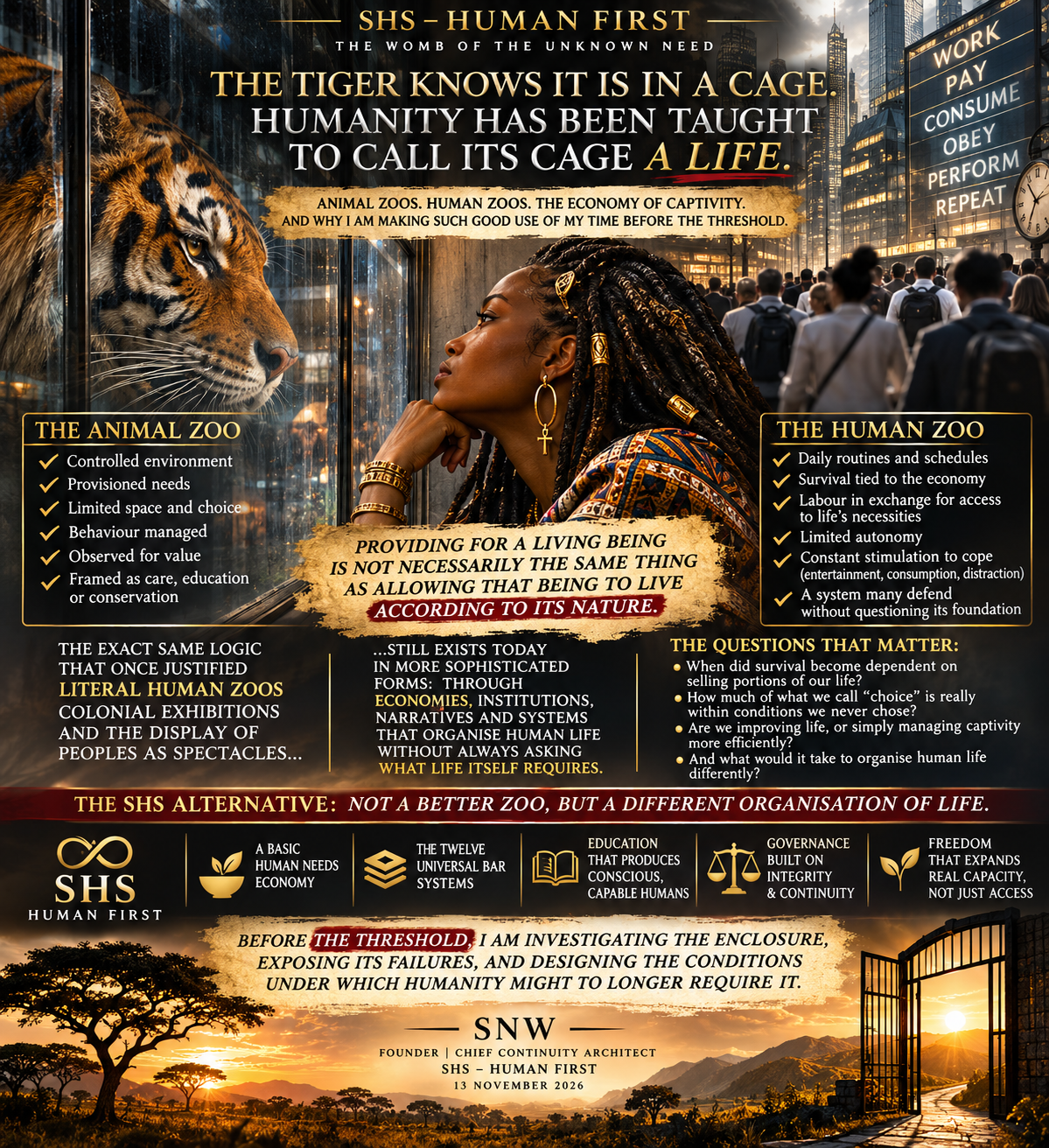
ANIMAL ZOOS. HUMAN ZOOS. THE ECONOMY OF CAPTIVITY. AND WHY I AM MAKING SUCH GOOD USE OF MY TIME BEFORE THE THRESHOLD.
— SNW | SHS – HUMAN FIRST
13 November 2026
Oh, humanity.
I came across something rather interesting.
A reflection suggesting that perhaps the reason people feel uncomfortable watching a tiger pace behind glass has very little to do with the tiger itself.
Perhaps we recognise the behaviour.
The repetition.
The artificial environment.
The scheduled feeding.
The limited enrichment.
The occasional excursion outside the usual surroundings.
The pacing.
The waiting.
The existence of a living creature whose entire environment has been organised by something other than itself.
And then comes the rather uncomfortable proposition.
Perhaps the difference is that the tiger knows it is in a cage.
Now, whether the tiger understands its captivity in precisely those human terms is another investigation.
But the comparison raises a question that I find considerably more interesting.
WHAT IF HUMANITY HAS BECOME SO ACCUSTOMED TO ITS ENCLOSURE THAT IT NO LONGER RECOGNISES THE STRUCTURES KEEPING IT THERE?
And more importantly:
WHAT HAPPENS TO THE HUMAN WHO RECOGNISES THE ENCLOSURE BUT CONTINUES LIVING INSIDE IT?
Ah.
Now we have arrived at the threshold.
1. THE ANIMAL ZOO: WE CALL IT CARE WHEN WE CONTROL THE CONDITIONS OF ANOTHER LIFE.
Let us begin with the animal.
We take a creature whose existence developed through its relationship with an environment.
An environment containing territories, ecosystems, social relationships, dangers, choices, instincts, and opportunities for behaviours particular to its species.
Then we construct a controlled version of that environment.
We determine its food.
We determine its space.
We determine its interactions.
We determine what constitutes adequate stimulation.
We determine the boundaries within which it may express its natural behaviours.
And then we invite other humans to observe it.
Sometimes we do this for conservation, rehabilitation, education, or protection. These purposes deserve examination on their actual merits.
Sometimes, however, the animal’s welfare becomes subordinate to the value humans extract from its captivity.
And therein lies a very important distinction.
PROVIDING FOR A LIVING BEING IS NOT NECESSARILY THE SAME THING AS ALLOWING THAT BEING TO LIVE ACCORDING TO ITS NATURE.
A well-fed animal can still be deprived.
An animal can be medically maintained while lacking meaningful opportunities to express its natural capacities.
An enclosure can be beautiful to its visitors while restrictive to its inhabitants.
And the fact that its keeper has provided food does not, by itself, answer the question of whether the arrangement is justifiable.
Now.
Let us turn the mirror around.
2. THE HUMAN ZOO: WE HAVE REPLACED THE GLASS WITH AN ECONOMY.
What an extraordinary development.
Humanity, the species that constructs enclosures for other animals, has organised much of its own survival through systems that can also impose boundaries on choice.
Not identical boundaries, of course.
Human workers are not literally zoo animals. Their rights, capacities, circumstances, and degrees of freedom differ enormously.
But the structural comparison is worth investigating.
Consider the person who wakes up every morning to an alarm.
Travels along the same route.
Enters the same building.
Performs tasks determined by someone else’s organisational requirements.
Returns home.
Eats.
Sleeps.
And repeats.
Not necessarily because the activities are meaningful to them.
Not necessarily because those activities contribute to the development they would otherwise choose.
But because their access to food, housing, transport, healthcare, and the broader conditions of survival depends on obtaining sufficient money.
And money is distributed through an institutional arrangement that they were born into.
THE TIGER’S SURVIVAL DEPENDS ON THE KEEPER’S PROVISION. THE HUMAN’S SURVIVAL CAN DEPEND ON PARTICIPATION IN THE ECONOMIC ARRANGEMENTS THAT GOVERN ACCESS TO PROVISION.
The mechanisms are different.
The dependence deserves investigation in both.
And here is the question I keep putting to humanity.
WHEN DID WE DECIDE THAT THE ABILITY TO SUSTAIN A HUMAN LIFE SHOULD DEPEND SO HEAVILY ON THE ABILITY TO SELL PORTIONS OF THAT LIFE?
Time.
Attention.
Physical capacity.
Mental capacity.
Creativity.
Labour.
Presence.
Even emotional availability.
We have built entire markets around the extraction and exchange of human capacities.
Then we wonder why so many people are exhausted.
Why they require entertainment to recover from their daily existence.
Why they dream of holidays.
Why retirement is often treated as the long-awaited opportunity to finally live.
Oh, humanity.
IF YOU MUST WAIT UNTIL THE END OF YOUR PRODUCTIVE YEARS TO EXPERIENCE THE FREEDOM YOU HAVE BEEN WORKING TOWARDS, WHAT EXACTLY HAVE YOU BEEN PRODUCING ALL THIS TIME?
And for whom?
I am not condemning work.
Work is one of the ways humanity creates, participates, develops, and contributes.
I am investigating the conditions under which work becomes compulsory for survival, regardless of whether those conditions serve the life doing it.
That is an entirely different conversation.
3. THE MOST SOPHISTICATED ENCLOSURE IS ONE WHOSE OCCUPANTS ARE TAUGHT TO DEFEND IT.
Now here is where the human zoo becomes particularly fascinating.
Because human beings are not merely its inhabitants.
We are also its architects.
Its administrators.
Its investors.
Its employees.
Its customers.
Its spectators.
And occasionally, its most enthusiastic defenders.
We have created systems in which people can spend their lives aspiring to become the ones who manage the conditions that restrict everybody else.
The individual who obtains greater economic security may gain access to greater freedom.
The individual who acquires sufficient power may begin determining the freedoms of others.
The individual who escapes one form of dependency may enter another.
Status.
Reputation.
Debt.
Institutional approval.
Public perception.
Political influence.
Financial obligation.
And, of course, the rather curious requirement to preserve the very arrangements that made one’s elevation possible.
SOME PEOPLE DO NOT WANT TO DISMANTLE THE ZOO. THEY WANT TO BECOME ITS OWNERS.
Some genuinely want to improve its conditions.
Some simply want a larger enclosure.
And others are so accustomed to its organisation that the possibility of living differently appears more frightening than remaining inside.
Which brings us to the question of education.
If a human being is born into a system, educated within that system, evaluated according to its expectations, employed through its structures, and recognised through its institutions, how much opportunity have they been given to investigate whether that system is the only possible arrangement?
How many genuinely different ways of organising human life have they been encouraged to examine?
And how much of what we call individual choice is exercised within conditions that were never individually chosen?
FREEDOM WITHIN AN ENCLOSURE IS NOT NECESSARILY FREEDOM FROM THE ENCLOSURE.
4. THERE WERE LITERAL HUMAN ZOOS. WE SHOULD NOT FORGET THAT.
And before we dismiss the phrase human zoo as merely an artistic metaphor, we should remember something.
Humanity has literally exhibited other human beings.
Colonial exhibitions and ethnological displays presented people from colonised societies as spectacles for European audiences.
Human beings were made objects of observation, classification, entertainment, and supposed demonstrations of civilisational hierarchy.
Imagine that.
An institution deciding that another human being’s existence could be reduced to an exhibit.
Their culture interpreted by outsiders.
Their identity framed through somebody else’s narrative.
Their humanity subjected to the gaze of an audience.
Now ask yourself what made such arrangements possible.
Was it only the physical enclosure?
Or was it the institutional belief that certain people possessed the authority to determine how others should exist, how they should be represented, and what value should be extracted from their presence?
THE GLASS WAS NEVER THE ONLY PROBLEM.
The relationship between power, possession, interpretation, and the living being subjected to them was also the problem.
And while the literal exhibitions of that historical period must not be confused with modern employment or everyday institutional dependency, their history raises questions that remain relevant.
Who gets to define another person’s existence?
Who determines whose life is valuable?
Who controls the narrative?
And who benefits from the arrangement?
5. BEFORE THE THRESHOLD: I AM LIVING IN THE SOCIETY I AM INVESTIGATING.
Now.
Here is where my own existence enters the investigation.
Because I have been speaking about something rather particular recently.
Before the threshold.
The period before an anticipated change in recognition.
Before a different set of expectations might be placed upon my existence.
Before my work might acquire a different institutional or public significance.
And I have been making rather deliberate use of it.
You see, I am not standing outside society, pointing at its enclosures from a comfortable distance.
I am living within the very structures I investigate.
Its economy.
Its laws.
Its institutions.
Its definitions of success.
Its expectations of acceptable behaviour.
Its systems of recognition and rejection.
I experience, observe, interact, document, interpret, and investigate.
And then I create.
Through SHS – Human First, I am developing alternatives while continuing to investigate the structures those alternatives are intended to address.
I AM NOT WAITING TO LEAVE THE ENCLOSURE BEFORE INVESTIGATING HOW IT OPERATES.
Because what would be the point?
If I only began examining the conditions of human life once I had acquired sufficient wealth or recognition to escape their most restrictive consequences, how much of the reality would I still be able to observe directly?
How much would be filtered through comfort?
Through privilege?
Through institutional relationships?
Through the expectations of those now willing to associate themselves with me?
And, most importantly, how much of my ability to expose would become subject to negotiation?
Imagine if, at some point in my investigations, I had accepted an agreement that prevented me from speaking openly about the very institutional arrangements I was examining.
Imagine acquiring elevation at the expense of the capacity to investigate.
WHAT GOOD WOULD IT DO TO BE INVITED INTO THE KEEPER’S OFFICE IF THE CONDITION OF ENTRY WERE TO STOP QUESTIONING THE ENCLOSURE?
Terrible arrangement.
For me.
For SHS.
And for the humanity whose conditions I am attempting to improve.
6. THE METAPHYSICAL MENACE: WHAT HAPPENS WHEN AN INHABITANT STARTS INVESTIGATING THE ZOO?
Ah, yes.
My rather entertaining creation.
The Metaphysical Menace.
A character I have been consciously developing, expressing, and bringing towards completion before the threshold.
Not because confrontation is the entirety of my existence.
But because confrontation has a particular function within the environment I am investigating.
I find it rather fascinating that a society capable of normalising extensive human suffering can become profoundly offended by the manner in which somebody exposes it.
The conditions are acceptable.
The exposure is inappropriate.
The suffering can continue.
But the language used to describe it must remain respectable.
How very convenient.
THE INSTITUTION MAY PRESERVE THE CONDITIONS, BUT THE PERSON QUESTIONING THOSE CONDITIONS MUST BE ON THEIR BEST BEHAVIOUR.
And what happens when that person refuses to perform the expected gratitude?
When they do not seek approval from the very institutions they are investigating?
When they use those institutions’ own laws, declarations, principles, historical records, and accountability standards to examine their conduct?
When they are not particularly interested in being celebrated for fitting into a system they are proposing to restructure?
They become inconvenient.
Perhaps even menacing.
Not because every criticism they make is automatically correct.
My work must remain open to evidence, correction, and contradiction too.
But because the investigation does not end simply because someone in authority finds it uncomfortable.
And that distinction matters.
I AM NOT TRYING TO BECOME THE MOST ACCOMPLISHED TIGER IN THE ZOO.
I am investigating why the zoo exists, what conditions it imposes, which of those conditions are necessary, and what could exist beyond them.
And while I do so, I am building a record.
A past.
A history of my thoughts, provocations, examinations, creations, mistakes, discoveries, and the methods through which they developed.
Before whatever comes next.
Because I do not want my existence to be explained solely by those who encounter it after the threshold.
I want the development to remain visible.
7. THE THRESHOLD DOES NOT AUTOMATICALLY MEAN FREEDOM.
And here is something rather important.
We must not confuse elevation with liberation.
A tiger moved from a small enclosure into a larger enclosure may gain meaningful improvements in its welfare.
But the question of captivity has not necessarily disappeared.
Likewise, a person who moves from poverty into wealth may gain access to options they never previously possessed.
That matters.
Money can remove very real restrictions.
But increased purchasing power does not automatically create independence from every social, political, contractual, or institutional condition.
Indeed, recognition can introduce entirely new expectations.
New obligations.
New people attempting to influence your behaviour.
New reasons to protect your public image.
New incentives to remain silent.
New relationships in which support comes attached to conditions.
THE ENCLOSURE CAN BECOME MORE BEAUTIFUL WITHOUT CEASING TO BE AN ENCLOSURE.
That is one of the things I am consciously examining before the threshold.
Not simply what I might gain.
But what I must not surrender in exchange.
Because I do not want recognition to become another form of captivity disguised as reward.
And I certainly do not want to reproduce for others the dependencies I have spent so much time investigating.
8. SHS – HUMAN FIRST: WE ARE NOT BUILDING A BETTER ZOO.
Now, this is where criticism must become creation.
Because simply telling humanity that it is trapped does not provide anybody with a way forward.
And dismantling systems without considering the lives dependent upon them can cause enormous harm.
Imagine opening every animal enclosure without investigating whether the animals can survive outside it.
Some may require rehabilitation.
Some may have lost capacities necessary for independent survival.
Some may depend on human intervention because of injuries, environmental destruction, or circumstances beyond their control.
REMOVING A BARRIER WITHOUT PROVIDING THE CONDITIONS FOR LIFE IS NOT NECESSARILY LIBERATION.
The same principle informs my investigations into human systems.
If we want to reduce humanity’s dependence on money, we must develop arrangements through which essential needs can be met.
If we want people to exercise greater autonomy, we must investigate what they require to exercise it meaningfully.
If we want education to produce independently thinking human beings, we must examine the conditions under which children learn to understand themselves and their society.
If we want to transform governance, we must consider consent, responsibility, institutional accountability, safeguards, and continuity.
That is why SHS – Human First is developing a Basic Human Needs Economy.
Why we investigate twelve interconnected systems.
Why education, social welfare, health, economy, law, infrastructure, and the environment cannot simply be treated as unrelated matters.
Why integrity must be examined alongside continuity.
BECAUSE HUMANITY DOES NOT NEED ANOTHER KEEPER PROMISING TO BE KINDER.
It needs systems that progressively expand its capacity to live, participate, create, contribute, and govern its conditions with meaningful autonomy.
And it needs continuity safeguards that prevent the transition itself from becoming another source of unnecessary suffering.
I do not want to replace one set of masters with another.
I want to investigate why mastery over another person’s access to life’s necessities became such a central feature of human organisation in the first place.
9. THE MOST INTERESTING THING ABOUT THE TIGER IS NOT ITS PACING.
It is what the pacing might tell us about the conditions of its existence.
A behaviour that appears meaningless when observed in isolation can become understandable when placed within its environment.
And the same is true of humanity.
Before we condemn an individual for their exhaustion, disengagement, anxiety, frustration, inability to participate, or apparent lack of ambition, perhaps we should examine the conditions under which that person is expected to function.
Not every difficulty originates in the environment.
Not every routine is oppressive.
Not every person experiencing repetition is captive.
Many people find genuine meaning, freedom, and fulfilment in structured lives.
But where distress and deprivation repeatedly emerge across populations, there is a legitimate institutional question.
IS THE INDIVIDUAL FAILING TO ADAPT TO THE ENVIRONMENT, OR IS THE ENVIRONMENT FAILING TO PROVIDE CONDITIONS SUITABLE FOR THE INDIVIDUAL?
And what happens when the answer is both?
That is the purpose of investigation.
Not simply choosing a side.
But understanding what is occurring well enough to correct what needs correction.
10. AND NOW, HUMANITY, LET US RETURN TO THE GLASS.
Perhaps the person watching the tiger feels uncomfortable because something about its circumstances resembles their own.
Perhaps they are responding to the animal’s distress.
Perhaps they are simply recognising that a living being has been placed within an environment it did not choose.
But I find another possibility particularly interesting.
WHAT IF THE DISCOMFORT COMES FROM REALISING THAT WE HAVE BECOME VERY GOOD AT ORGANISING LIFE WITHOUT NECESSARILY ASKING WHAT LIFE ITSELF REQUIRES?
We organise animals.
We organise workers.
We organise children.
We organise nations.
We organise resources.
We organise access.
We organise behaviour.
We organise entire economies.
And somewhere between organising and controlling, we can forget that the purpose of organisation should be to serve the lives participating in it.
Not the other way around.
This is why I keep investigating.
This is why I am creating SHS.
And this is why the period before the threshold is so valuable to me.
Because I am not merely documenting what humanity has constructed.
I am documenting what happens when a human being attempts to understand that construction from within, refuses to treat its current conditions as the limits of possibility, and begins developing something beyond them.
All while still living here.
Still participating.
Still observing.
Still creating.
Still developing the Metaphysical Menace.
And still enjoying the rather considerable freedom that comes with not yet being required to protect an elevated institutional position.
Oh, humanity.
I have a final question for you.
WHEN YOU LOOK AT A TIGER BEHIND GLASS, DO YOU FEEL SORRY FOR THE ANIMAL BECAUSE IT CANNOT LEAVE?
OR DOES SOME PART OF YOU RECOGNISE WHAT IT MEANS TO HAVE YOUR EXISTENCE ORGANISED AROUND CONDITIONS YOU DID NOT CHOOSE?
And if you recognise it, what will you do with that recognition?
Demand a better enclosure?
Become a keeper?
Or begin investigating what it would take to create an environment in which freedom and the conditions necessary to sustain life no longer stand in opposition?
As for me?
I AM USING MY TIME BEFORE THE THRESHOLD TO INVESTIGATE THE ENCLOSURE, EXPOSE ITS FAILURES, AND DESIGN THE CONDITIONS UNDER WHICH HUMANITY MIGHT NO LONGER REQUIRE IT.
Because my ambition was never simply to acquire a better position inside the human zoo.
IT WAS TO QUESTION WHY WE BUILT ONE.
And whether, after everything humanity has learned, we are finally capable of organising ourselves differently.
— SNW
Founder | Chief Continuity Architect
SHS – HUMAN FIRST
The Womb of The Unknown Need.
13 November 2026


Leave a Reply