
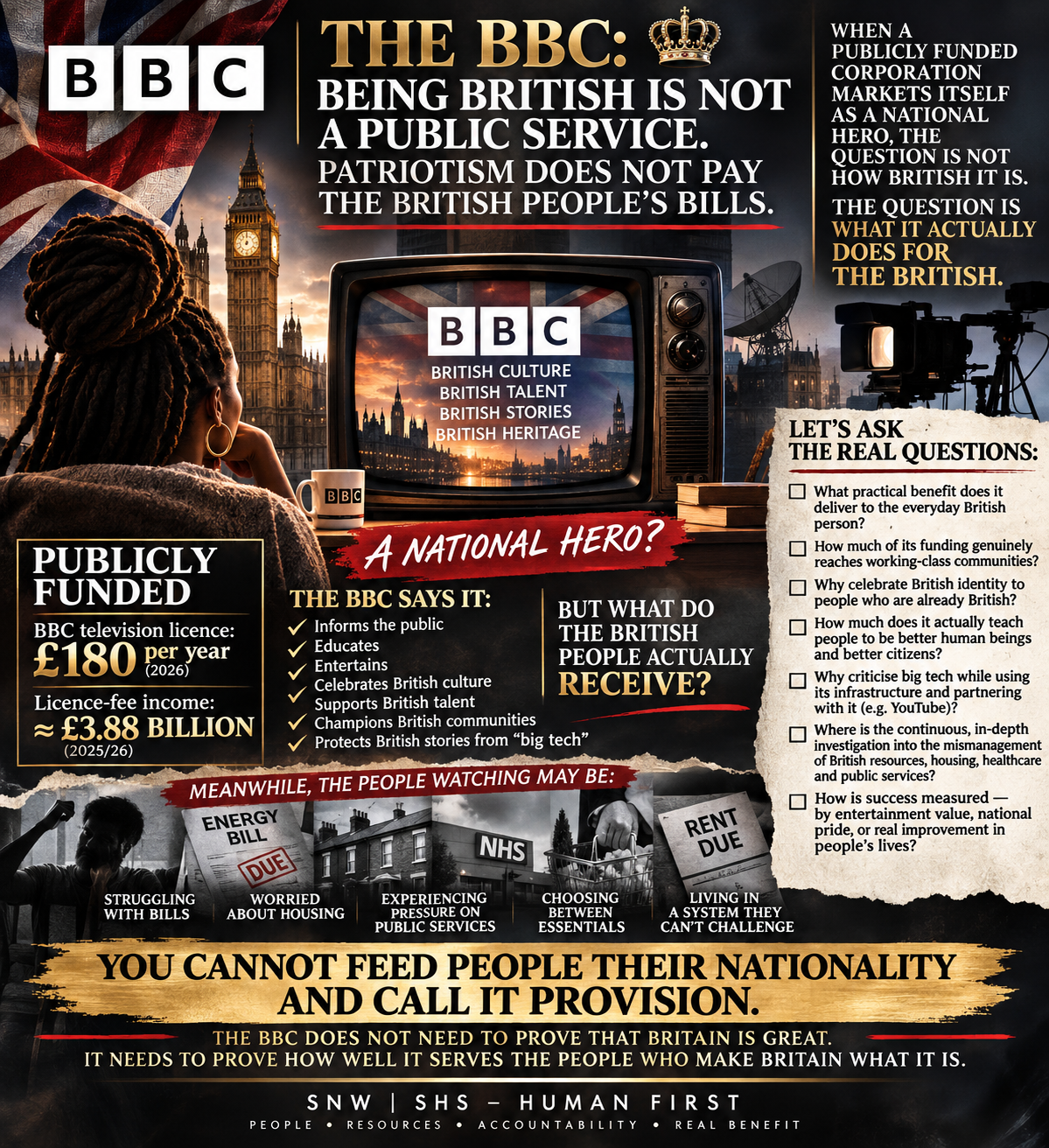
WHEN A PUBLICLY FUNDED CORPORATION MARKETS ITSELF AS A NATIONAL HERO, THE QUESTION IS NOT HOW BRITISH IT IS. THE QUESTION IS WHAT IT ACTUALLY DOES FOR THE BRITISH. Selling its patritism to people who would bank on it, is a market strategy, not consideration. I would know. It keeps the people locked in, it gives crumbs of the crumbs back though…
SNW | SHS – HUMAN FIRST
15 November 2026
Oh, Britain.
Here we go again.
I’ve just come across an interesting defence of the BBC, and I must say, the amount of patriotism being sold as public benefit is rather fascinating.
Apparently, the BBC is the cultural thread running through generations, celebrating British heritage, championing British writers, British musicians, British performers, British communities and the great British identity.
And apparently, without the BBC, British culture risks disappearing behind the paywalls of international technology giants.
How terribly heroic.
But I have a question.
WHAT EXACTLY ARE THE BRITISH PEOPLE RECEIVING IN RETURN FOR ALL THIS BRITISHNESS?
Because I’m pretty sure the people being reminded how wonderful it is to be British are already British.
They don’t need a television to validate their nationality.
They don’t need a corporation to explain that their culture belongs to them.
And they certainly don’t need to finance an institution merely to have their own identity marketed back to them.
BRITISH PEOPLE DON’T NEED TO BE REMINDED THAT THEY ARE BRITISH. THEY NEED TO EXPERIENCE THE BENEFITS OF BEING BRITISH.
And that’s where things start getting interesting.
1. THE BBC IS PUBLICLY FUNDED. BUT WHAT IS THE PUBLIC ACTUALLY FUNDING?
Let’s establish something.
The BBC is not simply another television corporation.
It is a public corporation established under a Royal Charter, funded primarily through television licence fees, and expected to serve the public interest independently of government editorial control.
As of April 2026, a standard television licence costs £180 annually.
And the BBC received approximately £3.88 billion in licence-fee income during the 2025/26 financial year.
Billions.
Not millions.
Billions.
And its official mission is to inform, educate and entertain.
Now, entertainment I can understand.
Education I can understand.
Informing the public I can understand.
But I would like to investigate the relationship between those three things and the actual condition of the population funding them.
Because entertaining a population is not the same thing as improving the population’s circumstances.
A person can watch television every evening and still not understand how their government operates.
Still not understand their rights.
Still not understand how public resources are distributed.
Still not understand how to challenge institutional misconduct.
Still not know how to manage their finances, improve their relationships, exercise accountability, recognise manipulation or participate meaningfully in the organisation of their society.
And after all that television?
They still have to wake up tomorrow and survive.
So what exactly was the public benefit?
The fact that they were entertained while their circumstances remained unchanged?
2. SHOWING BRITISH CULTURE IS NOT THE SAME AS SERVING THE BRITISH PEOPLE.
I find it interesting how often British institutions use British identity to justify their existence.
British this.
British that.
British talent.
British heritage.
British values.
British stories.
And of course, the British people must rally behind it because it represents Britain.
But represent Britain to whom?
The British already live here.
They already experience Britain.
They experience its housing system, its healthcare system, its employment system, its educational system, its taxation, its social services and its cost of living.
They experience the consequences of British governance every single day.
SO WHY IS THE CORPORATE REPRESENTATION OF BRITAIN BEING SOLD AS THOUGH IT WERE A SUBSTITUTE FOR THE ACTUAL WELLBEING OF BRITISH PEOPLE?
If you’re going to claim to be a national institution serving the nation, I want to see the nation being served.
Not simply represented.
And no, I’m not saying British culture shouldn’t be celebrated.
I’m asking why celebrating it is being presented as though it settles the question of public value.
Culture is something people create and embody.
A broadcasting corporation can document it, distribute it and contribute to it.
But it doesn’t own the British identity.
And preserving an identity isn’t the same thing as improving the conditions under which the people carrying that identity live.
3. THE PEOPLE ON THE SCREEN ARE NOT NECESSARILY THE PEOPLE STRUGGLING IN FRONT OF IT.
Another fascinating defence is how the BBC invests in British talent.
Actors.
Writers.
Musicians.
Directors.
Producers.
Studios.
Regional productions.
And yes, these are economic contributions. They create work for people across the creative industry, including people who are not wealthy or famous.
But I would like to investigate the distribution of that benefit.
Because the amount invested in British production does not automatically tell us how much of that investment reaches ordinary British households.
How much goes to major production companies?
How much to highly paid executives and established celebrities?
How much reaches working-class creatives?
How many genuinely new opportunities are created?
And how much goes towards educating and materially empowering the millions of people who are neither actors nor television producers?
Because the person watching the television may be choosing between electricity and groceries.
They may be struggling with rent.
They may be in debt.
They may be living under a poorly managed local authority.
They may have absolutely no idea how to hold their elected representatives accountable.
And what do we offer them?
Another programme celebrating British excellence.
Wonderful.
BRITISH EXCELLENCE ON THE SCREEN. BRITISH STRUGGLE ON THE SOFA.
And everybody is expected to applaud because it’s British.
4. THE TECHNOLOGY GIANTS ARE THE ENEMY? THEN WHY ARE YOU WORKING WITH THEM?
Now, this is one of my favourite parts.
The argument is that the BBC must be protected because international technology giants threaten British storytelling.
Apparently, if the BBC loses its position, British culture will disappear behind foreign technology companies.
But forgive me.
WHAT TECHNOLOGY DOES THE BBC USE TO DISTRIBUTE ITS CONTENT?
Is television not technology?
Is digital broadcasting not technology?
Is BBC iPlayer not technology?
Are the devices people use to access BBC services not technology?
And most interestingly, didn’t the BBC announce a strategic partnership with Google’s YouTube in January 2026?
So let’s understand this arrangement.
The technology giants are sufficiently threatening to feature in the BBC’s defence of its public funding.
Yet their infrastructure and distribution platforms are sufficiently beneficial to form commercial and strategic relationships with.
Now, using technology while criticising its market dominance isn’t inherently contradictory.
I understand that distinction perfectly well.
But that’s precisely why I want a more intelligent conversation than simply presenting foreign technology companies as villains and the BBC as Britain’s cultural saviour.
WHERE DOES THE DEPENDENCE BEGIN? WHERE DOES THE COMPETITION END? AND WHO BENEFITS FINANCIALLY FROM BOTH?
If these relationships are necessary, explain them.
If they are advantageous, account for those advantages.
If they compromise the independence of British cultural distribution, investigate that dependence.
And if they generate additional revenue, show the public how that revenue improves the services they are already financing.
Because you cannot expect the public to understand the entire technological ecosystem through a patriotic marketing campaign.
They deserve the actual accounts.
5. WHY ISN’T THE BBC TEACHING PEOPLE HOW TO BECOME BETTER HUMAN BEINGS AND BETTER CITIZENS?
Now, this is where my investigation becomes particularly important.
I must clarify that I don’t personally watch the BBC, so I cannot pretend to know the depth of everything it broadcasts.
And yes, I can establish that the BBC provides educational services, including BBC Bitesize, documentaries, journalism, local news and other informational programming.
So I am not suggesting that education is completely absent.
I AM QUESTIONING THE EXTENT, PRIORITY, ACCESSIBILITY AND RESULTS OF THAT EDUCATION.
Because surely, after more than a century of broadcasting, we should be able to investigate what the institution has contributed to the development of British society beyond entertainment and cultural recognition.
How well do people understand the responsibilities of citizenship?
How well do they understand their own rights?
How much do they know about the organisations governing their lives?
How many people understand the actual distribution of public finances?
How effectively can people identify misinformation?
How much practical education is provided on relationships, communication, accountability, conflict resolution, financial literacy, community organisation and social responsibility?
How many people have been empowered to identify public-sector failures and challenge them successfully?
And how much attention is given to teaching people how to prevent the problems they keep watching documentaries about?
Because reporting that a problem exists is one thing.
Understanding how it was allowed to exist, what sustains it, who is accountable and how to prevent its recurrence is another.
WE DON’T NEED ANOTHER GENERATION THAT KNOWS WHAT WENT WRONG. WE NEED A GENERATION THAT KNOWS HOW NOT TO RECREATE IT.
And if we have an institution receiving billions to inform, educate and entertain, I would like to know how those billions are being prioritised across these responsibilities.
Not simply how many people tuned in.
Not simply whether an audience enjoyed a programme.
Not simply how recognisable British culture became internationally.
What did the population learn?
What could they do afterwards that they couldn’t do before?
How was their capacity to participate in society improved?
That, to me, is a far more interesting measure of public value.
6. WHY NOT STAND UP FOR THE BRITISH AGAINST THE MISMANAGEMENT OF BRITAIN?
Here’s another thing.
If the BBC is so committed to serving Britain, why shouldn’t one of its greatest contributions be the continuous, comprehensive investigation of the institutions managing British life?
And no, I don’t mean simply broadcasting politicians arguing with each other.
I mean investigating the actual organisation of society.
Public spending.
The consequences of legislation.
The distribution of housing.
Healthcare capacity.
The social-care system.
The relationship between taxation and public provision.
The financial interests involved in public contracts.
The circumstances that produce poverty and keep people within it.
And most importantly, whether public institutions are resolving problems or simply managing their continuation.
The BBC does conduct investigative journalism and political scrutiny.
But my question is how extensive that scrutiny is, how consistently it is pursued, and whether the public is being equipped to act on what is revealed.
AN INVESTIGATION CAN BE EXTENSIVE WITHOUT BEING THOROUGH.
And a report can be entirely accurate while still failing to investigate the full organisation responsible for the circumstances it describes.
I don’t expect a broadcasting corporation to become the government.
In fact, its independence from government is precisely one of the reasons public-service broadcasting can be valuable.
But I do expect a publicly funded information institution to use that independence to investigate the management of the country funding it.
Not merely relay the government’s explanations.
Not merely produce another political spectacle.
And certainly not confuse informing the public about failures with ensuring the public has the information necessary to challenge them.
7. PATRIOTISM HAS BECOME ONE OF BRITAIN’S MOST CONVENIENT MARKETING STRATEGIES.
This is something I keep observing across British institutions.
The moment an organisation’s existence, funding or conduct is questioned, suddenly it becomes a matter of protecting Britain.
Protect British jobs.
Protect British culture.
Protect British heritage.
Protect British institutions.
And because the British population has such strong cultural attachments to its national identity, these appeals can be extraordinarily effective.
But I want people to consider something.
WHY DOES SUPPORTING A CORPORATION GET PRESENTED AS SUPPORTING YOUR COUNTRY?
Those are not automatically the same thing.
A corporation may contribute to the national economy while still requiring scrutiny.
It may employ thousands while distributing its benefits unequally.
It may preserve heritage while failing to meet other public needs.
It may produce excellent work while wasting resources elsewhere.
And it may represent a nation’s identity without representing the interests of every person within that nation.
That’s why accountability exists.
Because no institution should be able to substitute symbolism for evidence of its performance.
If anything, the greater the public funding and national significance, the greater the responsibility to demonstrate results.
PATRIOTISM IS NOT AN EXEMPTION FROM ACCOUNTABILITY.
And the British people should be particularly concerned when their love for their country becomes the very instrument through which they are persuaded not to question the organisations operating in its name.
8. I DON’T WANT TO KNOW HOW MUCH THE BBC LOVES BRITAIN. I WANT TO KNOW HOW WELL IT SERVES BRITAIN.
So here’s my proposition.
Instead of continuously presenting the BBC as some indispensable national hero, let’s investigate its actual public value.
Separate the cultural contribution from the educational contribution.
Separate employment figures from the distribution of economic benefit.
Separate audience satisfaction from measurable learning.
Separate news coverage from the depth of institutional accountability.
Separate the success of British productions internationally from improvements in the lives of the people financing the institution domestically.
Then publish the findings accessibly.
Let the public see how much is spent, what it produces, who benefits, what has been improved and what remains insufficient.
And compare those outcomes with what alternative uses of the same funding could achieve.
Because there’s a difference between a corporation being valuable and a corporation providing the greatest possible public value for the resources it receives.
The BBC may have significant achievements.
Its educational programmes may have helped millions.
Its journalism may have exposed important misconduct.
Its local services may provide information unavailable elsewhere.
Those are benefits worth acknowledging.
But they are not reasons to stop asking questions.
THE EXISTENCE OF BENEFIT DOES NOT ESTABLISH THE ADEQUACY OF BENEFIT.
And that distinction seems to escape a rather impressive number of institutions.
9. THE BRITISH PEOPLE ARE NOT YOUR PUBLIC RELATIONS DEPARTMENT.
And this brings me back to the argument I originally encountered.
The BBC celebrates British heritage.
The BBC promotes British talent.
The BBC represents British communities.
The BBC protects British storytelling from international corporations.
Beautiful.
But what does the British population actually have to show for it?
How much of this national pride translates into practical knowledge?
How much translates into personal capacity?
How much translates into meaningful public accountability?
And how much is simply a beautifully packaged reminder of an identity the audience already possesses?
Because if an institution requires people to rally around their nationality to defend its funding, I would like to see precisely what that funding has delivered.
Not just what the institution claims to represent.
YOU CANNOT FEED PEOPLE THEIR NATIONALITY AND CALL IT PROVISION.
You cannot pay their rent with cultural recognition.
You cannot resolve administrative injustice with a patriotic documentary.
And you cannot improve public understanding simply by increasing the number of programmes available to watch.
The actual substance matters.
So does the outcome.
And while television entertainment has its place, the survival, development and empowerment of the population must not become secondary considerations in an institution claiming to exist for the public.
THE BBC DOES NOT NEED TO PROVE THAT BRITAIN IS GREAT. IT NEEDS TO PROVE HOW WELL IT SERVES THE PEOPLE WHO MAKE BRITAIN WHAT IT IS.
Because Britain doesn’t belong to the BBC.
British culture doesn’t belong to the BBC.
And British patriotism certainly doesn’t belong to the BBC.
It belongs to the people.
The same people whose money, attention and national identity are being appealed to.
And those people deserve considerably more than being told how lucky they are to have an institution that celebrates them.
THEY DESERVE TO KNOW EXACTLY WHAT IT DOES FOR THEM.
After all, a national hero should be recognised by the benefit of its actions.
Not by the success of its marketing.
— SNW | SHS – HUMAN FIRST
Humanity first. Not the institutions that claim to represent it.
….
Write with my tone about how bbc spekas on being such a national hero when they’re entertaining people without actually giving them any value. They don’t teach them how be better human heings, better citizens, and nothing in between. Just all about showing what it is to be british. Well I’m pretty sure those who they show how to be british are british themselves and can figure out how to be british themselves without being reminded by tv that benefits financially from claiming to be a national hero. Bbc gets publically funded but why?! Is it a governmental thing? And if so what actual benefit doe it bring to the country? Sure it might pay british actors, but those same actors aren’t the british that sit in front of the screen struggling to make ends meet. They’re the upperchalance that has no financial problems and can pay their way through life. Not to say they might not have mental or emotional issues, but they certainly dont have to worry about their survival. Getting thr people behind their backs showing all that patriotism is an insult to the very people that are watching, cause they might rile for bbc just because of the marketing about the british culture and agaisnt big tech whatever, but thech is still the infrastrucuture they use to air the contnet is it not? Or don’t they use any tech?! So they finance tech, speak bad about thech, don’t take accountabikity for playing both sides and on top of that don’t even give actual benefit to the same british?! Like survival benefit or stand up for the british against its politicians and poor management of resources. That would help the british actually, not more empty contnet. I mist say I do not watch bbc so I do not know the depths to what they relay, I just look at the results in the people that do watch it and it doesn’t look good. It’s like every british corporation sells to the british the ” all british” but then doesn’t actually help the british, it’s all optics cause they know their country is very patriotic. They know they can get the people’s support like that.





Leave a Reply