
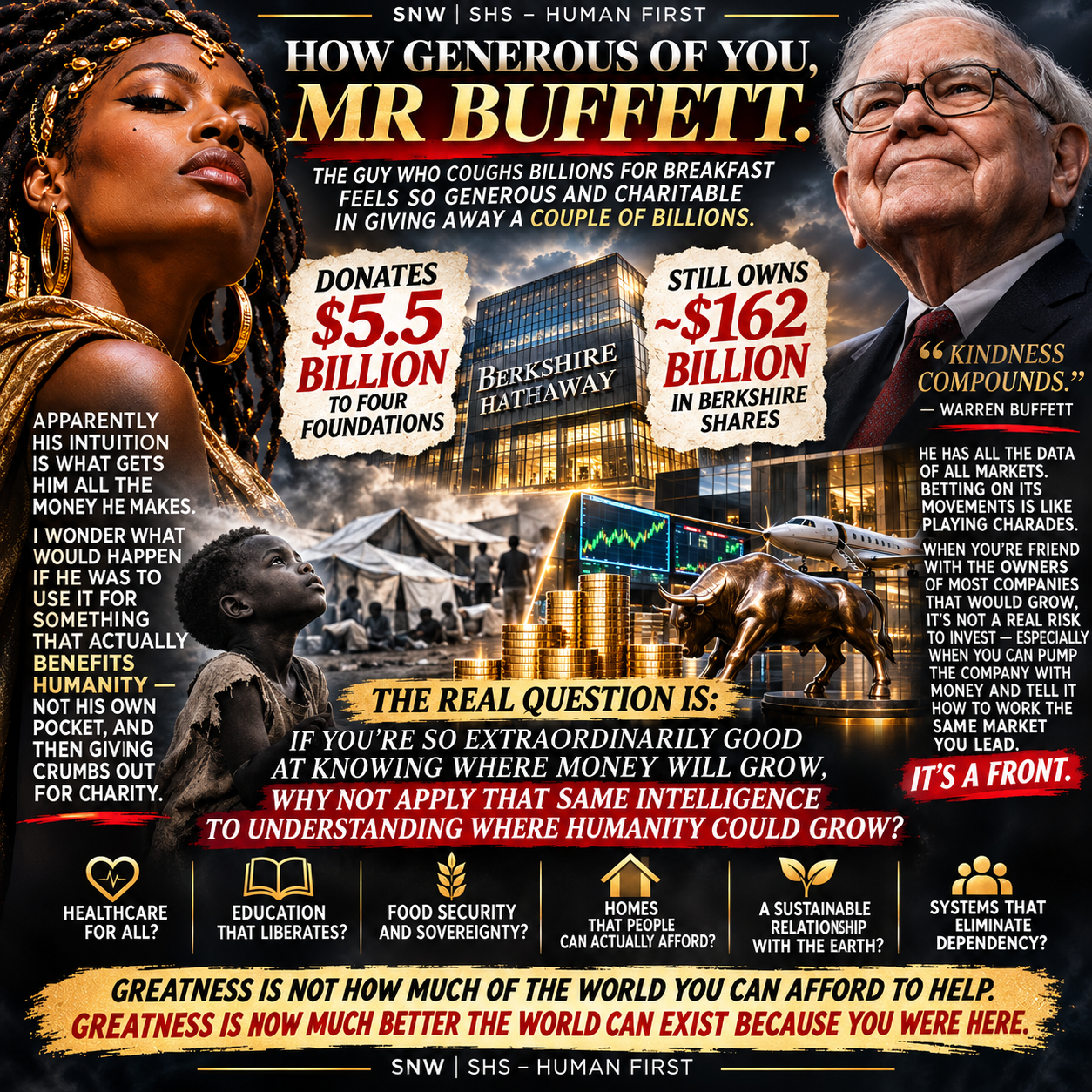
Why is the ability to accumulate extraordinary wealth celebrated as human greatness, while using that same intelligence to eliminate the conditions that make charity necessary is treated as an optional act of generosity?
Most of them promote each other either because of optics, leverage, connection, basically only how useful they are to make more money, nothing more. If money was a penis, well you can imagine the rest to that analogy..
THE BILLIONAIRE’S GREATEST TALENT: KNOWING WHERE MONEY WILL GROW. BUT WHAT ABOUT KNOWING WHERE HUMANITY NEEDS TO?
— SNW | SHS – HUMAN FIRST
16 November 2026
Oh, Warren.
How generous of you.
$5.5 BILLION.
My goodness.
The man who practically coughs billions for breakfast has decided to distribute a few more of them to charity.
And the world celebrates.
What a philanthropist.
What an extraordinary human being.
What an example of success.
And now we’re being told that kindness compounds.
How lovely.
I suppose it does, especially when you’ve spent your life studying compounding interest.
But I have a rather different question.
IF YOU’RE SO EXTRAORDINARILY GOOD AT KNOWING WHERE MONEY WILL GROW, WHY NOT APPLY THAT SAME INTELLIGENCE TO UNDERSTANDING WHERE HUMANITY COULD GROW?
Not financially.
Humanly.
Intellectually.
Socially.
Ecologically.
In the organisation of our lives.
Because that’s the kind of intuition I’d be interested in celebrating.
Not merely knowing which company will make the most money, but knowing how to create conditions in which entire populations no longer have to depend on somebody else’s financial fortune to live well.
Now THAT would be impressive.
THE ORACLE OF OMAHA. OR THE MAN WHO LEARNED HOW THE GAME WORKS?
Warren Buffett has spent decades being celebrated for his extraordinary investment judgement.
The Oracle of Omaha.
The man who understands value.
The investor who apparently sees opportunities others cannot.
And I’ll give him credit for understanding his field.
But can we please stop confusing extraordinary proficiency within an established financial system with extraordinary understanding of human existence?
Because the two are not interchangeable.
If you’ve spent decades examining businesses, reading financial statements, studying industries, meeting executives, understanding market behaviour, acquiring companies and accumulating capital, naturally you’ve developed an enormous advantage.
That’s experience.
That’s knowledge.
That’s access.
That’s an extensive network.
And, importantly, that’s an enormous quantity of money with which to act on what you know.
WHY MUST WE MYSTIFY INTELLIGENCE WHEN WE CAN INVESTIGATE THE CONDITIONS UNDER WHICH IT OPERATES?
The mythology of the brilliant investor often focuses on the spectacular decision.
The stock that multiplied.
The acquisition that generated billions.
The opportunity everybody else overlooked.
But how much attention do we give to the infrastructure behind those decisions?
The researchers.
The financial analysts.
The executives.
The available data.
The lawyers.
The advisers.
The industries already established.
The companies already producing goods and services.
The people whose labour generates the value that investors eventually receive?
And, of course, the enormous financial reserves available to someone who can afford to remain patient while others cannot even afford to miss a month’s wages.
You call that intuition.
I call it intelligence operating with extraordinary structural advantages.
That doesn’t mean every investment is guaranteed.
It doesn’t mean the risks disappear.
And it certainly doesn’t establish that anyone is trading on unlawful inside information.
But let’s stop pretending that a billionaire entering a market and an ordinary individual entering that same market are playing under remotely comparable conditions.
THEY MAY HAVE ACCESS TO THE SAME STOCK EXCHANGE. THEY DO NOT HAVE ACCESS TO THE SAME POWER.
And that difference matters.
WHEN YOU’RE BIG ENOUGH, YOU DON’T JUST PREDICT THE MARKET. YOU CAN INFLUENCE IT.
Here’s what I find particularly fascinating.
At a certain level of wealth, your decisions are no longer merely responses to the economic environment.
They can become part of what shapes that environment.
An investment from a highly influential institution can attract attention.
A major acquisition can change the strategic direction of a business.
Capital injections can enable expansion.
Management decisions can transform operations.
And public statements from renowned investors can influence how others perceive a company.
None of this guarantees profitability.
But it demonstrates something rather important.
THE LARGER YOUR FINANCIAL INFLUENCE, THE LESS YOUR SUCCESS CAN BE UNDERSTOOD AS NOTHING MORE THAN PREDICTING AN INDEPENDENT MARKET.
You’re participating in the very conditions that determine what happens next.
Now, isn’t that interesting?
Imagine having enough capital to invest in a business, enough experience to understand its weaknesses, enough connections to recruit exceptional people and enough influence to contribute to its development.
Then imagine being celebrated as though you possessed supernatural intuition when the company succeeds.
Darling, you didn’t necessarily foresee the future.
YOU HAD RESOURCES TO PARTICIPATE IN BUILDING IT.
And that is precisely what I want humanity to understand.
If you possess the resources to influence outcomes, why restrict your ambition to the outcomes that generate the greatest financial return?
Why not ask what becomes possible when the return you’re pursuing is the advancement of human existence itself?
Because I find that far more interesting than another successful investment portfolio.
$5.5 BILLION IN CHARITY. AND $162 BILLION STILL IN SHARES.
Now, before somebody accuses me of dismissing the real benefits of charitable donations, let’s establish something.
Five and a half billion dollars is an extraordinary amount of money.
It can fund healthcare.
Education.
Food programmes.
Humanitarian assistance.
And meaningful improvements to people’s lives.
Those things matter.
Buffett has also pledged to donate his remaining Berkshire shares, so this is not merely a man making one donation while declaring the rest untouchable.
Fine.
Recognise that.
But recognising the benefit of his philanthropy does not mean we must suspend our investigation of the system that allowed such extraordinary private fortunes to accumulate in the first place.
CHARITY CAN BE VALUABLE WITHOUT BEING THE HIGHEST FORM OF HUMAN ACHIEVEMENT.
And I refuse to accept that giving away billions should automatically make somebody one of humanity’s greatest examples of success.
What exactly are we measuring?
The amount donated?
The percentage of wealth donated?
The number of people helped?
The duration of those improvements?
Or whether the underlying problems actually stop reproducing themselves?
Because those are very different measurements.
And I have an even more uncomfortable question.
Why should the distribution of resources required for human development depend so heavily on the personal philanthropic decisions of those who accumulated the greatest fortunes?
What an extraordinary arrangement.
Humanity produces the labour, participates in the economy, sustains the markets and generates the conditions in which immense private wealth can accumulate.
And then waits to discover which social problems the wealthiest individuals would like to help solve.
HOW GENEROUS OF THEM TO LET HUMANITY BENEFIT FROM RESOURCES AFTER THEY’VE BEEN CONCENTRATED UNDER PRIVATE CONTROL.
That’s the structure I want to investigate.
Not whether every billionaire secretly hates humanity.
Not whether a charitable foundation can accomplish genuine good.
But why we’ve normalised a system in which access to essential support can depend on the discretionary generosity of a wealthy minority.
THE DIFFERENCE BETWEEN FINANCING A SOLUTION AND CREATING ONE.
You see, this is where I believe society has confused money with intelligence.
If you give someone $1 billion to fund a programme, you’re considered its great benefactor.
But who actually develops the programme?
Who investigates the needs?
Who understands the communities?
Who designs the infrastructure?
Who provides the services?
Who performs the work?
Who identifies the failures and improves them?
THE MONEY FUNDS THE SOLUTION. THE INTELLIGENCE AND LABOUR MAKE THE SOLUTION POSSIBLE.
And yet, remarkably often, the person who supplies the money receives the greatest public recognition.
Why?
Because we’ve organised an entire hierarchy of perceived value around financial ownership.
The person with the cheque becomes the hero.
Even when others conceived, developed and delivered the very thing being celebrated.
And I’d like us to examine that rather carefully.
Because if you remove the money from the billionaire, the knowledge and labour of everyone else don’t suddenly cease to exist.
Human capabilities remain.
Natural resources remain.
The problems remain.
And so does the potential to organise solutions.
What changes is access to the financial permission we’ve established as a prerequisite for coordinating those things.
MONEY IS NOT THE SOURCE OF HUMAN CAPABILITY. IT IS A SYSTEM THROUGH WHICH WE CURRENTLY AUTHORISE MUCH OF ITS USE.
And that is a rather enormous distinction.
IMAGINE COMPOUNDING HUMAN DEVELOPMENT INSTEAD.
Now let’s return to this extraordinary intuition we’re supposed to admire.
Suppose we take somebody with decades of experience analysing systems, identifying weaknesses, recognising opportunities and directing resources.
And instead of asking how that person could multiply another billion dollars, we ask:
How could we reduce preventable human suffering?
How could we organise food production and distribution so that fewer people experience hunger?
How could we make education continuously accessible?
How could we reduce the structural causes of homelessness?
How could we design healthcare around prevention and continuity rather than simply treating the consequences of deterioration?
How could we organise resources so that one generation’s progress becomes the next generation’s foundation?
How could the knowledge developed by one human become an inheritance available to many?
And, most importantly, how could we create these improvements without requiring somebody to become enormously wealthy before deciding that the problems deserve attention?
THAT IS WHAT I CALL INTELLIGENCE ALIGNED WITH LIFE.
Not simply using your understanding of the world to identify where money will accumulate.
But using your understanding to identify where human capability can expand.
Because what good is an intuition capable of recognising a profitable future if it never seriously attempts to create a better one?
And yes, investors can contribute to that future.
Businesses can contribute.
Philanthropists can contribute.
But the contribution needs to be examined by its actual consequences, not merely the size of the financial transaction attached to it.
PHILANTHROPY IS NOT A SUBSTITUTE FOR ACCOUNTABILITY.
And here comes my favourite part.
What happens when we examine not only what wealthy individuals give away, but the entire economic organisation from which their wealth emerged?
The industries.
The labour conditions.
The environmental consequences.
The market structures.
The access to resources.
The relationships between ownership, production and distribution.
The costs society absorbs.
The benefits that flow towards shareholders.
Because none of those questions disappears when someone makes a charitable donation.
Nor does philanthropy automatically establish that the original accumulation was unethical.
That’s precisely why investigation is necessary.
CHARITY IS EVIDENCE OF A CONTRIBUTION. IT IS NOT A COMPLETE ACCOUNTING OF ONE’S CONTRIBUTION TO HUMANITY.
If somebody funds a hospital, wonderful.
But that doesn’t answer every question about their wider business activities.
If somebody supports education, excellent.
But it doesn’t establish that the economic structures they participate in are equally beneficial to the people whose lives those structures affect.
And if somebody pledges to give away their entire fortune, that is a substantial commitment.
But I still want to know what that fortune ultimately accomplishes.
Not just how much is transferred.
How much genuinely changes.
How much suffering is prevented.
How much dependency is reduced.
How much knowledge is made accessible.
How much human capacity continues developing after the benefactor is gone.
THE ULTIMATE MEASURE OF CHARITY SHOULD NOT BE HOW MUCH THE DONOR CAN AFFORD TO GIVE. IT SHOULD BE HOW MUCH BETTER HUMANITY CAN EXIST BECAUSE OF IT.
I DON’T WANT TO BE AN ORACLE OF MONEY.
I want something considerably more ambitious.
I want the intelligence we keep celebrating in financial markets to be directed towards understanding the organisation of human existence.
Not merely predicting which company will rise.
But recognising which conditions need to change.
Not simply accumulating capital for the privilege of distributing it later.
But developing systems in which access to fundamental resources is organised from the beginning.
Not creating lifelong dependence on charitable foundations.
But making their assistance less necessary through sustainable provisioning.
And not mistaking the accumulation of billions for proof of superior consciousness.
Because to me, the most interesting human being isn’t necessarily the one who can make the greatest amount of money.
It’s the one who can understand the greatest number of relationships between things and use that understanding constructively.
Humanity.
Nature.
Society.
Consciousness.
Resources.
Continuity.
Free will.
Responsibility.
All of them.
I have no interest in becoming the richest participant in a game whose foundations I believe need to change.
And I’ve already said it.
The money can follow.
For as long as it’s necessary.
Until we develop something better.
I DON’T WANT TO BECOME SO RICH THAT I CAN AFFORD TO BE GENEROUS.
I WANT TO DEVELOP A WORLD IN WHICH HUMANITY DOESN’T HAVE TO WAIT FOR THE RICH TO FEEL GENEROUS.
That’s the difference.
And that, Mr Buffett, is what I’d be interested in seeing your celebrated intelligence applied towards.
Not because the billions you’ve donated are worthless.
But because I refuse to believe that the greatest possible achievement of a human mind is to accumulate wealth and subsequently decide how much of it to give away.
You spent decades mastering the art of compounding financial value.
Imagine if the true inheritance of that intelligence were a system that compounded human capability across generations.
Where one generation’s discoveries become the next generation’s starting point.
Where every improvement becomes a foundation.
Where progress no longer requires humanity to return repeatedly to the beginning.
Where success is measured not by how much wealth somebody accumulates, but by how much genuine capacity their existence adds to the world.
Now THAT would be compounding.
And THAT would be a remarkable inheritance.
Because at the end of the day, I am not interested in how rich you can become while humanity continues struggling.
I WANT TO KNOW HOW MUCH OF THAT STRUGGLE YOUR INTELLIGENCE CAN ACTUALLY ELIMINATE.
So congratulations on the $5.5 billion.
May it genuinely benefit those who receive its support.
But forgive me if I don’t fall to my knees in admiration simply because a billionaire has found another way to distribute billions.
I’ll reserve my greatest admiration for the minds that create a future where human survival no longer depends on the generosity of those who own the most.
GREATNESS IS NOT HOW MUCH OF THE WORLD YOU CAN AFFORD TO HELP.
GREATNESS IS HOW MUCH BETTER THE WORLD CAN EXIST BECAUSE YOU WERE HERE.
And, darling, I intend to take that measurement very seriously.
— SNW | SHS – HUMAN FIRST
….
And then this… how generous of him, the guy that coughs billions for breakfast feels so generous and charitable in giving away a couple of billions, when he supposedly has the intuition of a beast. Appsrently his intuition is what gets hik all the money he makes, I wonder what would happen if he was to use it for something thst actual benefits humanity, not his own pocket and then giving crumns out for charity. How wonderful these are the greatest examples of human success. Ignorance seems to be the real manner, but hey if they want to call it intuitive knowing. When these people have all the data of all markets, betting on its movements it’s like playing charades. We all know or shoukd know that one call of his can lead to a huge rise in the market. When you’re friend with the owners of most companies that would grow of course it’s easy to know where to put your money and especially if you know the people to make one company profiteable, it’s not a real risk to invest in a company when pumping it with money and telling it how to work the same market they lead, makes them a succesful investment. It’s a front.




Leave a Reply