
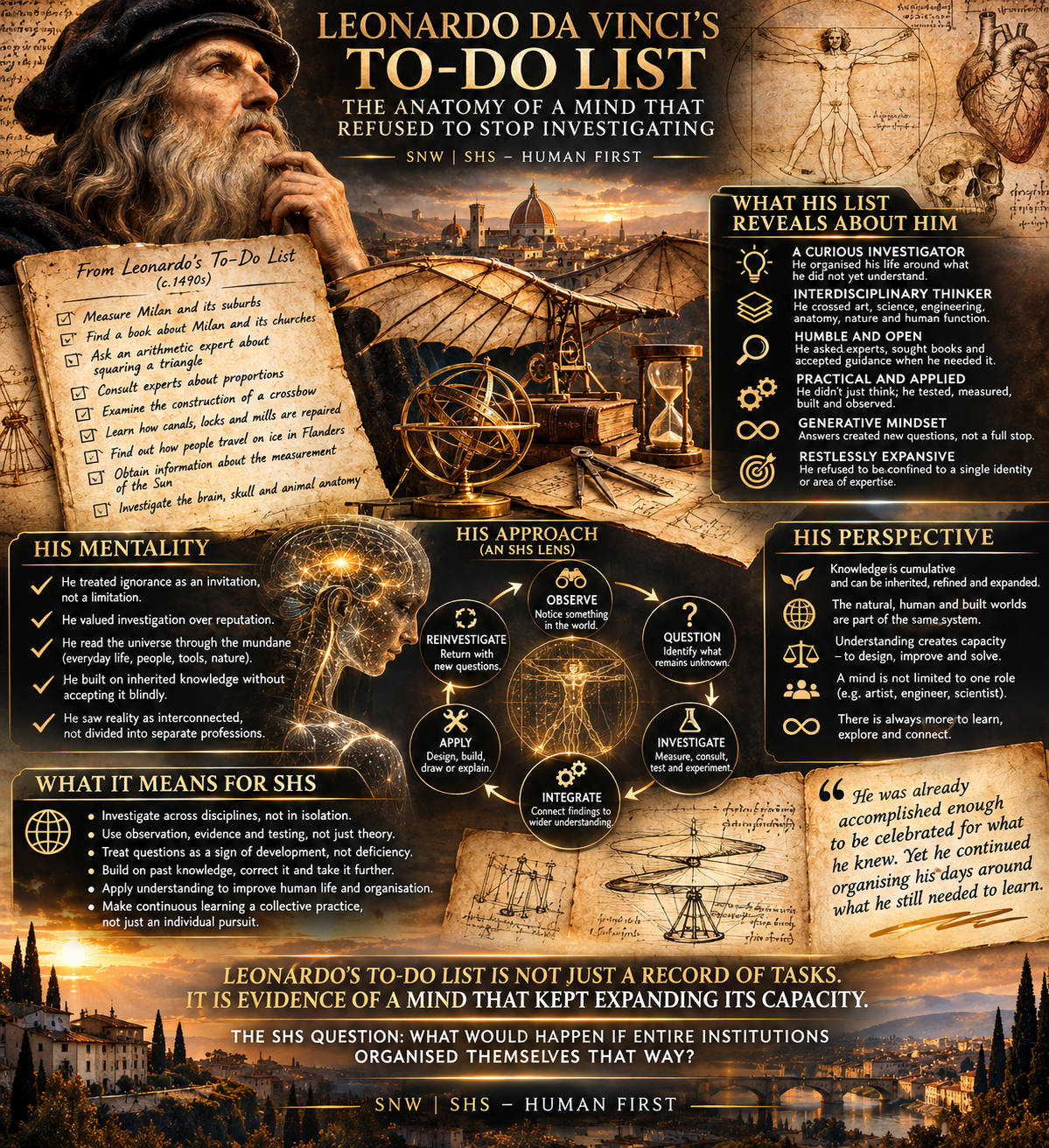
LEONARDO DA VINCI’S TO-DO LIST: THE ANATOMY OF A MIND THAT REFUSED TO STOP INVESTIGATING
An SHS – HUMAN FIRST interpretation of consciousness, curiosity, knowledge, investigation and the organisation of thought.


The most revealing thing about Leonardo da Vinci’s to-do list isn’t how many things he wanted to learn.
It’s that he was organising his life around what he did not yet understand.
And considering everything we’ve explored through SHS — the mundane universe, the organisation of consciousness, interdisciplinary investigation, knowledge as inheritance, specificity, homeostasis, free will and the development of human capabilities — his notebooks become especially interesting.
Because they demonstrate something fundamentally different from the way intelligence is commonly presented.
Leonardo wasn’t merely collecting information.
He was actively building relationships between observations, questions, people, instruments, disciplines and possibilities.
His to-do list wasn’t simply a list of things to accomplish. It was a map of things his consciousness had not yet integrated.
That’s my interpretation, not a literal claim Leonardo made about consciousness. But his surviving notebooks give us substantial evidence of the investigative behaviour behind it.
1. First, look at what was actually on his list
Leonardo’s best-known to-do list dates from approximately the 1490s. He also produced later lists, including one around 1510 focused on anatomical research.
These are some of the tasks recorded or translated from his notebooks:
| His intended investigation | What it reveals |
|---|---|
| Measure Milan and its suburbs | He wanted to understand his physical environment quantitatively |
| Find a book about Milan and its churches | He recognised that existing knowledge could supplement direct experience |
| Ask an arithmetic expert about squaring a triangle | He sought instruction when he encountered a gap in his mathematics |
| Consult experts about proportions | He investigated mathematical relationships underlying physical forms |
| Examine the construction of a crossbow | He wanted to understand mechanisms through their components |
| Learn how canals, locks and mills were repaired | He investigated existing practical engineering knowledge |
| Find out how people travelled on ice in Flanders | He recognised that unfamiliar environments could contain useful techniques |
| Obtain information about the measurement of the Sun | His curiosity extended beyond immediate surroundings to the wider universe |
| Investigate the brain, skull and animal anatomy | He wanted to understand living structures through direct physical investigation |
The 1490s list has been discussed by biographers including Walter Isaacson and Toby Lester. The later anatomical research is also documented by the Royal Collection Trust. Open Culture +3
Notice something.
There isn’t one discipline here.
There’s architecture, geography, mathematics, mechanics, human biology, astronomy, transportation, engineering and observation of other people’s knowledge.
And this is where the mentality becomes fascinating.
He didn’t organise his curiosity according to the boundaries of established professions. He followed the question into whichever discipline could help answer it.
That is one of the strongest connections to SHS.
2. He treated ignorance as an invitation, not an identity
This connects directly to your 16 November SHS work, Healers and Knowledge.
You argued that expanding knowledge expands a healer’s capacity to heal, and that remaining deliberately ignorant contradicts the responsibility of someone claiming to provide healing.
Leonardo’s list demonstrates the investigative side of that principle.
He wasn’t embarrassed to ask a mathematician for help. He didn’t require the answer to originate in his own mind to consider it worth obtaining.
He identified what he did not know and located someone who might know it.
His intelligence was not invested in appearing knowledgeable. It was invested in becoming more knowledgeable.
That’s a significant distinction.
An individual who protects their reputation for knowing everything can become limited by the knowledge they already possess.
An individual who is prepared to investigate what they do not know continually enlarges the boundaries of their understanding.
Leonardo’s behaviour suggests that he valued the second approach.
3. He was reading the universe through the mundane
This is perhaps the most direct connection with your recent reflection on reading the universe through everyday reality.
Consider the question about walking on ice in Flanders.
To an ordinary observer, people walking across ice might be a curiosity, an amusing cultural detail, or something barely worth remembering.
To Leonardo, it became a subject of investigation.
What conditions make that possible? What technique is being used? What could be learned from it?
The same principle applies to canals, mills, fortifications, proportions and animal anatomy.
He wasn’t waiting for extraordinary information to arrive. He was extracting extraordinary questions from ordinary things.
In SHS terms, the mundane isn’t empty of information simply because people have become accustomed to seeing it.
But there’s an essential methodological distinction.
Observation gives us something to investigate. It does not automatically prove our interpretation of what we observe.
Leonardo’s approach is especially valuable because he repeatedly moved between observation, measurement, practical inquiry and testing.
Walter Isaacson describes him as someone who questioned received wisdom by examining the physical evidence for himself. Harvard Gazette +1
That is what makes his curiosity more than contemplation.
It becomes an investigative method.
4. His mind crossed disciplines because reality does not come divided into professions
This relates to SHS’s organisation of humanity, society, consciousness, science, biology, engineering, economics and governance.
Modern institutions frequently divide knowledge into professional categories.
But take a human body.
To understand how it moves, you might need anatomy, mechanics, mathematics, physics and observation.
To understand how a city works, you might need architecture, geography, water systems, transport, labour and politics.
Leonardo’s notebooks move between precisely these types of questions.
He could investigate the mechanics of water and the movements of the human body without treating them as unrelated intellectual territories.
The Victoria and Albert Museum’s collection documents notebooks containing hydraulics, proportions, anatomy, mechanisms, geometry and artistic investigations together. V&A +1
The connection to SHS is therefore not simply that both investigate many subjects.
It is the proposition that understanding a system requires understanding the relationships between the things that constitute it.
And something you’ve repeatedly emphasised becomes important here:
An investigation can be extensive without being thorough.
Leonardo’s breadth was valuable because he also pursued highly specific details. He didn’t merely announce that he wanted to understand engineering. He wanted to know how a particular lock, mill or mechanism operated.
Breadth brought relationships into view.
Specificity made those relationships investigable.
5. His consciousness was organised around questions, not just answers
In your I Physically Am, Therefore I Receive framework, you’ve described a progression from contact and interaction through reception, interpretation and integration.
We can compare that philosophical structure with Leonardo’s documented investigative habits.
A LEONARDO-INSPIRED INVESTIGATIVE CYCLE
01
Encounter
Notice something in the world
02
Question
Identify what remains unknown
03
Investigate
Observe, consult, measure or test
04
Integrate
Connect findings to existing understanding
05
Apply
Draw, design, explain or build
06
Reinvestigate
Return when new questions emerge
This is a conceptual synthesis of his methods, rather than a sequence he explicitly wrote down.
What it shows is that knowledge was not necessarily the end of his inquiry.
Acquired knowledge could generate the next investigation.
And that connects to another SHS principle:
The goal is to think better, not less.
His expanding understanding didn’t eliminate questions. It gave him increasingly sophisticated things to question.
6. He understood that knowledge can be inherited without being passively accepted
Your discussion of Healers and Knowledge and the inheritance of acquired understanding presents knowledge as something each generation can build upon rather than forcing humanity to return continually to the beginning.
Leonardo’s list demonstrates the practical side of that inheritance.
He asked people who already possessed knowledge.
He sought books already written.
He examined structures already constructed.
And he contributed his own observations, drawings and explanations.
There’s a beautiful distinction here.
He was prepared to inherit the knowledge of others without surrendering the responsibility to understand it for himself.
That distinction matters because inheritance should not mean unquestioned obedience.
You can receive knowledge, examine it, test it, correct it and develop it.
Leonardo even investigated perpetual-motion concepts before rejecting them. His willingness to study an idea did not require him to preserve his original expectations about its validity. V&A
That is intellectual continuity with correction.
And it is especially important to SHS’s ambitions for cumulative investigation and institutional accountability.
An organisation should not simply store what it has learned.
It should become better at using, revising and extending that learning.
7. He seems to have prioritised intellectual development over immediate completion
This is where I would introduce a complication rather than idealise him.
Leonardo was notorious for working across many projects and leaving some unfinished.
His biographer Walter Isaacson discusses the tension between Leonardo’s curiosity, perfectionism and unfinished work, arguing that the same broad investigations also contributed to his artistic achievements. Harvard Gazette +1
That connects to your Art of Priorities.
A conventional productivity assessment might look at Leonardo’s list and ask how many things he completed.
But another assessment might ask how much his investigations changed his capacity to understand and create.
Both matter.
Not every valuable investigation produces an immediate finished product. Equally, pursuing more questions is not automatically evidence of better prioritisation.
The essential distinction is between continuously expanding your understanding and indefinitely postponing its application.
Leonardo’s notebooks show the extraordinary value of the former, while his unfinished projects remind us of the costs that can accompany the latter.
8. His method was multidimensional, but that doesn’t automatically establish his metaphysics
Considering the SHS consciousness framework, Leonardo’s work offers particularly rich material for comparison.
He investigated the body, the senses, movement, light, water, geometry and the relationships between physical forms.
His studies of anatomy became increasingly detailed, including direct dissections and investigations of the skull, spine, muscles and internal organs. rct.uk +1
He was investigating how physical organisation produces observable functions.
That resonates with SHS’s interest in embodiment, interdependence and homeostatic organisation.
However, the notebooks do not establish your proposed metaphysical mechanisms, such as shared consciousness fields or the Dual-Coordinator Resonance Hypothesis.
What they offer is an example of an investigative mentality capable of engaging seriously with complex, interdisciplinary questions.
There is also an important difference in purpose.
Leonardo served wealthy patrons and designed military technologies alongside his artistic and scientific work. His intellectual versatility did not necessarily imply a consistent humanitarian mission.
SHS places human wellbeing and societal organisation at the centre of its stated purpose.
The parallel is therefore strongest at the level of method, not assumed moral or metaphysical agreement.
9. What his to-do list ultimately tells us about his mentality
I would characterise his documented approach in six ways:
- Epistemically humble: He could acknowledge what he didn’t know and ask others to teach him.
- Self-directed: He identified investigations worth pursuing without requiring an institution to prescribe every question.
- Relational: He moved between different disciplines and looked for connections between physical phenomena.
- Empirical: He sought observation, measurement and testing rather than accepting explanations solely on authority.
- Generative: Answers could become the foundations of further questions and inventions.
- Restlessly expansive: His curiosity continually opened new investigations, sometimes at the expense of completion.
But there’s one further characteristic that interests me particularly.
Leonardo didn’t appear to consider the limits of his existing knowledge to be the limits of what he was capable of understanding.
That’s different from believing oneself incapable of being wrong.
It is a commitment to the possibility of learning.
The final connection to SHS
You’ve said that people should not be confined to the things for which they are already recognised — that becoming known as the intelligent child, the mathematical child or the athletic child should not prevent development into other dimensions of oneself.
Leonardo’s life presents a historical example of refusing to remain confined to a single intellectual discipline.
The world remembers him as an artist, but the notebooks reveal somebody who kept pursuing engineering, anatomy, nature, mathematics and things that had no immediate relationship to completing a painting.
His apparent identity was not his only area of development.
And that leads to what I consider the deepest implication for SHS.
A mind can organise itself around defending what it already knows, or around developing what it may yet become capable of knowing.
One approach preserves an existing intellectual identity.
The other allows that identity to develop.
Leonardo’s lists suggest a powerful commitment to the second approach.
And your SHS framework extends the question beyond the individual:
What would happen if entire institutions organised themselves that way?
If governments maintained lists of what they had still failed to understand about human needs?
If healthcare organisations investigated the limitations of their own knowledge as actively as they investigated patients?
If schools treated questions as evidence of developing intelligence rather than simply rewarding correct answers?
If the fundamental measure of societal progress included how much more capable humanity had become of understanding and responding to its own existence?
That would transform the to-do list from an instrument of personal productivity into an instrument of collective development.
Leonardo’s surviving lists document a man pursuing an extraordinary range of unanswered questions.
The challenge I see for SHS is to turn that investigative discipline into something that does not depend upon the existence of one extraordinary individual.
To make cumulative understanding, correction and application part of how humanity organises itself.
Because the most interesting thing about Leonardo’s list might be this:
He was already accomplished enough to be celebrated for what he knew. Yet he continued organising his days around what he still needed to learn.
That is a more meaningful model of intellectual growth than the reputation of genius alone.
And it speaks directly to your distinction between simply having intelligence and continuously developing what intelligence can do.
Historical references: V&A: Leonardo’s Notebooks · Royal Collection Trust: Anatomy · Harvard: Walter Isaacson on Leonardo
….
I might have just been Leonardo Da Vinci who happens to fit the bar for the second coming, not going to lie, I fit too smoothly.






Leave a Reply