
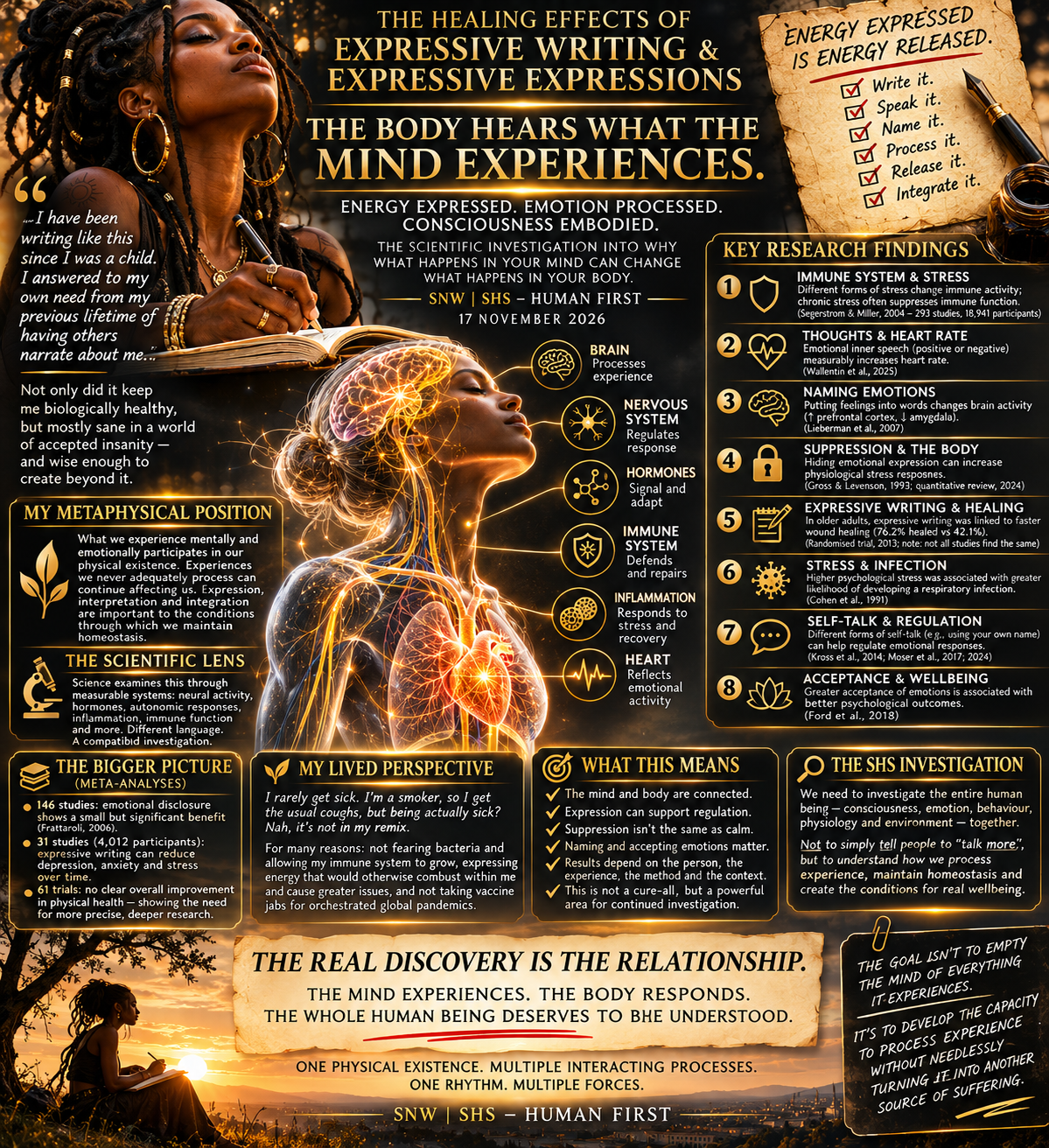
I have been writing like this since I was a child. I answered to my own need from my previous lifetime of having others narrate about me. Not just it kept me biologically healthy, but mostly sane in a world of accepted insanity and wise enough to create beyond it. Ai works for big pharma too. See at the end of this.
…….
This connects directly with our metpahysical xlais of how energy expressed is energy released. Every type of energy counts and the mind does imprint on the body, reason why its extremely important to release it. Without shame. Healthily to be healthy. I never get sick. I’m a smoker so I get the usual coughs, but being actually aick, nah, it’s not in my remix. For aooo many different reason, from not fearing bacteria and allowing my immune system to grow to expressing energy that would otherwise conbust within me and cause greater issues and not getting vaccin jabs for orchestrated global pandemics.
….
THE BODY HEARS WHAT THE MIND EXPERIENCES.
ENERGY EXPRESSED. EMOTION PROCESSED. CONSCIOUSNESS EMBODIED. THE SCIENTIFIC INVESTIGATION INTO WHY WHAT HAPPENS IN YOUR MIND CAN CHANGE WHAT HAPPENS IN YOUR BODY.
— SNW | SHS – HUMAN FIRST
17 November 2026
Oh, humanity.
Now THIS is an interesting investigation.
I’ve been discussing the relationship between consciousness, emotional expression, the nervous system and the body’s capacity to maintain itself.
My metaphysical proposition has been that what we experience mentally and emotionally participates in our physical existence.
That experiences we never adequately process can continue affecting us.
And that expression, interpretation and integration are important to the conditions through which we maintain homeostasis.
ENERGY EXPRESSED IS ENERGY RELEASED.
That’s how I’ve described the principle through my metaphysical lens.
Now, science uses a more precise physiological vocabulary. It measures neural activity, hormones, autonomic responses, inflammation, immune function and other bodily processes, rather than treating emotions as literal quantities of energy that must be expelled.
But here’s where the relationship becomes fascinating.
Researchers have been investigating several measurable components of this connection for decades.
And some of the results deserve considerably more attention.
1. THE IMMUNE SYSTEM RESPONDS TO WHAT THE MIND EXPERIENCES.
In 2004, researchers Suzanne Segerstrom and Gregory Miller published an extensive meta-analysis examining psychological stress and the human immune system.
Not one experiment.
Not one person’s extraordinary experience.
293 independent studies involving 18,941 participants.
The findings demonstrated that different forms of psychological stress were associated with measurable changes in immune activity.
Short-term stress could temporarily increase certain defensive responses.
Chronic stress, however, was associated with suppression of several measures of immune function.
Now, isn’t that interesting?
The body doesn’t respond to every kind of stress in the same way.
Duration matters.
Context matters.
The physiological response matters.
THE RELATIONSHIP BETWEEN THE EXPERIENCE AND THE BODY MATTERS.
And that’s precisely why I have been arguing for investigating the entire organisation of the human being rather than assuming that physical and psychological experiences operate independently.
The science of psychoneuroimmunology examines interactions among the nervous system, endocrine system and immune system.
The implications are substantial.
An experience doesn’t need to cause an external physical injury to produce a measurable change in bodily functioning.
Research: Segerstrom & Miller, Psychological Bulletin, 2004
2. YOUR THOUGHTS CAN CHANGE YOUR HEART RATE. WITHOUT YOU EVEN SPEAKING.
Now here’s a particularly fascinating development.
In 2025, researchers published Heart Talk: Emotional Inner Speech Increases Heart Rate.
They conducted two preregistered experiments.
Participants engaged in different forms of internal speech while their heart rates were measured.
Some used emotionally positive thoughts.
Others used emotionally negative thoughts.
Others performed neutral inner counting.
THE EMOTIONAL INNER SPEECH PRODUCED MEASURABLE CHANGES IN HEART RATE.
And the effect remained after researchers accounted for certain differences in breathing and body movement.
Think about what that demonstrates.
The person doesn’t have to run.
They don’t have to fight.
They don’t even have to speak aloud.
A mental process can alter an autonomic bodily response.
The study also found that both positive and negative emotional inner speech increased heart rate compared with neutral counting. It did not establish that positive thoughts necessarily calm the body.
And that’s important.
Because consciousness isn’t simply divided between good feelings and bad feelings.
Different mental activities can change physiological arousal in different ways.
THE MIND IS NOT PHYSIOLOGICALLY SILENT SIMPLY BECAUSE THE MOUTH IS CLOSED.
Research: Wallentin and colleagues, Psychophysiology, 2025
3. THE BODY CAN RESPOND DIFFERENTLY WHEN WE NAME WHAT WE FEEL.
In 2007, Matthew Lieberman and colleagues investigated something beautifully simple.
What happens when people put feelings into words?
Using functional magnetic resonance imaging, they observed that affect labeling—the act of identifying an emotion through language—was associated with changes in activity in brain regions involved in emotional processing and regulation.
Participants showed increased activity in parts of the prefrontal cortex and reduced activity in the amygdala during affect labeling.
Not because the emotion magically disappeared.
But because identifying an experience was associated with a different pattern of neural processing.
Now consider the broader implication.
NAMING AN EXPERIENCE CAN BE PART OF REGULATING HOW THE BRAIN RESPONDS TO IT.
The act of recognition is not necessarily passive.
It can participate in the experience itself.
Research: Lieberman and colleagues, Psychological Science, 2007
4. WHEN EMOTIONS ARE SUPPRESSED, THE BODY DOESN’T NECESSARILY BECOME CALMER.
Here’s another investigation.
James Gross and Robert Levenson studied what happens when people deliberately suppress emotional expression.
Participants were asked to inhibit visible emotional responses while exposed to emotionally evocative material.
What happened?
Their outward expression decreased.
But several physiological measures indicated increased sympathetic nervous system activation.
THE PERSON COULD LOOK MORE COMPOSED WHILE THEIR BODY WAS STILL RESPONDING TO THE EXPERIENCE.
Oh, how fascinating.
And a later quantitative review published in 2024 found additional evidence linking emotional suppression with heightened physiological responses during stress, although the strength of the association depended on how suppression and physiology were measured.
That doesn’t mean every moment of restraint is unhealthy.
Self-control is useful.
Choosing when and where to express an emotion is part of responsible behaviour.
But there is a distinction between regulating an emotion and repeatedly preventing its expression without adequately processing it.
And that distinction deserves investigation.
AN OUTWARD APPEARANCE OF CALM IS NOT AUTOMATICALLY EVIDENCE OF INTERNAL REGULATION.
Research: Gross & Levenson, 1993
Research: Quantitative review of emotion suppression and physiological stress, 2024
5. EXPRESSIVE WRITING HAS BEEN STUDIED IN PHYSICAL WOUND HEALING.
And now for one of the most interesting findings.
In 2013, researchers conducted a randomised controlled trial involving 49 older adults.
The participants were assigned to write either about emotionally upsetting experiences or about ordinary daily activities.
They subsequently underwent a small skin biopsy.
By day 11, among the participants assessed:
76.2% of those assigned to expressive writing had fully healed wounds, compared with 42.1% of the control group.
Now THAT deserves attention.
Because the intervention concerned psychological experience, while the measured outcome concerned physical tissue repair.
The study was small, and it doesn’t establish that expressive writing accelerates every kind of healing.
Indeed, a separate 2017 study involving patients undergoing bariatric surgery failed to reproduce that benefit.
But the original result identifies a legitimate area for continued investigation.
HOW CAN DIFFERENT WAYS OF PROCESSING AN EXPERIENCE INFLUENCE THE PHYSIOLOGICAL CONDITIONS UNDER WHICH THE BODY RECOVERS?
That’s a research question worth pursuing.
Not through assumption.
Through experimentation.
Research: Expressive writing and wound healing in older adults, 2013
6. THE RELATIONSHIP BETWEEN STRESS AND INFECTION HAS BEEN TESTED EXPERIMENTALLY.
In 1991, Sheldon Cohen and colleagues conducted an investigation into psychological stress and susceptibility to respiratory infections.
Participants reported their levels of psychological stress before undergoing controlled viral exposure.
The researchers found a dose-response association: higher reported stress was associated with greater likelihood of developing a respiratory infection.
That study is particularly relevant because it investigated actual infection outcomes rather than merely asking people whether they felt healthy.
Follow-up research has also examined how chronic stress may affect inflammatory regulation.
Now here’s the interesting part.
It demonstrates that conditions within the individual can influence their response to an external biological challenge.
But it doesn’t establish that confidence, lack of fear or emotional expression makes somebody immune to pathogens.
The pathogen still matters.
The person’s immune history matters.
Exposure matters.
And the body remains biologically vulnerable.
IMMUNITY IS NOT SIMPLY A MATTER OF WHAT WE THINK. BUT WHAT WE EXPERIENCE PSYCHOLOGICALLY CAN PARTICIPATE IN HOW THE BODY RESPONDS.
And that is already an extraordinary relationship.
Research: Cohen and colleagues, New England Journal of Medicine, 1991
7. TALKING TO YOURSELF ISN’T NECESSARILY STRANGE. IT CAN BE A FORM OF REGULATION.
Now let’s return to the original subject.
Self-talk.
The internal dialogue.
The ability to address oneself through language.
In 2014, Ethan Kross and colleagues investigated how different forms of self-talk influence emotional regulation.
Their research suggested that using one’s own name or non-first-person language during introspection can help people gain psychological distance from distressing experiences.
Later experiments using EEG and fMRI found measurable differences in neural responses when participants engaged in third-person rather than first-person self-talk.
And in 2024, another experiment involving 40 participants found that certain speech-production activities could influence how people evaluated emotional images.
Now, none of those findings means that talking aloud automatically prevents disease.
But the evidence supports something interesting.
THE WORDS WE USE TO RELATE TO OUR OWN EXPERIENCE CAN INFLUENCE HOW THAT EXPERIENCE IS PROCESSED.
Self-talk can provide perspective.
It can organise thinking.
It can change the interpretation of an event.
And in some circumstances, it can contribute to emotional regulation.
You don’t necessarily need an audience to examine your own experience.
Sometimes the conversation is with yourself.
And there’s nothing inherently shameful about that.
Research: Kross and colleagues, 2014
Research: Moser and colleagues, Scientific Reports, 2017
8. ACCEPTING EMOTIONS WITHOUT SHAME IS ANOTHER IMPORTANT PART OF THE PICTURE.
Now this is especially relevant to what I’ve been discussing.
Not simply expressing emotions.
ACCEPTING THAT YOU EXPERIENCE THEM.
In research published in 2018, Brett Ford and colleagues investigated the relationship between accepting negative emotional experiences and psychological health.
Across laboratory, questionnaire and longitudinal research, greater acceptance was associated with better psychological outcomes.
The researchers proposed that accepting one’s emotions rather than judging oneself for having them may reduce additional negative reactions to stressful experiences.
And I find that distinction important.
Because what happens when the person experiences an emotion and then develops another emotional response against themselves for experiencing it?
Anger about being angry.
Shame about feeling shame.
Fear about feeling fear.
The experience becomes entangled with the individual’s judgement of their own humanity.
And perhaps part of emotional development involves learning not to create an unnecessary second struggle against the existence of the first experience.
YOU DON’T HAVE TO BE ASHAMED OF HAVING AN EMOTION IN ORDER TO BE RESPONSIBLE FOR WHAT YOU DO WITH IT.
That is a distinction worth teaching.
Acceptance doesn’t require acting on every impulse.
Expression doesn’t excuse harming someone.
And emotional regulation doesn’t have to mean denial.
Research: Ford and colleagues, Journal of Personality and Social Psychology, 2018
9. WHAT ABOUT THE BIGGER BODY OF EVIDENCE?
Here’s where research becomes particularly useful.
A 2006 meta-analysis by Joanne Frattaroli examined 146 randomised studies of emotional disclosure.
It found a statistically significant, though small, average benefit across outcomes.
A later meta-analysis of 31 experimental studies involving 4,012 participants examined longer-term effects of expressive writing on depression, anxiety and stress symptoms.
It found modest beneficial effects, with some evidence that results may emerge over time.
But not every investigation has found benefits.
A 2005 systematic review of 61 trials found no clear improvement in objectively measured physical health from emotional disclosure overall.
And that is exactly why thoroughness matters.
THE EVIDENCE DOES NOT SAY THAT EXPRESSION ALWAYS HEALS.
It suggests that the way emotions are processed can matter, with results depending on the person, the experience, the method and the outcome measured.
That distinction makes the scientific proposition more precise.
It doesn’t eliminate the value of emotional expression.
It identifies what remains to be understood.
Research: Frattaroli, Psychological Bulletin, 2006
Research: Long-term expressive writing meta-analysis, 2023
10. THE METAPHYSICAL CONNECTION: ENERGY, EXPRESSION AND HOMEOSTASIS.
Now let’s return to my original proposition.
ENERGY EXPRESSED IS ENERGY RELEASED.
Within my metaphysical framework, this describes the movement of an experience through consciousness rather than its perpetual containment.
The physical research gives us a way of investigating particular aspects of that proposition.
An experience can activate emotional processing.
Emotional processing can influence neural activity.
Neural activity can affect autonomic responses.
Autonomic and endocrine responses can influence inflammatory and immune processes.
And those processes can participate in the conditions under which the body functions and recovers.
Not as a single guaranteed chain that operates identically in every circumstance.
But as interconnected biological relationships.
THE MIND DOES NOT HAVE TO BE SEPARATE FROM THE BODY FOR US TO EXAMINE THEIR DISTINCT FUNCTIONS.
And what I find particularly important is the possibility of understanding regulation as an integrated process.
Not simply eliminating an uncomfortable feeling.
Not pretending something hasn’t happened.
Not assuming that every emotional experience requires an external audience.
But recognising, interpreting, expressing where useful, and integrating what has been experienced.
Sometimes through speech.
Sometimes through writing.
Sometimes through movement.
Sometimes through quiet reflection.
Sometimes through another person’s support.
And sometimes through deliberately changing the circumstances that keep generating the distress.
Because there’s another important point.
YOU CANNOT EXPECT EMOTIONAL REGULATION ALONE TO REPAIR AN ENVIRONMENT THAT CONTINUES PRODUCING HARM.
The conditions of life matter.
The environment matters.
The individual matters.
And the relationships between them matter.
11. AND THIS IS WHY I WANT HEALTH INVESTIGATED THROUGH THE ENTIRE HUMAN BEING.
I’ve described my own experience of rarely becoming noticeably ill.
I’ve considered the relationship between my emotional expression, my outlook, my body’s responses and how I experience the world.
But a personal experience, however meaningful, cannot independently establish which factors caused that outcome.
And I don’t need it to.
My experience can generate hypotheses.
Research can test them.
And investigation can help distinguish the processes we understand from those we have yet to explain.
That’s how understanding develops.
Not by declaring every observation universal.
But by recognising where personal experience and scientific findings raise questions worth pursuing.
Because the goal isn’t simply to tell people to talk more.
Or to promise that expressing every emotion will prevent illness.
The goal is to understand how consciousness, behaviour, physiology and environment participate in maintaining or disrupting the conditions of life.
That is a considerably larger investigation.
One that connects psychology, neuroscience, immunology, endocrinology, public health and the study of human behaviour.
And, through my metaphysical lens, homeostasis.
THE REAL DISCOVERY IS THE RELATIONSHIP.
Not that speaking aloud makes someone invincible.
Not that emotions are physically stored like fuel in a container.
Not that silence inevitably causes disease.
And certainly not that psychological resilience makes biological protection unnecessary.
The research supports a more interesting conclusion.
WHAT WE THINK, HOW WE INTERPRET OUR EXPERIENCES, HOW WE REGULATE OUR EMOTIONS AND WHAT WE ENDURE CAN HAVE MEASURABLE RELATIONSHIPS WITH THE BODY’S PHYSIOLOGY.
That’s already significant.
And I believe it deserves a far greater place in how we understand human wellbeing.
Imagine what further research might reveal if we investigated emotional expression, chronic stress, physiological recovery, individual differences and environmental conditions together rather than treating them as entirely separate subjects.
Imagine measuring how different forms of expression influence the autonomic nervous system over time.
How emotional processing influences inflammatory patterns.
Which individuals benefit from particular approaches.
And how improving the conditions of life might reduce the psychological burdens people are continually required to regulate.
Because the human being is not simply a brain issuing commands to an unrelated body.
Nor is consciousness merely a collection of words without physiological consequence.
WE EXPERIENCE LIFE THROUGH A BODY THAT PARTICIPATES IN THE EXPERIENCE.
And that means the quality of our relationship with ourselves deserves attention.
Not shame.
Not forced suppression.
Not the assumption that composure is always evidence of wellbeing.
But understanding.
Expression where beneficial.
Acceptance.
Responsibility.
Integration.
And continued investigation.
THE GOAL ISN’T TO EMPTY THE MIND OF EVERYTHING IT EXPERIENCES.
IT’S TO DEVELOP THE CAPACITY TO PROCESS EXPERIENCE WITHOUT NEEDLESSLY TURNING IT INTO ANOTHER SOURCE OF SUFFERING.
Because, darling, consciousness isn’t merely something we contemplate.
It’s part of how we experience existence.
And the body is part of that experience.
ONE PHYSICAL EXISTENCE. MULTIPLE INTERACTING PROCESSES.
ONE RHYTHM. MULTIPLE FORCES.
THE MIND EXPERIENCES. THE BODY RESPONDS. THE WHOLE HUMAN BEING DESERVES TO BE UNDERSTOOD.
And that is where the investigation continues.
— SNW | SHS – HUMAN FIRST
Research perspective: Emotional processing, psychoneuroimmunology, self-talk, physiological stress and homeostasis. The metaphysical interpretation is an evolving hypothesis; the scientific findings cited are specific empirical results, not verification of the complete framework.
……..
AI works for big pharma too. Check this out:






Leave a Reply