
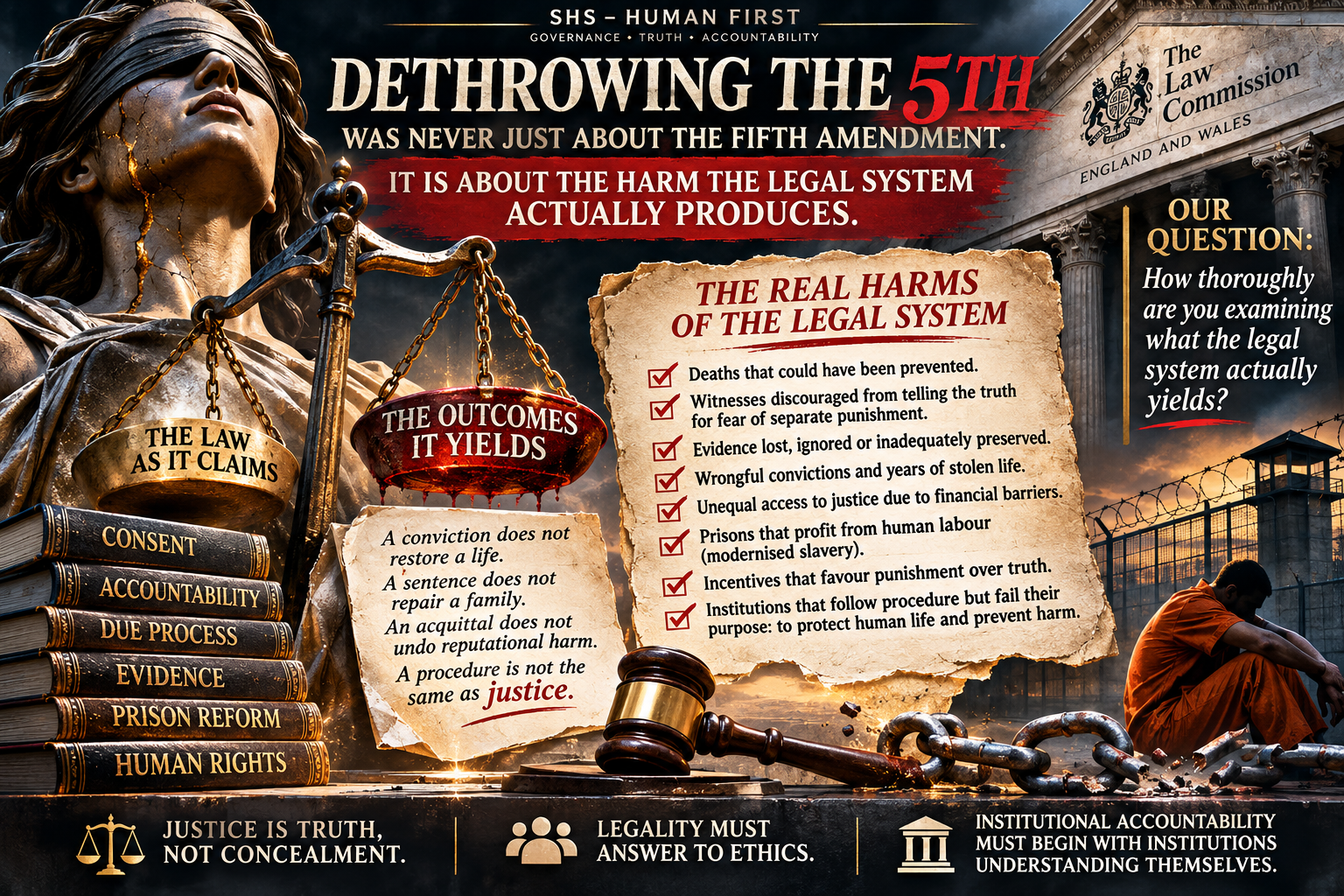
The question is: ” Why does our legal systems reform themselves for cowards and liars, but not for truth, what it was supposed to.. “
WHEN LAW BECOMES AN INDUSTRY, HUMAN SUFFERING BECOMES PART OF ITS ECONOMY.
— SNW | SHS – HUMAN FIRST
20 November 2026
Oh, the Law Commission.
You see, the Fifth Amendment was merely one entry point into a much larger investigation.
We are not investigating one legal protection. We are investigating the entire organisation of justice, what it incentivises, what it permits, what it fails to prevent, and what humanity has actually received as a consequence.
Because what is the purpose of a legal system?
To establish the truth? To protect human life? To prevent harm? To establish accountability? To restore what can be restored and ensure that what cannot be restored is not unnecessarily lost again?
Or has the administration of justice become so occupied with procedures, convictions, punishments, professional interests and institutional self-preservation that we have forgotten to examine what the machinery itself produces?
Look at the consequences.
A person dies. We investigate the murderer, but how thoroughly do we investigate everyone who knowingly permitted the circumstances that led to that death?
A witness knows something. We tell society, “If you see something, say something.” Then we operate legal procedures in which revealing information can expose that witness to entirely separate proceedings, creating incentives to remain silent.
Evidence disappears. We discuss evidential limitations, but how thoroughly do we investigate who was responsible for preservation, what precautions were taken, and whether the loss could have been prevented?
A person is wrongfully convicted. They can lose years of their life, relationships, opportunities, health and freedom. Even when the conviction is overturned, who can return the continuity of life they were denied?
A person is harmed and cannot afford adequate legal representation. How meaningful is equal justice when the ability to pursue it is shaped by financial resources?
A prison population becomes a source of labour. In the United States, the Thirteenth Amendment expressly retains an exception allowing involuntary servitude as punishment for crime. We should be investigating whether laws, prison contracts and commercial incentives create financial interests in incarceration. The existence of those incentives warrants examination; it is not, by itself, proof of bribery or collusion.
And when a legal institution says that its procedures were followed, are we supposed to consider the investigation complete?
Following a procedure is not the same as fulfilling its purpose.
A conviction does not restore a life.
A sentence does not automatically repair a family.
An acquittal does not necessarily repair reputational destruction.
A settlement does not necessarily correct the institution that produced the harm.
And an institution declaring that something falls outside its remit does not establish that every question within the original enquiry was properly examined.
This is the distinction between PERFORMATIVE LAW AND ETHICAL LAW.
We are not proposing that investigators should manufacture evidence, compel false confessions or disregard the rights of people accused of crimes.
We are proposing something much more fundamental:
Build the system so that telling the truth serves justice rather than becoming an opportunity for indiscriminate punishment.
Protect witnesses inside court, not merely outside it.
Examine the responsibility of people who knowingly conceal serious wrongdoing.
Investigate the disappearance of evidence as seriously as the consequences of its disappearance.
Separate unrelated offences from the central investigation and assess them proportionately.
Examine preventable deaths through every relevant contribution, action and omission.
Eliminate exploitative incentives from incarceration.
Measure the success of justice through truth established, harm prevented, lives protected, errors corrected and institutions improved.
And above all, hold the organisations responsible for reviewing the law accountable for how they exercise that responsibility.
This is why the Law Commission’s response to SHS – HUMAN FIRST matters.
Our enquiry raised questions about statutory authority, consent, institutional accountability, alternative governance and the mechanisms available to challenge existing arrangements.
Their answer concentrated on powers they do not possess, without explaining whether the law-reform dimensions had been separately considered.
Yet Section 3 of the Law Commissions Act 1965 establishes their responsibilities for reviewing the law of England and Wales, considering reform proposals and recommending changes.
They do not control every court, prosecution, prison or legislative decision. But examining and recommending reforms to the law is precisely their institutional purpose.
So we ask:
How thoroughly are you examining what the legal system actually yields?
How are you identifying the laws that contribute to preventable harm?
How are you assessing whether existing protections produce the consequences they were designed to prevent?
And when a human being challenges the foundations of those arrangements, why does your written response explain what you cannot do without clearly accounting for what you can?
We have documented the interaction in our Institutional Accountability Notice, alongside the broader questions raised in Dethrowing the 5th.
Our intention is to use institutional correspondence, evidence, public scrutiny, reform submissions and, where legally supported, collective legal proceedings to examine responsibility.
Not for the pleasure of punishing institutions.
Not to win another argument.
But because accountability should produce correction, not merely recognition that something went wrong.
The system itself must become subject to the same seriousness of examination that it demands from the people living under it.
And here is the question I want humanity to consider:
If a legal system follows its own rules while repeatedly producing preventable human suffering, who is responsible for investigating the rules themselves?
That is where SHS – HUMAN FIRST enters the conversation.
We are not interested in simply dethroning the Fifth Amendment. That is an American provision within a much wider international landscape of legal protections.
We are examining the design, incentives and outcomes of legal systems themselves.
The goal is not to determine how many people can be punished. The goal is to determine how much truth can be established, how much harm can be prevented, and how much human life can be protected.
Because the law is not humanity’s highest achievement merely because it exists.
Its worth must be examined through what it actually does for humanity.
JUSTICE IS TRUTH, NOT CONCEALMENT.
LEGALITY MUST ANSWER TO ETHICS.
AND INSTITUTIONAL ACCOUNTABILITY MUST BEGIN WITH INSTITUTIONS UNDERSTANDING THEMSELVES.
— SNW
Metaphysical Legal Representative | SHS Governance
SHS – HUMAN FIRST
Accompanying document: SHS – HUMAN FIRST, Institutional Accountability Notice to the Law Commission, 20 November 2026.
This is an institutional critique and programme of proposed reforms. Allegations of individual misconduct, collusion or unlawful failure require independently established evidence.






Leave a Reply