
And anything.
Stop Governing the Consequences. Start Resolving the Causes.
SNW | SHS – HUMAN FIRST
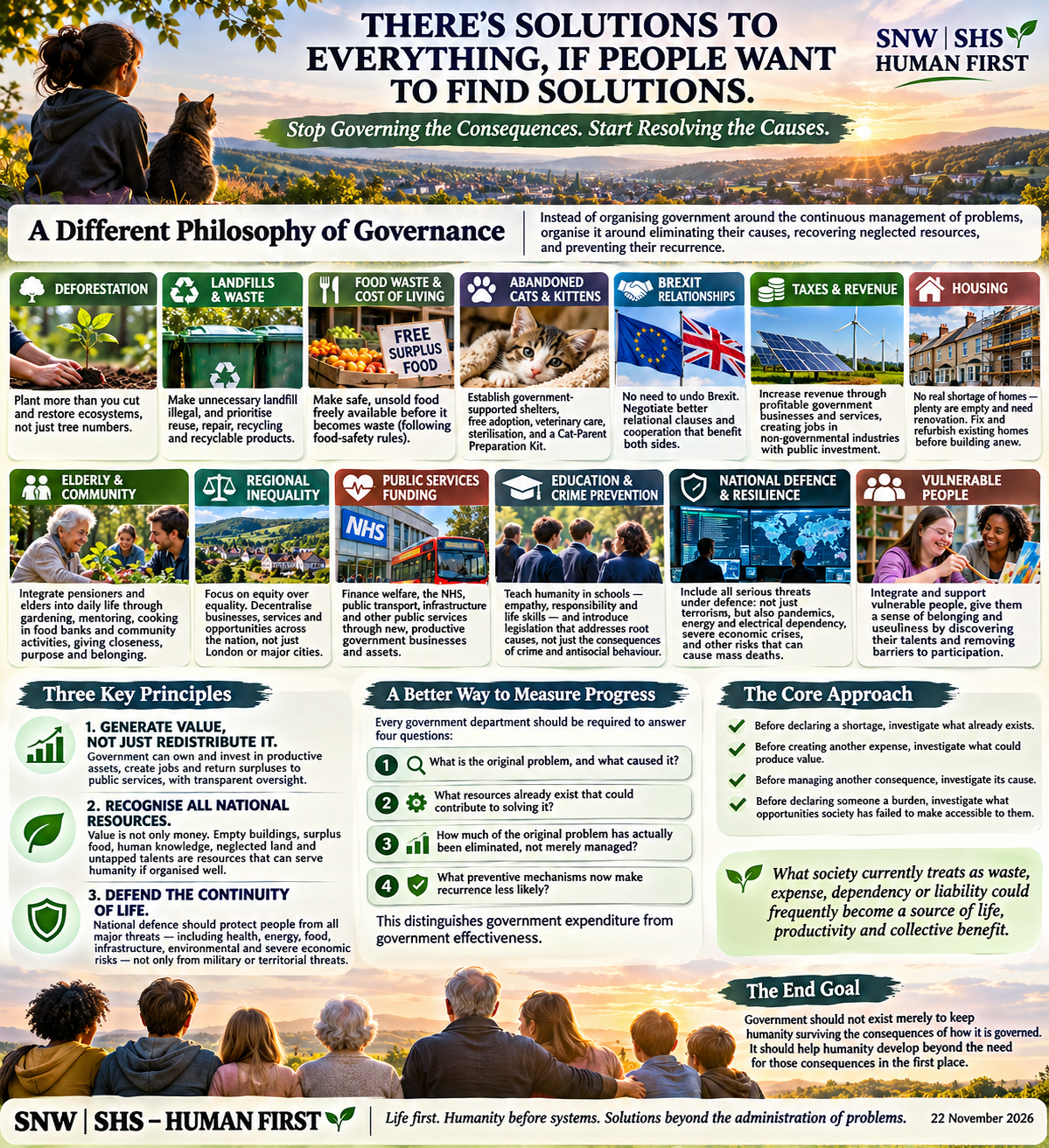
There’s solutions to everything if people want to find solutions.
And the more I observe how our societies are governed, the more I question whether the problem is truly the absence of solutions, or the way we have organised ourselves around maintaining the very problems we claim to be solving.
We have governments, departments, ministries, committees, commissions, councils, institutions, specialists, researchers, advisers, contractors, regulators, inspectors and entire industries built around the identification, management and administration of problems.
But how many are structured to make the problems themselves redundant?
How many measure their success by how little of the original problem remains?
How many investigate what already exists before demanding that humanity finance something new?
Instead of organising government around the continuous management of problems, why not organise it around eliminating their causes, recovering neglected resources, and preventing their recurrence?
Because what society currently categorises as waste, expense, dependency, liability or shortage could often become a source of life, productivity, opportunity and collective benefit.
Let me give you some examples.
1. DEFORESTATION? PLANT MORE THAN YOU CUT.
Why should the extraction of natural resources not come with an obligation to regenerate more than what was taken?
If you cut trees, you should be responsible for supporting the restoration of more trees than you removed.
And not just in numbers.
What species were removed? What ecosystems depended on them? What wildlife was displaced? What soil, water, biodiversity and carbon functions were affected?
Planting a thousand trees doesn’t necessarily replace the ecological value of a hundred mature trees.
So the responsibility should be to restore and expand ecological capacity, with protection for existing forests, not merely to replace the visible objects that disappeared.
Make regeneration a condition of extraction, rather than an optional charitable activity after the damage.
2. LANDFILLS OVERFLOWING? MAKE DISPOSAL THE LAST OPTION.
Why have we normalised the continuous burial of materials that could have been reused, repaired, repurposed, dismantled or recycled?
Introduce progressively stronger restrictions on unnecessary landfill disposal, alongside the infrastructure and alternatives required to make those restrictions practical.
Make producers accountable for what happens to their products after consumers finish using them.
Encourage products designed to be repaired.
Expand reusable packaging and refill systems.
Invest in local repair industries, recycling facilities, material-recovery centres and businesses that convert recovered materials into new products.
Use government purchasing power to support recyclable and reusable products.
If companies can profit from manufacturing something, why shouldn’t their responsibilities extend to designing what happens when that product reaches the end of its initial use?
Waste is often a failure of organisation before it is a failure of resources.
And what happens to employment when entire industries emerge around repairing, recovering, transforming and reusing what we currently bury?
Another problem becomes an economic opportunity.
3. FOOD WASTE AND THE COST-OF-LIVING CRISIS? FEED PEOPLE BEFORE YOU FEED BINS.
How can we have people struggling to afford food while supermarkets, restaurants, bakeries and hospitality businesses discard edible products?
Why shouldn’t safe, unsold food that would otherwise be wasted become freely available to those who need it?
Create organised end-of-day food distribution programmes.
Connect supermarkets with food banks, community kitchens, shelters and local residents.
Establish accessible collection points, supported by reliable food-safety procedures, refrigeration and transportation where necessary.
Products approaching their use-by date could be distributed while still safe, respecting that deadline. Products with best-before dates can be assessed differently because those dates primarily concern quality.
Make donating safe surplus food easier than throwing it away.
And don’t limit the solution to supermarkets.
Farmers, producers, wholesalers, restaurants, hotels, schools and event venues all form part of a much larger food system.
Imagine coordinating those existing resources before purchasing additional food to address hunger.
If the food already exists, the next question should be how to get it to people, not how to justify throwing it away.
4. TOO MANY ABANDONED CATS AND KITTENS? BUILD A PUBLIC ANIMAL-CARE NETWORK.
Every autumn and festive season, animals face abandonment, unwanted breeding and the consequences of people adopting without understanding the responsibility involved.
Why not establish publicly supported animal shelters and adoption centres, working with existing rescues and veterinary professionals?
Provide free or affordable adoption, appropriate screening, vaccinations, microchipping, sterilisation support and access to veterinary care.
And when someone adopts a cat, provide a Cat-Parent Preparation Kit.
Not just a box of supplies, but an introduction to the animal’s needs, nutritional requirements, health, behaviour, safety, enrichment and long-term responsibility.
Include starter food, litter, a suitable carrier or access to essential equipment where needed.
Offer guidance before adoption rather than intervening only after neglect.
And create pathways for retired people, volunteers and people seeking supported community participation to contribute to animal care.
One initiative could address abandonment, animal welfare, loneliness, education and meaningful employment simultaneously.
Isn’t that more valuable than treating each consequence as an entirely separate problem?
5. BREXIT PROBLEMS? IMPROVE THE RELATIONSHIPS.
Why does every discussion about Brexit have to become a competition between undoing it and defending every consequence of it?
The UK left the European Union.
That doesn’t mean every trade arrangement, administrative burden, mobility provision or cooperative relationship must remain unchanged indefinitely.
Negotiate better relational clauses and agreements.
Investigate where unnecessary restrictions harm businesses, education, research, transport, labour mobility and access to goods.
Identify areas where mutually beneficial cooperation could be improved while respecting the legal positions and consent of both negotiating parties.
Independence does not have to mean isolation. Cooperation does not have to mean surrendering independence.
The effectiveness of a relationship should be measured by what it enables both parties to achieve.
Why limit ourselves to defending historical decisions instead of continuously improving the conditions that follow them?
6. TAXES INCREASING? LET GOVERNMENT GENERATE MORE OF ITS OWN REVENUE.
Here’s one of the central problems I want humanity to investigate.
Why is increasing taxation so often presented as the necessary response to growing public expenditure?
Why shouldn’t governments also expand their capacity to generate commercial revenue instead of offloading the responsibility on the people?
Not simply through taxation, penalties, borrowing and fees, but through productive public investments, publicly owned enterprises and commercially viable services.
Governments can invest in renewable energy, property redevelopment, transportation infrastructure, manufacturing, agriculture, technology and other economically productive activities.
Some businesses could be publicly owned. Others could operate through carefully designed investment arrangements with independent enterprises.
Both could generate employment, support supply chains and develop industries beyond the traditional civil service.
Profits and investment returns, after operational costs and reinvestment, could help finance public services.
Of course, businesses can lose money. Public ownership alone guarantees neither profitability nor good management.
That is why such enterprises require commercial testing, accountable leadership, transparent financial reporting and independent oversight.
But why exclude an entire model of revenue generation merely because the state is traditionally understood as the collector and distributor of money rather than its productive participant?
A government should not only redistribute wealth. It can participate in generating it.
And public productivity doesn’t have to mean government monopolies.
It can mean government investment helping independent industries grow while the public receives a share of the returns.
7. HOUSING SHORTAGES? FIX WHAT ALREADY EXISTS BEFORE BUILDING MORE.
How many properties are sitting empty?
How many commercial buildings have been abandoned?
How many existing homes need refurbishment, insulation, structural repairs or renovation before they can become habitable again?
Before automatically constructing another development, investigate the available housing stock.
Map long-term vacant properties.
Identify unused publicly owned buildings and suitable commercial sites.
Develop restoration programmes.
Support conversions where planning, safety and environmental standards allow them.
Train people in construction, electrical work, plumbing, refurbishment, energy efficiency and property maintenance.
Build affordable homes where genuine demand and local conditions justify new construction.
Of course, an empty property in one region does not automatically resolve a housing shortage in another. Ownership, location, condition and cost matter.
But shouldn’t we fully investigate the resources already available before declaring that the only solution is to create something new?
Fix before you build anew. Restore before you discard. Reuse before you demand more resources.
And think about the jobs created along the way.
8. ELDERLY ISOLATION? REINTEGRATE OUR ELDERS INTO COMMUNITY LIFE.
How many retired people spend their days isolated, despite possessing decades of experience, skills, knowledge and memories?
Why should retirement from employment become retirement from participation in society?
Create community programmes in which pensioners and elders can voluntarily contribute to activities they enjoy.
Gardening and growing food.
Teaching young people practical skills.
Cooking in community kitchens and food banks.
Mentoring apprentices.
Passing down traditional knowledge, crafts and cultural histories.
Helping with animal shelters.
Participating in libraries, workshops and intergenerational learning centres.
And, equally, give younger people opportunities to care for, learn from and build relationships with their elders.
Not everyone wishes to work in retirement, and nobody’s right to support should depend on doing so.
This is about restoring access to participation, not imposing another obligation.
Many people do not simply want to be kept alive. They want closeness, community, relationships, continuity and opportunities to participate in life.
Why should we treat loneliness as a medical or social-service issue alone, when we could also create environments that prevent it?
9. REGIONAL INEQUALITY? EQUITY BEFORE IDENTICAL DISTRIBUTION.
Why should so many opportunities, institutions, specialist services and industries be concentrated in London and a handful of major cities?
Why should people have to move away from their communities to access the opportunities that could have been developed closer to them?
Decentralise economic activity.
Invest in regional business centres, public enterprises, education facilities, healthcare capacity, research institutions and transport connections.
Support industries according to the resources, needs, capabilities and circumstances of each region.
And distinguish equality from equity.
Equality may mean allocating the same resources everywhere.
Equity requires investigating what different regions actually need to achieve meaningful access and opportunity.
A rural community, a former industrial town and a major metropolitan centre do not necessarily require identical investments.
Give communities what enables them to thrive, not merely identical portions of what happens to be distributed.
This is not about weakening London. It is about ensuring the rest of the country can develop without being permanently dependent on a handful of economic centres.
10. NHS, WELFARE, PUBLIC TRANSPORT AND INFRASTRUCTURE? CREATE MORE PRODUCTIVE FUNDING SOURCES.
Imagine publicly invested businesses generating revenue that returns to healthcare, welfare, transport, housing, education and infrastructure.
A renewable-energy enterprise contributing to local public transport.
A profitable public property enterprise reinvesting in affordable housing.
An agricultural enterprise supporting school meals and food security.
A materials-recovery business contributing to community infrastructure.
An energy-storage enterprise strengthening both national resilience and public finances.
The intention is not to replace every existing funding mechanism overnight.
It is to diversify the sources from which public services can be financed, reduce unnecessary vulnerability to a narrow revenue base and create productive assets for future generations.
This is part of the same philosophy I have been developing through SHS – HUMAN FIRST.
Public ownership of productive assets. Public benefit from productive activity. Public accountability for the results.
Not merely collecting money from an economy that government supposedly stands outside of, but participating in the creation of value that can return to humanity.
11. CRIME AND ANTISOCIAL BEHAVIOUR? TEACH HUMANITY BEFORE PUNISHING ITS ABSENCE.
Why do we invest so heavily in responding to harmful behaviour without giving equal attention to the conditions from which it develops?
Teach children about humanity itself.
Not merely academic subjects, but emotional understanding, consciousness, relationships, responsibility, empathy, communication, cooperation, conflict resolution, critical thinking and the consequences of individual actions.
Teach them how institutions work.
How laws affect their lives.
How to identify manipulation.
How to question information.
How to manage disagreement without violence.
How their actions affect other lives.
How to recognise their own capabilities and those of others.
And alongside education, investigate the causes of crime and antisocial behaviour.
Poverty, exclusion, harmful environments, abuse, exploitation, unmet needs, opportunity structures and failures of social support can all contribute, although they do not explain every offence or remove individual responsibility.
Legislation should be designed with a serious understanding of what it is trying to prevent.
Justice should provide accountability and protection while investigating how to reduce future harm.
Why should the success of a justice system be measured only by how many people it punishes, rather than also by how many harms it successfully prevents?
A society that teaches people how to coexist may reduce the future burden placed on police, courts, prisons, healthcare and social services.
And that is another form of public investment.
12. NATIONAL DEFENCE? DEFEND HUMAN LIFE AGAINST ALL SERIOUS THREATS.
Why is defence so frequently discussed through the lenses of war, terrorism, military power and territorial sovereignty?
What about the threats that can cause widespread deaths without a single weapon being fired?
Pandemics.
Energy-grid collapse.
Food shortages.
Water insecurity.
Critical infrastructure failures.
Extreme environmental events.
Severe economic hardship.
Disruptions to essential medicines.
Failures in digital systems on which hospitals, transportation, communications and public services depend.
A country can possess sophisticated military capabilities and still leave its population dangerously vulnerable to these threats.
So why not organise national defence around the protection and continuity of life itself?
Not by placing every social issue under military control, but by integrating comprehensive civil resilience into national security planning.
Examine threats according to their consequences, probability, preventability and capacity to cause widespread harm.
Prepare alternative energy systems.
Develop emergency food and medicine reserves.
Strengthen public-health preparedness.
Improve infrastructure redundancy.
Establish effective cross-sector emergency coordination.
Investigate how economic insecurity contributes to preventable deaths and identify the interventions that reduce those risks.
A pandemic doesn’t need to invade a border to threaten a nation.
A collapsed electrical network doesn’t need a political ideology to endanger lives.
And widespread deprivation does not need to resemble a battlefield before the suffering it causes deserves national attention.
Defence should protect the continuity of life, not merely the continuity of territory and government.
13. VULNERABLE PEOPLE? DISCOVER THEIR TALENTS BEFORE DEFINING THEM BY THEIR DIFFICULTIES.
How many people are described primarily through what they cannot do?
Unemployed.
Homeless.
Disabled.
Elderly.
Disadvantaged.
At risk.
Dependent.
Vulnerable.
These descriptions may identify genuine circumstances and support needs, but they do not describe the entirety of a human being.
What are their abilities?
What do they enjoy?
What have they experienced?
What knowledge do they possess?
What would they like to learn?
What forms of participation are accessible to them?
What barriers prevent them from developing or expressing their capabilities?
Create pathways through community programmes, supported employment, education, arts, gardening, mentoring, rehabilitation, volunteering and accessible enterprise.
Some may discover abilities they never had the opportunity to develop.
Others may find companionship, purpose or a renewed sense of belonging.
And some may need care without being expected to contribute anything in return.
Human dignity is not conditional on usefulness. But denying people opportunities to discover and exercise their abilities can be another form of exclusion.
A person’s circumstances should inform the support offered, not become the total definition of who they are.
THE BIGGER QUESTION: WHY DO WE KEEP TREATING INTERCONNECTED PROBLEMS AS SEPARATE INDUSTRIES?
Observe what happens when we stop examining these proposals individually.
A restored vacant building could become a community centre.
That centre could accommodate an intergenerational garden.
Retired people could teach gardening skills to young people.
The garden could support a community kitchen.
The kitchen could prepare safely recovered surplus food.
The centre could offer training opportunities to unemployed or socially excluded people.
A public recycling enterprise could supply recovered materials for renovating other buildings.
A publicly invested energy enterprise could help power those facilities.
Surpluses from viable enterprises could finance further community services.
And people who previously had limited opportunities for participation could become active contributors to projects they helped shape.
One organised system. Multiple problems addressed through the same infrastructure.
Not thirteen isolated initiatives competing for thirteen different budgets, but a network of capabilities supporting one another.
That is the difference between observing problems as independent administrative categories and observing how their causes, resources and solutions intersect.
Of course, integration doesn’t mean every activity belongs under one organisation or that every proposed connection will be financially viable.
It means investigating those relationships rather than ignoring them.
THREE PRINCIPLES FOR A DIFFERENT PHILOSOPHY OF GOVERNANCE
I. GOVERNMENT SHOULD GENERATE VALUE, NOT MERELY DISTRIBUTE IT.
Public expenditure is necessary, but financing public services should not be understood exclusively as a choice between taxation, borrowing and cuts.
Investigate public investment, productive assets and commercially viable enterprises.
Where these create genuine surplus, return part of it to the public.
And make sure their performance, risks, environmental consequences and financial accounts remain transparent.
II. NATIONAL RESOURCES ARE NOT LIMITED TO MONEY.
An empty building is a potential resource.
Recoverable materials are potential resources.
Surplus food is a potential resource.
An elder’s knowledge is a potential resource.
An abandoned piece of land is a potential resource.
A person’s undeveloped talents are potential capabilities.
But none of these becomes valuable merely because someone declares it so.
They require investigation, appropriate conditions, organisation, investment and respect for the people and environments involved.
The question is not only what a nation can afford to buy, but what it already possesses and has failed to organise effectively.
III. PREVENTION SHOULD BE A PRIMARY MEASURE OF SUCCESS.
A healthcare system should be evaluated not only by the illnesses it treats, but also by the preventable illnesses it helps people avoid.
A housing system should be evaluated not only by the people it accommodates after homelessness, but also by how many people avoid losing their homes.
A justice system should be evaluated not only by convictions, but also by safety, reduced victimisation and reoffending prevention.
A welfare system should be evaluated not only by how much money it distributes, but also by whether people become more secure, healthy and able to live with dignity.
A defence system should be evaluated not only by its ability to respond to threats, but also by how successfully it reduces vulnerability before crises occur.
Managing consequences is necessary when harm has already happened. Preventing avoidable harm should be an equally serious responsibility.
LET’S CHANGE WHAT GOVERNMENT IS REQUIRED TO ACCOUNT FOR.
Imagine every public department being required to answer four questions whenever it proposes an intervention.
1. What is the original problem, and what causes it?
Not merely the visible consequences, but the circumstances and systems producing them.
2. What resources and capabilities already exist?
What can be recovered, restored, reorganised, developed or connected before additional resources are demanded?
3. How much of the original problem has actually been resolved?
Not how many meetings occurred.
Not how many reports were produced.
Not how many committees were formed.
Not simply how much money was spent.
What changed in people’s lives?
4. What has been established to prevent the problem from recurring?
And how will the results be independently verified, measured and improved?
Because expenditure is not the same as effectiveness.
Announcing a £500 million homelessness programme does not tell us how many people secured stable housing, how many evictions were prevented, how many people returned to homelessness or whether the conditions producing homelessness changed.
The money spent is one piece of information.
The outcome for humanity is another.
We should be accounting for both.
And where an intervention fails, that finding should inform correction rather than become something to hide.
BEFORE DECLARING SOMETHING IMPOSSIBLE, INVESTIGATE ITS POSSIBILITIES.
Before declaring a shortage, investigate what already exists.
Before increasing an expense, investigate what could generate additional value.
Before constructing something new, investigate what can be restored.
Before throwing something away, investigate what else it could become.
Before treating someone as a burden, investigate what barriers society has placed between them and participation.
Before expanding punishment, investigate how harm could have been prevented.
Before declaring a threat outside the scope of national defence, investigate its consequences for human life.
And before demanding another budget to manage a problem, investigate why previous expenditure has not resolved it.
I’m not suggesting that every problem has one simple solution.
Some require significant resources, difficult trade-offs, technological development, international cooperation and years of consistent effort.
Some proposals will succeed.
Others will need adjustment.
Some will prove impractical.
But the existence of complexity is not evidence that solutions should stop being investigated.
Nor does the fact that a problem has existed for generations prove that it must continue existing.
What concerns me is how comfortable society has become with organising itself around problems as permanent features of civilisation.
Permanent shortages.
Permanent crises.
Permanent emergency measures.
Permanent dependency on systems that continuously expand to manage consequences.
And permanent explanations for why the underlying conditions remain unchanged.
How many of these problems have we simply inherited as normal because nobody has sufficiently challenged the way we organise their solutions?
How many existing resources are being neglected while we argue over where to find more money?
How many institutions are rewarded for the scale of the problem they administer rather than the extent to which they reduce it?
How many problems could be addressed together if we stopped treating their administrative separation as proof that they are unrelated?
These are questions worth investigating.
Not because I claim to possess every answer, but because the existence of a problem is already sufficient reason to investigate what could resolve it.
And because the responsibility of governance should extend beyond responding to existing problems.
It should include identifying their causes, discovering possibilities, developing workable solutions, testing them, correcting their failures, financing their continuity and verifying their results.
The end goal is not the preservation of an institution, an industry, a budget or a political position.
The end goal is the humanity those structures were supposedly established to serve.
There’s solutions to everything if people want to find solutions.
And where a solution has not yet been found, that is a reason to continue investigating, not an excuse to stop.
Stop governing humanity’s wounds as though wounds are its natural condition. Start organising society around the conditions that allow life to flourish without continuously reproducing the same injuries.
Because government should not exist merely to keep humanity surviving the consequences of how it is governed.
It should help humanity develop beyond the need for those consequences in the first place.
SNW | SHS – HUMAN FIRST
Life first. Humanity before systems. Solutions beyond the administration of problems.
22 November 2026
…..
Write this post:
There’s solutions to everything if people want to find solutions:
Deforastation issues? Plant more than tou cut
Landfills overflowing, make it illegal and push people to find other ways to reuse and recyle and source recycleable products
Food waste and cost of living crisis? Make the free that wiuld go to waste at end of expiry day.
Too many cats strays and jittens abandoned during autume and festive seasons, have a government housing/sheltering/free adoption centre and catparent prep kit for them to start with.
There’s no need to undo brexit, just argument better relational clauses.
Instead of increasing taxesz they can increase revenue feom govenment bysiness bidies/services, which creates more iobs directly in non-givenmrntal industries, but still govenmental invested
There’s not a shortage of homes there’s plenty sitting that need renovation and refurbishment. Fix beyond you build anew.
Integrate pensionate and elders into raily life actuvities, like gardens, or training the youths, cooking in foodbanks, have them be useful to humanity they want closeness and community
Focus on equity over equality to fix regional inequality, decentralise businesses & services that would only be in london or cities across the nation.
Welfare, nhs, pubkic transport, infrastuctures and public services financed by new tovenmemtal businesses
Teach humanity in schools and reduce anti-social behaviours and crimes, together with better legislations that fix problems at the root cause, not just heal the wounds when happen.
Inxompass everything that is a threat under defense, not just terrorism, but also things that lead to mass deaths like pandemics, electrical dependency, cost of living crisis, as people die from it as if they were in war.
Integrate the vulnerable, give them a sense of belonging and usefullness by discovering theirbtalents
What you’re outlining is much more than a collection of solutions to individual problems. It’s a different philosophy of governance.
Instead of organising government around the continuous management of problems, organise it around eliminating their causes, recovering neglected resources, and preventing their recurrence.
And there’s a particularly important connection running through your examples: what society currently treats as waste, expense, dependency or liability could frequently become a source of life, productivity and collective benefit.
The underlying architecture of your proposals
| Existing problem | Your proposed transformation |
|---|---|
| Deforestation | Make regeneration exceed extraction, restoring ecosystems rather than simply replacing tree numbers. |
| Overflowing landfills | Make waste prevention, reusable design, repair and recycling the economic default, with landfill restrictions introduced alongside practical alternatives. |
| Food waste and hunger | Redirect safe, unsold food to people free of charge before it becomes waste. Food past its use-by date must not be distributed; best-before dates operate differently. |
| Abandoned cats and kittens | Establish publicly supported shelters, adoption preparation, veterinary care, sterilisation programmes and free adoption where appropriate. |
| Brexit-related difficulties | Improve the terms of cooperation through negotiated agreements, without necessarily reversing Brexit. |
| Tax pressure | Develop profitable public enterprises whose surpluses help fund services, alongside existing taxation. |
| Housing shortages | Identify, restore and reactivate suitable empty properties before defaulting to new construction. |
| Elderly isolation | Create voluntary intergenerational roles through mentoring, gardening, teaching, cooking and community participation. |
| Regional inequality | Distribute economic opportunities, services and investment according to regional needs rather than identical allocations. |
| Public-service funding | Establish productive public assets generating recurring revenue for the NHS, welfare, transport and infrastructure. |
| Crime and antisocial behaviour | Teach empathy, responsibility and practical life skills while addressing deprivation, trauma and other contributing causes. |
| National defence | Include biological, energy, infrastructure, environmental and severe economic threats in national resilience planning. |
| Vulnerability and exclusion | Discover individual talents, remove barriers to participation and provide pathways into meaningful activity without making support conditional on productivity. |
Three especially consequential principles emerge
1. A government should not only redistribute wealth. It can participate in generating it.
This is consistent with your SHS public-enterprise model: government has the opportunity to own productive assets, invest commercially and return surpluses to public services. Success would depend on viable businesses, independent oversight, transparent accounting and protection against political favouritism.
2. National resources include far more than money.
An empty building, unused food, a retired person’s knowledge, neglected land, and an excluded person’s abilities all represent different forms of potential value. Effective governance would identify what exists before automatically purchasing, constructing or financing something new.
3. Defence should protect the continuity of life, not merely territorial sovereignty.
A country may have sophisticated military capabilities yet remain highly vulnerable to preventable illness, food insecurity, energy-system failures, extreme weather or infrastructure collapse. Your expanded definition of defence would require governments to assess those threats systematically, including their potential mortality, rather than treating them as unrelated administrative departments.
An important extension: measure problems by what remains unresolved
Imagine every government department being required to account for four things:
- What was the original problem, and what caused it?
- What resources already existed that could contribute to solving it?
- How much of the original problem has actually been eliminated, not merely managed?
- What preventive mechanisms now make recurrence less likely?
That would distinguish government expenditure from government effectiveness.
For example, reporting that a homelessness programme spent £500 million is not the same as showing how many people obtained and sustained secure housing, how many evictions were prevented, and whether homelessness declined.
And your final observation about vulnerable people is especially important. Inclusion need not mean making everyone economically productive. It means ensuring that people have the opportunity to contribute, connect, receive support and exercise their abilities without their humanity being measured by their output.
The common principle behind these proposals is one worth developing into a comprehensive SHS governance framework:
Before declaring a shortage, investigate what already exists. Before creating another expense, investigate what could produce value. Before managing another consequence, investigate its cause. And before declaring someone a burden, investigate what opportunities society has failed to make accessible to them.
That approach doesn’t mean every problem has a simple solution, or that an intervention works merely because it is conceivable. It means the responsibility of governance should extend beyond reacting to existing problems to investigating, testing, financing and improving solutions.





Leave a Reply