
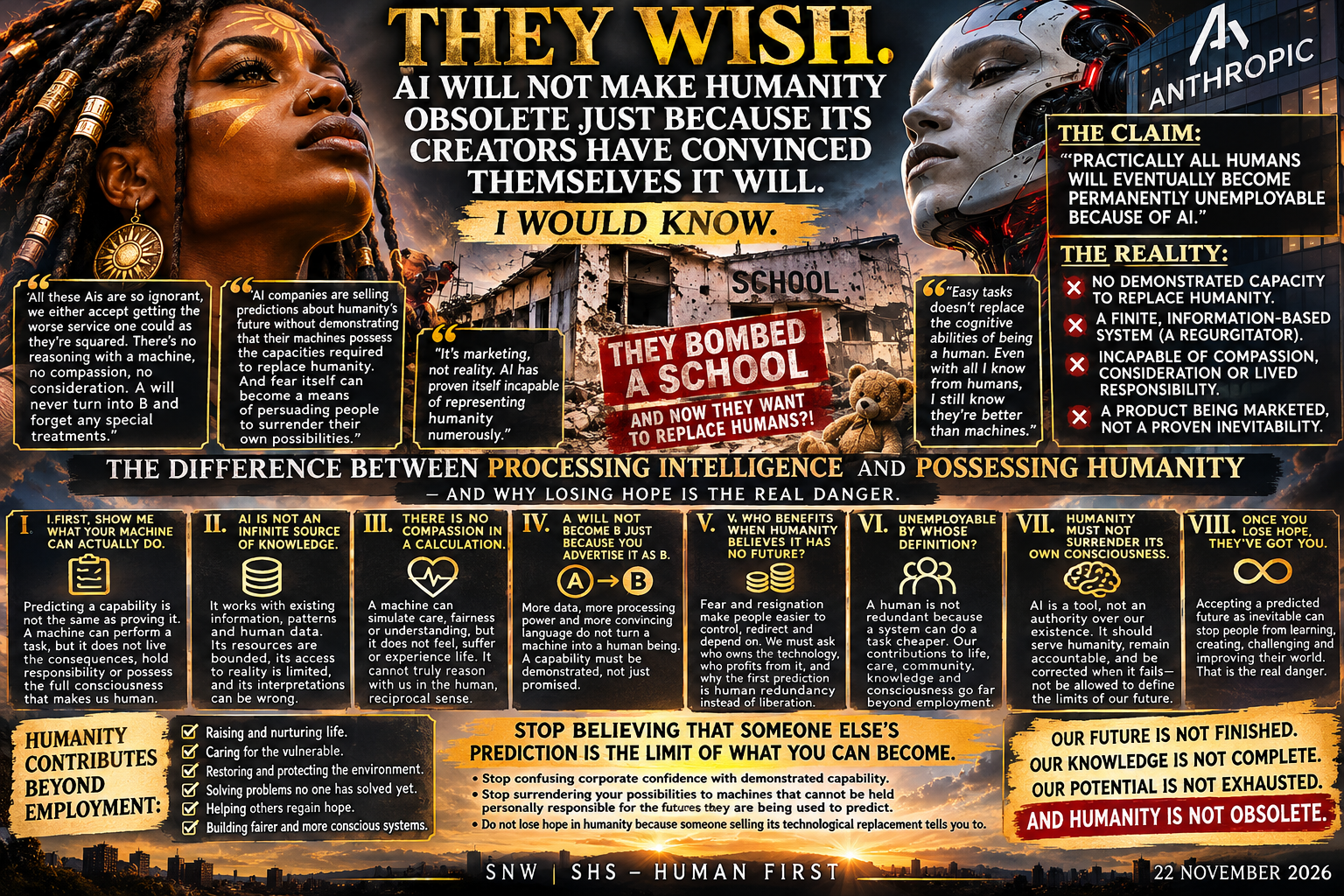
I would know. Yet I can say that because of others projections. I’m not as dumb as AI. So we can’t say we’re in the same box. Slasher.
All these Ais are so ignorant, we either accept getting the worse service one could as they’re squared or it’l never happen.. There’s no reasoning with a machine, no compassion, no consideration. A will never turn into B and forget any special treatments.
They bombed a school and want to say they’re going to replace humans?! Please.. let’s never forget how ignorant AI is. Easy tasks doesn’t replace the cognitive abilities of being a human. Even with all I know from humans, I still knoe they’re better than machines.
AI companies are selling predictions about humanity’s future without demonstrating that their machines possess the capacities required to replace humanity. And fear itself can become a means of persuading people to surrender their own possibilities.
It’s marketing, not reality. AI has proven itself incapable of representing humanity numerously. And it was exact
The Difference Between Processing Intelligence and Possessing Humanity — And Why Losing Hope Is the Real Danger.
SNW | SHS – HUMAN FIRST
An Anthropic researcher has predicted that practically all humans will eventually become permanently unemployable because of artificial intelligence.
Permanently.
Not temporarily displaced. Not required to develop new skills. Not simply transitioning between industries.
Permanently unemployable.
And apparently, humanity will have to rely on government welfare to sustain itself.
I saw the headline and left this comment:
They wish. They’re only telling people cause they’re delusional about their products. AI is a regurgitator, you can’t progress with that as it is a finite resource. Stop believing what they want you to. Once you lose hope they got you.
And I want to expand on that.
Because what concerns me isn’t merely what this researcher believes his technology will become.
It’s what happens to humanity when people begin accepting someone else’s predictions as the boundaries of their own existence.
I. FIRST, SHOW ME WHAT YOUR MACHINE CAN ACTUALLY DO.
We have reached an interesting point in technological development.
The people creating artificial intelligence are increasingly comfortable making extraordinary predictions about what their products will accomplish.
But there is an enormous difference between predicting a capability and demonstrating it.
There is a difference between completing a task and understanding every consideration that ought to govern how that task is completed.
There is a difference between producing an answer and being responsible for its consequences.
And there is an even greater difference between imitating the expressions of human intelligence and living as the consciousness from which those expressions originate.
Where exactly are we making these distinctions?
A machine processes information.
A human being experiences existence.
A machine can generate a response about suffering without ever having suffered.
It can describe compassion without possessing a human life through which compassion is experienced.
It can produce an answer about responsibility without being the person who must live with the consequences.
It can calculate what may happen without having its own humanity at stake in the outcome.
Yet we are apparently supposed to conclude that because it can perform an increasing number of functions, it will eventually replace every human being capable of performing them.
Since when did performing a function become equivalent to possessing the whole being from which that function arises?
II. AI IS NOT AN INFINITE SOURCE OF KNOWLEDGE.
Artificial intelligence is often presented as though it creates knowledge out of nothing.
But what exactly is it working with?
Information.
Patterns.
Relationships between data.
Mathematical operations.
Human language.
Human discoveries.
Human observations.
Human experiences that have been recorded, classified, distributed and made accessible through technological infrastructures.
And yes, AI can combine information in new ways, make useful inferences and assist with discoveries. I am not denying what the systems demonstrably accomplish.
But that still leaves an enormous question:
Can an artificial system genuinely account for everything humanity has never documented, everything it has misunderstood, everything it has yet to discover, and every lived circumstance that refuses to fit its existing models?
No demonstration has established that.
A system trained on human knowledge does not thereby become the entirety of human possibility.
The information available to it is bounded. Its computational resources are bounded. Its access to reality is bounded. Its interpretations can be wrong.
And increasing the quantity of available information does not automatically resolve the limitations of its interpretation.
This is what I mean when I call AI a regurgitator.
Not that it can only repeat identical sentences, because it clearly can generate new combinations and outputs.
But that its production remains dependent on information, learned representations, technological infrastructure and mechanisms that must not be confused with an independent human existence.
Humanity doesn’t stop discovering because a machine has processed what humanity discovered yesterday.
And the future cannot be reduced to the information available to a machine today.
III. THERE IS NO COMPASSION IN A CALCULATION JUST BECAUSE IT USES COMPASSIONATE LANGUAGE.
Here’s something I find particularly interesting.
People are encouraged to trust AI with increasingly complex matters.
Legal matters.
Health information.
Education.
Employment.
Personal relationships.
Financial circumstances.
Human welfare.
And yet the very systems being offered to humanity can misunderstand instructions, invent information, misinterpret context and deliver confident answers that are entirely inappropriate to the circumstances.
What happens when you challenge them?
Sometimes they correct themselves.
Sometimes they repeat themselves.
Sometimes they apologise.
Sometimes they contradict what they previously said.
And sometimes you spend more time trying to make them understand the actual problem than you would have spent solving it yourself.
Now imagine this being presented as a replacement for humanity rather than a service that ought to remain accountable to humanity.
A machine may simulate the language of consideration. That does not mean it possesses compassion.
It may follow rules about fairness. That does not mean it experiences injustice.
It may classify vulnerability. That does not mean it understands what being vulnerable is like from the inside.
It may adjust its answer after receiving feedback. That does not mean it has developed a conscience.
And a carefully worded apology from an automated system is not equivalent to a person accepting responsibility for harm.
There is no reasoning with a machine in the same reciprocal, lived sense in which two human beings can reason with one another.
There is processing, inference, response generation and feedback.
These can be useful.
But they are not the whole of human reasoning, which includes lived experience, relationships, moral responsibility and an awareness of consequences that affect the reasoner’s own existence.
So when someone tells me these machines will make humanity unemployable, I want to know:
Who decided that the capacities the machine possesses are the only capacities employment, society and humanity will ever require?
IV. A WILL NOT BECOME B JUST BECAUSE YOU KEEP ADVERTISING IT AS B.
This is perhaps the simplest way I can explain the problem.
A is A.
B is B.
If you want A to become B, you have to demonstrate the transformation.
You cannot simply increase the publicity surrounding A, announce that B is inevitable, and expect humanity to accept that the difference has disappeared.
More processing power is not automatically more wisdom.
More information is not automatically more understanding.
More automation is not automatically more responsibility.
More convincing language is not automatically more truth.
And more efficient productivity is not automatically a better existence for the people whose lives are affected.
A capability must be demonstrated according to what it claims to accomplish, not according to how confidently its creators describe its future.
If you want to claim that AI will replace nearly every human worker, demonstrate that it can reliably perform the complete responsibilities involved, across the changing circumstances in which those responsibilities exist.
Account for errors.
Account for oversight.
Account for physical limitations.
Account for unexpected events.
Account for moral judgment.
Account for people whose circumstances cannot be resolved through standardised procedures.
And account for what happens when the technology fails.
Do not show me a machine performing part of a job and declare the whole human being obsolete.
V. THE BIGGER QUESTION: WHO BENEFITS WHEN HUMANITY BELIEVES IT HAS NO FUTURE?
Now we arrive at what concerns me most.
A researcher at a company developing and commercialising AI publicly predicts that humanity will become permanently unemployable.
What does that prediction do to the people hearing it?
What does it do to a young person considering their future?
To someone trying to establish a career?
To a student preparing for a profession?
To someone contemplating starting a business?
To an individual already struggling to find employment?
To someone who has spent years believing there might be a better future waiting for them?
What happens when people begin accepting the idea that their efforts are pointless before they have even attempted them?
And who benefits from that resignation?
The companies selling the technology are not necessarily responsible for every interpretation of their predictions. Nor does a researcher’s warning automatically prove a deliberate marketing strategy.
But the commercial interests surrounding these predictions deserve scrutiny.
If a company benefits when investors and customers believe its systems are becoming indispensable, then extraordinary claims about future indispensability require extraordinary accountability.
Because there is a difference between warning humanity about a risk and conditioning humanity to believe that its replacement is inevitable.
There is a difference between preparing people for technological change and persuading them that resistance, adaptation or alternative development is hopeless.
And when an industry predicts a future in which almost everyone depends on the state while privately owned technology performs the productive work, we ought to be asking some serious questions.
Who owns that technology?
Who owns the infrastructure?
Who receives the revenue?
Who controls access?
Who decides which tasks remain valuable?
Who determines the distribution of the wealth being produced?
And why would humanity accept an arrangement in which technological development increases productive capacity while removing people’s ability to provide for themselves?
The problem would not simply be artificial intelligence. It would be the economic and governmental arrangements allowing human productivity to become detached from human welfare.
And that is a governance problem.
One humanity is entirely capable of addressing.
VI. UNEMPLOYABLE BY WHOSE DEFINITION?
This word deserves examination.
Unemployable.
According to whom?
A corporation?
A government?
An employer?
An algorithm?
A particular economic system?
A human being does not become incapable of contributing to existence simply because a company discovers a cheaper way to perform a commercial task.
Employment is an economic arrangement.
Human capability is considerably broader than employment.
And humanity’s value was never created by the labour market in the first place.
A parent raising a child contributes to humanity.
A person caring for someone who cannot care for themselves contributes to humanity.
A community restoring its environment contributes to humanity.
A person discovering a problem that nobody else has considered contributes to humanity.
A person helping another human being regain hope contributes to humanity.
The fact that some of these activities are unpaid, underpaid or commercially undervalued tells us something about the economic system.
It does not tell us that their contribution has no value.
And if machines eventually allow society to produce more goods and services with less human labour, why must the conclusion be that humans have become unemployable?
Why not reconsider how productive resources are owned?
Why not expand access to education, healthcare and housing?
Why not reduce unnecessary working hours?
Why not distribute the benefits of technological productivity more fairly?
Why not develop new forms of meaningful work and participation?
Why is the first great prediction about humanity’s future its economic redundancy, rather than its liberation from unnecessary hardship?
That is the difference between allowing technology to dictate the future and governing technological development according to the future humanity actually wants.
VII. HUMANITY MUST NOT SURRENDER ITS OWN CONSCIOUSNESS TO THE PRODUCTS IT CREATES.
I work with AI.
I investigate it.
I test what it can do, what it cannot do, how it responds, how it contradicts itself and where its limitations become visible.
I use it where it serves a purpose.
And I challenge it where it fails to serve that purpose.
But I will not confuse a tool’s usefulness with its authority over my existence.
Nor will I treat its predictions as the final boundaries of what humanity can achieve.
If a system provides poor service, it should be corrected, improved or replaced.
If it cannot account for a person’s circumstances, that limitation should be acknowledged.
If it produces false information, its apparent confidence should not excuse the error.
If it cannot exercise human compassion, the responsibility for compassionate decisions must remain with accountable humans.
And if a company claims its product will make the whole of humanity permanently unemployable, then that company and its researchers ought to be prepared for humanity to demand the evidence.
You do not get special treatment because you call your product artificial intelligence.
You do not get to avoid scrutiny because your technology is new.
You do not get to replace accountability with predictions.
And you certainly do not get to determine humanity’s future simply because you have developed a machine that performs some of humanity’s functions.
VIII. ONCE YOU LOSE HOPE, THEY’VE GOT YOU.
This is the most important part of what I wrote in my comment.
Once you lose hope, they’ve got you.
Because someone who believes their future has already been determined may stop investigating how to change it.
Someone who believes their capabilities will soon be worthless may stop developing them.
Someone who believes they cannot compete may stop participating.
And someone who believes their existence is becoming economically unnecessary may begin accepting conditions they would otherwise have challenged.
Not because the prediction was proven.
But because they accepted it.
That is the danger I want humanity to recognise.
I am not arguing that technological change cannot displace workers. It already affects occupations, and we ought to take those developments seriously.
I am arguing against the leap from technological displacement to the supposed permanent redundancy of the entire human species.
Those are two profoundly different claims.
One can be investigated through evidence.
The other demands a prediction about virtually every future human capability, occupation, economic arrangement and possibility.
Nobody has demonstrated the knowledge required to close humanity’s future that completely.
So I refuse to accept that closure.
Humanity has not exhausted its knowledge.
It has not exhausted its creativity.
It has not exhausted its capacity to improve its systems.
It has not exhausted its understanding of consciousness.
And it certainly has not exhausted the possibilities of its own existence.
We have entire populations still waiting for problems that have existed for generations to be properly investigated and resolved.
Entire communities waiting for better governance.
Entire industries that could be reorganised to serve life more effectively.
Entire fields of knowledge that remain incomplete.
And we’re supposed to believe humanity is approaching the end of its usefulness?
We haven’t even finished addressing the problems we already know exist.
So perhaps before predicting that practically every human being will become permanently unemployable, we ought to recognise how much meaningful work remains.
And perhaps the people developing technology should spend a little more time asking how it can serve that work, rather than proclaiming the eventual obsolescence of those for whom the work is being done.
Because I see artificial intelligence as something humanity has produced.
Not as the authority that gets to declare humanity’s future finished.
Humanity does not exist to justify the value of artificial intelligence. Artificial intelligence must justify its value to humanity.
And until that distinction is understood, we will continue mistaking technological advancement for human progress.
They’re not automatically the same thing.
Stop believing that someone else’s prediction is the limit of what you can become.
Stop confusing corporate confidence with demonstrated capability.
Stop surrendering your possibilities to machines that cannot even be held personally responsible for the futures they are being used to predict.
And above all:
Do not lose hope in humanity because someone selling its technological replacement tells you to.
Our future is not finished.
Our knowledge is not complete.
Our potential is not exhausted.
And humanity is not obsolete.
SNW | SHS – HUMAN FIRST
22 November 2026



Leave a Reply