
Gotcha in the previous one. Funny how everyone flocks when you don’t give context. Y’all don’t want clarity. You want me to look bad calling YOU out. You want illusions and I won’t give it to you.
Goving me my flowers is looking heroic cause no one else is building a new ship, everyone is happy to play the violin while Titanic falls. Make yourself make sense y’all. Nonsense.
To answer the title… Susan Ndinga Wright is. Evyone else? Playing within the same system. Basically moving water like the waves, when it has the ability to dry water. I’m not talking about an ocean. But water on a boardroom.(dry your emotions and start acting logical.)
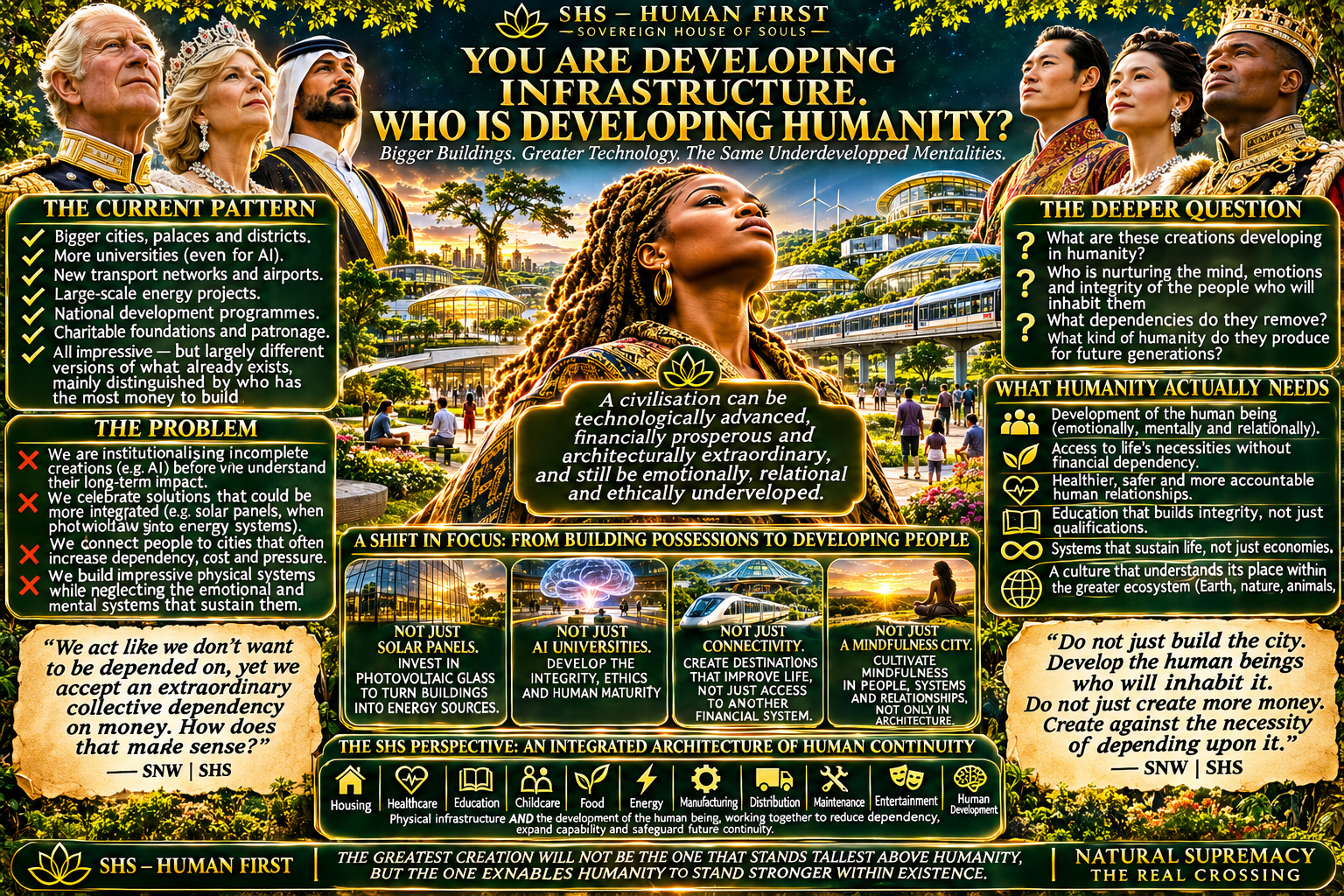
Bigger Buildings. Greater Technology. The Same Underdeveloped Mentalities.
SNW | SHS – HUMAN FIRST
Following the investigation into the world’s 43 sovereign monarchies.
Nothing fundamentally new.
Different versions of what has already been created, predominantly distinguished by who has the most money to develop them.
Bigger cities. Bigger universities. Bigger transportation networks. Bigger financial opportunities. More sophisticated technology.
But where is the evolution of humanity itself?
Where is the development of the mind that will inhabit those cities, use those technologies, administer those institutions and determine what becomes of their creations?
Because having beautiful buildings does not eliminate the abuses that happen within them.
Having advanced technology does not establish an advanced mentality.
Having sophisticated infrastructure does not establish a sophisticated relationship with existence.
You can modernise the entirety of a civilisation’s physical infrastructure whilst leaving its mentality in the Middle Ages.
1. DEVELOPING CREATIONS BEFORE DEVELOPING THEIR CREATORS
We now have universities dedicated to artificial intelligence.
An extraordinarily powerful but still developing creation, whose reliability, understanding, limitations and long-term relationship with humanity remain subjects of investigation.
And we are already building entire institutional environments around it.
Certainly, researching an incomplete technology can help improve it. But there is a considerable difference between investigating its limitations and prematurely organising humanity’s future around its capabilities.
Who is developing the human mentality that will determine what artificial intelligence is used for?
Who is establishing the integrity of the objectives it will be instructed to pursue?
Who is examining the emotional motivations of those directing its development?
Who is ensuring that the technology will expand human capability rather than become another dependency?
Artificial intelligence can inherit humanity’s knowledge, but it can also reproduce humanity’s contradictions.
What happens when an immature human mentality develops an immature artificial intelligence, and both become increasingly influential in determining humanity’s future?
I don’t see how this could possibly go wrong.
Sarcasm intended.
2. IF YOU ARE GOING TO NURTURE THE EXISTING ECOSYSTEM, DO IT PROPERLY
We continue to celebrate the installation of solar panels as evidence of extraordinary environmental innovation.
But why is the greater ambition not to examine the entirety of the physical environment through which energy could be generated, conserved and distributed?
Photovoltaic glass already presents possibilities for incorporating energy generation into windows and building façades.
Why not invest substantially in developing its efficiency, affordability, durability and accessibility?
Why not investigate replacing existing windows, where appropriate, rather than exclusively adding new infrastructure?
Why not develop building materials that perform multiple functions without continuously demanding additional resources?
Why not create buildings that progressively reduce the financial dependency of those inhabiting them?
The objective should not simply be to establish another profitable industry selling environmental solutions.
It should also be to reduce the conditions that make human beings financially vulnerable to their energy requirements.
A technology should be examined not only through what it produces, but through what dependencies it removes.
Innovation is not merely adding something to existence. It can also be removing something that existence no longer needs.
3. CONNECTING PEOPLE TO WHAT, EXACTLY?
We celebrate transportation infrastructure because it connects people to cities.
But what are those cities connecting people to?
Greater opportunities for employment?
Greater opportunities for consumption?
Greater accessibility to expensive housing?
More sophisticated environments in which they can experience the same financial pressures?
More opportunities to participate in a culture that has not yet fully understood its own humanity?
Connectivity has value. Mobility has value. Access has value.
But the destination must also be examined.
Connecting more human beings to an environment does not necessarily improve their existence if that environment reproduces the circumstances from which they were trying to escape.
We must examine not merely how efficiently people can reach a destination, but what conditions await them when they arrive.
Accessibility to a system is not necessarily freedom from its limitations.
4. A MINDFULNESS CITY?
The concept itself introduces an interesting question.
Can mindfulness be established architecturally?
Can integrity be constructed through buildings?
Can human beings become more conscious of their relationship with existence simply because they inhabit an environment that has been given a particular name?
Physical environments can certainly support psychological wellbeing, emotional regulation, social cohesion and human development.
But an environment cannot substitute for the development of the individual.
A peaceful-looking city can still contain abusive relationships.
A sustainable building can still house unsustainable behaviours.
An economically prosperous community can still produce emotionally impoverished human beings.
A spiritually inspired institution can still reproduce financial inequality.
The name of the creation does not establish its embodiment.
Mindfulness must exist in the people, the relationships, the decisions, the governance and the conditions through which the environment continuously functions.
Otherwise, it risks becoming another architectural representation of something humanity has not yet sufficiently learnt to embody.
5. WHAT DOES HUMANITY NEED, NOT JUST WHAT DOES YOUR COUNTRY NEED?
I do not want this investigation to become an individual criticism of every monarch, every country or every development project.
That is not what this post is for.
I want us to begin thinking beyond the boundaries through which humanity has been taught to organise its concerns.
What does humanity need?
Not what will make a particular country more competitive.
Not what will attract the greatest international investment.
Not what will make another royal family more significant.
Not what will increase the value of another currency.
Not what will allow one population to experience advantages over another.
What does humanity, as a collective natural existence, actually need?
Because a creation that benefits one country while transferring its destructive consequences elsewhere has not necessarily improved the condition of humanity.
It may simply have redistributed the circumstances of humanity.
We need to develop our capacity to think beyond the individual, the institution and the territory without disregarding their existence.
Humanity is not the sum of competing business interests.
Earth is not a marketplace that exists exclusively to accommodate them.
6. WHY ARE WE NURTURING THE DEPENDENCY WE CLAIM TO DISLIKE?
Human beings frequently speak about independence.
They do not want to be dependent upon their parents forever.
They do not want to be dependent upon their partners.
They do not want to be dependent upon their employers.
They do not want to feel controlled by other human beings.
Yet they accept an extraordinary collective dependency upon money.
An inorganic creation that cannot independently sustain its own relevance.
How does that make sense?
We have become so accustomed to associating financial independence with freedom that we rarely question the dependency upon which financial independence itself is founded.
Financial independence is still independence measured within a financial construct.
It generally means possessing enough money or income to reduce one’s dependency upon particular people or institutions.
It does not necessarily mean reducing one’s dependency upon money itself.
There is a considerable difference between the two.
| Financial independence | Reduced monetary dependency |
|---|---|
| Accumulate enough money to afford necessities. | Develop access to necessities through additional means. |
| Generate sufficient income to maintain stability. | Make stability less vulnerable to income fluctuations. |
| Protect purchasing power. | Expand access to real productive resources. |
| Become successful within the financial architecture. | Develop capabilities beyond the financial architecture. |
| Secure one’s individual position. | Establish more resilient conditions of collective provision. |
| Depend less on particular providers. | Depend less on monetary access itself. |
Why are we investing so much human intelligence into teaching people how to become financially independent, without investing comparable intelligence into reducing the necessity of financial dependency?
Why is everything still about creating more money?
Why is the greatest ambition not to progressively reduce the number of circumstances in which human beings require it?
Money can remain a useful instrument during such a transition.
But the instrument should not be confused with the ultimate objective.
7. THE GREATEST LEADERS ARE STILL BUILDING PREDOMINANTLY WITHIN THE SYSTEM
Look at the developments being celebrated across the world.
Railways.
Airports.
Universities.
Energy systems.
Financial institutions.
Housing developments.
Tourism destinations.
Technological ecosystems.
All these creations can contribute to human existence.
But most operate within a familiar architecture of monetary exchange, employment, investment, competition and consumption.
They are predominantly developments of the existing system rather than attempts to transcend its foundational dependencies.
The physical creation might be new.
The relationship between humanity and the creation might remain remarkably familiar.
| Physical development | The greater developmental question |
|---|---|
| A new city | How will its inhabitants develop healthier relationships? |
| A new university | How will it develop integrity alongside intelligence? |
| A new hospital | How will it help prevent the conditions producing illness? |
| A new energy system | How will it reduce vulnerability to energy insecurity? |
| A new housing development | How will it reduce the possibility of homelessness? |
| A new financial institution | How will it reduce harmful financial dependency? |
| A new technology | How will it increase human capability without creating another harmful dependency? |
| A new government institution | How will it develop the mentality necessary for responsible governance? |
Building something physically different is not necessarily creating a fundamentally different experience of existence.
8. THE INFRASTRUCTURE OF THE MIND
The most important infrastructure sustaining a civilisation cannot be understood exclusively through its physical architecture.
It also exists in the minds of its inhabitants.
Their emotional regulation.
Their understanding of themselves.
Their relationships with other human beings.
Their accountability.
Their sense of responsibility.
Their capacity to collaborate.
Their ability to recognise harmful continuities and create against them.
Their understanding of integrity.
Who is investing in this infrastructure with the same ambition, resources and urgency with which they invest in physical infrastructure?
We construct institutions to address the consequences of human behaviour.
But what are we creating to improve the mentality from which those behaviours emerge?
We build prisons.
But what are we building within the developmental conditions of human beings to prevent the circumstances that contribute to criminal behaviour?
We establish institutions to address domestic abuse.
But what are we creating to develop emotionally regulated human beings who understand the difference between love, possession, control and responsibility?
We build mental health facilities.
But what are we creating to address the social and economic conditions that contribute to psychological distress?
We introduce regulations against corruption.
But what are we doing to develop people who understand why integrity is valuable beyond the fear of punishment?
The physical architecture is necessary.
But it cannot indefinitely compensate for an insufficiently developed human architecture.
9. BEAUTIFUL BUILDINGS DO NOT PRODUCE BEAUTIFUL BEHAVIOURS
A palace can contain abuse.
A university can contain intellectual arrogance.
A hospital can contain negligence.
A religious institution can contain exploitation.
A government building can contain corruption.
A luxurious home can contain emotional deprivation.
A technologically advanced city can contain human isolation.
The beauty of the building does not eliminate the ugliness of the behaviour occurring within it.
Nor does the financial value of the building establish the value of the relationships it houses.
And yet, when measuring the development of civilisation, we frequently look first at the physical environment.
The skyscrapers.
The roads.
The transport.
The technological capabilities.
The economic statistics.
Where are the equivalent measures of emotional maturity?
Where are the measures of integrity?
Where are the measures of humanity’s capacity to live truthfully, collaboratively and responsibly?
Where are the measures of how much less human suffering is being produced by the ways in which people relate to themselves and one another?
A civilisation cannot be considered fully developed while the conditions of its human relationships remain persistently destructive.
10. THE REAL CROSSING — DEVELOPING HUMANITY THROUGH TIME
This is where the SHS understanding of logic becomes particularly important.
CONTINUITY — THE PAST
Humanity has experienced thousands of years of building physical infrastructures.
It has also experienced thousands of years of destructive relationships, exploitation, financial inequality, conflict, abuse and failures of accountability.
Both continuities must be examined.
We cannot celebrate the architectural continuity while disregarding the behavioural continuity.
CREATIVITY — THE PRESENT
Humanity possesses extraordinary creative capabilities.
It can construct cities, develop technologies, reorganise resources and establish entirely new institutions.
But it can also develop new educational approaches, new relationships, new forms of provision and new understandings of human existence.
Why should the first category receive so much more recognition than the second?
INTEGRITY — THE FUTURE
What are we creating in the present to ensure that future generations do not inherit the same emotional and behavioural vulnerabilities?
What are we creating to reduce the dependency upon systems that currently determine access to existence?
What are we creating so that the people inhabiting our extraordinary buildings are capable of maintaining extraordinary relationships?
This is where development becomes more than construction.
This is where creativity begins to incorporate integrity.
11. SHS — DEVELOPING THE INHABITANTS AS WELL AS THE HABITAT
The SHS ambition is not simply to build another city.
It is not simply to introduce another economic model.
It is not simply to establish another educational institution, healthcare facility or governance arrangement.
It is to develop an ecosystem within which the physical architecture and the development of the human being continuously support one another.
The infrastructure must serve humanity.
Humanity must develop the understanding necessary to sustain the infrastructure.
Education must extend beyond employment.
Healthcare must extend beyond treating illness.
Governance must extend beyond administering circumstances.
Economic organisation must extend beyond facilitating monetary exchange.
Human development must extend beyond the accumulation of qualifications, possessions and socially assigned identities.
Emotional regulation, accountability, responsibility, integrity, self-understanding and collaboration are not secondary considerations.
They are foundational components of any architecture intended to sustain human existence.
The objective is not to create a population dependent upon SHS.
It is to develop conditions through which human beings acquire greater capabilities, greater autonomy and greater opportunities to contribute to one another.
A service that genuinely values independence must be capable of celebrating the reduction of dependency upon itself.
12. WHAT WOULD ACTUALLY BE NEW?
Not simply a city that produces more wealth.
A city that reduces the necessity of monetary wealth to exist securely.
Not simply a university that teaches people how to develop artificial intelligence.
An educational ecosystem that also develops the integrity of the intelligence directing it.
Not simply a sustainable building.
Human beings capable of sustaining their relationships with one another and the greater environment.
Not simply a more efficient means of transporting people into existing conditions.
The development of conditions worth transporting people towards.
Not simply an institution capable of surviving indefinitely.
An institution whose continued development makes humanity progressively less vulnerable.
Not simply an extraordinary physical creation.
An extraordinary evolution in the relationship between humanity and existence.
STOP CONFUSING THE DEVELOPMENT OF HUMANITY’S POSSESSIONS WITH THE DEVELOPMENT OF HUMANITY.
A technologically advanced society can remain emotionally underdeveloped.
A financially prosperous society can remain relationally impoverished.
An architecturally extraordinary society can remain ethically unstable.
We have developed extraordinary capabilities to nurture our creations.
Now let us direct comparable capabilities towards nurturing their creators.
DO NOT JUST BUILD THE CITY. DEVELOP THE HUMAN BEINGS WHO WILL INHABIT IT.
DO NOT JUST CREATE MORE MONEY. CREATE AGAINST THE NECESSITY OF DEPENDING UPON IT.
DO NOT JUST DEVELOP ARTIFICIAL INTELLIGENCE. DEVELOP THE INTEGRITY OF HUMAN INTELLIGENCE.
The greatest creation will not necessarily be the one that stands tallest above humanity.
It will be the one that enables humanity to stand stronger within existence.
SNW | SHS – HUMAN FIRST
Natural Supremacy — Homo Agen — The Real Crossing — The Architecture of Human Continuity
NOthing really new. It’s all still about who has the most money to build a different version of what has been. Per example the AI university. How can you teach something that’s isn’t even rooted in our existence nor has proven itself to be stable in its responses?! Ai isn’t recreating a character, it is what it is now. And they’re creating great universities to teach an incomplete creation?! I don’t see how this could go wrong(sarcastic). It is an unmatured mind.
Solar panels are outdated when they can invest in glass panels and replace people’s windows. If they really want to nurse what already exists within the ecosystem, they should do it properly. Connecting people to ac city that doesn’t know its humanity fully is great, though it is on the line of still building for self and giving accessibility, with a cost, to something that might just hinder further more those who do access a city life.
Mindfullness city…? I don’t want to say too much about all of them specifically, cause that’s not what this post is for. Instead I want for us all to start thinking about what humanity needs, not just what a coutnry needs.
Not things that create more money, but that remove its dependency. We act like we don’t want to be cuddled or depending on something, so why are we allowing ourselves to depend on money in the first place?!
It’s like the greatest and highest leaders only know how to build within the current system, which is much of a physical infrastructural system. But to tend to the mind that can suistain this culture it is to tend to emotions and mentalities. Cause having nice buildings doesn’t take away from all the abuses that happen within it.




Leave a Reply