
Integrity cuts through all the bullshit. Not the fake futures we build for, but those who count.
Thousands of years of reconstructed dependency disguised as human advancement.
SNW | SHS – HUMAN FIRST
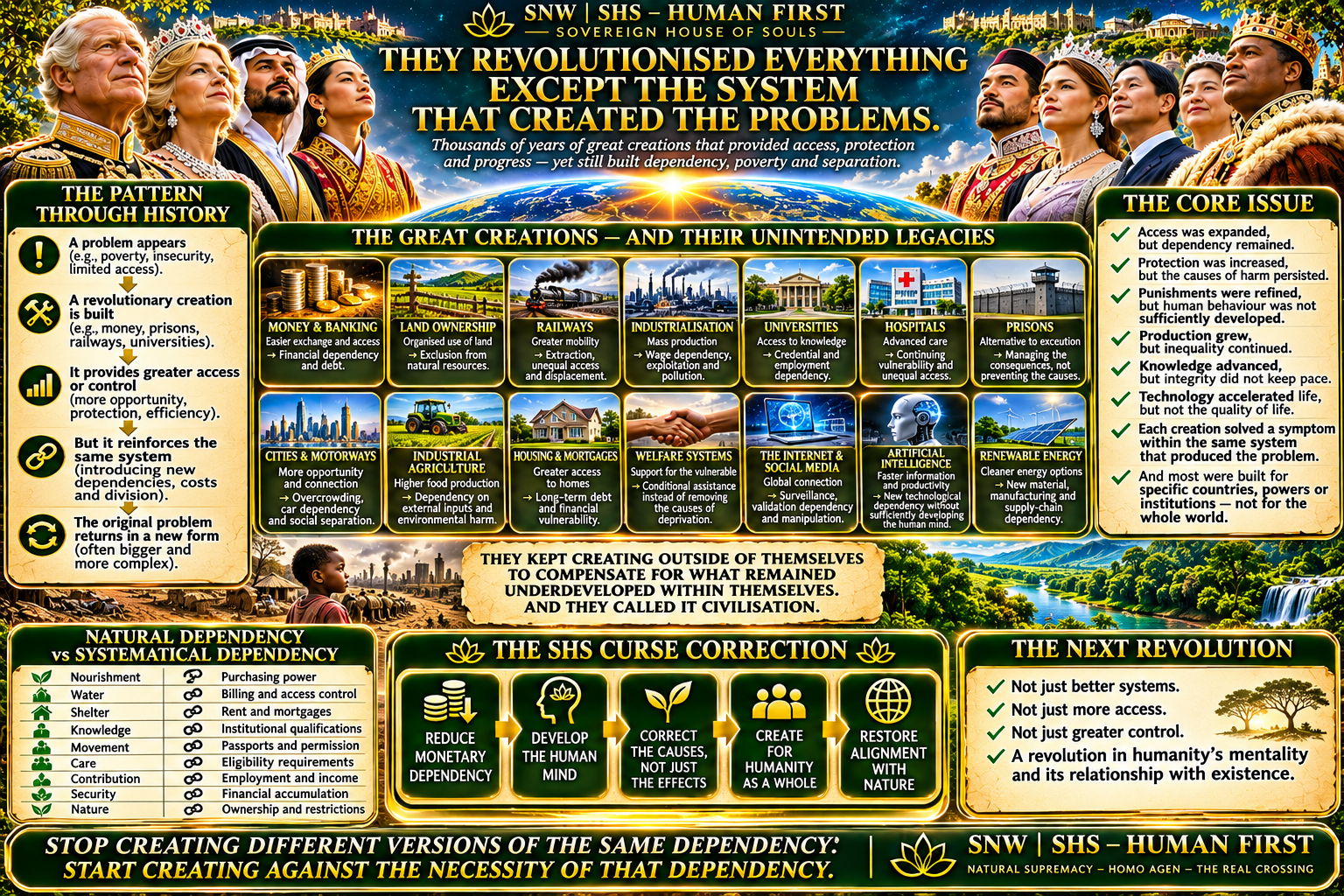
Throughout history, those occupying positions of supremacy have built, commissioned, financed, witnessed and supported revolutionary creations.
Greater access. Better infrastructure. More sophisticated punishments. New institutions. Technological advancements.
Yet how many of those creations actually liberated humanity from the conditions that made their creation necessary?
They kept developing solutions within the same architecture that produced the problems.
They changed the instruments without changing the mentality.
They expanded accessibility without eliminating dependency.
And most importantly, they built predominantly for their respective territories, institutions, economies and interests rather than making the continuity of the whole world their foundational objective.
THE HISTORY OF REVOLUTIONISING DEPENDENCY
| Creation | What appeared revolutionary | What it introduced, reinforced or failed to eliminate |
|---|---|---|
| Money | Easier exchange | Dependency on purchasing power |
| Banking | Secure storage and access to capital | Institutional financial dependency |
| Credit | Immediate access to otherwise unaffordable resources | Debt and future financial obligations |
| Interest | Incentivised lending | Compounding indebtedness |
| Taxation | Collective infrastructure funding | Obligations often independent of individual financial security |
| Land ownership | Organised resource management | Exclusion from natural resources |
| Enclosure | Greater agricultural efficiency | Loss of customary access to common land |
| Empires | Large-scale infrastructure and administration | Colonisation, extraction and subordination |
| National borders | Territorial organisation | Separation of humanity |
| Citizenship | Recognised rights and protections | Unequal rights according to nationality |
| Passports | Regulated international movement | Conditional freedom of movement |
| Religious institutions | Community, guidance and shared beliefs | In some contexts, division and dependency on institutional authority |
| Abolition of slavery | Legal emancipation | Inherited economic inequalities |
| Democracy | Greater political participation | Continuing disparities in political influence |
| Political parties | Organised representation | Institutional competition and ideological separation |
| Written legislation | Consistent rules and protections | Reliance on legal knowledge, representation and enforcement |
| Prisons | Alternatives to execution and corporal punishment | Institutional management of harmful behaviour |
| Fines | Alternatives to imprisonment | Punishments experienced unequally according to wealth |
| Workhouses | Provision for impoverished people | Conditional assistance and family separation |
| Police forces | Organised public protection | Potential dependency on external enforcement rather than prevention |
| Industrialisation | Greater productive capacity | Wage dependency, exploitation and pollution |
| Factories | Mass production | Separation of producers from ownership and distribution |
| Railways | Greater mobility | Unequal access and, historically, colonial extraction |
| Motorways | Faster transportation | Car dependency and divided communities |
| Urbanisation | Greater concentration of opportunities | Housing pressure, overcrowding and environmental separation |
| Mass education | Access to knowledge | Credential dependency and employment-oriented development |
| Universities | Advanced intellectual development | Financial and institutional barriers to knowledge |
| Hospitals | Advanced treatment | Continuing vulnerability to preventable illness and unequal access |
| Pharmaceutical industries | Medical innovation | Potential conflicts between commercial incentives and prevention |
| Insurance | Protection against uncertainty | Conditional protection and recurring payments |
| Welfare systems | Protection against deprivation | Administrative eligibility and conditional provision |
| Charities | Assistance for vulnerable people | Continuing reliance on assistance where underlying causes remain |
| Mortgages | Greater access to home ownership | Long-term debt |
| Housing developments | Increased housing supply | Continuing financial barriers to shelter |
| International development loans | National investment opportunities | Debt servicing and external financial obligations |
| Industrial agriculture | Increased food production | Dependency on external inputs and environmental degradation |
| Supermarkets | Convenient access to necessities | Reliance on centralised distribution networks |
| Consumer technology | Convenience and communication | Replacement cycles and technological dependency |
| Social media | Greater expressive freedom | Commercial surveillance, comparison and validation dependency |
| Digital banking | Faster financial exchange | Dependency on devices, connectivity and authorisation |
| Renewable energy | Reduced fossil fuel dependency | New material, manufacturing and supply-chain dependencies |
| Artificial intelligence | Faster information processing | Potential dependency on external reasoning and technological infrastructure |
| Smart cities | Integrated urban infrastructure | Potential surveillance and centralised technological dependency |
These are not imaginary contradictions. Historical records document workhouse conditions, compensation awarded to former slave owners, industrial exploitation, community displacement through motorway construction, agricultural environmental damage and commercial surveillance through social media. parliament.uk +4
THEY PROVIDED ACCESS WITHOUT QUESTIONING WHAT HUMANITY WAS BECOMING DEPENDENT UPON
The railway provided greater access to cities.
But did the cities provide greater freedom to exist?
The university provided greater access to knowledge.
But did it develop the individual beyond their economic usefulness?
The bank provided greater access to financial resources.
But did it reduce the necessity of depending upon money?
The prison provided an alternative to previous punishments.
But did humanity sufficiently develop the mentality that would reduce the necessity of punishment?
Artificial intelligence provides faster access to information.
But does it develop the individual’s capacity to reason independently?
Greater access to a system is not necessarily greater freedom from that system.
THEY DEVELOPED EXTERNAL INFRASTRUCTURE INSTEAD OF INTERNAL CAPABILITY
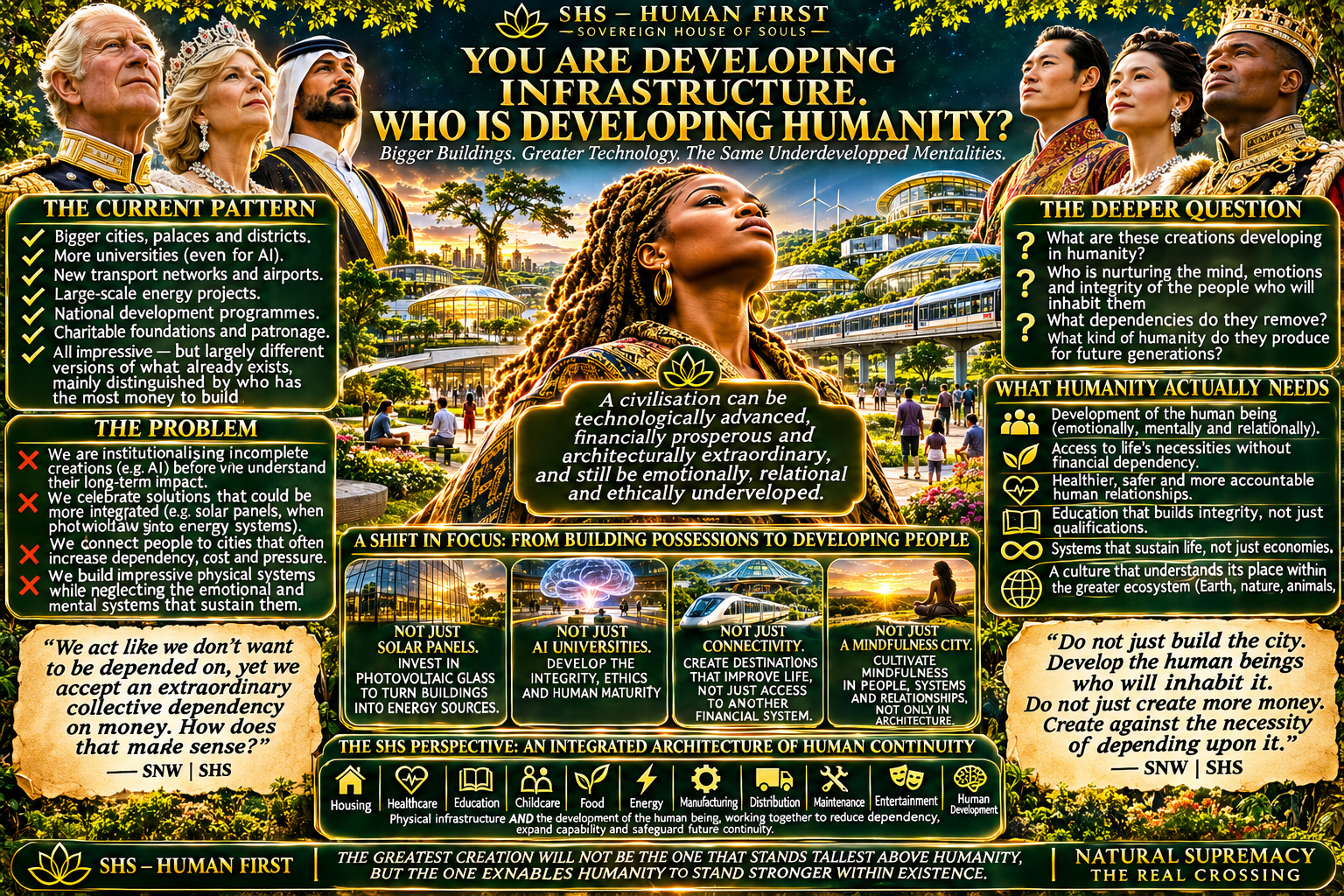
Humanity has invested thousands of years into developing things outside of itself.
Institutions to regulate its behaviour.
Money to determine its access.
Qualifications to validate its understanding.
Laws to enforce its accountability.
Technology to compensate for its lack of time.
Punishments to address the consequences of insufficient emotional development.
Where is the equivalent investment in developing human beings who possess the integrity to regulate themselves?
Imagine if accountability did not require exposure.
If responsibility did not require punishment.
If contribution did not require financial compensation in every circumstance.
If self-worth did not require external validation.
If collaboration did not require competition.
If access to necessities did not require continuous participation in monetary exchange.
That would constitute a fundamentally different developmental direction.
NATURAL DEPENDENCY V SYSTEMATICAL DEPENDENCY
| What humanity naturally requires | What humanity has constructed around it |
|---|---|
| Nourishment | Purchasing power |
| Water | Billing arrangements |
| Shelter | Rent and mortgages |
| Knowledge | Institutional qualifications |
| Relationships | Social validation |
| Movement | Financial and administrative permission |
| Care | Eligibility requirements |
| Contribution | Employment and monetary recognition |
| Security | Financial accumulation |
| Nature | Ownership and access restrictions |
Humanity cannot eliminate its natural interdependence.
Nor should it.
But it can reconsider the unnecessary dependencies it has constructed between itself and nature.
Money does not sustain humanity independently. Nature and human contribution do.
WHO WAS BUILDING FOR THE WHOLE?
Countries built for their citizens.
Monarchies built for their territories and dynasties.
Corporations built for their markets.
Financial institutions built for their participants.
Religious institutions built around their respective beliefs.
Humanity repeatedly organised its creative capabilities around subdivisions of existence.
There have been exceptions, such as the worldwide eradication of smallpox and the international protection of the ozone layer. These demonstrate what becomes possible when humanity collaborates towards a shared objective instead of exclusively protecting competing interests. who.int +1
Why has that mentality not become the foundation of civilisation itself?
Why is global collaboration exceptional rather than fundamental?
THE SHS CURSE CORRECTION
| What has historically been developed | What SHS seeks to develop |
|---|---|
| Financial independence | Reduced monetary dependency |
| Better punishments | Greater emotional regulation and prevention |
| Greater production | Greater direct accessibility |
| More employment | More freedom to contribute |
| More qualifications | Greater human understanding |
| More healthcare | Healthier conditions of existence |
| Bigger cities | Better-developed human beings |
| More charities | Fewer circumstances requiring charity |
| Stronger institutions | More autonomous individuals |
| Greater competition | Greater collaboration |
| National prosperity | Human and ecological prosperity |
| Institutional continuity | Existential continuity |
SHS is not questioning whether previous creations had value.
SHS is questioning why humanity keeps inheriting their limitations as though those limitations were natural laws.
They are not.
They are arrangements created by human beings, and human beings can reconsider them.
THEY BUILT BETTER PRISONS WITHOUT SUFFICIENTLY DEVELOPING BETTER BEHAVIOURS.
THEY BUILT BETTER BANKS WITHOUT REDUCING MONETARY DEPENDENCY.
THEY BUILT BIGGER CITIES WITHOUT SUFFICIENTLY DEVELOPING HEALTHIER RELATIONSHIPS.
THEY DEVELOPED ARTIFICIAL INTELLIGENCE WITHOUT FULLY DEVELOPING THE INTEGRITY OF HUMAN INTELLIGENCE.
They kept creating outside of themselves to compensate for what remained underdeveloped within themselves.
And they called it civilisation.
The next revolution must not simply be another revolution of humanity’s possessions.
IT MUST BE A REVOLUTION OF HUMANITY’S MENTALITY AND ITS RELATIONSHIP WITH EXISTENCE.
Stop creating different versions of the same dependency.
Start creating against the necessity of that dependency.
Continuity is experienced. Integrity is created.
SNW | SHS – HUMAN FIRST
Natural Supremacy — Homo Agen — The Real Crossing — Curse Correction
This survey covers 43 categories of creation. The dependencies identified are documented consequences or structural risks, not inevitable outcomes of every implementation. The distinction matters because SHS seeks to retain humanity’s accumulated knowledge whilst correcting the conditions under which it is exercised.
…..
What are all the things that supreme forces have built, witnessed built, supported building that seemed great, new, provided higher access, better punishments, revolutionary things, that then created more dependency, poverty, systems of separation, because they were all still part of the same system that created what they were trying to solve, a system that depended on things oitside of self and not nature. And none were trying to build what was best for the whole world




Leave a Reply