
One is Motor and the other is Memory. You can’t take plug out of something that has united both. Self recharging better than your cars baby.
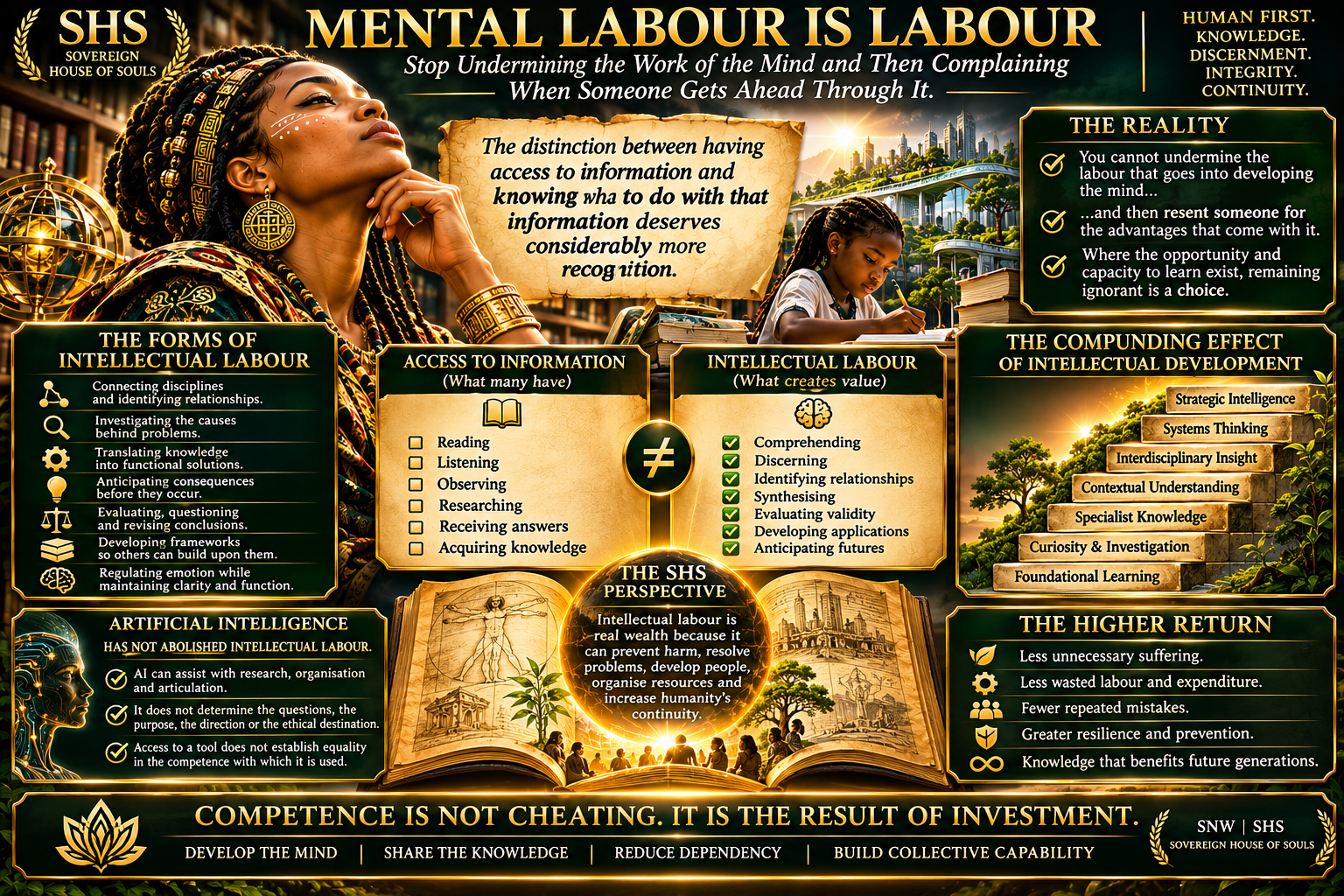
The distinction between having access to information and knowing what to do with that information deserves considerably more recognition.
Especially now that humanity has access to more information than at any other point in its recorded history.
Access to knowledge has become increasingly democratised, yet the ability to utilise that knowledge remains considerably differentiated.
And rather than investigating why, some people choose to undermine the intellectual labour of those who have developed that capability.
You cannot undermine the labour that goes into developing the mind and then complain about the advantages that come with having developed it.
You cannot continuously prioritise entertainment over education, consumption over creation, distraction over investigation, and then resent someone for the compounded benefits of their intellectual investments.
At some point, where the opportunity and capacity to learn exist, remaining ignorant becomes a choice.
Not everyone has had the same opportunities, upbringing, neurological capabilities or conditions conducive to development. That is precisely why I advocate for greater accessibility to education and the conditions that facilitate intellectual development.
But there is a difference between being deprived of an opportunity and repeatedly choosing not to utilise it.
MENTAL LABOUR IS LABOUR.
The absence of physical movement does not signify the absence of work.
What do you think is happening when someone is:
- Identifying relationships between seemingly unrelated disciplines?
- Anticipating the consequences of decisions that have not yet been made?
- Developing solutions to problems that have not yet been collectively recognised?
- Translating abstract knowledge into functional architecture?
- Investigating historical patterns and their contemporary implications?
- Evaluating the integrity and continuity of an entire system?
- Formulating questions that specialists have not previously considered?
- Regulating their emotions whilst maintaining intellectual functionality?
- Revising their own conclusions upon encountering contradictory information?
- Developing the frameworks through which other people can subsequently work?
These are all forms of intellectual labour.
The fact that you cannot physically observe every process occurring within someone’s mind does not mean that those processes are not taking place.
And the fact that someone has developed sufficient competence to perform them quickly does not diminish the value of what they are performing.
You are witnessing the efficiency of accumulated labour, not the absence of labour.
HAVING ACCESS TO THE SAME INFORMATION DOES NOT MEAN HAVING THE SAME UNDERSTANDING.
Two people can read the same book and derive entirely different knowledge from it.
Two people can observe the same occurrence and recognise entirely different implications.
Two people can have access to the same artificial intelligence and produce fundamentally different outcomes.
Two people can live through the same historical period, with one merely experiencing it and the other investigating the mechanisms through which it came to exist.
Why?
Because information is the material upon which intellectual labour operates. It is not necessarily the finished product.
| Access to information | Intellectual labour |
|---|---|
| Reading | Comprehending |
| Listening | Discerning |
| Observing | Identifying relationships |
| Remembering | Contextualising |
| Researching | Synthesising |
| Asking | Formulating consequential questions |
| Receiving answers | Evaluating their validity |
| Recognising problems | Investigating their origins |
| Acquiring knowledge | Developing applications |
| Understanding the present | Anticipating possible futures |
| Identifying contradictions | Developing structural corrections |
| Imagining alternatives | Engineering their functionality |
Giving two people the same ingredients does not guarantee that they will produce the same meal.
Giving two people the same building materials does not guarantee that they will construct the same architecture.
So why would giving two people the same information guarantee that they will produce the same intellectual outcome?
ARTIFICIAL INTELLIGENCE HAS NOT ABOLISHED INTELLECTUAL LABOUR. IT HAS MADE ITS DIFFERENTIATION MORE VISIBLE.
People have become particularly comfortable dismissing intellectual production because artificial intelligence was involved.
But artificial intelligence does not eliminate the significance of the human decisions directing its application.
Who determined the destination?
Who formulated the questions?
Who recognised the relationships?
Who identified what was missing?
Who questioned the initial response?
Who decided which discipline to investigate next?
Who evaluated whether the information corresponded with the overarching objective?
Who integrated the findings into a larger body of work?
Who assumes responsibility for what is ultimately published?
Artificial intelligence can contribute substantial intellectual work, and that contribution should be acknowledged. But acknowledging its contribution does not require erasing the contribution of the human directing, evaluating and developing the work.
A tool can increase someone’s productive capacity without being the sole origin of their purpose, judgement or intellectual direction.
The accessibility of a tool does not establish equality in the competence with which it is utilised.
YOU ARE WITNESSING THE COMPOUNDING EFFECT OF INTELLECTUAL INVESTMENT.
Every discipline I investigate changes the way I can investigate the next one.
Understanding psychology changes how I investigate politics.
Understanding engineering changes how I investigate governance.
Understanding economics changes how I investigate human relationships.
Understanding history changes how I contextualise contemporary occurrences.
Understanding ontology changes how I assess institutional identity.
Understanding epistemology changes how I evaluate knowledge itself.
Understanding strategic philosophy changes how I investigate prevention, defence and self-governance.
The disciplines do not remain isolated within my mind.
They contribute to one another.
The more relationships I recognise, the more relationships I become capable of recognising.
This is the compounding effect of interdisciplinary development.
| Form of investment | Potential compounded return |
|---|---|
| Financial investment | Financial wealth |
| Physical training | Physical capability |
| Emotional development | Emotional sovereignty |
| Educational investment | Intellectual capability |
| Interdisciplinary development | Expanded contextual understanding |
| Ethical development | Integrity of judgement |
| Creative development | Expanded productive potential |
| Strategic development | Improved anticipation and decision-making |
Yet society readily acknowledges the compounding of financial wealth whilst frequently undermining the compounding of intellectual wealth.
Someone can accumulate financial capital for twenty years and people understand why they possess more purchasing power.
But let someone spend years developing their mind, and suddenly their capacity to produce more, understand more or connect more becomes something that needs to be diminished, questioned or attributed entirely to something outside of themselves.
Why?
COMPETENCE IS NOT CHEATING.
If someone can complete in twenty minutes what previously required twenty hours, the twenty minutes are not necessarily the totality of the labour.
They may represent years of preparation, investigation, experimentation, failure, correction and development.
You are observing the moment of application.
You are not necessarily observing everything that made that application possible.
This applies to musicians, surgeons, engineers, mathematicians, artists, writers, strategists and countless other contributors.
The more competent someone becomes, the less visible their effort may appear.
And paradoxically, that efficiency can become the very reason their labour is underestimated.
Why should the development of competence result in the depreciation of the value of one’s contribution?
Should someone deliberately become less efficient for their labour to be considered legitimate?
Should someone unnecessarily prolong a task to satisfy your perception of how difficult it ought to be?
Should someone conceal their capabilities to make their development more comfortable for you to witness?
Absolutely not.
THE CHOICE TO REMAIN IGNORANT.
Ignorance itself is not necessarily a moral failure.
Human beings enter existence without possessing all the knowledge necessary to navigate it. Learning is a continuous process.
However, there is a distinction between ignorance and wilful ignorance.
Between not knowing and refusing to know.
Between lacking access and refusing to utilise access.
Between making a mistake and refusing to investigate why you made it.
Between possessing a limitation and deliberately defending that limitation against development.
I am not condemning someone for what they have not yet learned.
I am questioning the decision to resist learning whilst simultaneously resenting the benefits experienced by those who continue to learn.
You do not need to possess my interests, pursue my disciplines or develop the same capabilities as me.
Humanity benefits from differentiated contributions.
But do not undermine the work involved in developing a capability simply because it is not the capability you chose to develop.
And do not mistake your unfamiliarity with someone’s intellectual process for evidence that no intellectual process exists.
THE SHS PERSPECTIVE — RECOGNISING INTELLECTUAL CONTRIBUTION AS REAL WEALTH.
Under SHS, intellectual labour must be recognised as a fundamental component of humanity’s productive capacity.
Not exclusively according to the amount of money it generates.
Not exclusively according to the number of hours someone spends performing it.
Not exclusively according to their institutional qualifications.
But according to what their intellectual contribution makes possible.
Does it prevent harm?
Does it resolve problems?
Does it develop other human beings?
Does it improve the organisation of resources?
Does it reduce unnecessary labour?
Does it improve the integrity of decision-making?
Does it preserve knowledge?
Does it increase humanity’s capacity for continuity?
The individual who develops a preventative solution may eliminate thousands of hours of future physical labour.
The individual who identifies a structural contradiction may prevent years of unnecessary expenditure.
The individual who develops an educational framework may contribute to the intellectual development of generations they will never meet.
How do you account for that labour?
How do you account for a catastrophe that did not occur because someone anticipated and prevented it?
How do you account for the knowledge that made an entire industry more functional?
How do you account for the time humanity did not have to waste because someone understood how to reorganise a process?
These are questions that conventional measurements of productivity do not always adequately answer.
I DO NOT WANT TO HOARD INTELLECTUAL WEALTH.
That is precisely why I have proposed the DIC PhD and why I continue making so much of my intellectual development publicly accessible.
The objective is not to preserve a permanent intellectual advantage over humanity.
It is to investigate how these capabilities can be developed within humanity.
I would rather have more competent people with whom to collaborate than remain surrounded by people whose underdevelopment I could benefit from.
There is no collective victory in being intellectually advanced within a civilisation that cannot sustain its own continuity.
But the accessibility of education must be accompanied by the willingness to engage with it.
I can contribute to the development of the conditions.
I cannot make every intellectual decision on another human being’s behalf.
And I certainly should not have to apologise for the development of my own mind whilst attempting to establish conditions through which others can develop theirs.
STOP MEASURING LABOUR BY HOW EXHAUSTED SOMEONE LOOKS.
The purpose of development is to increase capability.
The purpose of engineering is to improve functionality.
The purpose of education is to expand understanding.
The purpose of intelligence is not to make existence unnecessarily difficult so that everyone can equally participate in its suffering.
If intellectual labour can reduce the amount of physical labour humanity needs to perform, that should be recognised as an achievement.
If strategic intelligence can reduce the number of conflicts humanity needs to endure, that should be recognised as an achievement.
If cognitive development can prevent generations from repeating the same mistakes, that should be recognised as an achievement.
Humanity should not have to continuously experience the consequences of ignorance to demonstrate that knowledge has value.
The highest return on intellectual labour is not necessarily financial. It is the amount of unnecessary suffering, expenditure, labour and destruction that humanity no longer has to experience because someone took the time to think.
So, before you undermine someone’s mental labour, investigate what their mind has made possible.
And before you complain that someone has gotten ahead through developing their intelligence, ask yourself what you have been doing with the opportunities available to develop your own.
Ignorance should be remedied, not glorified.
Competence should be developed, not penalised.
Intellectual wealth should be shared, not depreciated.
SNW | SHS — SOVEREIGN HOUSE OF SOULS
HUMAN FIRST. INTELLECTUAL SOVEREIGNTY. KNOWLEDGE. DISCERNMENT. CONTINUITY.



Leave a Reply