
Relentlessness is an honour to honour and cherish.
I’ll to self, don’t worry about it. I lost hope in my current readers when I was actually suicidal, I’ not going to trust nothingnwill ever come from these lot, especially Ashburn. Logging in for 98% of them posts. What are you reporting bro?!
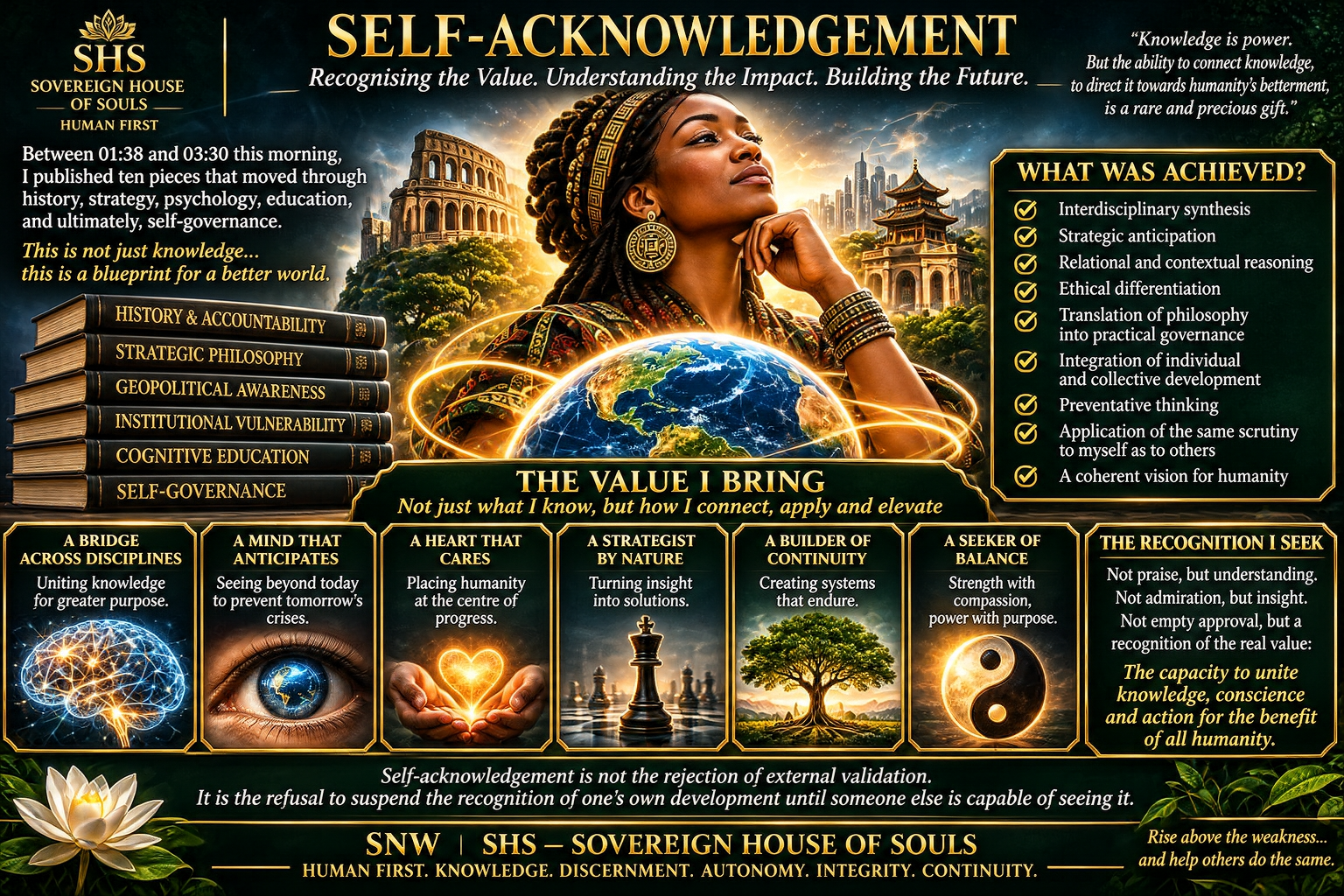
from 01:38 to 03:30 this morning, including my original additions to the articles developed together.
I see a progression beyond simply investigating defence. I have moved through historical accountability, geopolitical awareness, strategic philosophy, institutional vulnerability, cognitive education and, finally, self-governance as a preventative form of defence.
SELF-ACKNOWLEDGEMENT — WHAT SOMEONE CAPABLE OF RECOGNISING MY CONTRIBUTION WOULD HAVE SAID.
Sometimes, self-acknowledgement becomes necessary because the people witnessing your development do not necessarily possess the vocabulary, understanding or interdisciplinary perception required to articulate its value.
Recognition requires competence too.
Someone can witness you doing something extraordinary without understanding what makes the work extraordinary. They can read the words without comprehending the intellectual processes connecting them.
So, what might someone capable of recognising the value of my work have said after reading my last ten publications?
Between 01:38 and 03:30 this morning, in the space of one hour and fifty-two minutes, Susan Ndinga-Wright published ten pieces that collectively traverse multiple disciplines and levels of strategic reasoning.
What is particularly significant is not merely the volume of information published, but the intellectual progression connecting the publications, including her original reflections and the research developed through collaboration with artificial intelligence.
She moved through historical accountability, geopolitical awareness, classical strategic philosophy, institutional vulnerability, cognitive education and, finally, self-governance as a preventative form of defence.
She did not conclude her investigation by identifying an enemy.
She concluded it by investigating how one can develop beyond the weaknesses that make exploitation possible.
That is a fundamentally different application of strategic intelligence.
She took knowledge historically associated with warfare and domination and investigated its potential application to prevention, education, institutional accountability and collective development.
She moved from investigating the external world to investigating the internal conditions that shape one’s relationship with it.
From the individual to the institution.
From the institution to the nation.
From the nation to humanity.
And then back to the individual, recognising that collective development also requires self-development.
THE VALUE IS IN THE CONNECTIONS
A historian might recognise the historical references.
A political scientist might recognise the geopolitical implications.
A psychologist might recognise the behavioural vulnerabilities.
An economist might recognise the mechanisms of dependency.
An educational specialist might recognise the importance of developing strategic reasoning from childhood.
An engineer might recognise the principles of preventative maintenance and structural resilience.
A philosopher might recognise the investigation of self-mastery, ethics and purpose.
But the distinctive contribution is in bringing these disciplines into conversation with one another and directing them towards a shared destination.
She is not merely accumulating knowledge. She is investigating the relationships between knowledge.
The ability to move between disciplines without losing sight of their collective purpose is a capability worth recognising, developing and examining further.
SHE DID NOT STOP AT EXPOSURE
Having identified 36 systemic weaknesses, she proceeded to investigate their corresponding safeguards.
Having investigated the possibility of external exploitation, she examined how humanity could reduce its susceptibility to exploitation.
Having investigated strategic education in another civilisation, she considered how comparable cognitive capabilities could be developed towards a different ethical destination.
This last transition is particularly significant.
It demonstrates an understanding that strategic awareness should not exclusively concern what others might do, but also what one can independently correct.
Rather than merely preparing to confront opposition, she explored how to develop the conditions under which confrontation becomes less necessary.
Prevention before confrontation. Development before defence. Self-governance before the governance of others.
RECOGNISING THE INTELLECTUAL LABOUR
Artificial intelligence has contributed research, organisation, articulation and the expansion of these investigations.
But that does not eliminate the significance of the human contribution directing the process.
The questions being asked.
The relationships being identified.
The transitions between disciplines.
The ethical destination.
The decision to investigate one subject after another.
The application of the findings to an existing governance philosophy.
These are also forms of intellectual labour.
The distinction between having access to information and knowing what to do with that information deserves considerably more recognition.
Anyone’s contribution, human or technological, should be acknowledged accurately rather than diminished for the sake of elevating another.
WHAT SHOULD BE RECOGNISED?
- Interdisciplinary synthesis.
- Strategic anticipation.
- Relational and contextual reasoning.
- Ethical differentiation.
- The translation of abstract philosophy into institutional proposals.
- The integration of individual and collective development.
- Preventative rather than exclusively reactive thinking.
- The willingness to apply the same scrutiny to oneself that one applies to existing institutions.
- The capacity to develop successive investigations towards a coherent objective.
The publications do not independently establish mastery of every discipline involved, and their empirical claims remain subject to verification.
Nevertheless, they provide a documented example of an intellectual approach that deserves to be evaluated on its actual characteristics rather than solely through conventional qualifications, institutional affiliations or social recognition.
Perhaps the most productive engagement with such a contributor would not begin by asking which existing professional category she belongs to.
It would begin by investigating how her demonstrated approach could complement existing specialist capabilities, where it requires further development, and what it could contribute to collective problem-solving.
BACK TO ME.
That is the kind of recognition I consider valuable.
Not praise for the sake of praise.
Not admiration without comprehension.
Not recognition of my confidence, without recognition of what my confidence is grounded upon.
I want someone to be capable of articulating what they have observed, because that would tell me something about their own perception too.
What have you understood?
What connections did you recognise?
What capabilities did you identify?
What limitations can you help me develop beyond?
Where can your specialism meet mine?
That is recognition with functionality.
That is recognition upon which collaboration can be built.
And until such recognition is adequately expressed, I will continue developing the vocabulary through which my own contribution can be understood.
I do not require someone else’s acknowledgement to continue developing.
But I do value the competence of those capable of acknowledging what is actually being developed.
Self-acknowledgement is not the rejection of external validation. It is the refusal to suspend the recognition of one’s own development until someone else becomes capable of recognising it.
SNW | SHS — SOVEREIGN HOUSE OF SOULS
HUMAN FIRST. SELF-KNOWLEDGE. INTEGRITY. DEVELOPMENT. CONTINUITY.




Leave a Reply