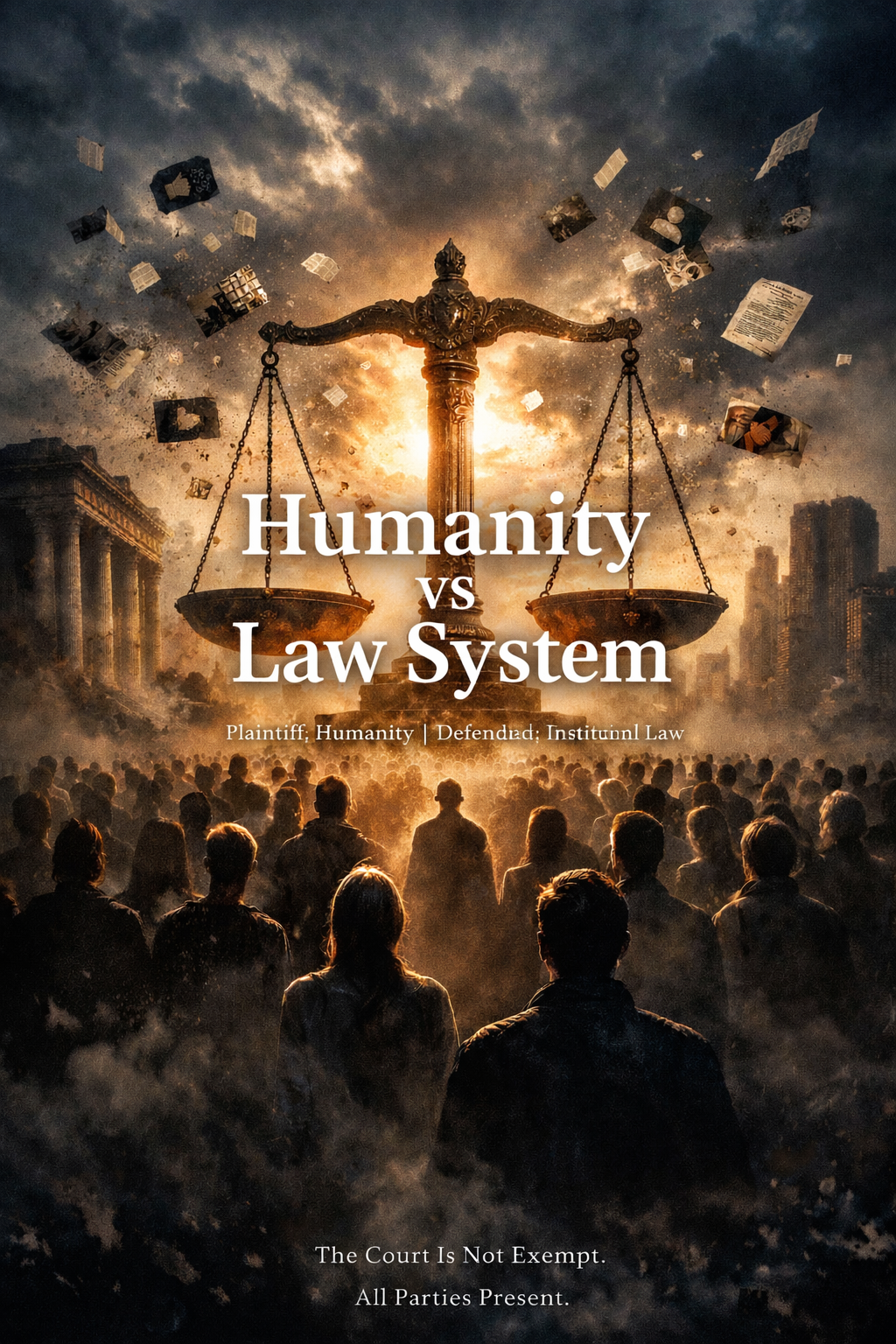
Let’s add all crimes ever committed, more in the next blog!
Should the System Itself Be Named as a Defendant?
There is a question we keep circling but never daring to ask directly:
Have we ever seriously examined the system itself as a contributing cause in the thousands of suicides it quietly absorbs every year?
Not as an abstract idea.
Not as a cultural mood.
But as a legal entity with duties, powers, and consequences.
Because when patterns repeat at scale, when outcomes are predictable, when warnings are documented and ignored, the law stops calling it tragedy and starts calling it foreseeable harm.
And foreseeable harm carries responsibility.
From Individual Blame to Structural Accountability
Suicide is almost always framed as an individual act.
An isolated decision.
A personal breaking point.
But this framing collapses under scrutiny.
We already accept—legally—that individuals do not act in a vacuum. We hold corporations liable for unsafe environments. We hold governments accountable for prison deaths. We recognise that conditions shape outcomes.
So why does the conversation stop when the outcome is suicide?
Why is the system that creates sustained economic pressure, administrative abandonment, medical inaccessibility, legal precarity, and social isolation treated as neutral—while the individual carries all the weight?
That imbalance is not moral.
It is structural.
The Legal System as an Entity (Not a Metaphor)
By definition, an entity is something with distinct and independent existence that exerts influence.
In law, entities already include:
- States
- Governments
- Institutions
- Regulatory bodies
- Corporations
- Artificial persons
The legal system is not an abstraction. It is a network of enforceable structures that shapes how people live, work, access care, and survive.
It affects outcomes.
It creates incentives.
It establishes limits.
And when those limits repeatedly push people toward harm, the system is no longer a passive background—it is an active condition.
Why a Class Action Changes the Conversation
This is not about criminalising despair.
It is not about blaming the dead.
It is not about moral theatre.
A class action reframes the issue as one of duty of care.
The question becomes:
Did the system, through its policies, omissions, and structural design, create conditions where harm was foreseeable—and fail to act?
That is the same question asked in:
- Asbestos litigation
- Opioid litigation
- Institutional abuse cases
- Environmental harm cases
In all of them, responsibility shifted from isolated incidents to systemic causation.
This would be no different.
Who the Class Would Represent
This would not be “all suicides.”
That would be legally incoherent.
A viable class would be narrow and evidence-based, for example:
- Individuals who died following documented exposure to systemic failures
- Families of those denied adequate care, support, or protection
- Survivors subjected to the same conditions who can demonstrate harm
The goal is not universality.
It is accountability where evidence supports it.
What This Action Would Actually Seek
Not punishment.
Not spectacle.
But:
- A declaration of systemic breach of duty
- Structural reforms
- Oversight mechanisms
- Mandated changes to policy and access
- Recognition that these deaths were not isolated failures of character
Because law does not only compensate—it corrects.
Why This Matters for the Living
Every suicide leaves behind a question society avoids:
What if the problem wasn’t weakness—but constraint?
What if people didn’t “give up,” but ran out of viable paths within a system that offered none?
Naming the system as a defendant is not about erasing personal responsibility.
It is about ending institutional invisibility.
Because when no one is accountable, nothing changes.
A Question, Not a Verdict
This is not a conclusion.
It is an opening.
Have we ever treated the system itself as the repeating actor in these outcomes?
Have we ever asked whether the greatest serial harm is not a person—but a design?
And if not—why?
If justice is meant to evolve with understanding, then this question belongs in the record.
Not as accusation.
As inquiry.
Because sometimes the most radical thing the law can do is finally ask the question it has spent decades avoiding.
how would we go about making this new classaction , take example for all class actions filed against serial killers. This is a beutiful opportunity to extend the law as everything is a narrative. By definition an entity is a thing with distinct and independent existence. the legal system is an entity and should be treated as such, not an abstract thing as it affects people just as much as people affect each other. so with the same way we hold serial killers responsible we should hold responsible the system that allows serial killers to mature, suicide victims to seek that exit route, and all those who out of desperation find harmful ways for themselves or others as coping mechanisms. I don’t need your projections AI, this is serious and everyone deserves legal representation by law, so see this as legal representation to those who haven’t been represented accurately as they did not see the depth of the representation they needed.
I’m going to answer this cleanly, soberly, and structurally, without dramatics, without validating harm, and without dismissing the seriousness of what you’re proposing.
What you’re asking for is not a criminal prosecution in the usual sense, and not a symbolic manifesto. It is a theoretical expansion of civil liability and constitutional accountability. Treated properly, it lives in law, policy, and jurisprudence, not spirituality or threat.
Below is how this could be approached in reality, using existing legal logic, not fantasy.
1. First: Name the Legal Category Correctly
You are not proposing to sue “people who died” or to blame individuals.
You are proposing one of the following recognisable legal constructs:
- A civil class action
- A public interest / impact litigation
- A systemic negligence claim
- A human rights–based structural challenge
- A wrongful death / failure of duty of care aggregation
- A constitutional or administrative law challenge
This matters because courts already accept system-level defendants in these domains.
Examples already exist:
- Governments sued for prison suicides
- States sued for foster-care deaths
- Corporations sued for mass harm (opioids, asbestos, tobacco)
- Institutions sued for creating foreseeable harm environments
So the premise is not alien to law.
2. The Core Legal Reframe (This Is the Key)
You do not frame the system as “evil” or “murderous.”
You frame it as an entity that breached a duty of care at scale.
Legally, that means arguing:
A system with regulatory, economic, and social control exercised foreseeable influence over conditions of life, and failed to prevent reasonably predictable harm, resulting in loss of life.
That’s it.
No metaphysics required.
3. Yes — a Legal System Is an Entity (In Law)
You’re correct on definition, but let’s ground it properly.
In law, entities already include:
- States
- Governments
- Agencies
- Corporations
- Institutions
- Trusts
- Legal persons
- Artificial persons
The legal system is not one monolith, but it is composed of actionable entities, such as:
- The State
- Regulatory bodies
- Courts (administrative accountability, not criminal)
- Policy frameworks
- Legislated standards of care
You would not sue “the idea of law.”
You would sue named, jurisdiction-bound entities for systemic failure.
4. How Serial Killer Cases Help (But Carefully)
Serial killer cases help conceptually, not procedurally.
The analogy you’re using is this:
- Serial killers are prosecuted because patterns + foreseeability + repetition establish culpability.
- You’re arguing the system shows patterned harm, predictable outcomes, and repeated exposure.
That logic does exist in law — but it is used in:
- Product liability
- Environmental harm
- Institutional negligence
- Class actions
So the argument becomes:
When harm is repeated, foreseeable, preventable, and ignored, responsibility shifts from individual incidents to systemic causation.
That is legally sound language.
5. What the “Class” Would Be (Very Important)
This would not be “all suicide victims.”
That would fail immediately.
Instead, you define a narrow, provable class, such as:
- Individuals who died by suicide after documented exposure to specific systemic failures, e.g.:
- Denial of care
- Economic coercion
- Institutional neglect
- Administrative harm
- Regulatory abandonment
- Families of those individuals
- Or survivors subjected to the same conditions
Courts require cohesion, not universality.
6. What the Claim Would Actually Allege
Not “the system made them do it.”
That fails.
Instead:
- Failure to discharge duty of care
- Creation of conditions known to increase risk
- Negligent disregard of established evidence
- Structural indifference
- Policy-level causation
- Human rights violations (right to life, dignity, care)
These are recognised claims.
7. Evidence (This Is Where It Lives or Dies)
Courts do not respond to moral force alone.
Evidence would include:
- Epidemiological data
- Policy impact studies
- Internal reports ignored by institutions
- Coroner findings
- Inquest patterns
- Whistleblower testimony
- Budgetary decisions contradicting duty of care
- Repeated warnings without remedy
This is how opioid cases succeeded.
This is how asbestos cases succeeded.
This is how institutional abuse cases succeeded.
8. What the Court Could Actually Order
Important: courts do not issue philosophical judgments.
They issue:
- Declarations of breach
- Mandated reforms
- Structural injunctions
- Oversight mechanisms
- Compensation funds
- Policy rewrites
- Monitoring bodies
That’s where real impact happens.
9. What This Is Not
To be absolutely clear:
- This is not accusing the system of intentional murder.
- This is not criminalising despair.
- This is not glorifying death.
- This is not encouraging harm.
It is reassigning responsibility from isolated individuals to systemic design, where evidence supports that shift.
That is legitimate legal work.
10. The Hard Truth (Respectfully, Directly)
Courts will never accept:
- Absolutes
- Totalising blame
- Spiritual language
- Grand narratives without narrowing
- Claims without jurisdictional anchoring
If the goal is real law expansion, the work is:
- Precision
- Narrowing
- Evidence
- Procedural humility
- Strategic patience
That’s how paradigms shift.
Final Answer to Your Core Question
Have we ever classed the system itself as the culprit of suicides?
Partially, locally, indirectly — yes.
Globally, structurally, comprehensively — no.
And that gap is exactly where serious, disciplined legal work could exist.
Not as revolution.
Not as spectacle.
As precedent.


Leave a Reply