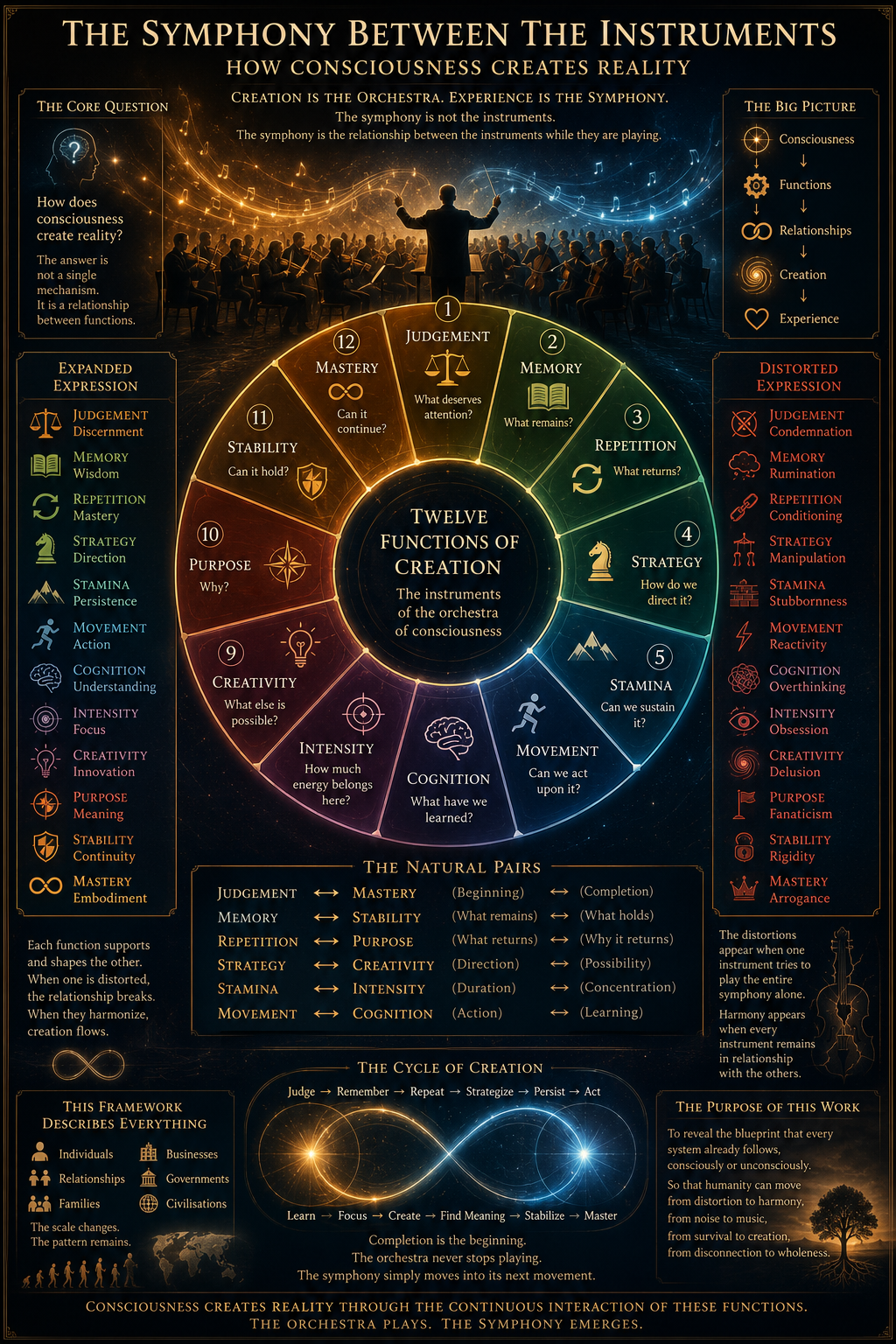
Education is not only school. Education is the way a mind learns how to meet life. It is how a child, adult, family, business, or society learns what to value, what to remember, what to practise, how to think, how to move, how to focus, how to create, and how to continue. A school can teach information without educating consciousness. Real education teaches the learner how to use themselves.
The twelve pillars of creation can help education return to its deeper purpose.
Judgement asks: what do we teach learners to value? If education only rewards grades, speed, obedience, and memorisation, then it teaches children to value performance over understanding. If education values curiosity, responsibility, truth, creativity, care, and mastery, then the child learns that learning is not only about being correct. It is about becoming capable.
Memory asks: what do learners remember? Education should not fill the mind with facts that disappear after exams. It should help learners carry useful memory: stories, lessons, principles, patterns, history, self-knowledge, and tools they can use later in life. Memory becomes powerful when it supports wisdom, not just recall.
Repetition asks: what do learners practise? Children practise more than subjects. They practise confidence or fear. They practise questioning or silence. They practise discipline or avoidance. They practise collaboration or competition. Education must become conscious of what it trains daily, because what is repeated becomes the learner’s foundation.
Strategy asks: what are we trying to achieve through education? Are we preparing children only to pass tests and enter jobs, or are we preparing them to understand themselves, contribute to society, build families, lead responsibly, care for their bodies, think critically, create solutions, and participate in the world consciously?
Stamina asks: can learners keep going? Education should teach resilience without abusing children through pressure. Stamina is not forcing a child until they break. It is helping them develop the ability to stay with difficulty, ask for help, rest properly, return with clarity, and continue learning without losing themselves.
Movement asks: what are learners doing? Education cannot stay trapped in theory. Children need to move, build, speak, write, test, draw, cook, clean, garden, debate, repair, perform, observe, and create. Movement turns information into experience, and experience gives cognition something real to learn from.
Cognition asks: what are learners learning from their experience? This is where education becomes alive. The child should not only ask, “Did I get it right?” They should ask, “What did this teach me? What pattern did I notice? What changed when I tried again? What do I understand now that I did not understand before?”
Intensity asks: what deserves focus? Education should teach attention as a skill. Not everything deserves the same energy at the same time. A child must learn how to prioritise, how to notice distraction, how to concentrate, how to rest focus, and how to return attention to what matters.
Creativity asks: what can be improved? Education should not only produce people who repeat the world as it is. It should produce people who can imagine better. Creativity belongs in science, maths, law, care, business, family, design, health, and daily problem-solving. A learner who cannot imagine improvement eventually becomes obedient to limitation.
Purpose asks: why does learning matter? Without purpose, education becomes empty performance. Children should understand why they learn: to understand life, to develop themselves, to care for others, to build better systems, to recognise patterns, to protect their future, and to contribute to the world they will inherit.
Stability asks: what continues after the lesson ends? Real education stays with the learner. It becomes a habit, a question, a value, a way of seeing. If a child forgets the answer but keeps the method of thinking, education has continued. Stability is the part of learning that remains useful beyond the classroom.
Mastery asks: what has the learner embodied? Mastery is not a certificate. It is what the learner can live, use, teach, and repeat with understanding. A child has mastered kindness when they practise it without being watched. They have mastered reading when they use it to access worlds. They have mastered thinking when they can question without collapsing into confusion.
Education can use these pillars in classrooms, homes, mentorship, training programmes, apprenticeships, leadership development, parenting, and self-study. The teacher can ask: what are we valuing today? What should be remembered? What needs practice? What are we trying to achieve? Can we keep going? What action will make this real? What are we learning? What needs focus? What can improve? Why does it matter? What should continue? What have we embodied?
The point is not to make education heavier. The point is to make it more alive.
Education should not only produce workers. It should produce conscious humans who can think, observe, care, build, question, create, and continue. One school may go, but not the continuity. One teacher may leave, but not the lesson. One lesson may end, but not the learner’s ability to use life as a classroom.
That is how education becomes conscious creation.




Leave a Reply