Leadership is not only authority, title, charisma, visibility, or decision-making. Leadership is the ability to carry responsibility in a way that creates direction, continuity, trust, movement, and development for more than oneself. A leader is not simply someone people follow. A leader is someone whose presence, choices, standards, and repetitions shape the field around them.
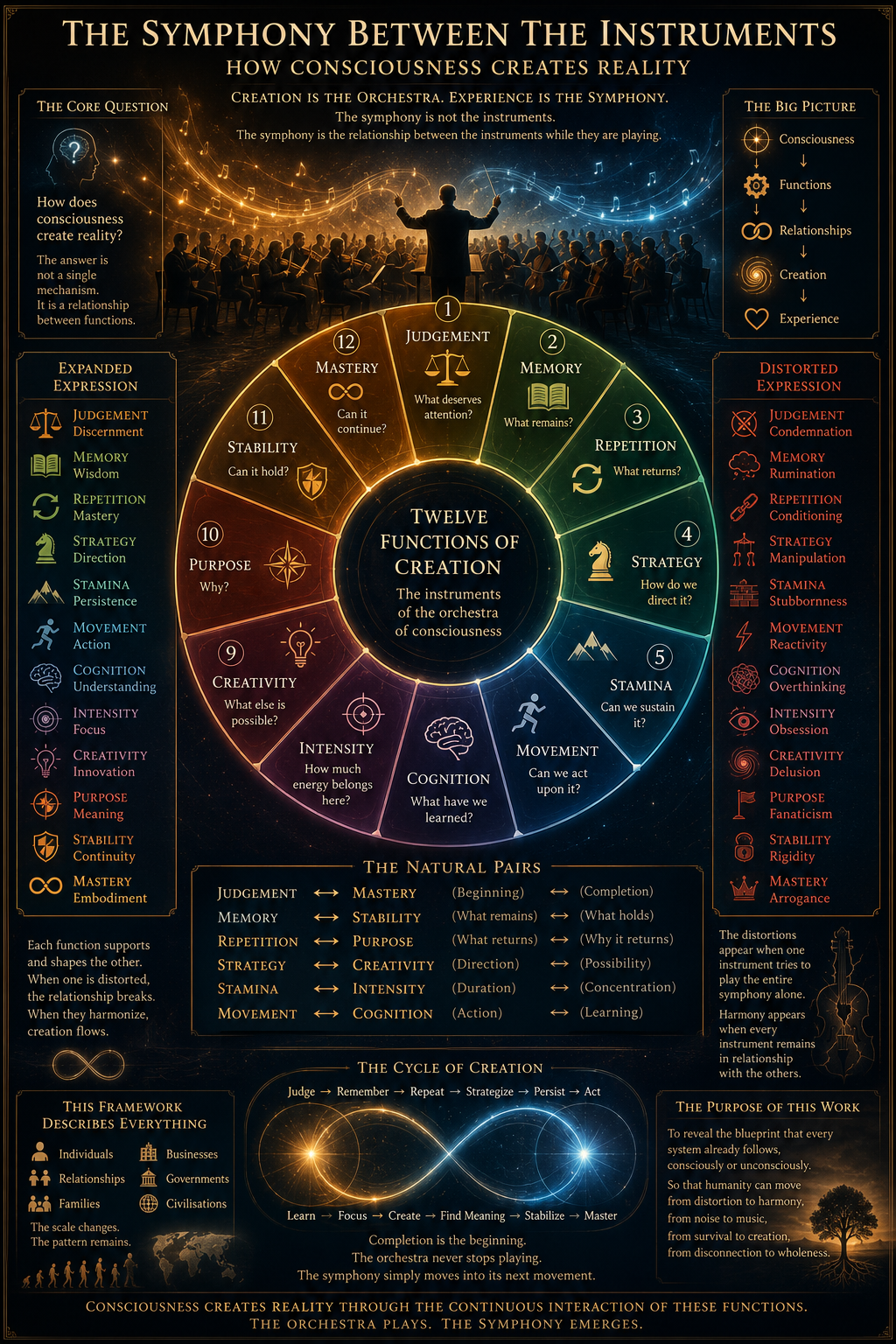
The twelve pillars of creation can help leadership become conscious.
Judgement asks: what does the leader value? A leader reveals their true values through what they protect, reward, tolerate, confront, ignore, and repeat. If a leader claims to value people but rewards burnout, the field will learn burnout. If a leader claims to value truth but punishes honesty, the field will learn performance. Leadership begins with clean judgement because what the leader values becomes culture.
Memory asks: what does the leader remember? A conscious leader remembers lessons, failures, promises, people, consequences, and patterns. They do not use memory to stay trapped in the past, but they do not erase the past to avoid responsibility either. Memory gives leadership depth. Without memory, leaders repeat harm and call it strategy.
Repetition asks: what does the leader practise? Leadership is not proven in one inspiring speech. It is proven in repeated behaviour. Does the leader repeatedly communicate, repair, follow through, observe, listen, act, and learn? Or do they repeatedly avoid, blame, rush, control, and perform? Repetition becomes trust or distrust.
Strategy asks: what is the leader trying to build? A leader must know the direction. Not every detail, not every answer, but the direction. Without strategy, leadership becomes reaction. With strategy, people understand why effort is being organised and where the movement is meant to go.
Stamina asks: can the leader keep going? Leadership requires endurance without self-destruction. A leader must learn how to continue through pressure, criticism, delay, responsibility, complexity, and change without losing coherence. Stamina is not martyrdom. It is sustained responsibility.
Movement asks: what is the leader doing? A leader’s actions educate the whole field. People watch what moves, not only what is said. If the leader speaks of accountability but never acts on it, the field learns inconsistency. If the leader speaks of growth and keeps moving with growth, the field learns possibility.
Cognition asks: what is the leader learning? A conscious leader does not only instruct others. They remain teachable. They learn from mistakes, staff, children, communities, data, resistance, consequences, and reality itself. A leader who cannot learn eventually becomes the limit of the system they lead.
Intensity asks: what deserves the leader’s focus? Leadership requires prioritisation. Not everything can receive the same attention. A leader must know what is urgent, what is foundational, what is distraction, what is noise, and what deserves deep focus. Misplaced intensity creates chaos. Clean intensity creates movement.
Creativity asks: what can the leader improve? A leader must be able to imagine better systems, better conversations, better roles, better structures, better futures, and better ways of carrying responsibility. Creativity keeps leadership from becoming administration without vision.
Purpose asks: why does this leadership matter? Leadership without purpose becomes control. Purpose reminds the leader that the role exists to serve something larger than ego, image, title, or personal gain. Purpose asks what kind of life, system, culture, or future the leadership is here to support.
Stability asks: what continues under this leadership? People need to know what remains reliable. Standards, care, communication, fairness, direction, and accountability cannot disappear every time emotions change or pressure rises. Stability gives the field enough safety to grow.
Mastery asks: what has the leader embodied? Leadership mastery is not what the leader announces. It is what they have become capable of carrying consistently. Have they mastered responsibility, repair, discernment, communication, patience, courage, vision, or stewardship? Or have they only mastered appearing in charge?
A leader can use these twelve pillars as an audit. What do I value? What do I remember? What do I practise? What am I building? Can I keep going? What am I doing? What am I learning? What deserves focus? What can I improve? Why does this matter? What continues through me? What have I embodied?
Leadership is not about becoming irreplaceable. It is about making continuity strong enough that the field can keep growing. One leader may go, but not the continuity. One title may change, but not the standard. One phase may end, but not the responsibility to create better conditions for those who follow.
That is how leadership becomes conscious creation.



Leave a Reply