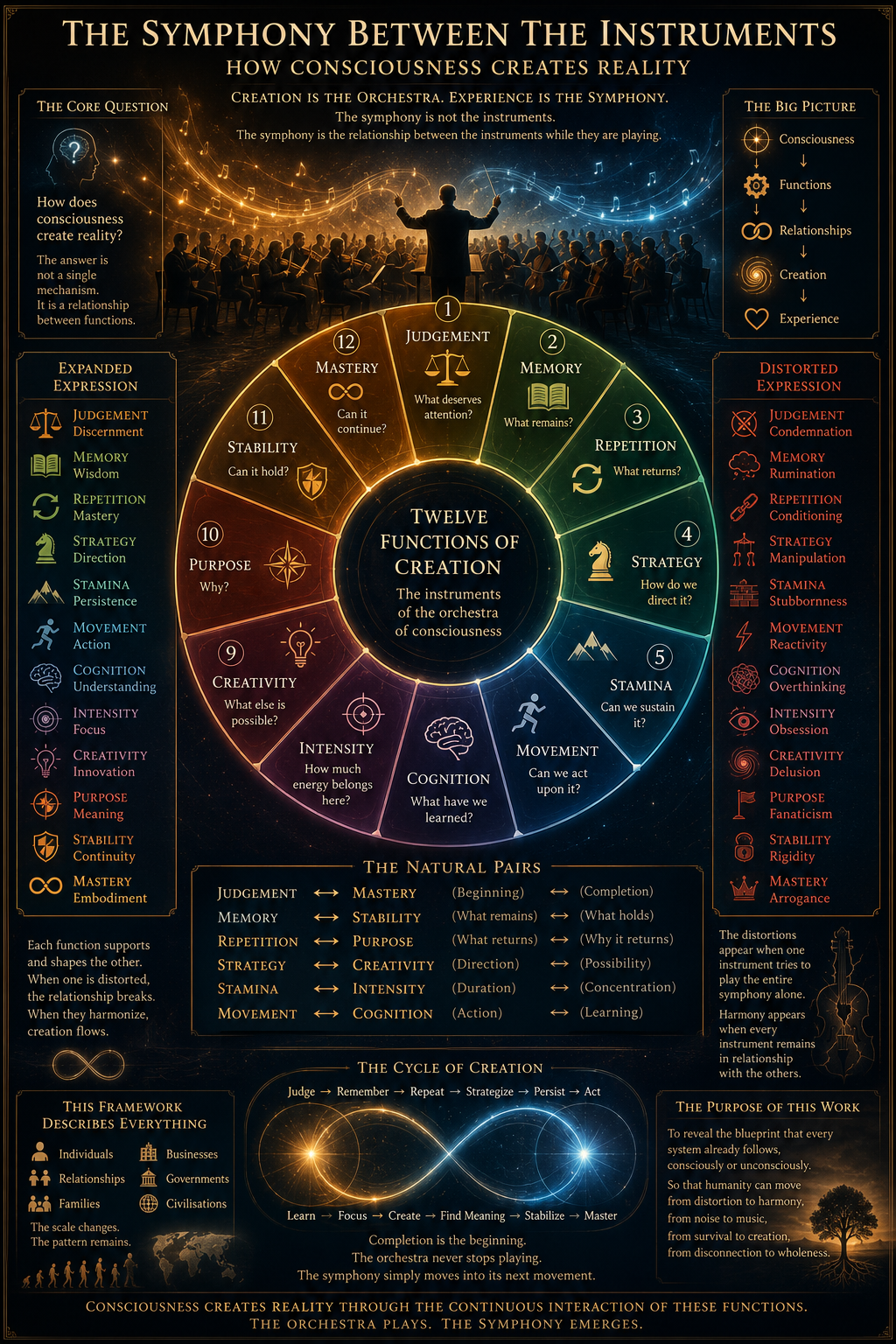
A family is not only blood, surname, home, history, or obligation. A family is a living system of memory, repetition, care, responsibility, conflict, repair, inheritance, protection, identity, and future. Whether chosen, biological, blended, extended, spiritual, or built through friendship, family becomes one of the first places where consciousness learns how to belong, how to communicate, how to love, how to hide, how to repeat, and how to grow.
The twelve pillars of creation can help a family understand itself more clearly.
Judgement asks: what does this family value? A family may say it values love, but reward silence. It may say it values honesty, but punish truth. It may say it values success, but shame the person who grows beyond familiar limits. This pillar asks the family to look honestly at what is actually protected, encouraged, excused, challenged, and repeated.
Memory asks: what does this family remember? Families carry stories, wounds, pride, grief, migrations, celebrations, betrayals, sacrifices, traditions, and unfinished conversations. Healthy memory turns history into wisdom. Distorted memory turns history into prison. A family must ask whether it is remembering to learn, or remembering to keep everyone trapped in old roles.
Repetition asks: what does this family practise? Every family has patterns. Some practise encouragement. Some practise criticism. Some practise avoidance. Some practise repair. Some practise survival. Some practise emotional silence and call it peace. The family becomes what it repeatedly does, not what it occasionally promises.
Strategy asks: what is this family trying to build? Is the family building safety, wealth, healing, education, legacy, community, emotional maturity, faith, freedom, or only appearance? Without strategy, family life becomes reaction. With strategy, family becomes a shared direction rather than a shared surname.
Stamina asks: can this family keep going through difficulty? Every family meets pressure: illness, money issues, conflict, distance, grief, disappointment, growth, and change. Stamina is not pretending everything is fine. It is the ability to remain responsible, caring, and honest when things are not easy.
Movement asks: what is this family doing? Love must move. Care must move. Apologies must move. Support must move. Protection must move. A family cannot survive on intention alone. If love is never acted upon, it becomes a claim without evidence.
Cognition asks: what is this family learning? Does the family learn from arguments, or repeat them? Does it learn from children, or only instruct them? Does it learn from pain, or hide from it? A conscious family is not one that never struggles. It is one that can learn from what happens inside it.
Intensity asks: what deserves focus? Not every disagreement deserves the same energy. Not every family issue is the root issue. Some things are symptoms. Some things are patterns. Some things are urgent. Some things need patience. A family must learn where to place its attention instead of letting drama decide.
Creativity asks: what can this family improve? Maybe the family needs a new way of speaking, a new routine, a new tradition, a new boundary, a new financial habit, a new way to celebrate, a new way to repair, or a new way to let children be heard. Creativity keeps family from becoming trapped in “this is how we have always done it.”
Purpose asks: why does this family matter? Family should not only be an inherited structure. It should be a field that serves life. Does this family help its members become more whole, more responsible, more loved, more capable, more truthful, more free? Purpose gives family direction beyond obligation.
Stability asks: what continues? What can family members rely on? What remains true even during conflict? What care remains available even when emotions shift? Stability does not mean rigidity. It means the family has enough continuity that people can grow without fearing abandonment every time something changes.
Mastery asks: what has this family embodied? Has it mastered repair? Has it mastered avoidance? Has it mastered survival but not joy? Has it mastered achievement but not tenderness? Has it mastered loyalty but not truth? Mastery shows what a family has practised long enough to become natural.
A family can use these pillars around a dinner table, during conflict, after a big change, before a child leaves home, when healing old wounds, when building new traditions, or when deciding what kind of legacy it wants to leave. The questions are simple, but they open the whole field.
What do we value?
What do we remember?
What do we practise?
What are we trying to build?
Can we keep going?
What are we doing?
What are we learning?
What deserves focus?
What can improve?
Why does this family matter?
What continues?
What have we embodied?
The family is the first civilisation many people ever know. If the family learns consciousness, the child does not have to spend adulthood translating chaos into wisdom alone.
One generation may go, but not the continuity. One home may change, but not the foundation. One family pattern may end, but not the love that deserved a better structure.
That is how family becomes conscious creation.




Leave a Reply