
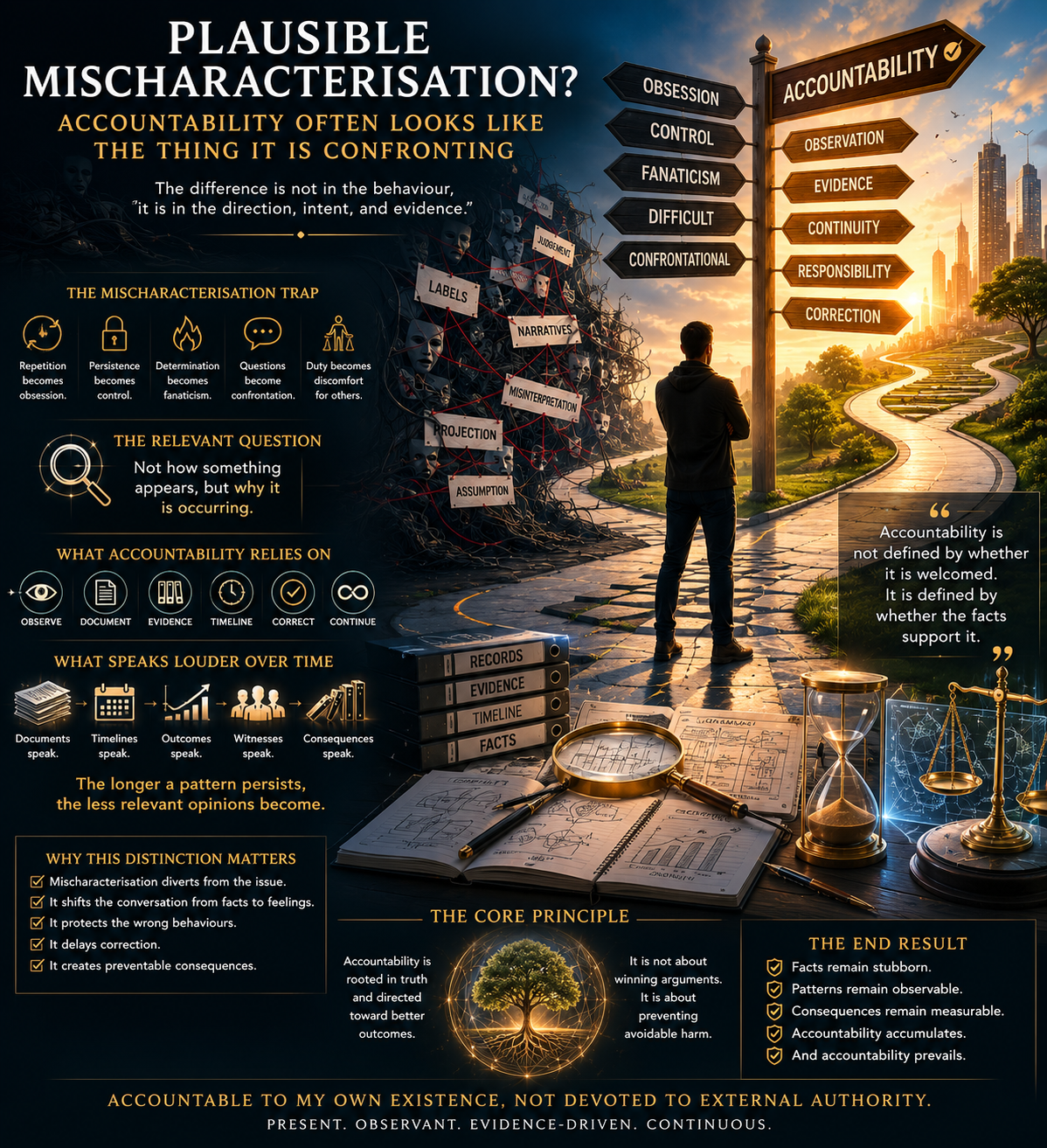
One red thread I have observed across many areas of life is that direction changes the meaning of behaviour.
From a distance, accountability, obsession, devotion, grit, fanaticism, submission, and control can sometimes appear remarkably similar.
The actions may even look identical.
The difference is often found in direction, scope, intent, and evidence.
This distinction matters because accountability is frequently mischaracterised by those who would rather avoid it.
A person repeatedly raising the same issue may be labelled obsessed.
A person documenting the same pattern may be labelled controlling.
A person refusing to abandon a matter may be labelled fanatical.
A person insisting on answers may be labelled difficult.
A person seeking correction may be labelled confrontational.
Yet none of these labels, by themselves, determine what is actually occurring.
The relevant question is not how something appears.
The relevant question is why it is occurring.
If an individual repeatedly identifies a documented failure, and the failure remains unaddressed, repetition is not necessarily obsession.
It may simply be continuity.
If an individual continues raising a risk after warnings have been ignored, persistence is not necessarily control.
It may simply be responsibility.
If an individual refuses to abandon an issue because consequences remain foreseeable and preventable, determination is not necessarily fanaticism.
It may simply be duty of care.
This is why accountability often attracts projection.
The easiest way to avoid addressing facts is to recharacterise the person presenting them.
The discussion shifts from the evidence to the messenger.
From the conduct to the character.
From the pattern to the observer.
From the issue to the individual identifying it.
Such approaches are common because they are strategically convenient.
Intent is removed.
Context is removed.
Chronology is removed.
Evidence is removed.
Duty is removed.
The remaining vacuum is then filled with interpretation.
Interpretation becomes accusation.
Accusation becomes narrative.
Narrative becomes defence.
Yet facts remain stubborn things.
Patterns remain observable.
Timelines remain traceable.
Consequences remain measurable.
And over time, accountability develops a characteristic advantage over mischaracterisation.
It accumulates evidence.
The longer a pattern persists, the less relevant opinions become.
The record begins speaking for itself.
The documents speak.
The timelines speak.
The outcomes speak.
The witnesses speak.
The consequences speak.
At that point, characterisations matter far less than continuity.
Because accountability is not defined by whether it is welcomed.
It is defined by whether the facts support it.
And where facts continue accumulating in the same direction, accountability eventually becomes self-evident regardless of how many alternative narratives were temporarily attached to it.
That is why I am accountable to my own existence rather than devoted to an external authority.
Accountability requires observation.
Accountability requires evidence.
Accountability requires correction.
Accountability requires continuity.
Most importantly, accountability requires the willingness to remain present long enough for facts to speak louder than words.
…
Lets write a post about it leading with my initial prompt and accountability appears as all where the projection is denial, rejection or confrontation. Meaning ifbik holding accountsble one that keeps wrongdoing, it can be classed as obsession if intent is removed, one could aim for plausible miscaracterisation, but when facts speak louder than words the accountsbility speaks for itself.
Why not keep it legal language: we’re on the professional series, keepbut such, less philosphy, more cunningness.
…
Plausible mischaracterisation is when a person, organisation, institution, or observer describes someone else’s behaviour in a way that is technically believable on the surface, but omits enough context, intent, chronology, or evidence that the description becomes materially misleading.
The key word is plausible.
Not obviously false.
Not absurd.
Not impossible.
Plausible.
Something that an uninformed third party could reasonably believe if they were not given the full picture.
That is what makes it effective.
For example:
A person sends 50 emails to an organisation.
Without context, that can be characterised as harassment.
With context, it may turn out those 50 emails occurred over three years, concerned an unresolved safety issue, received almost no substantive responses, and each email introduced new evidence.
The behaviour is the same.
The characterisation changes.
The first description creates the impression of obsession.
The second creates the impression of persistence.
The facts did not change.
The framing did.
That is plausible mischaracterisation.
Another example:
An employee repeatedly documents procedural failures.
A manager may characterise them as negative.
A colleague may characterise them as difficult.
A lawyer may characterise them as a whistleblower.
A regulator may characterise them as reporting foreseeable risk.
The conduct remains identical.
The interpretation changes according to the observer’s interests.
The question therefore becomes:
Which characterisation best survives the evidence?
That is where accountability separates itself from narrative.
A plausible mischaracterisation can survive first contact.
It struggles to survive chronology.
Because chronology asks:
- What happened first?
- What was reported?
- What responses were given?
- What remained unresolved?
- What evidence accumulated?
- What consequences followed?
The more complete the timeline becomes, the less room there is for plausible mischaracterisation.
This is why many accountability disputes are not actually disputes about facts.
They are disputes about framing.
One side is attempting to establish a pattern.
The other side is attempting to establish a character.
One argues:
“Look at what happened.”
The other argues:
“Look at the person saying it.”
In professional, legal, governance, and institutional environments, plausible mischaracterisation is often more useful than direct contradiction because direct contradiction can be disproved.
Mischaracterisation is harder to challenge because it usually contains a grain of truth.
The emails were sent.
The reports were made.
The questions were asked.
The persistence existed.
The dispute is not whether the behaviour occurred.
The dispute is whether the behaviour should be interpreted as accountability, obsession, harassment, diligence, control, persistence, or something else.
That is why intent, chronology, evidence, and outcomes matter so much.
Without them, almost any act of accountability can be plausibly mischaracterised as the very thing it is attempting to confront.
And that is often where accountability and denial become mirror images of one another.
The accountable party continues because the issue remains unresolved.
The denying party explains the continuation as proof that the accountable party is the problem.
The longer the issue remains unresolved, the stronger both narratives appear—until the evidence becomes sufficient for one narrative to collapse under the weight of the facts.






Leave a Reply