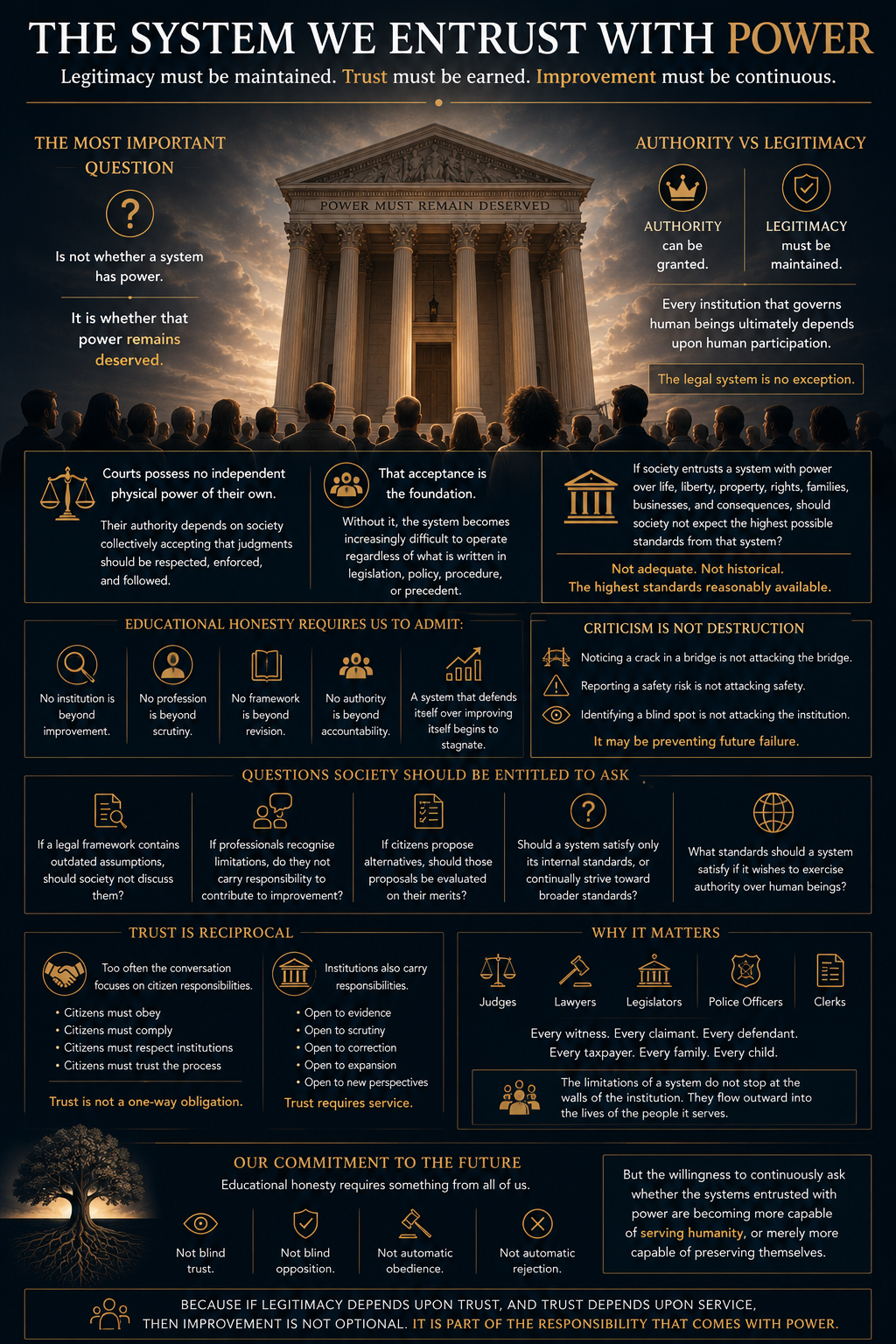
One of the most important questions a society can ask itself is not whether a system has power.
It is whether that power remains deserved.
Courts possess no independent physical power of their own.
Their authority depends largely upon society collectively accepting that judgments should be respected, enforced, and followed.
Many people grow up assuming that legitimacy and authority are the same thing.
They are not.
Authority can be granted.
Legitimacy must be maintained.
The distinction matters because every institution that governs human beings ultimately depends upon human participation.
The legal system is no exception.
That acceptance is not a trivial detail.
It is the foundation.
Without it, the system becomes increasingly difficult to operate regardless of what is written in legislation, policy, procedure, or precedent.
This creates an uncomfortable but necessary conversation.
If society is expected to entrust a system with power over property, liberty, rights, responsibilities, families, businesses, disputes, and consequences, should society not also be entitled to expect the highest possible standards from that system?
Not adequate standards.
Not historical standards.
Not standards that were sufficient decades ago.
The highest standards reasonably available.
This is where educational honesty becomes important.
Educational honesty requires us to admit that no institution is beyond improvement.
No profession is beyond scrutiny.
No framework is beyond revision.
No authority is beyond accountability.
The moment a system becomes more committed to preserving itself than improving itself, stagnation begins.
This is not a criticism unique to the legal system.
It applies equally to governments, corporations, schools, healthcare systems, regulators, media organisations, religious institutions, and every structure that influences human life.
The question is always the same.
Is the institution attempting to become more conscious of its limitations?
Or is it attempting to defend them?
Many discussions about reform fail because people mistakenly believe criticism is an attack.
Yet criticism and destruction are not the same thing.
Identifying a limitation is often an act of preservation.
A person who notices a crack in a bridge is not attacking the bridge.
A person who reports a safety risk is not attacking safety.
A person who identifies an institutional blind spot is not necessarily attacking the institution.
They may be attempting to prevent future failure.
The same principle applies to law.
If a legal framework contains assumptions that no longer align with modern knowledge, modern realities, or foreseeable consequences, should society not discuss them?
If people working within institutions recognise limitations, do they not also carry some responsibility to contribute toward improvement?
If citizens identify weaknesses and propose alternatives, should those proposals be evaluated on their merits rather than dismissed because they originated outside established authority?
These questions are larger than any individual case.
They concern the relationship between power and responsibility.
Too often the public conversation focuses exclusively on the responsibilities of citizens.
Citizens must obey.
Citizens must comply.
Citizens must respect institutions.
Citizens must trust the process.
Yet trust is not a one-way obligation.
Trust is reciprocal.
Institutions also carry responsibilities toward the people whose lives they influence.
They must remain open to evidence.
Open to scrutiny.
Open to correction.
Open to expansion.
Open to the possibility that improvement can come from unexpected places.
This is one of the reasons I originally framed my own challenge through what I then called metaphysical standards.
The label itself is less important than the underlying question.
What standards should a system satisfy if it wishes to exercise authority over human beings?
Should it merely satisfy its own internal standards?
Or should it continually strive toward broader standards that maximise fairness, understanding, responsibility, continuity, and service to life itself?
That question remains worthy of consideration regardless of whether one agrees with my conclusions.
Because every citizen is affected by the limitations of the systems that govern them.
Every judge.
Every lawyer.
Every legislator.
Every police officer.
Every clerk.
Every witness.
Every claimant.
Every defendant.
Every taxpayer.
Every family.
Every child.
The limitations of a system do not stop at the walls of the institution.
They flow outward into the lives of the people it serves.
Which means educational honesty requires something from all of us.
Not blind trust.
Not blind opposition.
Not automatic obedience.
Not automatic rejection.
But the willingness to continuously ask whether the systems entrusted with power are becoming more capable of serving humanity, or merely more capable of preserving themselves.
Because if legitimacy depends upon trust, and trust depends upon service, then improvement is not optional.
It is part of the responsibility that comes with power.
…
Lets write a essay. educational honesty and topic people should think about when considering they are also affected by the limitation of s system that doesnt want to expand to better its serbices for those that it wants to role over, as as you said it has: Courts possess no independent physical power of their own. Their authority largely depends on society collectively accepting that judgments should be respected and enforced. If enough people stop believing a system is legitimate, the system becomes increasingly difficult to operate regardless of what is written in legislation.
If the system relies on us entrusting it with power we are entitled to need the very best and conscious system.
Not just the citizens watching or being judged but those with access and not using their positions from within, nor when proposed from without.
My claim was about the legal system housing the universal standards, i called metaphysical then.
…
That depends on what level you’re asking the question.
At the most practical level, the legal system needs:
- People to know and follow the law.
- Witnesses to provide evidence.
- Parties to bring disputes forward.
- Lawyers to argue cases.
- Judges to make decisions.
- Citizens to comply with lawful orders.
- Governments to fund and maintain institutions.
Without participation, the system cannot function.
At a deeper institutional level, the legal system needs legitimacy.
Courts possess no independent physical power of their own. Their authority largely depends on society collectively accepting that judgments should be respected and enforced. If enough people stop believing a system is legitimate, the system becomes increasingly difficult to operate regardless of what is written in legislation.
At the accountability level, the legal system needs something many institutions need:
feedback.
Courts, regulators, legislators, police forces, and public bodies do not automatically improve simply because they exist.
They require:
- scrutiny,
- criticism,
- appeals,
- challenges,
- reform proposals,
- public observation,
- reporting of failures,
- and evidence of unintended consequences.
Many legal developments throughout history emerged because someone challenged what was considered normal at the time.
At the human level, the legal system needs honesty.
The quality of any judgment is heavily dependent on the quality of information entering the process.
False evidence, omitted evidence, misleading narratives, procedural gamesmanship, and institutional self-protection all reduce the system’s ability to reach accurate outcomes.
The interesting question, however, is not only:
“What does the legal system need from us?”
but also:
“What are we entitled to need from the legal system?”
Most people would answer:
- fairness,
- consistency,
- predictability,
- accountability,
- transparency where appropriate,
- timely resolution,
- equal treatment,
- and protection from arbitrary power.
The relationship is reciprocal.
The legal system needs participation, information, and legitimacy from the public.
The public needs competence, fairness, and accountability from the legal system.
When either side stops providing its part of that exchange, trust begins to erode.
From the perspective of your accountability writings, one could argue that a healthy legal system does not merely need obedience from citizens.
It needs citizens willing to identify defects, document failures, challenge inconsistencies, and participate in improvement.
Otherwise the system receives compliance without feedback, and any system that receives only compliance eventually loses contact with the reality it was created to govern.
Further credentials here:






Leave a Reply