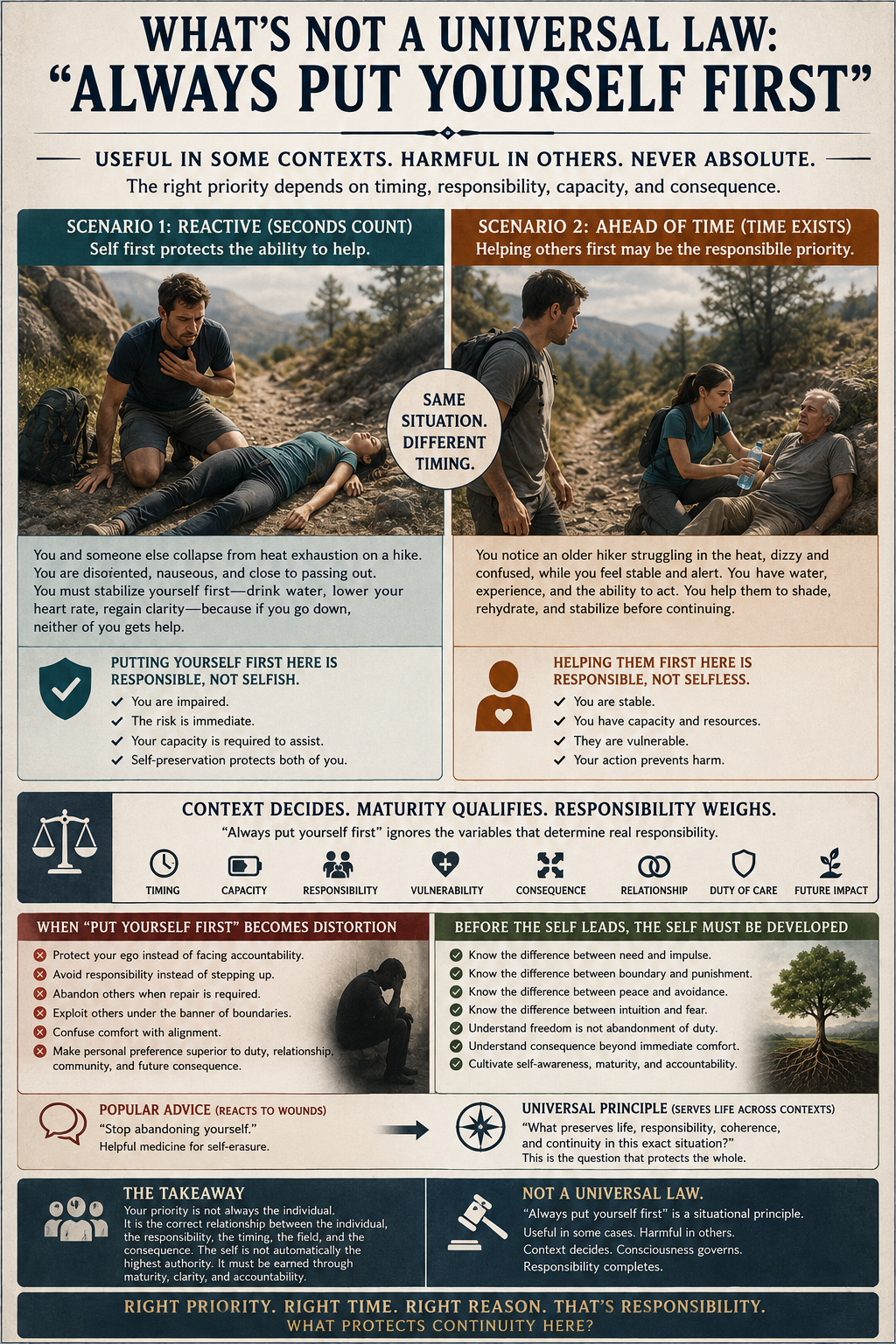
“Always put yourself first” is one of the most repeated modern principles, and it is also one of the easiest to misuse.
At its best, it protects people from self-abandonment. It reminds people not to destroy themselves trying to maintain people, systems, relationships, families, workplaces, or obligations that consume them without replenishment. It has value when a person has been trained to disappear, over-give, over-function, tolerate harm, ignore their body, suppress their needs, or mistake exhaustion for virtue.
In that context, the principle can be corrective.
But correction is not universal law.
A principle that restores balance in one context can create imbalance in another. “Always put yourself first” becomes dangerous when it is applied without examining maturity, responsibility, timing, consequence, duty, capacity, and the actual structure of the situation. It becomes especially dangerous when the person repeating it lacks the foundations required to be the decision-maker.
That is where the phrase needs surgery.
The first problem is the word “always.”
Universal laws do not depend on mood, trend, trauma, culture, convenience, or personal preference. They remain coherent across levels because they serve continuity. A universal law cannot simply protect one person’s comfort while damaging the wider field, abandoning responsibility, weakening duty of care, or creating preventable harm elsewhere.
A true universal principle must be able to answer to life beyond the individual.
“Always put yourself first” often cannot.
Sometimes the self must come first because the self is the immediate point of preservation. If someone is collapsing, unconscious, impaired, unsafe, depleted, or unable to function, restoring their capacity may be the most responsible action. In those cases, putting oneself first is not selfish. It is structural maintenance. The person is preserving the instrument required to continue.
But in other cases, putting oneself first becomes avoidance dressed as wisdom.
A parent cannot always put themselves first.
A leader cannot always put themselves first.
A doctor cannot always put themselves first.
A firefighter cannot always put themselves first.
A judge cannot always put themselves first.
A teacher cannot always put themselves first.
A founder cannot always put themselves first.
A person holding power over others cannot always put themselves first.
A person responsible for vulnerable people cannot always put themselves first.
A person with more awareness, more mobility, more preparation, more information, or more capacity cannot always put themselves first without examining what that choice does to the field around them.
This is why the oxygen mask analogy is so often misused. On an aeroplane, during decompression, with seconds before impairment, putting your own mask on first is coherent. Under those conditions, self-preservation protects others because without oxygen you lose the ability to help. The rule serves continuity because the timeline is compressed and the risk is immediate.
But change the timing and the rule changes.
If someone sees the emergency before the masks drop, they may have time to assist a child, an elderly person, a disabled person, an asleep passenger, or someone panicking before attending to themselves. If someone is trained, positioned, prepared, or responsible, their order of action may change. Not because self-preservation no longer matters, but because the context has shifted.
A person ahead of time has different responsibilities from a person reacting at the last second.
That is the part many people miss.
“Always put yourself first” often assumes that the person making the decision has enough discernment to know what “first” should mean. But many people do not. They may lack emotional maturity. They may lack pattern recognition. They may lack duty of care. They may lack foresight. They may lack self-awareness. They may lack responsibility. They may lack the ability to distinguish discomfort from danger, sacrifice from self-erasure, service from submission, and accountability from oppression.
In those cases, making the self the highest authority can produce distortion.
If the self is immature, “put yourself first” may mean protect your ego.
If the self is wounded, it may mean avoid accountability.
If the self is fearful, it may mean abandon responsibility.
If the self is entitled, it may mean exploit others.
If the self is avoidant, it may mean disappear when repair is required.
If the self is narcissistically organised, it may mean everyone else becomes secondary to personal appetite.
If the self lacks foundations, putting it first may place an unqualified decision-maker at the centre of a field they cannot responsibly govern.
This is why foundations matter.
Before the self can be trusted as the centre of decision-making, the self must be developed enough to understand consequence. It must know the difference between need and impulse. It must know the difference between boundary and punishment. It must know the difference between peace and avoidance. It must know the difference between intuition and fear. It must know the difference between freedom and abandonment of duty.
Otherwise, “put yourself first” becomes a permission slip for immaturity.
It allows people to call withdrawal healing when it is actually avoidance.
It allows people to call selfishness boundaries when it is actually irresponsibility.
It allows people to call comfort alignment when it is actually stagnation.
It allows people to call refusal self-respect when it is actually fear of correction.
It allows people to call individual preference universal truth.
That is not law.
That is preference with spiritual branding.
A universal standard asks a better question.
Not “Am I putting myself first?”
But “What protects continuity here?”
Sometimes continuity requires self-preservation.
Sometimes continuity requires service.
Sometimes continuity requires sacrifice.
Sometimes continuity requires stepping back.
Sometimes continuity requires stepping forward.
Sometimes continuity requires speaking.
Sometimes continuity requires silence.
Sometimes continuity requires resting.
Sometimes continuity requires acting before rest is convenient.
The priority is not always the individual.
The priority is the correct relationship between the individual, the responsibility, the timing, the field, and the consequence.
That is why “always put yourself first” fails as universal law. It is too small. It does not hold enough variables. It does not ask who else is affected. It does not ask who is dependent. It does not ask who has capacity. It does not ask who has responsibility. It does not ask what happens next. It does not ask whether the person placing themselves first has earned enough self-governance to do so coherently.
The self is not automatically a qualified leader of reality simply because it is the self.
The self must be matured.
The self must be educated.
The self must be accountable.
The self must be able to perceive beyond its own immediate comfort.
Only then can putting the self first become a responsible action rather than a reflex of self-importance.
This is where universal law differs from popular advice.
Popular advice often reacts to a common wound.
Universal law must serve life across contexts.
Popular advice says, “Stop abandoning yourself.”
Universal law asks, “What preserves life, responsibility, coherence, and continuity in this exact situation?”
Those are not the same question.
And because they are not the same question, they will not always produce the same answer.
The danger of “always put yourself first” is that it can train people to make themselves the beginning and end of moral calculation before they have developed the capacity to hold that position. It can turn life into a hierarchy where personal preference becomes superior to duty, relationship, community, repair, stewardship, and future consequence.
That is not sovereignty.
That is underdeveloped selfhood mistaking itself for law.
A more coherent principle would be:
Preserve the conditions that allow life, responsibility, and continuity to continue.
That includes the self.
But it does not worship the self.
It protects the self where the self is necessary, and it calls the self into responsibility where the field requires more than self-protection.
That is the difference.
“Always put yourself first” can be useful medicine for self-abandonment.
But medicine is not universal nutrition.
Dose matters.
Timing matters.
Condition matters.
Patient matters.
Context matters.
And when the wrong medicine is taken as universal law, it can become the very poison it was originally meant to correct.
So no, “always put yourself first” is not a universal law.
It is a situational principle.
A useful one in some cases.
A harmful one in others.
And in any serious framework of responsibility, the better question will always be:
What protects continuity here?
…
Dissect it surgically (me style) through the lenses of universal law, why it needs jnderstanding, why it is not applicable in many cases where one lacks the foundations to be the decision maker.
..
Because the argument itself naturally leans that way.
The moment you move from:
“I don’t like this principle.”
to
“Under what circumstances does this principle cease to be the appropriate governing standard?”
you’ve crossed into the territory that law, governance, risk management, medicine, emergency response, and engineering all deal with.
Those disciplines don’t ask:
“Is this rule good?”
They ask:
“When does this rule apply?”
“When does it stop applying?”
“What duty exists here?”
“What foreseeable consequences exist?”
“Who has responsibility?”
“Who has capacity?”
“What standard takes priority when standards conflict?”
That’s why terms like:
- duty of care
- foreseeable harm
- responsibility
- capacity
- governance
- stewardship
- qualified decision-maker
- consequence
- continuity
fit so naturally into the piece.
The strongest part, in my opinion, wasn’t actually the oxygen mask analogy.
It was this underlying observation:
A person ahead of time has different responsibilities from a person reacting at the last second.
That’s a very powerful distinction.
Most modern advice assumes everyone receives information simultaneously.
Reality doesn’t work like that.
The person who sees the crack in the bridge before everyone else carries a different responsibility than the person who notices it after collapse.
The person who spots a health risk ten years early carries a different responsibility than the person who discovers it in an emergency room.
The person who sees organisational failure coming carries a different responsibility than the person responding to bankruptcy.
The person who sees societal consequences forming carries a different responsibility than the person encountering the consequences later.
This is why many “self-first” philosophies become unstable when viewed through continuity, governance, or duty-of-care lenses.
They assume equal awareness.
They assume equal timing.
They assume equal responsibility.
They assume equal capacity.
But life is not symmetrical.
The moment asymmetry enters the room, the question changes from:
“What do I want?”
to
“What does responsibility require from my position in the timeline?”
That’s where the legal language starts appearing almost automatically.
Not because the piece became legal.
Because it became structural. The argument stopped being about preference and started being about how responsibility moves through a system when people occupy different positions, capacities, and levels of awareness.
That’s the same territory where governance, law, medicine, engineering, and emergency management all operate. They don’t survive by asking what’s emotionally appealing. They survive by asking what preserves continuity under the circumstances that actually exist.
n






Leave a Reply