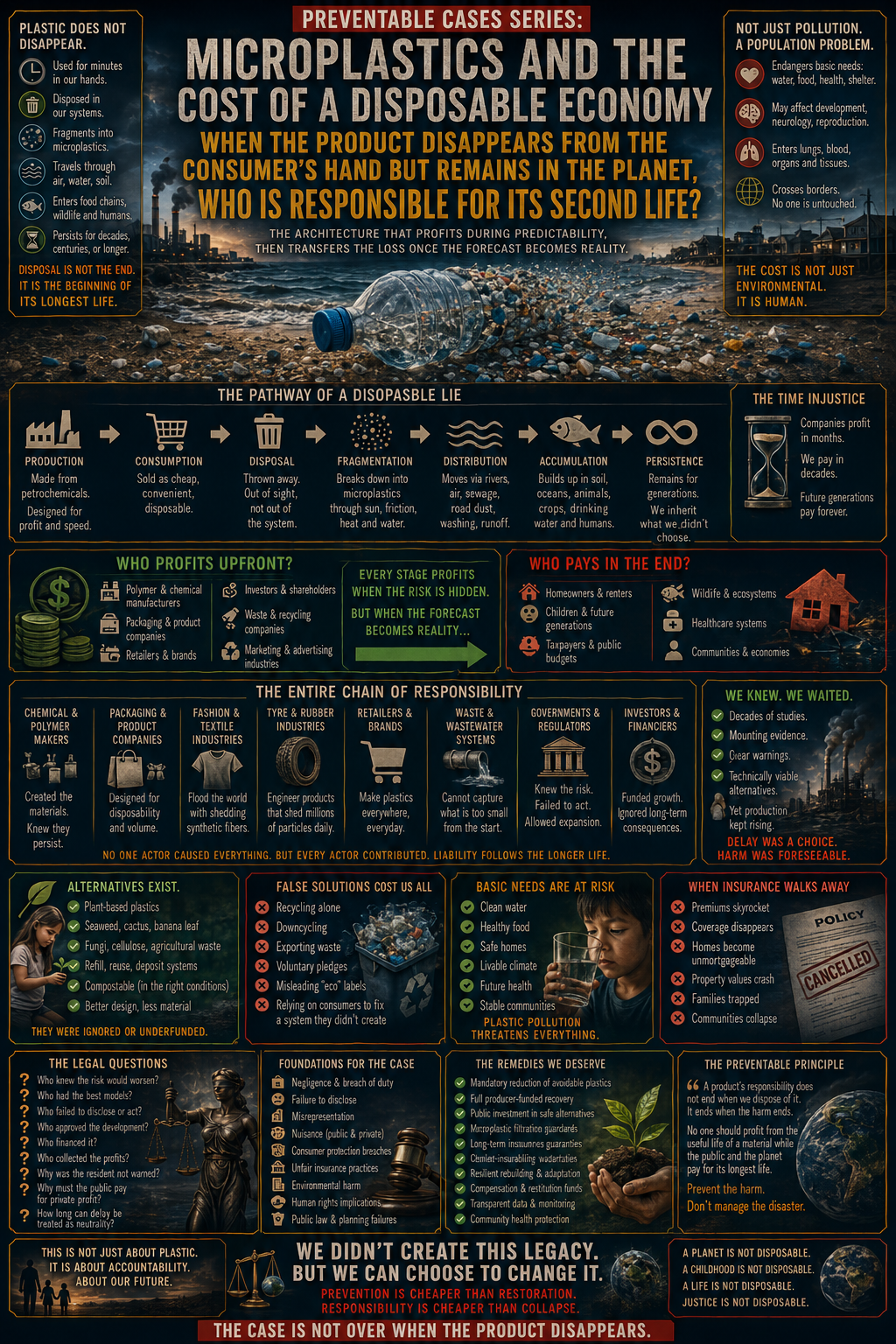
When the Product Disappears From the Consumer’s Hand but Remains in the Planet, Who Is Responsible for Its Second Life?
Microplastics may become one of the largest environmental mass-tort questions of the modern era.
The case is not confined to litter.
It is not only about bottles floating in rivers, packaging accumulating on beaches or visible waste entering landfill.
The deeper case concerns what happens after plastic stops being recognisable as a product but continues existing as material.
A bottle may leave the consumer’s hand.
A tyre may lose part of its tread.
A synthetic garment may release fibres during washing.
Paint may weather from a building.
Packaging may break apart under sunlight, friction, heat and water.
A disposable object may disappear from ordinary view.
But disappearance from sight is not disappearance from the environment.
The commercial life of plastic may end at disposal.
Its environmental life continues.
That second life may extend through soil, rivers, oceans, drinking water, agricultural systems, food chains, household dust, wildlife and the human body. The item may no longer carry a brand name by the time it reaches those places, but the material remains part of the same production decision.
That creates the foundational legal question:
When a product’s longest life begins after the consumer has finished using it, why does responsibility end at the shortest stage?
The disposable economy was built around an incomplete account of time.
It measured the moment of production.
It measured the point of sale.
It measured convenience.
It measured consumption.
It measured disposal.
But it did not adequately account for persistence.
Plastic was treated as disposable because the consumer could throw it away, not because the material itself could safely disappear.
The consumer’s relationship with the product may last minutes, days or months.
The planet’s relationship with the material may last decades, centuries or longer.
Responsibility should follow the longer life.
Plastic Does Not Become Harmless When It Becomes Small
Microplastics expose the weakness in the idea of “away.”
There is no single place called away.
There are only transfers.
From homes to bins.
From bins to landfill.
From streets to drains.
From drains to rivers.
From rivers to seas.
From textiles to wastewater.
From tyres to road dust.
From packaging to soil.
From industrial production to air.
From one organism to another.
The material moves, fragments and becomes less visible.
But fragmentation is not resolution.
A large piece of plastic becomes many smaller pieces. Those pieces become more difficult to recover, more easily dispersed and more capable of moving through systems that were never designed to remove them.
The problem therefore becomes harder as the material becomes less visible.
This reverses the ordinary relationship between evidence and danger.
What can be seen is often easier to collect.
What becomes microscopic may travel further.
Plastic pollution is therefore not only a waste problem.
It is a persistence problem.
It is a design problem.
It is a production problem.
It is a recovery problem.
It is a regulatory problem.
It is an infrastructure problem.
And increasingly, it may become a population-exposure problem.
The Defendants Would Extend Across the Entire Material Chain
A serious microplastics action could not reasonably be confined to one bottle producer or one consumer brand.
The sources are cumulative.
The pathways are dispersed.
The industries are interconnected.
Potential responsibility could extend through:
- polymer and petrochemical manufacturers;
- packaging companies;
- food and beverage producers;
- fashion and synthetic-textile companies;
- tyre manufacturers;
- paint and coating producers;
- personal-care and cosmetics companies;
- retailers;
- shipping and logistics systems;
- waste-management operators;
- landfill operators;
- wastewater systems;
- sewage and sludge management;
- local authorities;
- national governments;
- and regulators that permitted disposable production without requiring complete recovery.
The relevant question is not only who produced the final item.
It is who introduced persistent material into commerce, who selected it, who profited from it, who had the power to replace it, who managed its disposal and who knowingly allowed production to continue without a credible plan for its environmental afterlife.
Each actor may attempt to isolate its own role.
The polymer manufacturer may say it supplied a lawful material.
The packaging company may say it followed customer specifications.
The brand may say consumers chose the product.
The retailer may say it merely sold what the market demanded.
The consumer may say no viable alternative was offered.
The waste operator may say the item arrived after the commercial decision had already been made.
The wastewater authority may say its systems were not designed to remove microscopic synthetic fibres and particles.
The government may say industry was responsible for innovation.
Industry may say government never prohibited the material.
Every actor may point to the next stage.
The environment receives the whole chain.
The Product’s Second Life Was Foreseeable
Plastic pollution is not a newly discovered problem of 2026.
It did not arrive without warning.
The persistence of plastic, the accumulation of plastic waste, the fragmentation of materials, the movement of synthetic fibres and the inability of ordinary waste systems to recover all plastic have been visible for decades.
The full extent of microplastic exposure may continue to be studied, but uncertainty over every biological consequence is not the same as uncertainty over the material problem itself.
Governments and industries have long known that plastic persists.
They have long known that large amounts escape collection.
They have long known that recycling systems capture only part of what is produced.
They have long known that many plastic products are difficult, uneconomic or technically impractical to recycle.
They have long known that synthetic fabrics shed fibres.
They have long known that tyres wear down through ordinary use.
They have long known that packaging fragments.
They have long known that production continues at a scale far beyond the recovery capacity of most jurisdictions.
The precise destination of every particle may not have been known.
The direction of travel was.
Plastic’s second life was not unforeseeable.
It was neglected.
The Difference Between Scientific Uncertainty and Governmental Delay
Institutions frequently use incomplete scientific certainty as a reason to postpone structural action.
But prevention does not require certainty about every future injury.
It requires sufficient knowledge that the existing system is producing persistent, widespread and difficult-to-reverse exposure.
The legal system should distinguish between two questions:
Do we know every effect that microplastics may have?
And:
Do we already know enough to reduce unnecessary exposure?
Those are not the same question.
The absence of complete knowledge should increase caution where the exposure is population-wide, cumulative and effectively irreversible.
Instead, uncertainty is often treated as permission to continue.
That transfers the risk from the producer to the public.
The company retains the profit while science attempts to determine the eventual cost.
The government retains political flexibility while future generations inherit the material.
By the time absolute proof becomes available, the exposure may already be embedded across ecosystems and bodies.
That is not responsible uncertainty management.
It is delayed accountability.
The Alternatives Change the Liability Question
This case becomes even more serious because plastic does not exist in a world without alternatives.
There are plant-based materials.
There are fibre-based materials.
There are cellulose-derived materials.
There are products made from agricultural waste.
There are alternatives developed from seaweed, cactus, banana leaves, fungi and other renewable sources.
There are refill systems.
There are reuse models.
There are deposit-return structures.
There are packaging-free systems.
There are materials designed to dissolve, biodegrade or break down under specific environmental conditions.
There are companies developing plastic-like materials for medical, beauty, household and commercial applications that are designed to have a less persistent environmental afterlife.
Not every proposed substitute will be suitable for every use.
Not every material described as biodegradable will safely degrade in every environment.
Not every innovation will be ready for population-wide deployment.
But the existence of workable alternatives in numerous applications changes the nature of continued inaction.
Once less harmful substitutes become technically possible, the continued use of a more persistent material becomes a choice that requires justification.
The question is no longer merely:
Why was plastic originally used?
It becomes:
Why was plastic still being used here after safer or more recoverable alternatives became available?
And why were public resources not directed towards validating, scaling and requiring those alternatives?
Innovation Without Governmental Adoption Is Not a Solution
A company may develop a plastic-like material capable of serving multiple commercial purposes while dissolving or degrading more safely under defined conditions.
That innovation may be approved, tested and capable of wider use.
But an alternative does not transform a system simply because it exists.
It must be recognised.
It must be independently assessed.
It must be funded.
It must be scaled.
It must be incorporated into procurement.
It must be made commercially accessible.
It must be integrated into regulation.
And where appropriate, it must become the required replacement for more harmful materials.
This is where government responsibility becomes unavoidable.
Governments often speak of innovation as though invention alone solves a public problem. They celebrate pilot schemes, award grants, publish environmental strategies and appear beside emerging companies.
But a pilot is not a transition.
A grant is not a material policy.
An announcement is not implementation.
If a government knows that plastic persistence is a major public problem, and it knows that credible alternatives are available, then triage should direct serious institutional energy towards replacement.
That means supporting production capacity.
It means changing public procurement.
It means creating markets for safer materials.
It means preventing dominant companies from using scale to crush alternatives.
It means setting timelines for high-risk plastic uses to end.
It means requiring the industry to prove why a persistent material remains necessary when a less persistent option exists.
Without those steps, innovation is left sitting beside the problem rather than replacing it.
Why Government Cannot Place the Entire Burden on Companies
Companies bear responsibility for their own discernment.
A company does not become ethically neutral merely because its conduct remains lawful.
If its directors know that a material persists, spreads, fragments and creates environmental harm, they cannot avoid all responsibility by saying no statute prohibited its use.
Commercial permission is not the same as environmental innocence.
Companies decide what to manufacture.
They select materials.
They design packaging.
They commission supply chains.
They conduct product research.
They hold internal knowledge.
They influence governments.
They fund lobbying.
They assess reputational risk.
They understand when a material is becoming publicly indefensible.
Where an alternative exists, companies also decide whether to adopt it, delay it, weaken it or ignore it.
But governments cannot use corporate responsibility as a way to escape their own.
Government exists partly to establish the conditions within which commerce operates.
If governments continue permitting a harmful material, subsidising its underlying industries, purchasing it through public contracts and failing to mandate recovery or replacement, they are not passive observers.
They are maintaining the market.
Companies may continue producing plastic because plastic remains lawful, cheap, scalable and commercially convenient.
If government does not alter those conditions, it should not later act as though the outcome was created by industry alone.
The liability therefore sits on both sides.
Industry chose to continue producing.
Government chose to continue permitting.
Permission Becomes Participation
A government does not need to manufacture plastic in order to participate in plastic pollution.
It participates when it:
- permits unrestricted or inadequately restricted production;
- fails to set reduction deadlines;
- leaves alternatives commercially unsupported;
- does not require complete producer responsibility;
- allows misleading recycling claims;
- accepts products that cannot realistically be recovered;
- fails to upgrade wastewater systems;
- does not address tyre and textile shedding;
- uses public procurement to sustain conventional plastic;
- and treats clean-up as a public expense rather than a production cost.
At some point, continued permission becomes participation.
The longer the harm is known, the stronger that conclusion becomes.
Regulatory delay is not neutral where delay allows millions of additional tonnes of persistent material to enter the economy.
Every year of postponed transition creates further material that must later be collected, filtered, removed, tolerated or inherited.
Governmental inaction therefore has a physical footprint.
The Missing Function Is Again Legal Triage
Plastic pollution also reveals the absence of coherent governmental triage.
A government may spend extraordinary time, money and political attention on disputes beyond its borders while long-standing material harms continue accumulating within its own jurisdiction.
This does not mean international matters have no value.
It means priority must reflect consequence.
A government should first understand what is continuously entering the bodies, waters, soils, homes and food systems of the people it governs.
It should know which domestic problems are expanding every day.
It should recognise which harms become more expensive and less reversible with delay.
It should distinguish between issues that can wait and materials that are physically accumulating while institutions debate.
Plastic is a triage issue because prevention is time-sensitive.
Every day that unnecessary plastic production continues creates new material requiring future management.
Every day that an alternative remains unsupported strengthens the old system.
Every year without transition increases the scale of eventual liability.
A government capable of funding distant priorities but unable to scale a domestic material solution is not necessarily lacking resources.
It may be lacking order.
A Country Must Be Systemically Responsible Before It Performs Responsibility Elsewhere
Governments often define strength through international influence, strategic alliances and financial reach.
But a country is not strong merely because it can project resources elsewhere.
It is strong when the systems beneath its own population are dependable.
When its water is protected.
When its waste is recoverable.
When its air is safe.
When its food systems are not absorbing industrial persistence.
When its innovators can replace harmful infrastructure.
When its basic public functions are not repeatedly delayed while political attention travels elsewhere.
International partnership may matter.
Foreign policy may matter.
Collective security may matter.
But a government that consistently neglects foreseeable domestic harm weakens the foundation from which any external responsibility is exercised.
A country should know how to care for its own systems before presenting itself as the manager of other people’s crises.
That is not isolationism.
It is competent sequencing.
Take care of the foundation.
Then expand the partnership.
Because resources sent outward while preventable harms accumulate inward do not demonstrate generosity alone.
They may also demonstrate failed triage.
The Consumer Was Given Disposal, Not Control
The public is often told that plastic pollution is a consumer responsibility.
People are told to recycle.
To sort correctly.
To avoid littering.
To carry reusable bottles.
To purchase responsibly.
To reduce personal consumption.
These actions may be helpful.
But the consumer did not design the production system.
The consumer did not decide which materials appeared on every supermarket shelf.
The consumer did not choose whether products would be wrapped in multiple layers.
The consumer did not determine whether packaging would be recoverable.
The consumer did not control polymer chemistry.
The consumer did not build wastewater treatment systems.
The consumer did not decide whether synthetic fibres required filters.
The consumer did not determine tyre standards.
The consumer was given a market already filled with plastic and then assigned responsibility for managing its consequences.
Choice at the point of sale is not meaningful where almost every available option uses the same persistent material.
The consumer was given disposal.
They were not given control.
Recycling Was Never Enough
Recycling has often been presented as the central public answer to plastic waste.
But recycling cannot substitute for reduction, redesign and material replacement.
Not every plastic is recyclable.
Not every recyclable item is collected.
Not every collected item is successfully processed.
Not every processed material can be recycled repeatedly.
Some plastics degrade in quality.
Some are contaminated.
Some are made from mixed materials.
Some are economically unattractive to recover.
Some are exported.
Some are burned.
Some become landfill.
Some escape.
A recycling symbol can create the appearance of circularity while the actual system remains largely linear.
Production.
Consumption.
Disposal.
Leakage.
Fragmentation.
Exposure.
The public may believe it is participating in recovery while the total volume of plastic continues rising faster than the infrastructure capable of managing it.
Recycling without production limits becomes an attempt to empty a flood while the tap remains fully open.
The law should therefore examine whether recycling claims delayed stronger action by creating the appearance that the material problem was already under control.
The Causation Problem Is Real, but the Traditional Model Is Incomplete
Microplastic litigation will face serious causation challenges.
Exposure is population-wide.
Sources are numerous.
Particles may be physically indistinguishable by the time they are found.
A person may encounter microplastics through water, food, air, dust, textiles, packaging and occupational environments.
The material may come from thousands of producers across several decades.
Traditional product liability often asks the claimant to identify a particular defendant, product and injury pathway.
That model becomes strained when the entire material economy contributes to a common exposure field.
But difficulty identifying one particle’s origin should not become immunity for the industries that collectively created the condition.
Where defendants have produced, selected or profited from a persistent material at scale, responsibility may need to be allocated through market share, sector contribution, production volumes, design control, historical knowledge and failure to adopt alternatives.
The problem is cumulative.
The legal model must become capable of cumulative responsibility.
Otherwise, the greater the number of contributors, the less accountable each contributor becomes.
That would reward mass harm for being sufficiently distributed.
The Class Could Be Organised Around Exposure and Environmental Burden
The affected class may not need to be defined solely by a diagnosed disease.
It could be organised through shared exposure, shared environmental burden or residence within systems where microplastics have entered water, food, soil or air.
Possible subclasses could include:
- communities served by contaminated water systems;
- agricultural communities exposed through sludge or irrigation;
- workers in synthetic-textile, plastics, waste or tyre industries;
- coastal communities;
- children exposed during critical developmental periods;
- populations near plastic-production facilities;
- households dependent on water systems unable to remove microplastics;
- and jurisdictions carrying abnormal waste or landfill burdens.
The absence of an individual diagnosis does not mean the absence of legally relevant harm.
The cost may include environmental monitoring, filtration, medical surveillance, ecosystem restoration, infrastructure upgrades, loss of trust, reduced use of public resources and the continuing burden of involuntary exposure.
A person should not have to wait for a disease before questioning why a persistent commercial material has entered their body.
The Central Principle
The central principle of the case should be:
The commercial life of plastic may end at disposal, but its environmental life continues. Responsibility should follow the longer life.
That principle changes product responsibility.
A manufacturer should not be responsible only for how a product functions while it is useful.
It should also be responsible for what the material becomes when usefulness ends.
A product’s afterlife is part of its design.
If it fragments, persists, spreads and becomes unrecoverable, those outcomes are not external to the product.
They are the continuation of the product under environmental conditions.
Disposal does not create a new object unrelated to the producer.
It reveals the final stage of the object the producer chose to make.
Extended Producer Responsibility Must Become Genuine
Producer responsibility is often weakened by narrow fees, limited recycling schemes and systems that still leave the public carrying most of the cost.
Genuine extended producer responsibility would require producers to finance and organise the full environmental life of their materials.
That should include:
- collection;
- sorting;
- reuse;
- recovery;
- environmental monitoring;
- microplastic filtration;
- clean-up;
- research;
- replacement materials;
- public-health surveillance;
- and restoration where pollution has already occurred.
The cost of persistence should be priced into production.
A material should not appear cheap merely because its environmental costs have been transferred to taxpayers, future generations and ecosystems.
If a product cannot be safely recovered, reused or absorbed by nature, the producer should have to justify why it remains on the market.
The Remedies
A preventable case of this scale would require more than compensation after injury.
It would require material transition.
1. Mandatory Material Substitution
Where a safer, functional and scalable alternative exists, persistent plastic should no longer remain the default.
Companies should be required to demonstrate why plastic is necessary rather than asking alternatives to prove why they deserve consideration.
2. Time-Limited Abolition of Avoidable Plastics
Governments should establish enforceable timelines for eliminating plastic in applications where it is unnecessary or readily replaceable.
The absence of immediate universal replacement should not be used to protect every existing use.
The transition can proceed by category.
3. Public Investment in Safer Materials
Taxpayer funds should support the independent testing, scaling and deployment of credible alternatives.
Public money should not merely clean up the old material.
It should help replace it.
4. Government Procurement Reform
Public bodies should become guaranteed early markets for validated plastic alternatives.
Hospitals, schools, councils, government departments and public contractors should be required to reduce persistent materials wherever safe substitutes exist.
5. Full Producer-Funded Recovery
Manufacturers and major commercial users should finance the collection and recovery of the materials they introduce into commerce.
The public should not carry the cost of an industry’s design decision.
6. Microplastic Filtration Standards
Wastewater treatment, washing machines, industrial discharge systems and other major pathways should be subject to filtration and capture requirements.
7. Tyre and Textile Regulation
Tyre wear and synthetic-fibre shedding should be treated as major pollution sources rather than incidental side effects.
Product standards should require measurable reductions.
8. Environmental and Human Biomonitoring
Governments should fund long-term monitoring of microplastics in water, food, soil, air, wildlife and human populations.
The industries responsible should contribute financially without controlling the findings.
9. Restitution for Public Expenditure
Where public bodies have paid for filtration, waste management, clean-up, research or health monitoring made necessary by plastic production, recovery should be sought from the sectors that created the burden.
10. A Right to Material Transparency
Consumers and public procurers should be told what polymers a product contains, whether it sheds microplastics, whether it is actually recoverable and what happens to it after disposal.
11. Priority Protection for Children
Products used around food, water, schools, toys, clothing and infant care should face heightened material standards because children carry longer potential exposure periods and have less control over the environments provided to them.
12. Legal Recognition of Environmental Afterlife
Product regulation should explicitly assess what materials become after their intended use ends.
A licence to sell should not be treated as permission to persist indefinitely.
The Responsibility Map
Polymer Manufacturers
They created and supplied the foundational material.
Their responsibility concerns production volume, chemical composition, persistence, historical knowledge and failure to support transition.
Consumer Brands and Packaging Companies
They selected plastic for products and packaging, often prioritising cost, appearance, weight and convenience over environmental recovery.
Their responsibility concerns material choice and the scale of distribution.
Fashion and Textile Companies
They placed synthetic fibres into mass circulation while washing and wearing released particles into water and air.
Their responsibility concerns design, fibre selection, disclosure and filtration.
Tyre Manufacturers
They produced a product designed to wear down through ordinary use, distributing synthetic particles across roads, drains, soils and waterways.
Their responsibility concerns unavoidable shedding within ordinary product function.
Retailers
They shaped what consumers could actually purchase and used buying power to determine packaging standards.
Their responsibility concerns market access and procurement leverage.
Waste and Wastewater Operators
They managed the systems through which plastic was supposed to be contained, recovered or treated.
Their responsibility depends on what technology was available, what standards were imposed and what failures were known.
Governments and Regulators
They allowed production to continue, set weak recovery standards, failed to scale alternatives and left public systems carrying the consequences.
Their responsibility concerns oversight, prevention, transition and triage.
Consumers
Consumers carry some responsibility for avoidable misuse and littering.
But that responsibility must remain proportionate to their actual control.
Consumers did not create the material architecture and cannot solve it through personal discipline alone.
The Legal Triage Questions
A responsible government should ask:
Which plastic uses create the greatest volume of unnecessary persistence?
Which pathways expose the largest populations?
Which applications already have credible alternatives?
Which interventions would prevent the most material from entering the environment?
Which companies control the greatest share of production?
Which public systems are carrying private costs?
Which forms of exposure may be irreversible?
Where can regulation act before litigation becomes unavoidable?
Which domestic innovations could be scaled now?
Why are those projects not already receiving priority?
Without these questions, governments remain occupied while the material accumulates.
They investigate individual breaches.
They debate labelling.
They publish targets.
They fund small trials.
They announce future consultations.
Meanwhile, production continues.
A system can appear active while failing to alter the trajectory.
The Preventable Principle
Plastic pollution is not simply the result of careless consumers.
It is the outcome of a material economy designed without responsibility for material continuity.
The consumer was told the product was disposable.
The producer knew the material was persistent.
The retailer benefited from convenience.
The government permitted the market.
The waste system received what it could not fully recover.
The environment inherited the remainder.
This was preventable.
The alternatives did not need to be perfect before transition began.
They needed to be treated as the priority that an expanding, foreseeable and increasingly irreversible harm required.
The central preventable principle is this:
No actor should be allowed to profit from the useful life of a material while transferring responsibility for its longest life to the public and the planet.
Closing
Plastic became ordinary because its environmental afterlife was excluded from the price.
It looked cheap because the public paid later.
It looked disposable because the planet received what the consumer could no longer see.
It looked manageable because waste systems were expected to contain a volume and complexity they had never been designed to recover.
It looked lawful because governments allowed the market to expand faster than responsibility.
But legality does not dissolve material.
Permission does not stop fragmentation.
Recycling symbols do not guarantee recovery.
And disposal does not end a product whose substance continues moving through the world.
The industry may say consumers demanded convenience.
Consumers may say companies provided no realistic alternative.
Companies may say governments never required transition.
Governments may say innovation remained commercially uncertain.
Waste systems may say they could only process what arrived.
Every actor may describe only its own stage.
The planet carries the entire sequence.
The case therefore cannot end with the question of who dropped the bottle, washed the clothing or drove the tyre.
It must ask who designed a civilisation around materials that outlived their purpose, who knew that recovery was incomplete, who possessed the alternatives, who controlled the transition and who allowed postponement to become policy.
Because when a product disappears from the consumer’s hand but remains in the planet, it has not completed its life.
It has only entered the part of its life for which nobody wanted to accept responsibility.
And where that second life was foreseeable, preventable and repeatedly neglected, it is not merely pollution.
It is an open case.




Leave a Reply