
When the Public Pays Through Taxes, Bills, Bailouts and Lost Access, Who Actually Owns the Service?
The problem with privatised public infrastructure is not only that essential services may become more expensive.
It is that ownership, responsibility, control and consequence become separated.
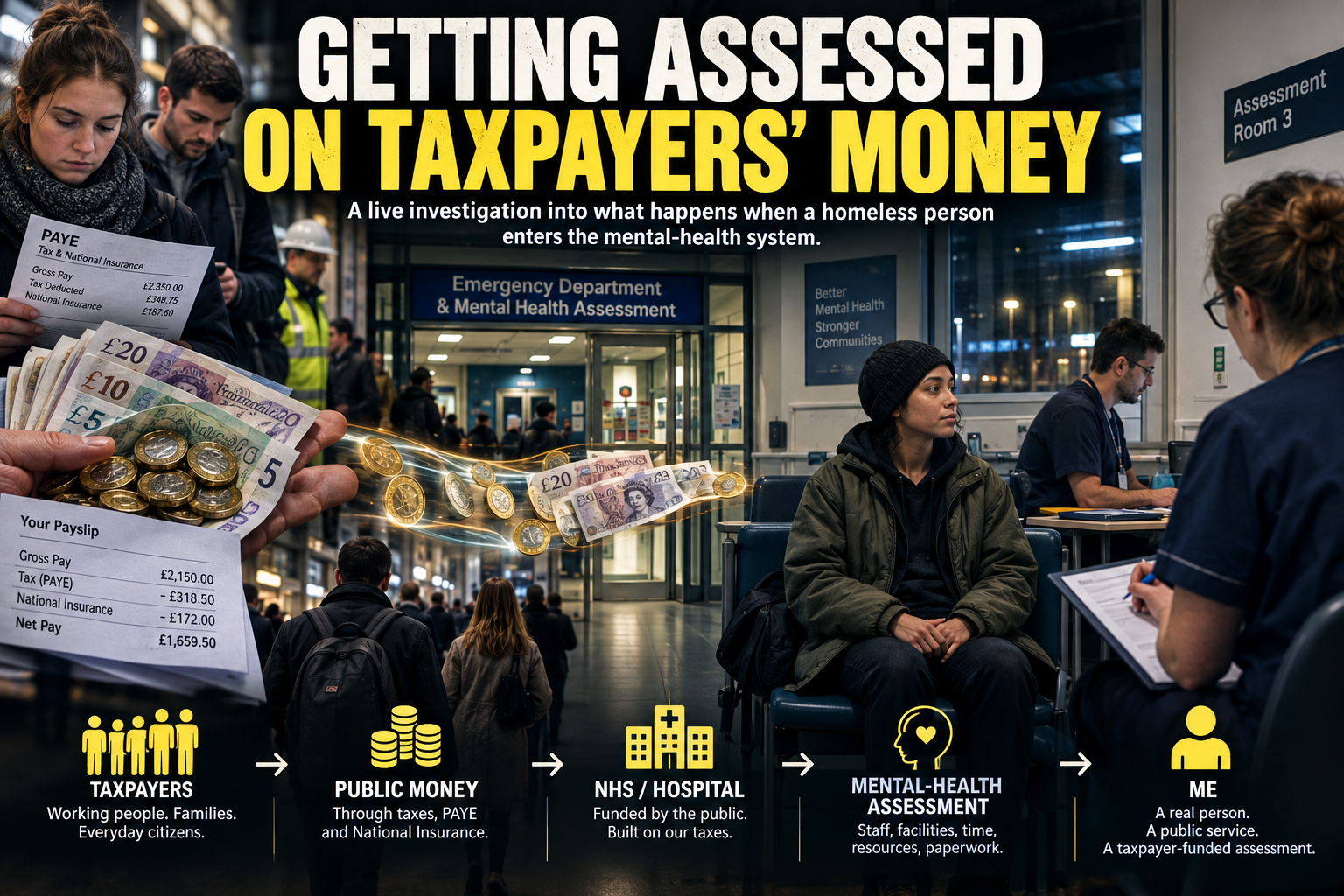
The public pays.
Private organisations operate.
Government regulates.
Contractors subcontract.
Investors extract returns.
Citizens depend on the outcome.
Then, when the system fails, every actor points towards someone else.
The company may say it delivered only what the contract required.
The contractor may say it followed the specifications it was given.
The regulator may say its powers were limited.
The government may say the service was operationally independent.
The public body may say the technology or supplier caused the disruption.
The supplier may say its system was used incorrectly.
Each actor describes one layer of the arrangement.
The citizen experiences the whole failure.
This is why the case is larger than ordinary poor service.
It concerns systems that are privately rewarded but publicly sustained.
It concerns public functions being transferred into commercial hands without transferring the full duties historically attached to public authority.
And increasingly, it concerns artificial intelligence being introduced as a new privatisation layer inside government itself.
AI may be presented as modernisation, efficiency, automation, digital transformation or administrative support. But where governments use privately developed AI systems to make, shape, filter or accelerate decisions affecting public access, employment, welfare, housing, education, healthcare, policing, immigration, taxation, legal administration or public communication, the technology is no longer merely a tool.
It becomes part of public infrastructure.
If a private system determines how citizens are seen, ranked, processed, investigated, approved, rejected or ignored, then it is performing a public function whether or not the company that built it is formally recognised as a public body.
The legal system must therefore ask:
Can a public duty be privately performed without inheriting public responsibility?
The Public Pays More Than Once
The public may pay for essential services through several layers at the same time.
They may pay:
- through taxation;
- through mandatory service bills;
- through price increases;
- through infrastructure subsidies;
- through government procurement;
- through rescue packages;
- through public guarantees;
- through compensation schemes;
- through the cost of correcting failed outsourcing;
- and through the personal consequences of service failure.
A taxpayer may help finance the infrastructure.
The same person may then pay a private bill to use it.
They may absorb an increase in price when the provider claims operational pressure.
They may contribute again when government subsidises the company or rescues the service.
They may lose income when transport fails.
They may suffer property damage when water infrastructure fails.
They may become ill when environmental standards collapse.
They may lose work when administrative systems malfunction.
They may spend months challenging a decision produced through an outsourced process.
The public therefore does not merely fund the service.
It funds the service, the profit, the failure and the repair.
Yet the public rarely receives equivalent control.
This creates an economic arrangement in which the public carries the full continuity burden while private actors retain selective ownership.
Profit remains private.
Systemic dependence remains public.
The Illusion of Consumer Choice
Privatisation is often defended through the language of markets, competition and consumer choice.
But many public functions do not operate like ordinary consumer markets.
A person cannot meaningfully opt out of water.
They cannot realistically opt out of energy.
They may be unable to opt out of the rail system required to reach work.
They cannot opt out of housing maintenance when they do not own the building.
They cannot opt out of public administration when they require benefits, identification, taxation services, licences, legal records, immigration decisions or healthcare access.
They cannot choose another government when one department’s outsourced system fails to process them.
Even where multiple brands appear to exist, the underlying infrastructure may remain concentrated, regionally monopolised, technically inseparable or governed by the same contractual architecture.
The citizen is therefore often described as a customer while lacking the basic power of a customer.
A real customer can leave.
A citizen dependent on essential infrastructure often cannot.
Where exit is not meaningful, stronger duties must replace the discipline that competition is supposed to provide.
A company performing an indispensable function under conditions of public dependence should not be permitted to behave like an ordinary seller.
It should inherit obligations proportionate to the dependency it has accepted.
The Core Public-Duty Principle
The central principle should be:
Where a private organisation performs an indispensable public function that people cannot meaningfully refuse, it should inherit public-level duties of transparency, continuity, equality, accessibility and care.
The company should not be able to receive the financial advantages of a public contract while rejecting the accountability of public office.
It should not be permitted to claim commercial confidentiality when the concealed system determines access to basic needs.
It should not be able to suspend service in ways that would be unacceptable from the state itself.
It should not be allowed to treat citizens as ordinary consumers where citizens have no meaningful substitute.
It should not be able to distribute profit during functional decline while the public finances recovery.
And it should not be able to use technical complexity to place its decisions beyond explanation.
A public function does not lose its public nature merely because the operator changes.
AI as the Next Layer of Privatised Government
Artificial intelligence intensifies this problem because it allows governments to privatise not only service delivery, but also parts of judgement, administration and decision-making.
A government may contract a private company to build or operate systems that:
- screen applications;
- detect alleged fraud;
- rank risk;
- allocate housing;
- determine inspection priorities;
- process welfare claims;
- shortlist candidates;
- predict demand;
- assess eligibility;
- monitor behaviour;
- identify anomalies;
- recommend enforcement;
- automate correspondence;
- filter complaints;
- or determine which cases receive human attention.
At that point, the private company is no longer simply supplying software.
It is shaping the conditions under which public authority reaches the person.
The company may influence which citizen is seen first.
Which claim is treated as suspicious.
Which household is considered high-risk.
Which applicant is excluded.
Which error becomes invisible.
Which complaint is deprioritised.
Which human being receives assistance.
And which human being is sent into an appeal process merely to reach the consideration that should have occurred at the beginning.
This is a form of privatisation because the architecture of public judgement is being transferred into systems designed, owned and often understood by private actors.
The public may fund the procurement through taxation.
The government may become operationally dependent on the system.
The company may retain the intellectual property.
The citizen may be affected without knowing how the decision was produced.
The worker may be displaced because the government has chosen automation.
And when the system fails, responsibility becomes fragmented between the public authority that deployed it and the company that built it.
Public Money Financing Public Redundancy
The contradiction becomes sharper when taxpayers finance AI systems that then reduce their own access to employment.
The public funds government.
Government uses public money to purchase automation.
Automation is used to reduce administrative, analytical, customer-service, technical or professional roles.
The people whose taxes funded the transition may then find fewer jobs available, weaker routes into employment and a public sector less capable of offering human access.
They have paid for a system that may make them economically less necessary.
This is not the same as ordinary technological change inside a voluntary private market.
Government is not merely another employer.
It is a foundational allocator of public resources.
Its investment choices shape labour markets, education priorities, economic security and access to essential services.
When government uses taxpayer money to fund systems that remove employment faster than it creates accessible alternatives, it cannot treat the resulting redundancy as an unrelated market outcome.
It participated in producing that outcome.
The state may claim AI will improve efficiency.
But efficiency for whom?
If fewer employees are needed, who carries the loss of income?
If entry-level work disappears, how do younger people enter professions?
If public-facing workers are removed, how do vulnerable citizens access help?
If human knowledge is no longer developed through work, who maintains the expertise on which the system depends?
If private technology companies receive increasing public contracts while ordinary workers lose access to stable employment, public money is being transferred upward while economic accessibility is being withdrawn downward.
The public pays for the replacement and then pays for the social consequences of being replaced.
Job Accessibility Is Part of Public Infrastructure
Employment should not be treated as separate from infrastructure.
Work is one of the primary systems through which people access housing, food, transport, security, education, healthcare and social participation.
A government that weakens job accessibility is not merely changing the labour market.
It is affecting the population’s access to basic needs.
This becomes especially serious where automation removes the roles through which people historically developed competence.
Junior administrative work.
Research assistance.
Customer service.
Basic analysis.
Entry-level design.
Public-sector processing.
Clerical roles.
Scheduling.
Translation.
Support functions.
Routine legal work.
These roles may appear repetitive from the top of an organisation.
But they are also training grounds.
They allow people to learn systems, make mistakes, build judgement, develop language, understand institutions and progress towards more complex responsibility.
When AI removes the lower levels of work, it may also remove the developmental ladder.
The system then demands experienced workers while erasing the pathways through which experience was once gained.
That is not simply redundancy.
It is institutional erosion.
The Dependence Paradox
The more government depends on AI, the greater the responsibility it carries for failure.
A government may initially describe AI as optional assistance.
Over time, departments may reduce staff, reorganise workflows and lose internal expertise because the technology is expected to perform an increasing share of the work.
Eventually, the system becomes structurally dependent on something it does not fully control.
If the AI service becomes unavailable, inaccurate, corrupted, commercially withdrawn, compromised or technically obsolete, the government may no longer possess the human capacity to continue the function.
The risk is therefore not limited to one wrong decision.
It is the possibility that public competence itself is hollowed out.
A public body may lose:
- experienced staff;
- institutional memory;
- direct contact with citizens;
- manual processing capacity;
- independent technical understanding;
- internal analytical ability;
- and the ability to challenge its supplier.
The technology becomes more central while the state becomes less capable of operating without it.
This is the dependence paradox.
The more government invests in the system, the less independent it may become from the company that owns the system.
AI Does Not Constitute a Liable Foundational Tool
Artificial intelligence may be valuable as a supporting instrument.
It may help organise information, identify patterns, reduce repetitive workload, improve access to records or assist human analysis.
But it should not be treated as a liable foundational tool.
A foundation must be dependable.
It must be accountable.
It must be repairable.
It must be explainable.
It must be capable of carrying duty.
AI cannot independently carry legal responsibility.
It does not possess property from which compensation can be recovered.
It does not stand trial.
It does not accept punishment.
It does not owe moral duties.
It does not experience the consequence of its error.
It cannot apologise in a way that produces actual institutional aftercare.
It cannot decide to take responsibility beyond the limits of its programming and deployment.
Every meaningful duty returns to a human actor, company or public authority.
That means government cannot place AI at the foundation of an indispensable service and then treat the system as the responsible agent when something goes wrong.
AI can produce outputs.
It cannot carry accountability.
A foundational public service must therefore remain grounded in actors who are legally identifiable, financially answerable and institutionally capable of remedy.
When the System Fails, Liability Must Increase With Dependence
The more a government relies on AI, the less credible it becomes to describe failure as a technical accident.
Dependence is a policy choice.
If government reduces staff because AI is expected to function, that is a policy choice.
If it routes public decisions through an automated system, that is a policy choice.
If it signs a contract that conceals the system’s logic, that is a policy choice.
If it permits a private supplier to retain exclusive control over essential infrastructure, that is a policy choice.
If it deploys a system before independent testing, that is a policy choice.
If it continues using the technology after evidence of error, that is a policy choice.
The company may be liable for design defects, misleading claims, negligence, poor security or failure to disclose limitations.
But government is separately liable for choosing where public money was invested and for determining the conditions under which the system was allowed to affect the population.
The responsibility chain should therefore begin with the public body’s duty to govern.
A government cannot outsource its judgement and retain only the appearance of authority.
The Procurement Decision Is Already a Public Decision
Public accountability should begin before an AI system is deployed.
The procurement itself is a constitutional act when the system will influence access to public rights or services.
The decision to buy one system rather than employ people is a public decision.
The decision to automate one function rather than strengthen another is a public decision.
The decision to give a private company access to public data is a public decision.
The decision to place a proprietary tool inside essential administration is a public decision.
The decision to fund AI rather than housing maintenance, healthcare staffing, teacher recruitment, public transport, legal aid or basic service recovery is a public decision.
Government investment is never only financial.
It reveals priority.
Where basic services remain unstable, governments should have to justify why public resources were directed towards speculative automation rather than restoring existing human systems.
This returns to legal triage.
AI Investment Must Pass a Public-Triage Test
Before public money is invested in AI, the government should be required to answer:
What public problem is being solved?
Is the problem caused by insufficient technology or by insufficient staffing, funding, coordination or leadership?
Would direct investment in people produce a more reliable result?
Will the system reduce public access to employment?
Will it remove entry-level work?
Will it weaken human contact?
What happens when it fails?
Can the service continue without the supplier?
Who owns the data?
Who owns the system?
Can the decision be independently reproduced?
Can the affected person obtain a human review?
Can the government explain the result without relying on the contractor?
What public need is being deprioritised to fund this investment?
Does the system produce savings only by transferring costs to workers, citizens or other departments?
If those questions cannot be answered, the procurement should not proceed.
Government should not fund technical prestige while foundational systems remain unstable.
The Public-Sector Capacity Test
Before an indispensable public function is automated or outsourced, government should have to prove that it retains enough internal capacity to govern the service.
That means retaining:
- human expertise;
- manual fallback systems;
- independent audit capability;
- technical understanding;
- sufficient staff to review disputed decisions;
- institutional memory;
- control over essential data;
- and the ability to replace the contractor without suspending the public function.
A service is not genuinely public if the government cannot operate, inspect or explain it without permission from a private supplier.
Public authority without operational capacity becomes ceremonial.
The department carries the logo.
The company carries the system.
The citizen carries the risk.
Privatised Rewards and Socialised Failure
This architecture repeats across water, energy, rail, housing maintenance, outsourced administration and private contracting.
When the system performs, private actors retain revenue, executive compensation, dividends, market value and contractual advantage.
When the system deteriorates, the public absorbs:
- service disruption;
- emergency intervention;
- higher bills;
- subsidies;
- compensation;
- environmental damage;
- health consequences;
- lost work;
- legal costs;
- and infrastructure repair.
This is not ordinary privatisation.
It is selective ownership.
The private actor owns the profitable period.
The public owns the failure.
AI risks deepening the same model.
A supplier may receive a major public contract.
The government may advertise efficiency.
Workers may be removed.
The system may become essential.
Then, if the tool fails, citizens lose access, public staff scramble to recover the function and government finances the correction.
The company may still retain the data, intellectual property and future commercial value gained from the project.
The public paid for the system.
The company learned from the deployment.
The worker lost the role.
The citizen absorbed the error.
Mandatory Services Require Constitutional-Level Duties
Where a service is indispensable and cannot meaningfully be refused, ordinary commercial standards are insufficient.
The operator should inherit constitutional-level duties, including:
Continuity
The service must remain available, with credible fallback systems and emergency capacity.
Transparency
The public must be able to understand how decisions are made, how money is used and how performance is measured.
Equality
Access cannot depend on profitability, technological literacy, disability, language, geography or the ability to navigate complex complaint systems.
Human Review
No consequential public decision should become final without meaningful access to a competent human decision-maker.
Explanation
The affected person should receive reasons that are understandable, specific and challengeable.
Data Protection
Public dependency should not become an opportunity for private surveillance or secondary commercial extraction.
Duty of Care
The operator should be responsible not merely for contractual delivery but for foreseeable human consequences.
Financial Responsibility
Profits should not be distributed while essential maintenance, resilience or remediation remains unfunded.
Public Audit
The system should be independently inspectable without commercial secrecy overriding public interest.
Remedy
Where failure occurs, the burden of correction should not fall primarily on the affected citizen.
The Class Is Broader Than the Direct Customer
The class in this case should not be limited to people who received an incorrect bill or missed one train.
The affected group may include anyone whose basic access, employment, income, health, housing, mobility, legal rights or public participation was harmed by a privately operated public system.
Potential subclasses could include:
- households affected by prolonged infrastructure failure;
- people charged for services that were not adequately delivered;
- workers displaced through publicly funded automation;
- job applicants excluded by automated public recruitment;
- benefit claimants delayed or wrongly rejected;
- tenants affected by outsourced housing maintenance;
- passengers who lost income through repeated transport failure;
- communities harmed by water or energy mismanagement;
- citizens forced to use digital-only services;
- people unable to challenge automated decisions;
- and taxpayers who repeatedly financed rescue, correction or replacement.
The common injury is not merely poor customer service.
It is dependence on a system that received public support without providing public-level performance.
A Taxpayer Standing Argument
The case also raises a deeper question about the legal position of taxpayers.
Taxpayers are often treated as too general a class to challenge how public money is allocated.
But where identifiable spending decisions create direct systemic harm, eliminate accessible employment, weaken public capacity and fund private dependency, the taxpayer’s interest is not purely abstract.
The taxpayer is funding the procurement.
The taxpayer may lose the job.
The taxpayer may depend on the service.
The taxpayer may pay again when the service fails.
The taxpayer may finance the welfare, retraining, compensation or repair that follows.
The same person may therefore occupy every side of the transaction except the side that controls it.
This could support a broader argument that public procurement decisions affecting foundational services should be open to collective challenge before irreversible dependency is created.
The public should not have to wait until the system collapses to question why it was funded.
The Responsibility Map
Government
Government chooses the policy, allocates the money, defines the contract, approves the supplier, determines whether human roles are removed and decides whether the system is safe enough to govern public access.
Its responsibility is foundational.
Private Operators
Private operators accept the benefit of performing indispensable services.
They should therefore inherit heightened duties of care, continuity, transparency and repair.
AI Developers and Technology Suppliers
They design, test, market and maintain systems capable of shaping public decisions.
Their responsibility concerns accuracy, security, foreseeable limitations, explainability, discrimination, data use and honest disclosure.
Regulators
Regulators are responsible for identifying when commercial structures are no longer compatible with public need.
Weak supervision does not become harmless because a contract exists.
Consultants and Procurement Advisers
Those who recommend systems, structure deals or certify readiness may carry responsibility where advice concealed risk, exaggerated savings or ignored public consequences.
Senior Public Decision-Makers
Individual authority cannot disappear inside the institution.
Those who approve high-risk deployments should remain identifiable and accountable for the basis of their decision.
Investors
Where returns depend on underinvestment, job reduction or public rescue, investors should not be treated as entirely separate from the operating architecture.
The Public
The public may have obligations to use systems responsibly.
But dependency is not consent, and payment is not control.
The Remedies
A case of this scale would require structural remedies rather than compensation alone.
1. Public-Function Classification
Any private entity performing an indispensable public function should be legally classified according to the function it performs, not merely its corporate form.
2. Mandatory Human Access
Citizens must retain access to competent human review in welfare, housing, healthcare, taxation, policing, immigration, education and other consequential public systems.
3. AI Procurement Moratoriums Where Foundations Are Unstable
Government departments should not be permitted to replace essential human capacity with AI where the underlying service is already failing, understaffed or incapable of maintaining manual continuity.
4. Employment Impact Assessments
Every major public AI procurement should include an independent assessment of job loss, entry-level access, regional employment, skill development and long-term workforce dependency.
5. Public Benefit Tests
A contract should proceed only where the public benefit exceeds not merely the purchase price, but the social cost of redundancy, exclusion, error, dependency and repair.
6. Public Ownership of Essential Data and Operational Knowledge
The state should not become dependent on a supplier that exclusively controls the data, models, documentation or technical knowledge required to continue the service.
7. Full Liability Chains
Contracts should not allow government and supplier to point endlessly towards each other.
Liability should be joint where both contributed to the architecture of failure.
8. Profit Restrictions During Service Failure
Private operators should not distribute exceptional profits, dividends or executive rewards while essential performance standards remain unmet.
9. Clawback of Public Funds
Where promised savings, accuracy or service improvements are not delivered, public money should be recoverable.
10. Public-Service Continuity Funds
Operators of essential systems should contribute to ring-fenced funds capable of maintaining service during failure, insolvency or supplier withdrawal.
11. Right to Explanation and Appeal
Any person materially affected by an automated or outsourced decision should receive clear reasons, access to the relevant evidence and a prompt human appeal.
12. Restoration of Human Capacity
Where automation has dangerously hollowed out a department, government should be required to rebuild staffing, knowledge and public-facing access.
13. Taxpayer Challenge Mechanisms
The public should have a collective route to challenge major procurements that threaten foundational services, employment accessibility or constitutional rights.
The Preventable Principle
The preventable principle is this:
Public money should not be used to privatise public authority, remove public access and then return the cost of failure to the public.
A government cannot claim efficiency while weakening the population’s ability to work.
It cannot call a system modern while citizens become less able to reach a human being.
It cannot describe AI as support while restructuring the service so completely that the tool becomes indispensable.
It cannot outsource judgement and retain only ceremonial accountability.
It cannot fund private dependency while leaving public institutions less capable than before.
And it cannot place a non-liable system at the foundation of functions on which life, livelihood and legal status depend.
AI may assist a public service.
It cannot become the party responsible for that service.
Closing
Public infrastructure is not defined only by who holds the legal title.
It is defined by who funds it, who depends on it, who controls it, who benefits from it and who carries the failure.
Where the public pays through taxation, mandatory bills, price increases, subsidies, rescue packages and personal loss, the public is not merely a customer.
It is the sustaining party.
Where a private organisation receives the revenue, the data, the contract, the intellectual property and the opportunity to reduce labour costs, it cannot later behave as though the public consequences fall outside its responsibility.
Where government chooses to fund AI while employment access narrows, human contact disappears and public competence is hollowed out, the resulting harm cannot be described as an accidental side effect of progress.
It was produced through public investment.
The company may say the government chose the deployment.
The government may say the company supplied the technology.
The regulator may say it lacked the power.
The department may say the decision came from the system.
The system cannot answer.
That is precisely the problem.
The most powerful actor in the process may be the only one that cannot carry responsibility.
So responsibility must return to those who designed, purchased, approved, deployed and profited from it.
Because a government does not become less responsible when it privatises the machinery through which it governs.
It becomes more responsible for choosing that machinery.
And when the public pays for a service, pays again when it fails, loses work through its automation and still cannot meaningfully control it, the real question is no longer whether the system is public or private.
The question is why the rewards were privatised while the duties remained with everyone else.
That is not merely poor administration.
It is an open case.


Leave a Reply