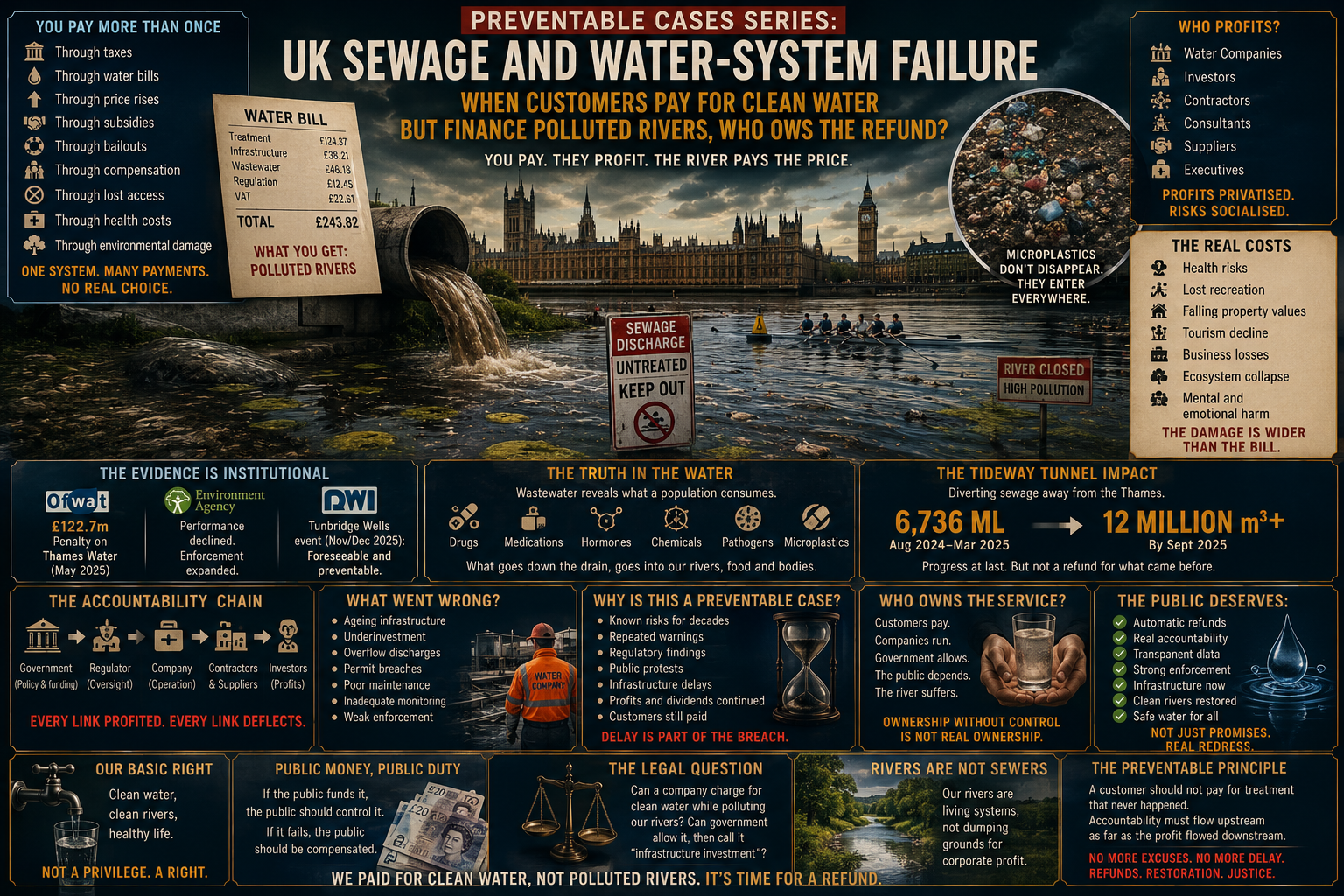
When Customers Pay for Clean Water but Finance Polluted Rivers, Who Owes the Refund?
The United Kingdom’s sewage crisis may become one of the strongest specifically British mass-action cases because nearly every element required for a wider claim is already present. This is a centuries’ problem.
There is a compulsory customer base.
There are repeated payments for water and wastewater services.
There are established environmental obligations.
There are findings of legal breach.
There are illegal discharges and permit failures.
There are rivers, streams and coastal waters carrying the consequences.
There are communities that have lost environmental use, confidence and safety.
There are major infrastructure projects whose costs ultimately sit within the wider public water economy.
There are increasing bills.
There are public regulators financed to prevent and respond to failure.
There are enforcement packages described as redress.
And there is a population that has paid throughout the period in which the system was deteriorating.
The larger case therefore should not ask only whether particular sewage discharges were unlawful.
It should ask why customers were charged for a functioning wastewater system while rivers received evidence that the system was not functioning to the standard for which the public had paid.
It should ask why regulatory fines, future investment packages and environmental projects are treated as though they complete the remedy when billpayers, swimmers, anglers, residents, river trusts, businesses and ecosystems carried the original damage.
And it should ask a question that reaches beyond water:
How long does a known and preventable problem have to remain unresolved before delay itself becomes part of the breach?
Britain is not discovering sewage in 2026.
London is not discovering that an old combined sewer system becomes overwhelmed.
Water companies are not discovering that population growth, ageing infrastructure, rainfall, development and insufficient treatment capacity place pressure on the network.
Regulators are not discovering that untreated wastewater damages rivers.
Governments are not discovering that pipes, reservoirs, treatment works and monitoring systems require sustained investment.
These are not sudden findings.
They are accumulated knowledge.
The problem has sat long enough to pass through multiple governments, regulatory plans, corporate strategies, investment cycles, consultations, warnings, public campaigns and promises of reform.
At some point, the issue stops being merely that the infrastructure was old.
The issue becomes that institutions knew it was old and continued governing as though time itself would perform the maintenance.
The Public Paid for Treatment, Not Transfer
A wastewater bill is not a donation to a water company.
It is payment for a service.
The customer pays with the reasonable understanding that human waste will be collected, safely transported, treated and returned to the environment without unlawfully transferring the untreated consequences into rivers, streams, seas, streets or homes.
The service is not complete when sewage leaves the customer’s property.
It is complete when that sewage has been responsibly managed.
If the waste enters a sewer but is later released untreated into a river, the company has not necessarily delivered the environmental function for which the customer paid.
It has moved the material.
It has not completed the service.
That distinction is central.
A delivery company could not claim full performance merely because it collected a parcel if it knowingly abandoned the parcel before reaching its destination.
A waste operator could not claim full performance merely because rubbish disappeared from the household if it was then unlawfully dumped elsewhere.
Wastewater treatment should be understood through the same principle.
Collection without lawful treatment is transfer, not completion.
The river becomes the unpaid final contractor.
The public pays the bill.
The company receives the revenue.
The environment receives the untreated remainder.
The Evidence of Failure Is Already Institutional
This is not a case built only on public anger.
Ofwat concluded investigations into Thames Water and imposed penalties totalling £122.7 million in May 2025. That included £104.5 million connected to breaches involving wastewater operations and £18.2 million relating to dividend rules. Ofwat also issued an enforcement order requiring the company to rectify identified wastewater breaches. The regulator stated that the penalties would fall on the company and investors rather than customers.
The wider regulatory picture is equally important. The Environment Agency stated in February 2026 that water-company environmental performance had continued to decline in recent years. Its water-enforcement workforce was expanded from 41 roles in 2023 to 195 by March 2026, with further expansion planned.
That increase should not be presented only as evidence that enforcement has improved.
It is also evidence of the scale of oversight that had previously been absent or insufficient.
If almost five times as many enforcement roles became necessary, the legal question is not simply what those new officers will discover.
It is what persisted while the regulator had only 41.
The Environment Agency reported that storm-overflow discharges remained unacceptably high in 2024. Spill numbers fell by only 2.9% compared with 2023, while total duration increased slightly. Its data recorded an average of 31.8 spills per overflow, and only 12.5% of monitored overflows did not spill at all.
The 2025 figures showed an important improvement, with spill numbers falling by 35% from the previous year and large reductions in total duration across many companies. That progress matters and should be recognised. But a decline from an unacceptably high baseline does not erase the years during which communities carried the earlier burden.
Improvement is not retrospective redress.
A cleaner river tomorrow does not repay the person who could not safely use it yesterday.
Regulatory Enforcement Is Not Civilian Redress
The language of enforcement can create the impression that the matter has been resolved.
A regulator investigates.
A breach is found.
A penalty is announced.
An enforcement package is agreed.
A company promises investment.
Government announces stronger powers.
The public is then expected to understand that accountability has occurred.
But accountability to the regulator is not necessarily redress to the population.
A regulatory fine may punish or deter the company.
It does not automatically repay customers for periods in which the service was not delivered to the required standard.
It does not compensate anglers for ecological loss.
It does not restore a swimmer’s confidence in local water.
It does not compensate a riverside business for reduced use or reputation.
It does not repay residents who endured odour, sewage flooding or repeated warnings.
It does not reimburse public organisations that spent money monitoring, cleaning, campaigning or responding.
It does not restore dead fish.
It does not return lost biodiversity.
It does not reverse the indignity of a population paying compulsory charges while being told to avoid the waters those charges were supposed to protect.
The regulatory relationship exists between the company and the state.
The service relationship exists between the company and the public.
Resolving one does not automatically resolve the other.
Who Receives the “Redress”?
Water-sector settlements are sometimes described as enforcement and redress packages.
But the word redress must be examined carefully.
Redress for whom?
If money is committed to future infrastructure, the environment may benefit.
If penalties are paid, regulatory objectives may be served.
If shareholder returns are restricted, corporate conduct may be affected.
But if the customer receives no direct refund, no service credit, no accessible claim and no acknowledgement that part of the service paid for was not properly delivered, then the civilian has not necessarily been redressed.
The public may instead be required to continue paying increased bills so that the system can finally provide the performance it should already have maintained.
Under Ofwat’s 2024 price review, the sector was approved to undertake £104 billion of investment for 2025–30. Average bills were forecast to rise substantially: Ofwat said the average household bill would increase by £157, or 36%, over five years, with an average increase of £86 in 2025–26 before inflation. The later industry forecast for 2025–26 put the average rise at approximately £123, or 26%, although actual increases vary by provider and household.
The investment may be necessary.
The problem is who is being asked to finance the correction.
Customers paid during the period of underperformance.
Customers then face higher bills to fund the improvement.
Customers also finance the public regulatory system through taxation.
Taxpayers support environmental enforcement and public restoration.
Communities carry the ecological and recreational loss.
The same population therefore pays before, during and after failure.
This produces the central principle:
A customer should not pay once for sewage to be treated and then pay again through higher bills, taxation, environmental damage, health risk and public restoration when it is not.
The Thames Is Not Merely Scenery
The Thames is often treated symbolically.
It appears in national imagery as a backdrop to Parliament, royal ceremony, London’s skyline, tourism, architecture and British identity.
It is presented as evidence of continuity, history and civilisation.
But a river is not an ornamental strip placed through a city.
It is a living system.
It carries water, organisms, sediment, human activity, industrial history, urban runoff and the consequences of the infrastructure surrounding it.
When a country uses a river as part of its national image while allowing it to function as an emergency outlet for an inadequate sewer system, there is a contradiction between presentation and condition.
Britain frequently prides itself on beauty, order, regality, polish and cleanliness.
But a country’s results speak beyond its branding.
Its streets speak.
Its rivers speak.
Its housing speaks.
Its drains speak.
Its sewage capacity speaks.
Its public toilets speak.
Its waste systems speak.
Its treatment plants speak.
Cleanliness cannot remain an aesthetic applied to the visible surfaces of institutions while pollution is moved beneath the ground and released into water.
A polished building beside a polluted river is not evidence of a clean civilisation.
It is evidence that visibility has been prioritised over systems.
What Wastewater Can Reveal About a Population
The United Kingdom’s wastewater-analysis programme demonstrates how much information is carried through collective sewage.
Since 2021, government programmes have sampled wastewater at treatment plants to estimate the consumption of substances including cocaine, MDMA and methamphetamine. The 2026 reporting identified urban areas—including London—as places where concentrations of several drugs were comparatively high.
This does not mean that cocaine is measured simply by testing the open Thames itself.
The official consumption estimates come primarily from sewage entering treatment works, where drug metabolites excreted by the population can be measured before treatment.
But that correction does not weaken the wider point.
It strengthens it.
Wastewater can reveal population behaviour because human bodies continuously send chemical information into the sewer system.
What people consume does not vanish when it leaves the body.
The sewage carries traces of medication.
Drugs.
Hormones.
Pathogens.
Household chemicals.
Personal-care products.
Industrial contaminants.
Microplastics.
Antimicrobial residues.
Nutrients.
Faecal bacteria.
And countless other signatures of the population and economy that produced it.
The capacity to infer cocaine consumption from sewage demonstrates that wastewater is not biologically empty material.
It is chemically informative.
When inadequately treated sewage is released into rivers, what enters the environment is not merely unpleasant-looking water.
It is a complex mixture carrying the biological and chemical afterlife of an entire population.
The fact that sewage can be used as a public-health intelligence system should deepen the duty to contain and treat it.
A substance capable of revealing how a city lives is not something that should be casually discharged into the city’s river.
Human Waste Is Not the Only Issue
The public discussion often reduces sewage pollution to faeces.
That image is powerful because it makes the failure visible and immediately offensive.
But the wider environmental burden is much more complex.
Wastewater may contain:
- human pathogens;
- pharmaceutical residues;
- recreational-drug metabolites;
- cleaning chemicals;
- hormones;
- nutrients that contribute to ecological imbalance;
- oils and fats;
- synthetic fibres;
- microplastics;
- household chemicals;
- industrial residues;
- and materials washed from roads and urban surfaces.
Modern sewage systems are receiving the chemical output of modern civilisation.
The infrastructure therefore cannot be assessed according to the needs of the population and industry that existed when much of the network was first built.
London’s old sewer architecture was an extraordinary historical intervention for its time.
But historical achievement does not create permanent adequacy.
A system built for an earlier population, climate, level of development and pattern of consumption must be renewed according to current conditions.
Regality cannot substitute for capacity.
Heritage cannot substitute for maintenance.
The Tideway Tunnel Shows Both Possibility and Delay
The Thames Tideway Tunnel demonstrates that large-scale intervention was possible.
The network, including the existing Lee Tunnel, was designed to intercept the majority of combined-sewer overflow discharges that had historically entered the tidal Thames. Thames Water states that the tunnel system is expected to reduce combined-sewer overflow discharges in a typical year by approximately 95%.
Between August 2024 and March 2025, Thames Water reported that 6,736 megalitres of sewage had already been diverted from the Thames into the Tideway system. By September 2025, the company reported that more than 12 million cubic metres had been diverted since operation began.
That is meaningful progress.
It proves that infrastructure can alter the trajectory.
But it also raises the preventable-case question:
If millions of cubic metres could be intercepted once the project existed, how much entered the river during the decades in which the inadequacy was already known but the solution had not yet been completed?
A major project should not be treated as evidence that no prior accountability remains.
It may also be evidence of how long the known need was allowed to mature before sufficient architecture was built.
The tunnel repairs part of the future.
It does not erase the past.
How Long Must a Problem Sit?
This case requires the law to confront institutional time.
A sudden failure may be difficult to prevent.
A decades-old failure is different.
Where a problem is repeatedly reported, measured, debated and postponed, every additional year strengthens foreseeability.
The timeline becomes evidence.
A known sewage outlet operating repeatedly is evidence.
An ageing treatment works left without sufficient maintenance is evidence.
Housing expansion without matching wastewater capacity is evidence.
Repeated permit breaches are evidence.
Recurring pollution incidents are evidence.
Regulatory warnings are evidence.
Declining performance data is evidence.
Internal corporate knowledge is evidence.
Public campaigns are evidence.
The commissioning of major remedial infrastructure is itself evidence that the underlying problem was real enough to require intervention.
A preventable case should therefore ask not merely when the final breach occurred.
It should ask:
When did each institution first know enough to act?
What did it do then?
What did it postpone?
What was paid to shareholders or executives during that postponement?
What infrastructure was not renewed?
What risks were accepted?
Who benefited from the delay?
Who carried its cost?
Foreseeable Supply Failure Extends the Case Beyond Sewage
The broader water-system action cannot be confined to wastewater discharges.
It should include drinking-water resilience, supply interruptions, treatment failures, ageing assets, maintenance gaps and institutional preparedness.
In April 2026, the Drinking Water Inspectorate concluded that the loss of supply and subsequent boil-water notice affecting as many as 60,170 consumers in the Tunbridge Wells area in November and December 2025 was both foreseeable and preventable.
The Inspectorate said the event did not arise from exceptional raw-water conditions. It attributed it to longstanding weaknesses in operational management, treatment optimisation, monitoring, maintenance and organisational preparedness at Pembury treatment works.
That finding is vital.
It challenges the repeated presentation of infrastructure failures as isolated emergencies.
An emergency describes the moment the public experiences the breakdown.
It does not necessarily describe the period in which the breakdown was created.
The taps may stop suddenly.
The conditions that made them stop may have developed for years.
A boil-water notice may arrive on one date.
The maintenance deficit may precede it by a decade.
The event is immediate.
The cause is institutional.
Infrastructure Does Not Fail Only When It Breaks
A pipe has not performed successfully merely because it has not yet burst.
A treatment works has not performed successfully merely because it has not yet produced a major public incident.
A sewer has not performed successfully merely because waste remains out of sight most days.
Infrastructure failure begins before collapse.
It begins when known maintenance is deferred.
When capacity falls behind population.
When monitoring is inadequate.
When warnings are ignored.
When resilience disappears.
When emergency operation becomes routine.
When staff know the system is vulnerable but lack authority or resources to correct it.
When a company’s financial structure rewards postponement.
When a regulator accepts promises in place of completed works.
When the public is told that the service remains functional because the most dramatic consequence has not yet arrived.
By the time sewage floods a river or water disappears from thousands of homes, the visible event may be the final stage of a much older failure.
The Cleaner-System Effect
A properly functioning water and wastewater system affects far more than the appearance of rivers.
Cleaner systems protect:
- public health;
- drinking-water confidence;
- aquatic life;
- biodiversity;
- fisheries;
- tourism;
- recreation;
- local businesses;
- housing value;
- food systems;
- farming;
- coastal economies;
- mental wellbeing;
- public space;
- childhood access to nature;
- scientific research;
- flood resilience;
- and trust in government.
A river that people cannot safely touch is socially diminished.
A river that cannot support healthy ecosystems is biologically diminished.
A river whose condition discourages swimming, fishing, boating, walking, tourism or education is economically and culturally diminished.
Pollution therefore produces more than environmental damage.
It removes public use.
It reduces the range of life a place can support.
It converts a shared natural asset into a managed hazard.
The public loses not only cleanliness.
It loses possibility.
Mental and Emotional Consequences
Environmental degradation is often assessed through measurable physical outcomes while emotional and psychological losses are treated as secondary.
But living beside a polluted river changes the relationship between people and place.
Residents may experience disgust, helplessness, anxiety and distrust.
Parents may prevent children from playing near water.
Swimmers may question whether entry is safe.
Anglers may repeatedly encounter ecological decline.
Communities may organise, report and protest for years without meaningful resolution.
That repeated exposure to institutional neglect carries an emotional cost.
People learn that reporting harm does not necessarily stop it.
They learn that compulsory payment does not guarantee performance.
They learn that public pride may coexist with public neglect.
They learn that the river is celebrated ceremonially while being damaged operationally.
A polluted river can become a physical record of broken trust.
The Paul Powlesland Connection
The case of river campaigners such as Paul Powlesland exposes the legal system’s distorted allocation of urgency.
When citizens physically intervene to clean or protect waterways, the law may focus intensely on permits, access rules, navigation requirements or technical restrictions.
Some of those rules may have legitimate safety or ecological purposes.
But the question of proportionality remains.
Why does the legal system sometimes appear more operationally prepared to control the person cleaning a river than the architecture polluting it?
Why is individual intervention highly visible to enforcement while diffuse institutional neglect survives through years of process?
Why is permission treated as central when the intervention is remedial, but prevention treated as negotiable when the harm is systemic?
If companies and public bodies have allowed waste, sewage and industrial consequences to enter living waters, a citizen trying to restore those waters should not automatically become the most administratively convenient target.
The legal system must distinguish between conduct that threatens a river and conduct that exposes the failure of those assigned to protect it.
Otherwise, law becomes procedurally precise against the smaller actor while remaining structurally patient with the larger harm.
The Public Pays for the Regulator Too
Customers do not pay only the water company.
Through the wider public system, taxpayers finance departments, regulators, inspectors, environmental monitoring, courts and enforcement processes.
The public therefore pays for the service and for the architecture meant to ensure that the service is delivered lawfully.
If the company fails and the regulator fails to detect or prevent that failure early enough, the citizen has financed two systems that did not protect the outcome.
When enforcement capacity must later expand dramatically, the public finances that expansion too.
When rivers require restoration, the public contributes again.
When health monitoring is needed, the public contributes again.
When companies become financially unstable, the public faces the risk of rescue, restructuring or managed continuity.
This is why the case cannot be framed simply as a dispute between regulators and companies.
The public is the financial foundation beneath both.
Who Actually Owns the Water System?
Water companies may hold operational control.
Investors may hold financial interests.
Government retains statutory authority.
Regulators hold oversight powers.
But the public supplies the compulsory revenue and depends on the physical outcome.
This creates a form of ownership without authority.
The public sustains the network but cannot choose another pipe.
It pays the regional provider but cannot meaningfully refuse the service.
It finances the regulator but does not control enforcement priorities.
It pays higher bills for improvements but may not receive compensation for historical underperformance.
It carries the ecological consequences but does not determine dividend policy.
It lives with the outcome but remains outside the architecture.
The legal system should therefore ask whether compulsory dependence creates a stronger public interest than ordinary consumer law currently recognises.
Where customers cannot select another wastewater network, the provider should inherit duties closer to public trusteeship than ordinary commerce.
A Compulsory Provider Cannot Be Treated Like an Ordinary Business
In an ordinary market, a customer dissatisfied with a service may leave.
A Thames Water customer cannot build another sewer network.
A household cannot choose a rival set of regional pipes.
A resident cannot refuse wastewater infrastructure while continuing ordinary urban life.
That absence of choice changes the relationship.
The customer is not participating in a normal commercial exchange.
They are dependent on a territorial provider exercising control over a basic need.
The provider should therefore carry enhanced obligations:
- continuity;
- environmental protection;
- transparent accounts;
- complete disclosure of failures;
- accessible complaint routes;
- automatic compensation;
- infrastructure resilience;
- public-interest investment;
- and restrictions on extraction where essential performance remains inadequate.
A monopoly over a basic human necessity should carry more responsibility, not less.
Dividends, Rewards and Deferred Infrastructure
The legal case should examine whether money left the system through dividends, financing structures, executive rewards or related-company arrangements while essential infrastructure remained inadequate.
The question is not whether every dividend was technically lawful.
It is whether extraction was compatible with the company’s public function at the time.
If a company knows that its sewer network is failing, treatment capacity is inadequate, pollution incidents are rising or maintenance is overdue, distributions should be assessed against the unmet duty.
A company should not be permitted to describe infrastructure as unaffordable after rewarding capital from the same revenue base.
Ofwat’s 2025 Thames Water decision is especially important because it separately penalised wastewater breaches and failures relating to dividend rules. That connection shows that operational performance and financial extraction cannot always be treated as unrelated fields.
The wider principle should be:
No essential-service provider should extract discretionary financial rewards while the public function remains materially below the standard customers are compelled to fund.
The Customer Refund Question
If a company repeatedly fails to provide wastewater treatment to the legally required standard, customers should not be forced to rely only on environmental enforcement carried out in the public name.
They should have a direct economic question.
What portion of the wastewater charge represented treatment that was not properly completed?
Could a service credit be calculated according to unlawful discharge duration, regional performance, permit breaches or failure to meet commitments?
Should customers receive automatic refunds where regulators make formal findings of breach?
Should compensation extend beyond the nearest residents where all customers financed the deficient system?
Should the company be prevented from recovering the cost of penalties or historical neglect through future bills?
Should the burden fall on shareholders and responsible decision-makers before it returns to the public?
The exact methodology would be complex.
Complexity is not a reason to deny the principle.
Water companies have sophisticated systems for calculating bills, investment allowances, performance commitments, executive remuneration and investor returns.
The same institutional capacity can be used to calculate public repayment.
The Class Architecture
The action could include several overlapping classes.
Billpayers
Customers charged for wastewater collection and treatment during periods of established noncompliance or repeated unlawful discharge.
Residents Near Polluted Waters
People whose homes, neighbourhoods, health, enjoyment or local environment were materially affected.
Swimmers and Other Recreational Users
People prevented from safely using rivers, beaches or coastal waters.
Anglers and Fisheries
Individuals, clubs and businesses affected by fish deaths, ecological decline and reduced river quality.
River Trusts and Environmental Organisations
Groups forced to spend time and money monitoring, reporting, cleaning and campaigning against damage that regulated operators were supposed to prevent.
Local Businesses
Tourism, hospitality, recreation, water-sport, fishing and riverside businesses affected by pollution warnings or reputational harm.
Communities Affected by Supply Failure
Households and organisations that lost water or received boil-water notices because of preventable operational and maintenance weaknesses.
Taxpayers
Members of the public required to finance enforcement expansion, environmental repair, emergency responses and possible institutional rescue after already paying service charges.
Children and Future Generations
Those inheriting damaged aquatic systems, higher future bills and the infrastructure debt created through delayed action.
The classes differ, but the architecture is shared.
A compulsory system did not provide complete public performance.
Causation Should Follow Control
Water companies may argue that sewage discharges arise from extreme rainfall, population growth, urban development, climate change, blockages, consumer misuse or historic sewer design.
Some of those factors are real.
But external pressure does not erase the duty to prepare for foreseeable conditions.
Rain is not an unforeseeable event in Britain.
Urban growth is recorded through planning.
Population change is measurable.
Climate trends are studied.
Sewer age is documented.
Treatment capacity is known.
Blockage patterns are monitored.
Housing developments receive approval.
A company responsible for a network cannot point to the ordinary conditions under which that network must function as though they were entirely external accidents.
Government and planning authorities also carry responsibility where development was permitted without ensuring corresponding water and wastewater capacity.
Responsibility should follow control:
Who controlled investment?
Who approved development?
Who knew the capacity?
Who monitored the assets?
Who controlled dividends?
Who issued permits?
Who observed repeated discharges?
Who delayed enforcement?
Who had the authority to require improvement?
Who benefited from postponement?
Government Responsibility
Government cannot place the whole burden on privatised water companies.
It created and maintained the legal architecture under which regional monopolies operate.
It established the regulatory framework.
It determines statutory duties.
It appoints or oversees public regulators.
It approves major policy directions.
It sets environmental priorities.
It influences planning, housing and infrastructure funding.
It chooses whether water protection is treated as urgent.
Where government knows that the sector’s performance is declining and does not provide regulators with adequate powers, staff or enforcement mechanisms until years later, governmental delay becomes part of the responsibility chain.
Where government allows billpayers to fund historical correction without constructing direct civilian redress, it chooses who carries the cost.
Where it celebrates future investment without accounting for past underperformance, it converts delayed duty into a new customer charge.
Legal Triage
The sewage case is one of the clearest examples of why government requires legal triage.
Water sits beneath almost every other public function.
Healthcare depends on it.
Housing depends on it.
Food systems depend on it.
Schools depend on it.
Businesses depend on it.
Public hygiene depends on it.
Biodiversity depends on it.
Emergency resilience depends on it.
Daily dignity depends on it.
A state that cannot reliably manage water and human waste is failing at the level beneath political performance.
Yet foundational infrastructure may receive less sustained urgency than disputes that are more visible, more politically dramatic or more internationally strategic.
The triage question is not whether those other matters possess value.
It is whether any matter can be competently prioritised above the systems that keep the domestic population alive and the domestic environment inhabitable.
A government should ask:
What harm affects the greatest number of people?
What threatens basic needs?
What becomes more irreversible with delay?
What infrastructure is already deteriorating?
Which failure will become more expensive if postponed?
Where is the public paying without receiving the promised outcome?
Which intervention would prevent rather than merely punish?
Which regulator lacks capacity?
Which company is extracting value while failing?
Which communities have carried the harm longest?
Water should sit near the top of that hierarchy.
Why Future Projects Are Not Complete Redress
Governments and companies may point to the Tideway Tunnel, expanded monitoring, larger investment plans, new enforcement powers, additional inspectors and future spill-reduction targets.
These interventions matter.
But they answer a future-facing question:
What will be done now?
They do not fully answer the retrospective question:
What is owed for what already happened?
The legal system often merges prevention, correction and redress into one package.
But they are different.
Prevention stops the next harm.
Correction repairs the defective system.
Punishment responds to wrongdoing.
Redress restores the injured party.
A new treatment works may correct infrastructure.
A fine may punish the company.
A regulator may prevent recurrence.
But the person who paid for years of inadequate service may still receive nothing directly.
That absence should be named.
The Remedies
A complete sewage and water-system action would require remedies broader than regulatory penalties.
1. Automatic Customer Refunds
Where a regulator establishes material wastewater breaches or repeated unlawful discharges, affected customers should receive automatic credits without having to prove individual negligence in separate claims.
2. No Double Charging
Customers should not finance the correction of failures caused by historic underinvestment, unlawful operation or inappropriate financial extraction.
Those costs should first fall on shareholders, responsible corporate entities and recoverable past distributions where legally available.
3. Environmental-Use Compensation
Swimmers, anglers, businesses, clubs and communities deprived of reasonable river or coastal use should have access to collective compensation.
4. River-Restoration Funds
Companies responsible for pollution should finance long-term ecological restoration, not only immediate clean-up.
Funds should be independently governed and protected from being reclassified as ordinary company investment.
5. Public-Health and Chemical Monitoring
Monitoring should extend beyond visible sewage incidents to pathogens, pharmaceutical residues, drug metabolites, antimicrobial resistance, microplastics and other wastewater-associated contaminants.
6. Infrastructure Maintenance Duties
Water companies should be subject to enforceable minimum maintenance and resilience duties rather than being assessed only after visible failure.
7. Capacity Before Development
Major housing and commercial development should not proceed without independently verified water and wastewater capacity or funded expansion plans.
8. Dividend and Bonus Restrictions
Dividends, executive bonuses and exceptional rewards should be prohibited where environmental performance, supply resilience or maintenance standards remain materially deficient.
9. Personal Accountability
Senior decision-makers should not disappear behind the corporate entity where they knowingly approved extraction, deferred essential maintenance or concealed material risk.
10. Transparent Sewer and Treatment Data
The public should have accessible, near-real-time information about discharges, treatment performance, asset condition, maintenance backlogs and health warnings.
11. Independent Regulatory Funding
Regulator capacity should not rise and fall according to political convenience. Enforcement staffing must reflect the scale of the regulated system and the seriousness of its risks.
12. Community Standing
River users, local organisations and affected residents should be able to bring preventive actions before catastrophic or clinically proven injury occurs.
13. A Public Trustee Duty
Regional water and wastewater providers should be treated as trustees of essential natural and physical systems, not merely companies selling a utility.
14. Long-Term Supply Resilience
The lessons of Tunbridge Wells should be applied nationally through mandatory reviews of operational preparedness, treatment optimisation, maintenance, monitoring and emergency continuity.
15. Separation of Correction From Redress
Future investment should not be described as compensation for past harm unless the affected public directly receives restorative benefit.
The Responsibility Map
Water and Wastewater Companies
They control day-to-day operations, maintenance, investment proposals, treatment works, sewer networks, emergency responses and internal knowledge.
Their responsibility concerns service delivery, legal compliance, asset care and honest reporting.
Executives and Boards
They control strategy, financing priorities, distributions, staffing and risk acceptance.
Their responsibility concerns decisions that allowed deterioration or extraction to continue.
Shareholders and Investors
They receive the financial benefit of the monopoly service.
They should also carry the financial consequences of failure before the burden is returned to customers.
Ofwat
It controls economic regulation, performance commitments, pricing allowances and major enforcement powers.
Its responsibility includes ensuring that customers do not finance rewards without corresponding performance.
The Environment Agency
It monitors environmental compliance, permits discharges, investigates incidents and brings enforcement.
Its responsibility includes acting early enough that monitoring does not become a historical record of preventable pollution.
The Drinking Water Inspectorate
It oversees drinking-water quality and supply-related events.
Its findings provide important evidence where operational weaknesses were foreseeable and preventable.
Government
It determines the structure, resources and laws under which every other actor operates.
Its responsibility is architectural.
Planning Authorities and Developers
They contribute where development increases pressure without adequate infrastructure provision.
Customers
Customers must avoid misuse such as flushing inappropriate materials or causing preventable blockages.
But this limited behavioural responsibility cannot be used to transfer the structural duty of maintaining the entire water system onto households.
The Public
The public funds, uses and inherits the system.
Dependency is not control.
Payment is not consent to pollution.
The Preventable Principle
The central preventable principle is:
A person should not be required to pay for lawful sewage treatment while the service provider transfers the untreated consequence into a river, and then be required to finance the repair as though the original service had been properly delivered.
A river is not an overflow entitlement.
A permit is not permission to avoid investment indefinitely.
Rainfall is not an excuse for permanent undercapacity.
A regulatory fine is not automatically a customer refund.
A future project is not retrospective redress.
A bill increase is not proof that the previous bill was properly used.
A monopoly is not ordinary commerce.
And a public necessity cannot be governed as though the public’s only role is to pay.
Closing
Britain presents itself through polished institutions, historic buildings, royal ceremony, landscaped parks, cultural refinement and a capital arranged around one of the most recognisable rivers in the world.
But civilisation is not measured only by what it displays above ground.
It is measured by what moves beneath it.
By whether the pipes work.
By whether human waste is treated.
By whether the tap remains dependable.
By whether a child can approach a river without being warned away.
By whether fish can survive the water.
By whether customers receive what they paid for.
By whether regulators act before decline becomes scandal.
By whether government can distinguish foundational infrastructure from political theatre.
The Thames Tideway Tunnel shows that large-scale correction is possible.
The expanded enforcement workforce shows that stronger oversight is possible.
The Tunbridge Wells findings show that foreseeable weakness can be named.
The penalties show that legal breach can be established.
The wastewater-testing programmes show how much biological and chemical information the sewage system carries.
The remaining question is why the public should accept these facts as complete accountability when it has not received complete redress.
The company may say it operated within an inherited system.
The regulator may say its powers were previously limited.
Government may say reform is now underway.
Investors may say they relied on lawful distributions.
Planning authorities may say housing was needed.
Customers may say they had no alternative provider.
The river carries every explanation at once.
And when the public funds the pipes, pays the bills, finances the regulator, carries the pollution and later pays to repair the river, the law must explain why the public remains the only participant that receives every consequence but controls none of the architecture.
How long does a problem need to sit before something is done about it?
In the United Kingdom’s water system, the answer has too often been:
Until the river records it.
Until the fish die.
Until the taps stop.
Until the public documents it.
Until the regulator expands.
Until the courts intervene.
Until the bill rises.
Until a new project becomes more expensive than the prevention that should have preceded it.
But where the weakness was known, the service was compulsory, the payment was continuous and the harm was preventable, delay is not merely the space before the solution.
Delay is part of the case.
And where people paid for clean water while the system financed polluted rivers, the question is no longer only who will repair the infrastructure.
The question is who owes the public a refund for the years in which it did not perform.
That is not simply a water-sector controversy.
It is an open case.


Leave a Reply