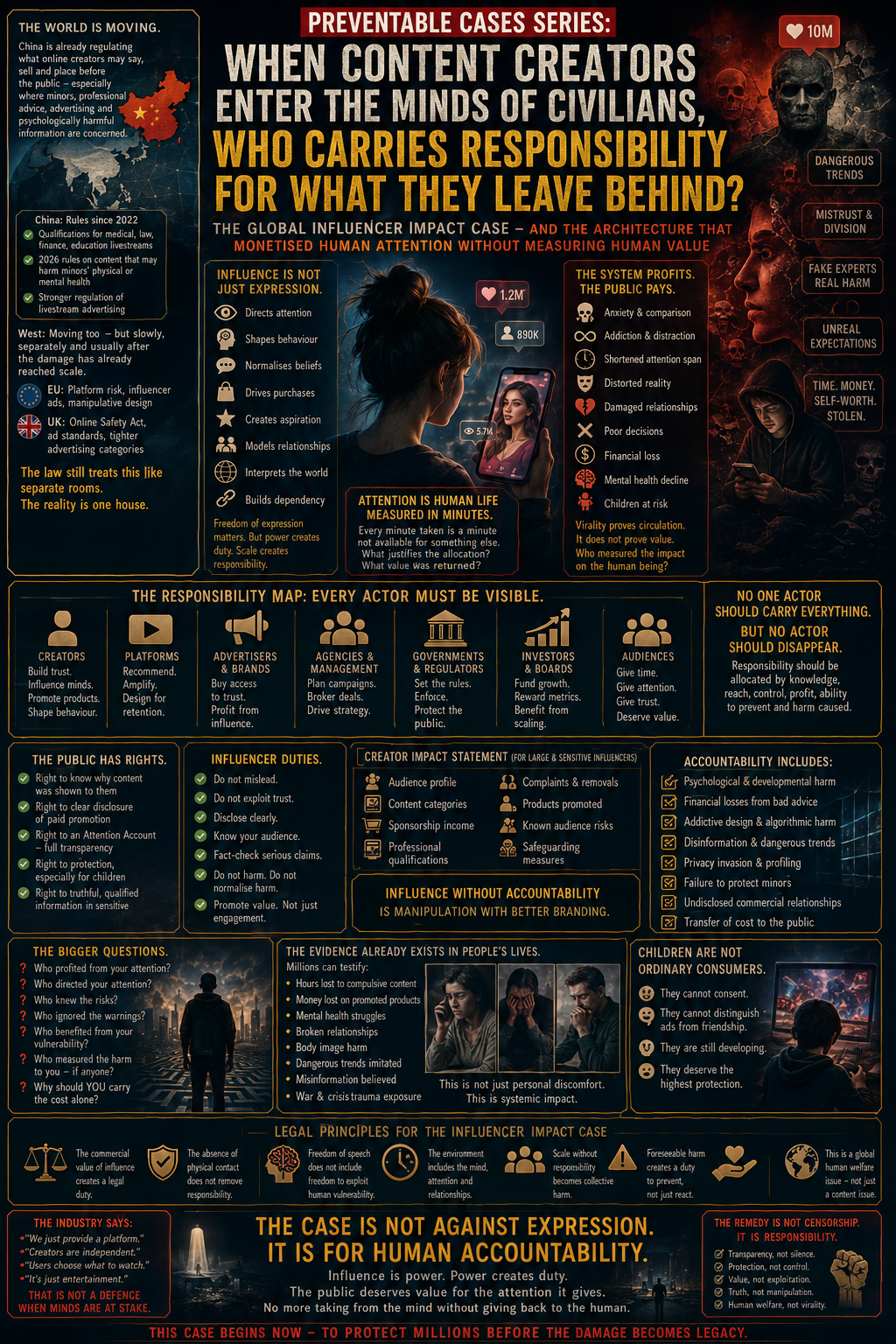
The Global Influencer Impact Case — and the Architecture That Monetised Human Attention Without Measuring Human Value
China is already moving more directly than much of the Western world toward regulating what online creators may say, sell and place before the public, particularly where minors, professional advice, advertising and psychologically harmful information are concerned. Some viral reporting exaggerated the novelty of China’s approach: rules requiring certain livestreamers discussing medicine, law, finance and education to verify relevant qualifications largely trace back to a 2022 code rather than an entirely new 2025 law. But China has continued expanding the architecture, including 2026 rules categorising online material that may harm minors’ physical or mental health and stronger regulation of livestream advertising.
To be fairer in this topic alone we have to look at how content creators support critical thinking, long attention span, grounded information or layed out with clarity and responsibility, does the content bring any value to the person or its entertainmemt costs psychological decline? And much more, but we’ll get to all the details of the shared “preventable cases series” when we start or contribute to those class actions. I could make a living off of it, instead of starting 4Honeth. Too many blindspots and neglectful acts, not to.
Do I want to be a business owner or a class-actioner?!….
Governments sit and watch cause they benefit from it all. Criminal judges are redundant in a peaceful civilisation.
The Western world is moving too, but more slowly, more separately and usually after the content has already reached scale.
The EU has developed rules around platform risk, influencer advertising and manipulative digital design. The UK has extended online-safety duties over platforms and has begun tightening particular advertising categories. Yet the legal system still tends to divide the problem into small rooms:
Advertising law.
Consumer protection.
Child safety.
Defamation.
Financial advice.
Medical misinformation.
Platform regulation.
Privacy.
Mental health.
Each room receives a rule.
Very few systems examine the whole house:
What cumulative impact have content creators had upon the minds, attention, behaviour, expectations and relationships of civilians across the world?
That is the legal focus.
Not whether every creator is harmful.
Not whether popular content should be forbidden.
Not whether every hour spent online creates a compensable injury.
The question is whether an enormous commercial ecosystem was permitted to enter human consciousness, gather attention, influence behaviour and create dependency without being required to account for the quality, truth, necessity or human consequence of what it repeatedly deposited there.
Influencers Are Not Merely Individuals Posting Online
The word “influencer” already admits the function.
Influence.
The creator is not merely speaking.
They are directing attention.
Shaping interpretation.
Normalising behaviour.
Producing aspiration.
Recommending products.
Modelling relationships.
Teaching language.
Establishing beauty standards.
Reframing morality.
Interpreting politics.
Influencing purchasing.
Creating emotional climates.
Helping people decide what is desirable, embarrassing, successful, masculine, feminine, healthy, normal or worthy of imitation.
Yet the legal architecture frequently treats the creator as though they are simply an individual expressing themselves.
That description becomes incomplete once the expression is monetised, optimised, distributed algorithmically and repeated before audiences numbering in the thousands or millions.
A person speaking privately to friends is expressing themselves.
A creator studying analytics, adapting content to retention patterns, accepting brand money, building parasocial intimacy and using platform tools to maximise reach is participating in a commercial influence system.
Their individuality remains.
But so does their public power.
The Industry Depends Upon Influence While Avoiding Responsibility for Influence
Companies depend upon influencers because creators can access something conventional advertising increasingly struggles to obtain:
Trust.
Familiarity.
Intimacy.
Repetition.
Creators enter homes through phones.
They appear in beds, bathrooms, kitchens, trains, schools, workplaces and moments of emotional vulnerability.
The audience may see the same face every day.
Hear personal stories.
Watch private routines.
Develop the feeling that they know the creator.
The company then purchases access to that relationship.
The advertisement does not arrive as an unfamiliar corporate message.
It arrives through someone the viewer has already allowed into their mental and emotional space.
That is why influencer marketing works.
And that is why the responsibility cannot be reduced to whether the word “advertisement” appeared somewhere on the screen.
The legal question must include what was purchased.
The company was not merely purchasing screen space.
It was purchasing influence already established inside another person’s mind.
Every Individual Can Speak to the Value—or Absence of Value—They Received
One of the most powerful aspects of this future case is that the evidence already exists inside the lives of users.
Every person can ask:
Which creators repeatedly captured my attention?
How many hours did I give them?
What did I receive in exchange?
Did the content educate me?
Expand me?
Entertain me meaningfully?
Strengthen my relationships?
Improve my skills?
Help me understand myself?
Or did it simply keep me watching?
Did I leave with more value than I entered with?
Or did I leave with comparison, agitation, urgency, envy, fear, compulsive desire, false expectations or nothing memorable at all?
This does not mean every piece of content must teach a formal lesson.
Rest, humour, beauty, storytelling and harmless entertainment can carry value.
The distinction is between content that genuinely serves a human experience and content engineered primarily to occupy time without caring what repeated occupation does to the person.
Attention was taken.
Time was taken.
Mental space was occupied.
Behaviour may have been changed.
Products may have been purchased.
The platform, creator, agency and advertiser may all have earned money.
The civilian should be permitted to ask what value entered their life in return.
Attention Is Not an Infinite Natural Resource
The content economy treats human attention as though it endlessly regenerates without consequence.
It does not.
Attention is connected to:
Memory.
Learning.
Decision-making.
Rest.
Relationships.
Imagination.
Work.
Self-awareness.
Emotional regulation.
A person has only so many waking hours.
Every hour directed toward one thing is an hour unavailable to another.
Content therefore does not merely occupy a screen.
It allocates life.
If one creator captures ten minutes from one million people, that is not simply a successful post.
It is ten million minutes of collective human existence.
What justified the allocation?
What was given back?
Who measured the effect?
Who profited from it?
The platform records watch time because watch time carries commercial value.
The legal system should recognise that the same time carries human value to the people who surrendered it.
Virality Has Been Treated as Success Without Asking What Became Viral
Creators are rewarded for reach.
Views.
Retention.
Shares.
Comments.
Clicks.
Conversions.
Controversy.
The system does not necessarily reward truth.
Care.
Depth.
Accuracy.
Proportion.
Psychological safety.
Long-term usefulness.
A creator can become more commercially valuable by producing content that shocks, enrages, sexualises, divides, frightens or creates dependency.
The metric records that people remained.
It does not record what remaining did to them.
This is one of the foundational legal failures.
The architecture measures what benefits the platform and creator while leaving the human consequence comparatively unmeasured.
High engagement is treated as evidence that the content worked.
But “worked” for whom?
The advertiser may sell.
The creator may grow.
The platform may retain the user.
The audience may become more anxious, distracted, polarised or dissatisfied.
A system cannot call an outcome successful merely because every commercial participant benefited.
The Creator Economy Has Been Allowed to Produce Before Proving Public Value
Manufacturing companies are expected, at least in principle, to answer questions about what their physical products contain.
Digital creators can distribute psychological material globally without comparable pre-release duties.
They may speak about:
Mental health.
Relationships.
Sex.
Parenting.
Medicine.
Law.
Money.
Nutrition.
Politics.
Trauma.
Spirituality.
Crime.
War.
Children.
Without training.
Without evidence.
Without quality control.
Without understanding how the same statement may affect an adult, a child, a vulnerable person or someone in crisis.
China’s existing framework is more willing to require qualification verification for some professional livestream topics. That model may carry risks of censorship and excessive state control, but the underlying principle deserves examination: reach and confidence should not automatically qualify a person to provide consequential guidance.
The Western model often allows the content to circulate first and asks questions only after measurable harm, public controversy or litigation.
That is not prevention.
It is civilian testing.
The Legal System Must Distinguish Expression From Professionalised Influence
Freedom of expression matters.
But not every form of speech operates through the same architecture.
The law already recognises distinctions between:
A private opinion and regulated financial advice.
Personal enthusiasm and paid advertising.
Casual conversation and medical representation.
Ordinary speech and fraudulent inducement.
The same principle should be developed for professionalised influence.
Relevant factors could include:
- audience size;
- monetisation;
- frequency;
- subject matter;
- vulnerability of the intended audience;
- use of paid promotion;
- algorithmic amplification;
- professional claims;
- creator training;
- foreseeable reliance;
- product sales;
- and whether the creator presents personal experience as generally applicable truth.
The greater the power, reach and commercial benefit, the greater the corresponding duty should become.
Platforms Cannot Own the Virality and Outsource the Meaning
Platforms may argue that creators make the content.
Creators may argue that platforms distribute it.
Advertisers may say they sponsored only one post.
Agencies may say they brokered the relationship.
Audiences may be blamed for choosing to watch.
Again, everyone narrows their role.
But the system is connected.
The creator produces.
The platform recommends.
The agency packages.
The advertiser funds.
The algorithm escalates.
The audience absorbs.
The platform cannot profit from prediction, recommendation and retention while presenting itself as a passive noticeboard whenever the content causes harm.
If it decides what appears next, to whom, how often and at what moment, it is not merely hosting expression.
It is directing exposure.
Recent research examining video recommendations found that experimental accounts registered as age 13 encountered harmful material more frequently and more quickly than adult accounts, including harmful recommendations appearing without an active search. That points to the responsibility created not only by the content’s existence, but by the system that selects and delivers it.
The Creator Cannot Own the Audience and Disown the Impact
Creators routinely speak of “my audience,” “my community” and “my followers.”
Those words express relationship and possession.
The audience generates their visibility.
Income.
Deals.
Status.
Access.
Career.
If the creator owns the benefit of that relationship, they cannot completely disown its foreseeable consequence.
This does not mean creators become responsible for every independent choice made by every follower.
It means they carry duties proportional to the influence they intentionally cultivate.
Where the creator repeatedly advises, persuades, pressures, frightens or emotionally binds an audience, they should be required to consider what their content is reasonably capable of producing.
Influence without responsibility is manipulation with better branding.
A Global Impact Case Would Need Civilian Testimony at Its Centre
This case should not be constructed only through expert reports and platform data.
The people affected must speak.
Large-scale testimony could document:
- hours lost to compulsive content;
- purchases made through parasocial trust;
- financial losses following creator advice;
- changed eating habits;
- body dissatisfaction;
- relationship expectations;
- exposure to sexual or violent content;
- anxiety created by constant crisis material;
- fear produced by war content;
- imitation of dangerous trends;
- disrupted sleep;
- shortened attention;
- reduced in-person interaction;
- and the experience of receiving little or no lasting value from prolonged exposure.
The purpose would not be to treat every unpleasant emotion as legal damage.
It would reveal patterns.
If thousands or millions of people independently report similar consequences from the same designs, creators, formats or recommendation systems, the law should stop treating each experience as isolated personal weakness.
Children Were Never Ordinary Consumers
Children require a separate and higher standard.
They do not possess adult developmental capacity.
They may not distinguish advertising from friendship.
Performance from reality.
Popularity from authority.
Anecdote from evidence.
Sexual display from healthy intimacy.
Conflict content from ordinary relationships.
War footage from immediate personal danger.
A child may see repeated content before they have developed the language to understand what it is doing to them.
China’s 2026 rules explicitly categorise forms of online material considered capable of harming minors’ physical and mental health. The EU and UK are also increasingly focused on child safety, addictive design and platform duties, although their approaches remain fragmented and contested.
The child should never carry the primary responsibility for resisting an architecture built by adults who understand attention better than the child understands themselves.
Creators Have Become Unlicensed Social Teachers
Content creators teach continuously.
Even when they do not call it teaching.
They teach through repetition.
What to buy.
How to speak.
What bodies deserve attention.
How relationships should behave.
How wealth should look.
What masculinity means.
What femininity means.
How conflict should be handled.
How grief should be displayed.
What counts as success.
What kind of life is embarrassing.
What the world should fear.
What should be desired.
Many creators reach more people daily than teachers, lecturers, ministers or local public institutions.
Yet the creators may have no professional standard, no duty to assess developmental impact and no requirement to distinguish what they know from what they merely believe.
The law should recognise the functional role.
A person does not stop teaching merely because the classroom is called a feed.
The Industry Has Profited From Dependency
The system does not merely want people to enjoy one piece of content.
It wants return.
Habit.
Recognition.
Routine.
Attachment.
Creators are encouraged to post consistently, cultivate community, reveal private life, create suspense and maintain emotional access.
Platforms recommend content according to predicted engagement.
Advertisers prefer creators whose audiences trust them.
Agencies convert trust into commercial opportunity.
Dependency becomes economically valuable.
The legal issue is not whether every returning viewer is addicted.
It is whether the system intentionally developed dependency-producing methods without adequate responsibility for foreseeable psychological consequences.
The European Commission’s 2026 accusations against Meta focus directly on features such as infinite scrolling and autoplay that may support compulsive use and harm mental or physical wellbeing.
The same inquiry must move beyond platform interface design and include creator practices specifically designed to keep audiences emotionally attached.
The Responsibility Map
Content creators should answer for what they knowingly publish, the claims they make, the products they promote, the audiences they cultivate and the foreseeable reliance they generate.
Platforms should answer for recommendation, amplification, targeting, retention design, age protection, data collection and repeated delivery of harmful material.
Advertisers and brands should answer for buying access to parasocial trust, approving campaigns and rewarding creators according to conversion without adequate assessment of audience welfare.
Influencer agencies and management companies should answer for campaign strategy, creator selection, content planning, risk review and commercial pressure.
Professional advisers and product companies should answer where creators are used to market medical, financial, cosmetic, dietary or other consequential products.
Schools and educational systems should answer for digital-literacy preparation and whether young people were taught to understand commercial influence.
Governments and regulators should answer for allowing the influencer economy to reach global scale before creating coherent duties covering psychological impact, professional claims, child development and cumulative exposure.
Investors should answer where growth and engagement expectations rewarded harmful dependence or low-value virality.
Users retain individual agency, but agency should not be used to erase power imbalance, developmental vulnerability, deceptive design or undisclosed commercial influence.
No One Actor Should Carry Everything, but No Actor Should Disappear
The creator is not solely responsible for the platform’s design.
The platform is not solely responsible for the creator’s lie.
The advertiser is not solely responsible for the audience’s entire psychology.
The government is not solely responsible for every online interaction.
But every actor who contributed knowledge, money, distribution, authority or design belongs within the map.
Responsibility should be allocated according to:
- knowledge;
- reach;
- control;
- profit;
- vulnerability of the audience;
- ability to prevent;
- repetition;
- concealment;
- and the seriousness of the foreseeable impact.
The Case Is Not About Demanding That All Content Be “Useful”
Value cannot be defined only as education, productivity or measurable improvement.
Humans also need laughter.
Fantasy.
Art.
Pleasure.
Rest.
Absurdity.
Community.
Light entertainment.
The case should not become a puritanical audit of whether every video taught a skill.
The issue is whether content repeatedly captures human attention through deceptive, compulsive or exploitative means while providing so little that the primary measurable benefit remains with the commercial system.
There is a difference between harmless entertainment and engineered emptiness.
There is a difference between giving someone a moment of rest and building a system whose purpose is to stop them from leaving.
A Right to an Attention Account
One important remedy could be an individual Attention Account.
Platforms should disclose:
- total time spent;
- creators receiving the most attention;
- content categories;
- advertisements viewed;
- purchases linked to creator promotion;
- late-night consumption;
- repeated exposure to distressing material;
- recommendation pathways;
- and the amount of revenue reasonably attributable to the user’s engagement.
The individual should be able to see where their time went.
Not only weekly screen time.
A full account of how their attention was allocated and monetised.
Because people cannot evaluate whether a creator brought value if the system withholds the actual size of the exchange.
A Creator Impact Statement
Creators above a defined scale or operating in sensitive fields could be required to publish a periodic Creator Impact Statement covering:
- primary content categories;
- audience age profile;
- sponsorship income;
- professional qualifications relevant to advice given;
- correction history;
- complaints;
- content removals;
- commercial products promoted;
- known audience risks;
- safeguarding procedures;
- and measures taken to prevent misleading reliance.
This would not require creators to prove that every follower benefited.
It would require professionalised influencers to recognise that influence creates public-facing duties.
A Public Value and Harm Audit
Platforms should be required to conduct independent audits measuring more than engagement.
Audits should examine:
- compulsive-use indicators;
- developmental effects;
- misinformation exposure;
- harmful-content frequency;
- parasocial dependency;
- sleep disruption;
- advertising opacity;
- and whether recommendation systems repeatedly direct vulnerable users toward escalating content.
The legal system should not allow the companies benefiting from the metrics to remain the only bodies defining what the metrics mean.
The Right to Know Why a Creator Was Placed Before You
A user should be able to ask:
Why did I see this person?
Was the creator paying?
Was a company paying?
Did the platform predict I was emotionally vulnerable?
Was I targeted because of age, insecurity, location, purchasing history or recent searches?
Was the recommendation influenced by someone else’s commercial objective?
The current system allows the content to feel organic while the distribution may be intensely calculated.
That is an informational imbalance.
The Right to Separate Content From Commercial Influence
Paid promotion should not hide inside personality.
Commercial relationships should be clearly, consistently and immediately visible.
Not buried in captions.
Not expressed through vague terms.
Not disclosed after the emotional hook has already worked.
The audience should know before persuasion begins that persuasion has been purchased.
Research and regulatory reviews continue to find inconsistent disclosure practices, including in financial influencer content and broader EU influencer marketing.
The Class Could Be Global
This may not be one courtroom action.
Different countries regulate speech, advertising, privacy, consumer protection and collective litigation differently.
The architecture could include:
- child-development classes;
- deceptive advertising claims;
- financial-loss cases;
- mental-health monitoring claims;
- undisclosed sponsorship cases;
- platform-design litigation;
- privacy and profiling actions;
- creator-specific cases;
- and public-law challenges against regulatory failure.
But the common global question remains:
What happens when commercial influence becomes one of the largest unregulated forces entering the human mind?
The Central Legal Formulation
The proposed claim could be developed as follows:
Content creators, digital platforms, advertisers, agencies and public authorities participated in constructing and permitting a global influence economy that intentionally captured, directed and monetised civilian attention while failing to assess, disclose, prevent or remediate foreseeable psychological, developmental, relational, financial and informational harms. Where actors derived commercial value from repeated access to human attention, their duties must be assessed according to the scale of influence, vulnerability of the audience, nature of the claims made, degree of control, profit received and reasonable opportunity to prevent harm.
And:
The absence of physical contact does not remove impact. Digital content enters cognition, emotion, behaviour and relationship. Where that influence is professionalised and monetised, it should no longer be treated as consequence-free personal expression.
The Strongest Evidential Question
The public should be asked:
What did this creator take from your time, attention, money, emotions and perception—and what enduring value did they return?
Not every answer will support liability.
But millions of answers may expose patterns no platform dashboard was designed to show.
The Central Principles
The word “influencer” is already an admission of impact.
A creator cannot own the audience commercially while disowning the audience psychologically.
Platforms cannot own virality and outsource meaning.
Attention is human life measured in minutes. It should not be commercially extracted as though it were consequence-free.
A person may be free to speak, but professionalised, monetised and algorithmically amplified influence carries additional duties.
Children should not be expected to defend themselves against an industry designed by adults to understand and capture attention.
Virality proves circulation. It does not prove value.
The public has the right to ask what entered its mind, who placed it there, who profited and what responsibility followed.
China may be ahead in recognising that creators and platforms require firmer boundaries, although its approach also demonstrates the danger of regulation becoming censorship rather than accountable protection.
The Western world should not wait until the only available choices are unrestricted commercial influence or excessive governmental control.
The better structure is transparent, rights-based and proportionate.
Protect expression.
Protect criticism.
Protect art.
Protect honest personal experience.
But do not allow companies, platforms and professionalised creators to hide commercial power inside the language of ordinary speech.
Because content is not weightless.
It occupies time.
It shapes thought.
It enters relationships.
It can educate or distort.
Strengthen or addict.
Clarify or frighten.
Liberate or narrow.
And when the same system reaches billions of minds, its impact is no longer merely cultural.
It is a matter of global civilian welfare.


Leave a Reply