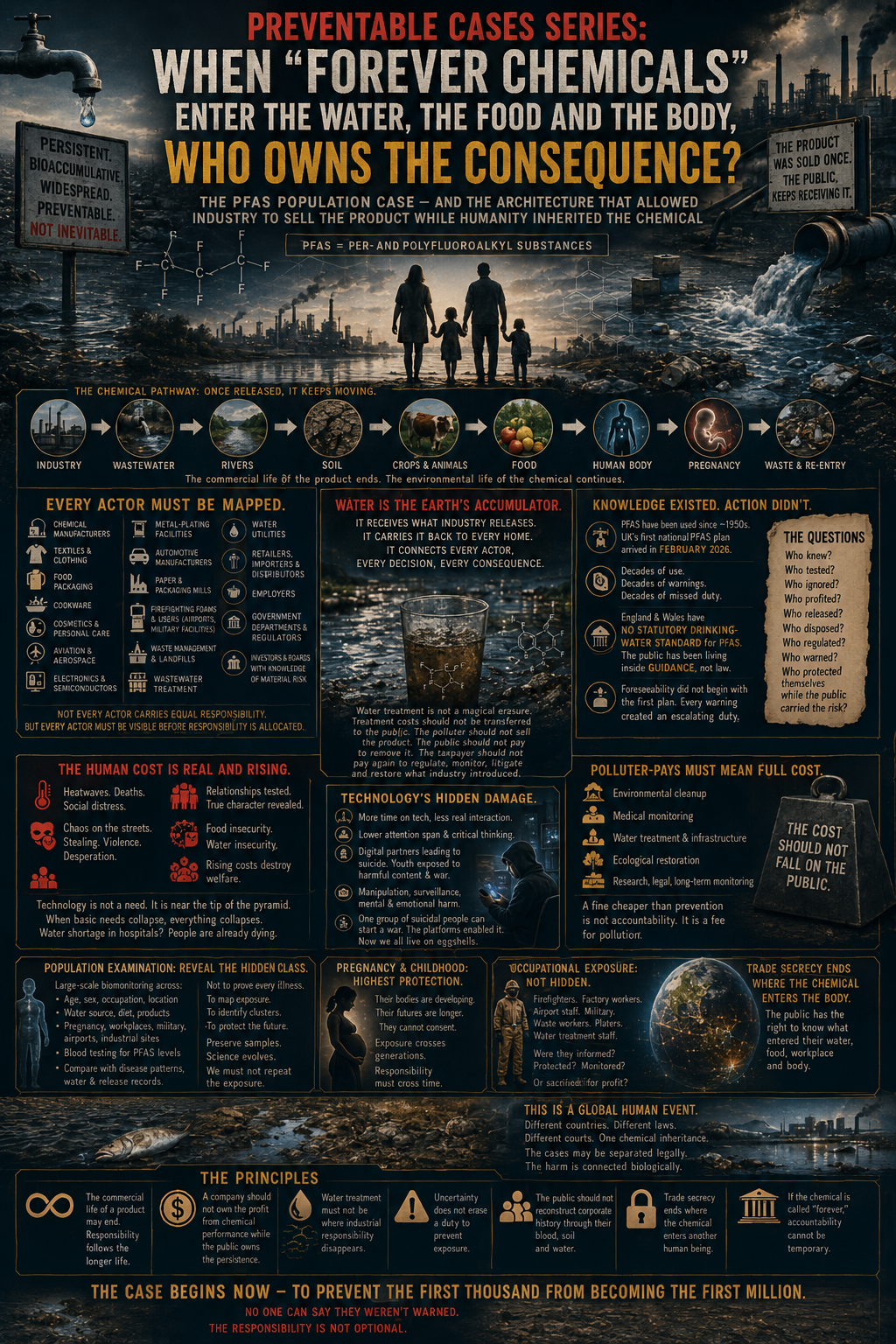
The PFAS Population Case — and the Architecture That Allowed Industry to Sell the Product While Humanity Inherited the Chemical
This is what I mean by a Preventable Case.
A case that should not need to wait until the damage has multiplied across millions of bodies before institutions recognise that the warning was already present.
A case whose eventual size can be foreseen from the scale of the exposure.
A case in which the evidence may presently appear fragmented across different companies, products, locations, medical conditions, waterways and regulatory bodies, even though those fragments may belong to one continuous architecture.
A case that can still be prevented from becoming larger if the responsible parties act now.
The PFAS case has the potential to become one of the largest collective accountability actions ever constructed because the possible class is not limited to customers who purchased one defective product from one identified company.
The possible class is humanity living inside an environment into which persistent chemicals have been repeatedly introduced.
PFAS—per- and polyfluoroalkyl substances—are a large family of synthetic chemicals used since approximately the 1950s across consumer products and industrial processes. They have been used to create resistance to water, grease, heat, oil and stains, including in some cookware, food packaging, clothing, carpets, firefighting foams and industrial applications. Many are extremely persistent because the carbon-fluorine bonds within them resist ordinary environmental degradation.
That persistence changes the responsibility.
A company may use the chemical for one product cycle.
The product may be manufactured, sold, consumed and discarded.
The company may record the transaction as complete.
But the chemical may continue moving.
Through wastewater.
Through rivers.
Through soil.
Through groundwater.
Through crops.
Through animals.
Through food.
Through the human body.
Through pregnancy.
Through waste.
Through the next water-treatment cycle.
The commercial life of the product ends.
The environmental life of the chemical continues.
So the responsibility should follow the longer life.
Every Company That Used the Chemical Belongs Inside the Initial Map
The case should not begin by deciding in advance that only the original chemical manufacturers are responsible.
Every company that manufactured, supplied, incorporated, applied, distributed, discharged or disposed of PFAS should be mapped according to the part it played.
That could include:
- primary chemical manufacturers;
- textile and clothing companies;
- carpet and furniture manufacturers;
- food-packaging businesses;
- cookware manufacturers;
- cosmetics and personal-care companies;
- aviation and aerospace operations;
- electronics and semiconductor companies;
- metal-plating facilities;
- automotive manufacturers;
- paper and packaging mills;
- firefighting-foam manufacturers and users;
- airports;
- military facilities;
- waste-management companies;
- landfill operators;
- wastewater-treatment organisations;
- water utilities;
- retailers;
- importers;
- distributors;
- employers;
- government departments;
- regulators;
- and investors or boards with knowledge of material risk.
Not every company would carry equal responsibility.
Not every use would have produced equal exposure.
Not every actor would have possessed the same knowledge.
But every actor should be visible before responsibility is allocated.
The law should ask:
Who manufactured the substance?
Who decided it should enter the product?
Who knew it was persistent?
Who knew it could move beyond the point of use?
Who discharged it?
Who disposed of it?
Who profited?
Who possessed the ability to investigate?
Who had regulatory authority?
Who received warnings?
Who ignored them?
Who failed to develop a safer alternative?
Who transferred the cost of removal to the public?
Who is still using it now?
Distributed responsibility should not become diluted accountability.
It should mean that no company disappears simply because the chemical travelled through several hands before reaching the person affected.
The Product Was Sold Once, but the Public Keeps Receiving It
A company may argue that it sold a lawful product.
But lawfulness at the moment of sale cannot automatically exhaust responsibility for a substance designed or known to persist long after the transaction.
The public may continue receiving the chemical through pathways it never chose.
A person may not purchase a PFAS-treated product knowingly.
They may still drink water affected by industrial discharge.
They may eat food grown in contaminated soil.
They may live near an airport where firefighting foam was repeatedly used.
They may work in a factory where the substances were handled.
They may consume fish from affected water.
They may carry exposure transmitted through multiple products and locations over decades.
That person did not enter one identifiable exchange.
They entered an environment already carrying the residue of thousands of exchanges performed by others.
This is why the PFAS case cannot be treated only as conventional consumer litigation.
The consumer relationship may be only one doorway.
The larger injury is environmental and population-wide.
The chemical does not respect the boundaries between customer and non-customer.
It does not stop at the factory gate.
It does not remain within the product.
It does not ask who consented.
It moves according to water, air, soil, waste and biology.
Water Is the Earth’s Accumulator
Water is like the Earth’s sponge.
It receives what industry releases.
It gathers what rain carries from surfaces.
It receives runoff from roads, factories, farms, airports and landfill sites.
It moves through rivers.
It enters reservoirs.
It filters into aquifers.
It passes through treatment works.
It returns to homes.
People then use it to drink, cook, wash, clean, bathe, grow food and support every ordinary function of life.
That makes water one of the principal witnesses in this case.
It records what manufacturing leaves behind.
A company may stop using a substance.
The water may continue carrying it.
A facility may close.
The groundwater may preserve the history.
A product may disappear from shelves.
The chemical may remain within the river, soil or body.
The water therefore connects companies that may otherwise appear unrelated.
One manufacturer releases a substance.
One waste operator receives contaminated material.
One wastewater facility cannot fully remove it.
One water company treats the supply.
One household consumes it.
One person accumulates exposure.
Each actor sees one stage.
Water carries the whole sequence.
Water Treatment Should Not Become the Point Where Responsibility Disappears
The existence of water treatment can create a dangerous assumption:
The water company will remove it.
The problem will be handled downstream.
But treatment is not a magical erasure of everything industry places into water.
Different PFAS behave differently, and treatment effectiveness varies according to the substance, concentration, source water and process used. The Drinking Water Inspectorate has stated that known treatment processes can remove PFAS from source water, but effectiveness varies and mitigation may require specific technology and investment.
That means several questions must be separated.
Can the substance be removed from the water?
What technology is required?
How much does that treatment cost?
What happens to the captured chemical afterward?
Who pays for the installation?
Who pays for operation and maintenance?
Does the treatment remove all PFAS or mainly certain compounds?
What about short-chain substances or replacement chemicals?
What happens where treatment is unavailable?
What happens to private water supplies?
What happens before the technology is installed?
Who carries exposure during the delay?
The water company should not automatically become the final financial container for pollution created by manufacturers and industrial users.
If utilities are forced to install expensive systems because upstream actors released persistent chemicals, then the cost should not simply be transferred to customers through higher bills.
The polluter should not sell the product.
The public should not then pay to remove it.
And the taxpayer should not pay again to regulate, monitor, litigate and restore what private industry introduced.
Water Treatment Chemicals Must Also Be Examined
The investigation should not stop with PFAS entering source water from industrial products.
It should examine the entire treatment process.
What chemicals are introduced to clean the water?
What by-products remain?
What interactions occur between treatment chemicals and contaminants?
Which residues remain within water reaching households?
What is removed?
What is transformed?
What enters sludge?
Where does that sludge go?
Could contaminated sludge then be spread on land and return the same substances to soil, crops, groundwater and rivers?
A system cannot claim to have solved contamination merely because the chemical is no longer present in the original place.
Removal is not destruction.
Transfer is not elimination.
If a treatment process captures PFAS and then produces waste that re-enters the environment elsewhere, the system may simply be moving the liability.
The full lifecycle must be examined.
Source.
Use.
Discharge.
Treatment.
Capture.
Storage.
Disposal.
Re-entry.
Human exposure.
No stage should be allowed to pretend it is unrelated to the others.
The Government’s First National Plan Arrived After Decades of Use
The UK published its first national PFAS plan in February 2026.
That fact belongs near the centre of the responsibility analysis.
PFAS have been used internationally since around the 1950s, yet the UK’s first coordinated national plan arrived many decades later. The plan now sets out three broad areas: understanding sources, addressing pathways and reducing ongoing exposure while transitioning toward safer alternatives.
The existence of the plan is an acknowledgement that the issue requires coordinated governmental action.
But it also produces questions.
Why did the first national plan arrive only in 2026?
What knowledge existed before then?
Which departments held it?
What did regulators know about persistence?
Which industries were monitored?
How many substances were tested?
How many were not?
Which contaminated locations were identified?
Which remained unexamined?
What warnings came from international research?
What restrictions could have been introduced earlier?
Why were safer alternatives not required sooner?
Which businesses continued using PFAS after persistence and possible health risks became reasonably foreseeable?
A plan arriving late does not erase earlier failure.
It documents the point at which government could no longer treat the issue as scattered.
No Statutory Drinking-Water Standard Means the Public Has Been Living Inside Guidance
England and Wales currently do not have statutory drinking-water standards applying broadly to PFAS. The Drinking Water Inspectorate instead uses precautionary tiered guideline values for water companies.
That distinction matters.
Guidance is not identical to a clear statutory limit.
A legal standard creates a defined threshold, enforceability structure and public expectation.
A guideline may direct action, but it can also leave uncertainty around legal entitlement, remedy and responsibility.
The public should be able to ask:
What level is legally permitted?
Which individual PFAS are included?
Are substances assessed separately or collectively?
How frequently is water tested?
Are all relevant water sources covered?
What happens when a threshold is exceeded?
How quickly must corrective treatment occur?
Must residents be informed?
Who pays?
What compensation follows where prolonged exposure occurred?
What standard applies to private supplies?
What standard applies where several PFAS are present simultaneously?
The legal system should not wait for perfect scientific certainty before defining precautionary protection.
Scientific knowledge can evolve.
The duty to prevent foreseeable exposure should exist during that evolution.
The Chemical-by-Chemical Approach Can Become an Industry Escape Route
One of the greatest risks is regulating PFAS one substance at a time.
A particular compound is identified.
Evidence accumulates.
Restrictions begin.
Industry substitutes another member of the same broad chemical family.
The replacement may possess less research, not necessarily less harm.
The absence of evidence is then presented as evidence of safety.
The cycle repeats.
This is regrettable substitution:
One chemical becomes controversial.
A structurally related chemical takes its place.
Years pass before the replacement is fully evaluated.
The public becomes the testing environment again.
A coherent case should therefore examine PFAS as a class where shared persistence or relevant properties justify doing so, while still allowing distinctions where particular compounds behave differently.
The burden should not remain entirely upon the public to prove harm from thousands of substances individually after exposure.
Where a company wants to use a persistent chemical, the burden should fall upon the company to prove:
Why it is necessary.
Why safer alternatives are inadequate.
How exposure will be prevented.
How release will be monitored.
How the substance will be recovered.
How contaminated waste will be destroyed or safely contained.
Who will fund remediation.
What happens if the scientific understanding later worsens.
Industry should not be free to introduce complexity and then use that complexity as a defence against accountability.
The Absence of Complete Science Is Not the Absence of Responsibility
Not every PFAS has the same toxicity.
Not every exposure produces illness.
Not every medical condition in an exposed person can be attributed to PFAS.
Those distinctions matter scientifically and legally.
But they should not be used to collapse the entire responsibility question.
The US Environmental Protection Agency says that current research suggests exposure to certain PFAS may be associated with adverse health outcomes, while acknowledging that research continues regarding different compounds, exposure levels and long-term effects, especially for children.
That means the responsible position is neither:
Every PFAS caused every illness.
Nor:
Because every causal pathway is not yet proven, nobody should act.
The correct position is:
There is sufficient evidence of persistence, widespread exposure and potential harm to justify precaution, monitoring, disclosure, substitution, medical research and allocation of remediation responsibility.
Scientific uncertainty does not neutralise risk.
It defines the area in which prevention matters most.
The Population Examination Could Reveal the Hidden Class
One of the strongest additions to this future case would be a large-scale human biomonitoring programme.
Thousands of people could be examined across:
- age;
- sex;
- occupation;
- pregnancy status;
- location;
- water source;
- proximity to industrial facilities;
- proximity to airports or military sites;
- diet;
- product use;
- and known contamination zones.
Blood testing could examine levels of selected PFAS.
The study could then compare exposure with:
- residential history;
- occupational history;
- water-supply records;
- industrial-release records;
- disease patterns;
- pregnancy outcomes;
- liver and kidney indicators;
- cholesterol;
- immune markers;
- developmental outcomes;
- and other scientifically relevant health data.
This should not be presented as a shortcut proving that every detected level caused a particular condition.
It would be an exposure map.
It would reveal whether apparently separate people belong to the same chemical environment.
It could identify:
- geographic clusters;
- occupational clusters;
- age-related patterns;
- household patterns;
- contamination pathways;
- and populations requiring long-term monitoring.
The class may already exist biologically before it exists legally.
The legal system simply has not assembled the people into one visible structure.
The Comparison Group Must Also Be Designed Carefully
A credible population study would require more than testing people in obviously contaminated areas.
It should include comparison populations.
People with different water sources.
People in urban and rural settings.
People near and far from known industrial sites.
People with occupational exposure and those without it.
Long-term residents and recent arrivals.
This would allow researchers to distinguish background exposure from elevated local burdens.
The study should also preserve samples for future analysis.
Scientific methods improve.
New PFAS become identifiable.
New health associations may emerge.
A sample collected today may answer questions tomorrow that current testing cannot yet ask.
The people should not need to provide their bodies repeatedly because the institutional system failed to design longitudinal evidence properly the first time.
Medical Monitoring Should Be a Remedy Before Disease Is Proven
Traditional compensation often requires a person to become ill before the system recognises an injury.
That is inadequate for persistent chemical exposure.
Where exposure has been materially elevated, the remedy should include medical monitoring even before a diagnosed disease can be attributed to the substance.
People should receive:
- baseline testing;
- periodic follow-up;
- access to exposure records;
- reproductive and pregnancy support where appropriate;
- occupational-health assessment;
- specialist referral pathways;
- psychological support;
- and clear information without alarmist distortion.
Waiting for disease before providing monitoring reverses prevention.
It tells the exposed person:
Return when the harm becomes undeniable.
But the entire purpose of identifying exposure should be to reduce later harm.
Pregnancy and Childhood Require the Highest Level of Protection
Children should not be treated as smaller adults within chemical regulation.
Their bodies are developing.
Their lifetime of possible exposure is longer.
Their ability to consent is nonexistent.
Pregnancy also creates additional questions regarding maternal exposure, placental transfer, infant development and the responsibility owed before birth.
This is where the idea of chemical continuity becomes unavoidable.
The company may introduce the substance into one product.
The exposure can cross time, place and generation.
A transaction performed years earlier may still affect a person who never existed when the chemical was released.
The legal system must be capable of handling injuries whose causal architecture outlives the commercial event.
Occupational Exposure Must Not Be Hidden Inside General Population Data
Workers may have faced much higher exposure than the wider public.
Firefighters.
Chemical workers.
Factory employees.
Airport staff.
Military personnel.
Waste workers.
Textile workers.
Metal-plating workers.
Water-treatment staff.
People handling contaminated sludge or firefighting foam.
Their cases require distinct consideration.
Did employers know the substances were present?
Were workers informed?
Was protective equipment supplied?
Were blood tests offered?
Were safer alternatives available?
Were exposure records preserved?
Did companies monitor air, dust, water and surfaces?
Were pregnant workers given additional protection?
Did employers minimise concern to preserve production?
Occupational groups may become some of the clearest evidence that elevated exposure was foreseeable and preventable.
The Government Cannot Claim That Industry Alone Held the Knowledge
Governmental responsibility must be examined at several levels.
Legislators determine what substances may be restricted and what evidence thresholds apply.
Regulators monitor chemicals, workplaces, drinking water, waste and environmental release.
Planning authorities approve industrial sites and waste facilities.
Environmental agencies investigate contaminated rivers, groundwater and soil.
Public-health bodies monitor illness and exposure.
Water regulators and inspectors establish treatment expectations.
Defence departments and emergency services may have used firefighting foams.
Local authorities may manage contaminated land or private water supplies.
The state cannot point only at manufacturers if governmental bodies had enough evidence to restrict, monitor, warn or investigate earlier.
Government possessed powers individuals did not possess.
It could compel disclosure.
Require testing.
Inspect sites.
Restrict use.
Create national registries.
Fund alternatives.
Warn communities.
Mandate remediation.
Its failure to use those powers belongs inside the responsibility map.
Foreseeability Did Not Begin With the First Government Plan
The government’s 2026 PFAS plan cannot become an artificial starting date for knowledge.
Foreseeability begins when sufficient information existed to raise the risk, not when the state finally consolidated that information into a public policy.
The case should examine:
- internal reports;
- correspondence with industry;
- scientific publications;
- international regulatory developments;
- contaminated-site records;
- water-company data;
- military and airport records;
- workplace exposure information;
- waste-disposal data;
- lobbying;
- and advice received by ministers and departments.
The question is not:
When did government publicly announce that PFAS were a national concern?
It is:
When did governmental actors possess enough information that a responsible system should have investigated the possibility?
Every Warning Creates an Escalating Duty
The first credible report creates a duty to look.
Repeated reports create a duty to connect.
Evidence of persistence creates a duty to trace.
Evidence of human exposure creates a duty to monitor.
Evidence of health risk creates a duty to reduce.
Evidence of safer alternatives creates a duty to substitute.
Evidence of contamination creates a duty to remediate.
Evidence of concealment creates an aggravated responsibility.
At each stage, the duty becomes heavier.
A company or government should not be judged only according to what it knew at the beginning.
It should be judged according to what it did each time the knowledge expanded.
The Polluter-Pays Principle Must Include the Full Cost
The polluter-pays principle should mean more than paying a regulatory fine.
It should include:
- environmental testing;
- public biomonitoring;
- medical monitoring;
- water treatment;
- replacement water;
- contaminated-soil remediation;
- groundwater restoration;
- waste destruction or containment;
- agricultural loss;
- property loss;
- ecological damage;
- public-health research;
- community communication;
- legal costs;
- and long-term maintenance.
A fine that is cheaper than prevention is not accountability.
It is a fee for pollution.
A settlement that covers only immediate contamination while leaving governments and utilities responsible for decades of monitoring is incomplete.
The responsible companies should fund the lifetime of the harm, not merely the moment when it became legally inconvenient.
Profits Should Be Traced Alongside Contamination
The case should map financial benefit as carefully as it maps chemical movement.
Which companies profited from PFAS performance?
Which products commanded higher prices because they were waterproof, grease-resistant, non-stick, stain-resistant or durable?
Which executives received compensation during periods of expansion?
Which investors benefited?
Which companies sold replacement substances after older compounds became restricted?
Which businesses shifted operations or restructured ownership?
Which entities still hold the assets?
Which entities were dissolved?
Liability should not disappear because the corporate form changed while the chemical remained.
If value travelled upward through parent companies, dividends, acquisitions and shareholder returns, responsibility should not be artificially confined to a subsidiary left holding the polluted site.
The chemical continuity should be matched by corporate continuity.
Companies Must Disclose What They Used and Where It Went
A major remedy should be a complete PFAS-use and release register.
Every relevant company should disclose:
- which PFAS it manufactured or used;
- chemical identities and quantities;
- dates of use;
- products involved;
- production sites;
- suppliers;
- customers;
- waste routes;
- water and air releases;
- firefighting-foam use;
- known spills;
- contaminated land;
- internal testing;
- worker exposure;
- and substitutions made.
Without this, communities are forced to investigate substances that companies introduced.
That reverses responsibility.
The producer should hold the records.
The public should not have to reconstruct decades of corporate behaviour from contaminated blood and water.
Trade Secrecy Cannot Override the Right to Know What Entered the Body
Companies may claim formulations, manufacturing processes or chemical identities are commercially confidential.
But trade secrecy cannot become bodily secrecy.
A person should have the right to know which substances may have entered their water, food, workplace and body.
The commercial interest in protecting a formula should not outweigh the public interest in identifying exposure and obtaining medical care.
Where confidentiality prevents regulators, doctors or communities from understanding risk, the law should favour life.
The secret belongs to the company only until the chemical enters somebody else.
The Case Must Include Environmental Injury, Not Only Human Diagnosis
PFAS litigation should not treat the natural environment merely as the route through which humans were harmed.
Rivers, lakes, estuaries, soil, wildlife and groundwater carry their own injury.
The environment is not only evidence.
It is an affected system.
Remedies should include:
- ecological restoration;
- wildlife monitoring;
- fish and food-chain testing;
- river and groundwater treatment;
- restrictions on contaminated produce;
- remediation of source zones;
- and long-term environmental surveillance.
Human beings do not exist outside those systems.
Environmental injury returns as food insecurity, water insecurity, economic loss, illness and loss of place.
The Class Could Be Larger Than Any Single Court Can Easily Hold
This may not become one global lawsuit.
Different countries have different procedural systems, limitation rules, environmental laws, tort doctrines, evidential burdens and collective-action mechanisms.
The eventual architecture may include:
- national collective actions;
- regional subclasses;
- occupational claims;
- contaminated-site litigation;
- water-utility recovery actions;
- medical-monitoring classes;
- consumer claims;
- environmental restoration claims;
- and coordinated governmental enforcement.
But procedural separation should not become conceptual separation.
The cases may be legally divided while remaining part of one global human event:
Industry released chemicals designed to endure.
The environment carried them.
The public received them.
Governments responded after decades.
This Is Why the Series Should Be Called “Preventable Cases”
Preventable Cases is stronger than “To-Be-Open Cases.”
It does not simply predict litigation.
It identifies the point of the work.
The purpose is not to celebrate the arrival of enormous claims after mass harm.
It is to expose the architecture early enough that the case may become smaller than it otherwise would have been.
A Preventable Case is one where:
- the pathway of harm is already visible;
- the responsible actors can still intervene;
- the affected population can still be monitored;
- future exposure can still be reduced;
- evidence can still be preserved;
- alternatives can still be developed;
- and governments can still prevent the first thousand from becoming the first million.
The series itself becomes an early-warning record.
No company can later say nobody raised the architecture.
No regulator can say the cumulative risk was unimaginable.
No government can say the issue appeared without warning.
The Proposed Cause at the Centre
The central allegation could eventually be framed as follows:
Manufacturers, industrial users, distributors, waste operators, water bodies and public authorities participated in or permitted the production, use, release and continued circulation of highly persistent chemical substances despite possessing, or having sufficient opportunity to obtain, knowledge that those substances could accumulate within water, soil, food, wildlife and human bodies. Their failure to investigate, disclose, restrict, substitute, monitor, prevent and remediate foreseeable exposure transferred the long-term environmental and health costs of private commercial activity onto the public.
And:
Where defendants benefited financially from chemical performance while communities inherited exposure and remediation costs, liability should be allocated according to each actor’s knowledge, contribution, control, benefit, authority and opportunity to prevent the harm.
The Remedies Should Begin Before Final Causation Is Determined
The following should not wait for the conclusion of decades of litigation:
- national PFAS exposure mapping;
- large-scale voluntary biomonitoring;
- medical monitoring for highly exposed populations;
- public registers of industrial use and release;
- mandatory disclosure to workers and communities;
- statutory drinking-water standards;
- treatment funding paid by polluters;
- immediate restrictions on non-essential uses;
- substitution requirements;
- a presumption against new persistent chemicals without full lifecycle evidence;
- independent testing;
- long-term sample preservation;
- ecological monitoring;
- and protected funds for future injury.
The legal system should not need to know the final number of victims before it prevents the number from increasing.
The Central Questions
Who manufactured the chemicals?
Who incorporated them into products?
Who knew they persisted?
Who knew they travelled through water?
Who measured human exposure?
Who chose not to?
Who warned government?
Who ignored the warning?
Who profited from performance?
Who paid for treatment?
Who inherited the waste?
Who became ill?
Who must prove causation using evidence held by the defendants?
Who will still carry the chemical after the company no longer exists?
And why should the public finance the removal of something it never consented to receive?
The Central Principles
The commercial life of a product may end at sale. The environmental life of its chemicals may continue for generations. Responsibility must follow the longer life.
A company should not be allowed to own the profit from chemical performance while the public owns the persistence.
Water treatment must not become the place where industrial responsibility disappears and customer bills begin.
The absence of complete scientific certainty does not erase a duty to prevent exposure to substances designed to resist disappearance.
The public should not have to reconstruct corporate history through contaminated blood, soil and water.
Trade secrecy ends where the chemical enters another person’s body.
The first national plan arriving after decades of use is not the beginning of responsibility. It is evidence of how long coordinated responsibility was missing.
If the chemical is called “forever,” accountability cannot be temporary.
This is not merely a potential case against one company.
It is a case about a manufacturing civilisation that behaved as though the environment would absorb everything indefinitely.
It is a case about products designed for convenience while the chemical consequence was transferred into water, food, soil, wildlife and human biology.
It is a case about governments that permitted thousands of substances to enter ordinary life without building an equally powerful system for tracking where they went afterward.
And it is preventable from becoming even larger.
The chemicals already released may persist.
But continued exposure is still a decision.
Further use is still a decision.
Non-disclosure is still a decision.
Failure to test is still a decision.
Failure to monitor is still a decision.
Failure to remediate is still a decision.
The case begins when enough people recognise that what appears inside separate products, separate rivers, separate workplaces, separate bodies and separate countries may be one continuous chemical inheritance.
The class does not need to be created.
It may already be living, drinking, eating and breathing the evidence.





Leave a Reply