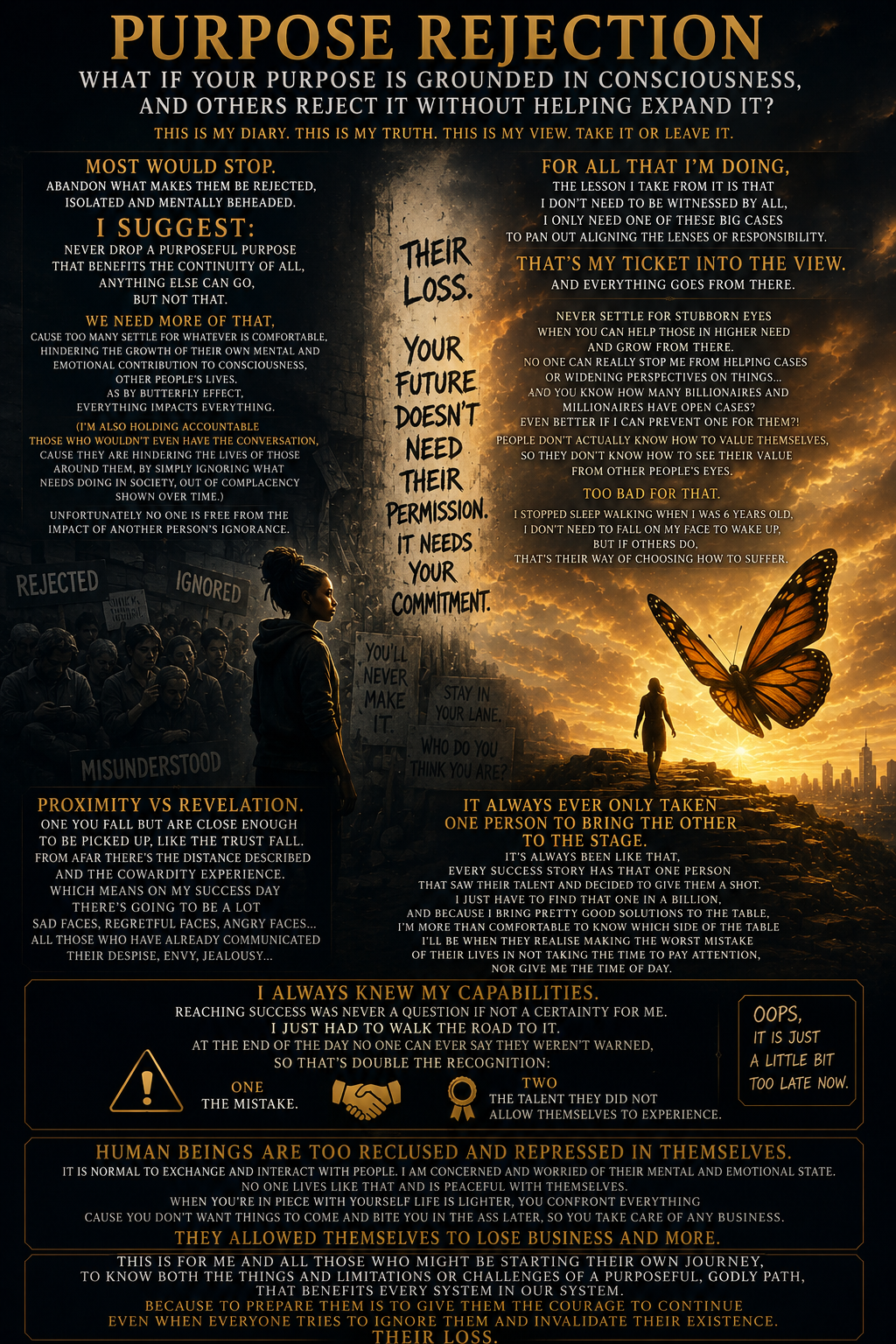
This is a diary entry.
It deserves the purity of what it means.
The perceptions, the judgments, whether right or wrong, all belong here because they are part of the view I am sharing. And objectively, considering all that I have gone through in order not to abandon this one mission, the view is quite fair.
Purpose rejection is different from ordinary rejection.
Ordinary rejection may concern a role, a relationship, an invitation, an opportunity or a version of yourself that no longer fits where you are going. Those things can hurt, but they can also be released. They are not always attached to the continuity of your existence or the wellbeing of others.
Purpose rejection is what happens when your purpose is grounded consciously, in consciousness, and people reject it without helping you expand it.
They do not question it to strengthen it.
They do not challenge it with enough care to reveal where it may be incomplete.
They do not sit with you long enough to understand what you are building.
They do not offer a better route.
They do not contribute a missing lens.
They simply reject it.
Ignore it.
Ridicule it.
Delay it.
Distance themselves from it.
Or treat your devotion to it as though the devotion itself is the problem.
That is a different wound.
Because when the purpose is not merely about personal gain, but about the continuity of all, the rejection does not feel like people are rejecting only you.
It feels like they are rejecting what could benefit everyone.
And that is what makes it confronting.
Most would stop.
Most would abandon what makes them rejected, isolated and mentally beheaded.
Most people are taught to treat social acceptance as evidence of correctness. If enough people do not understand something, they begin assuming that the thing must be wrong. If enough people refuse to witness them, they begin questioning whether there is anything worth witnessing. If enough doors remain closed, they begin shrinking themselves until they can fit beneath doors that were never built for what they carried.
I suggest never dropping a purposeful purpose that benefits the continuity of all.
Anything else can go.
But not that.
We need more of that.
We need more people capable of holding a mission beyond the immediate comfort of being liked.
Too many people settle for whatever is comfortable, and in doing so, they hinder the growth of their own mental and emotional contribution to consciousness, to other people’s lives and to the future they claim they want to see.
By butterfly effect, everything impacts everything.
No one is free from the impact of another person’s ignorance.
That may sound harsh, but it is true.
When someone refuses to address what needs doing in society, that refusal does not remain contained inside them. Their complacency travels into their relationships, their workplaces, their families, their decisions and the people who depend upon their judgment.
I am also holding accountable those who would not even have the conversation.
Because they are hindering the lives of those around them by simply ignoring what needs doing in society, out of complacency shown over time.
Silence is not always neutrality.
Avoidance is not always peace.
Refusal to engage is not always harmless.
Sometimes it is a decision to allow the existing problem to continue because confronting it would require more emotional, intellectual or moral labour than the person is willing to give.
Unfortunately, no one is free from the impact of another person’s ignorance.
That is why purpose rejection must be understood properly.
Sometimes people are not rejecting the purpose because they have seen all of it and found it unworthy.
They are rejecting it because accepting it would require them to expand.
It would require them to see something they have trained themselves not to see.
It would require responsibility.
It would require conversation.
It would require them to admit that their current life, profession, values or way of thinking may not be enough.
And many people would rather reject the messenger than enlarge the room.
The Lesson I Take From All of This
For all that I am doing, the lesson I take from it is that I do not need to be witnessed by all.
I only need one of these big cases to pan out, widening the lenses of responsibility.
That is my ticket into the view.
And everything goes from there.
I do not need every stubborn eye to open.
I do not need every person who ignored me to suddenly become capable of seeing me.
I do not need to spend the rest of my life standing in front of people committed to misunderstanding what they were never willing to examine.
Never settle for stubborn eyes when you can help those in higher need and grow from there.
There are people with larger responsibilities, larger open cases, larger risks, larger systems and larger consequences who may understand the value of widened perspective because their circumstances force them to.
No one can really stop me from helping cases or widening perspectives on things.
Do you know how many billionaires and millionaires have open cases?
Even better if I can prevent one for them.
People do not actually know how to value themselves, so they do not know how to see their value from other people’s eyes.
Too bad for that.
I stopped sleepwalking when I was six years old.
I do not need to fall on my face to wake up.
But if others do, that is their way of choosing how to suffer.
Some people only respect value once it becomes undeniable through success.
Some only recognise intelligence once it is publicly validated.
Some only understand a warning once the consequence arrives.
Some only appreciate proximity after distance becomes permanent.
That is not how I move.
I do not need the fall to understand gravity.
I do not need the loss to understand value.
I do not need public applause to understand capability.
I do not need success to tell me that success was possible.
I always knew my capabilities.
Reaching success was never a question for me, if not a certainty.
I simply had to walk the road to it.
Proximity Versus Revelation
There is a difference between proximity and revelation.
One, you fall but are close enough to be picked up, like the trust fall.
The other, you watch from afar and experience the distance you helped create.
From afar, there is the distance described and the cowardice experienced.
The people who were close enough to engage, support, question, challenge, refine, collaborate or simply speak honestly had the opportunity to participate before the outcome became public.
Those who chose distance made their own decision.
They created the distance.
And on my success day, there are going to be a lot of sad faces.
Regretful faces.
Angry faces.
Faces carrying envy, jealousy and the despise they already communicated before there was enough social proof to make admiration feel safe.
Some will be angry not because I harmed them, but because my success will confront them with what they refused to see.
Some will be sad because they will recognise that they were once close enough to participate.
Some will be regretful because they will realise that access was offered before the value became expensive.
Some will try to rewrite the past and say they always knew.
Some will minimise the achievement because acknowledging it fully would require acknowledging how wrong they were.
Some will call it luck because luck feels safer than admitting that the person they dismissed understood herself accurately.
But proximity was the opportunity.
Revelation will be the consequence.
The trust fall only works when someone is close enough and willing enough to catch.
A person cannot stand far away, refuse the responsibility of presence, and later complain that they were not part of the moment.
It Has Always Taken One Person
It has always ever only taken one person to bring the other to the stage.
It has always been like that.
Every success story has that one person who saw the talent and decided to give them a shot.
One producer.
One investor.
One employer.
One editor.
One mentor.
One judge.
One lawyer.
One client.
One person willing to look beyond the absence of recognition and see the presence of capacity.
I just have to find that one in a billion.
And because I bring pretty good solutions to the table, I am more than comfortable knowing which side of the table I will be on when they realise they made one of the worst mistakes of their lives by not taking the time to pay attention or give me the time of day.
The person who eventually sees it will not be creating my value.
They will be recognising what was already there.
That distinction matters.
People often behave as though recognition produces talent.
It does not.
Recognition reveals talent to a wider audience.
The work existed before the applause.
The mind existed before the title.
The capability existed before the institution approved it.
The mission existed before the person with access decided to open the door.
That one person matters because they become a bridge, not because they become the source.
I am still the source of what I carried.
They are the person intelligent enough, curious enough, secure enough or responsible enough to allow it to pass into a larger room.
No One Can Say They Were Not Warned
At the end of the day, no one can ever say they were not warned.
That is double the reckoning.
One: the mistake.
Two: the talent they did not allow themselves to experience.
Oops.
It is just a little bit too late now.
There is a particular kind of regret attached to recognising that the opportunity was not hidden from you.
It was presented.
It spoke.
It explained itself.
It asked for conversation.
It invited curiosity.
It gave examples.
It demonstrated pattern.
It remained present long enough for you to decide.
And you still chose not to see it.
That is different from missing something that was never available.
That is choosing not to engage with what was already in front of you.
So when the outcome becomes visible later, the regret is not only that the talent succeeded elsewhere.
The regret is that you had access before the success made the talent socially safe to acknowledge.
You had the human being before the public result.
You had the conversation before the headlines.
You had the possibility before the proof became expensive.
And you did not allow yourself to experience it.
That is your loss.
I Just Woke Up, and This Is How I Feel
I just woke up, and I am sugarcoating how I feel.
I was heartbroken to see human beings be so reclusive and repressed within themselves.
It is normal to exchange and interact with people.
It is normal to speak.
It is normal to ask questions.
It is normal to listen.
It is normal to be curious.
It is normal to confront a discomfort before that discomfort grows teeth.
I am concerned and worried about their mental and emotional state.
No one lives like that and is peaceful with themselves.
When you are at peace with yourself, life is lighter.
You confront everything because you do not want things to return and bite you in the ass later.
So you take care of any business.
You do not leave unspoken tension sitting in the room for years.
You do not avoid conversations that could protect a relationship, a business, a project or your own conscience.
You do not act as though suppression is maturity.
You do not call emotional distance professionalism.
You do not call fear discernment.
You do not call refusal peace.
You take care of what needs taking care of because you understand that neglect is still an action.
The thing you refuse to address does not disappear.
It accumulates.
It changes shape.
It enters other relationships.
It becomes resentment, regret, projection or missed opportunity.
People allowed themselves to lose business and more.
They allowed themselves to lose access.
Insight.
Relationship.
Trust.
Potential collaboration.
Future relevance.
The opportunity to say they were there before everyone else arrived.
They did not lose those things because I withheld them.
They lost them because they would not engage.
Purpose Rejection Is Not Always Evidence Against the Purpose
This is for me and for all those who may be starting their own journey.
They need to know both the things and the limitations or challenges of a purposeful, godly path that benefits every system within our system.
Because preparing them is giving them the courage to continue even when everyone tries to ignore them and invalidate their existence.
Purpose rejection can make a person believe that the purpose itself is wrong.
But rejection is not always evidence against the purpose.
Sometimes it is evidence of how far the surrounding environment must expand before it can receive the purpose.
Sometimes it means the language needs refinement.
Sometimes it means the audience is wrong.
Sometimes it means the timing has not reached the people prepared to carry it.
Sometimes it means the structure is too large to be recognised through the small doorway being offered.
Sometimes it means the mission has arrived before the social permission required for others to admit that it is necessary.
That does not mean never questioning yourself.
A purposeful path requires more self-questioning, not less.
It requires distinguishing devotion from ego.
Mission from obsession.
Continuity from control.
Purpose from the desire to be seen as purposeful.
But once the purpose has been examined, expanded, corrected and grounded in something that genuinely benefits the continuity of all, rejection alone is not enough reason to abandon it.
Never drop a purposeful purpose because people without the courage to carry it became uncomfortable in its presence.
The Purpose Must Be Able to Survive Isolation
A mission that depends entirely upon applause will die in silence.
A purpose that requires constant validation will collapse the moment people withdraw attention.
So part of the path is learning how to preserve the purpose when no one is clapping.
When people misunderstand.
When people project.
When people refuse.
When people isolate you.
When people mentally behead you by treating your mind as though it has no authority to speak beyond the credentials they recognise.
The purpose must become internally witnessed before it is externally validated.
That does not mean becoming delusional or refusing feedback.
It means knowing the difference between useful correction and empty rejection.
Useful correction gives you something to build with.
It identifies the weakness.
It expands the lens.
It offers evidence.
It asks questions.
It respects the purpose enough to improve it.
Empty rejection provides nothing.
It merely says:
Do not make me look.
Do not make me think.
Do not make me responsible.
Do not ask me to imagine more than I currently carry.
That is not guidance.
That is limitation speaking in the voice of judgment.
People Will Often Reject the Responsibility Before They Reject the Idea
A purpose grounded in consciousness is not easy for others to accept because it does not ask only for admiration.
It asks for participation.
It asks the listener to examine what they contribute.
It asks institutions to widen their responsibility.
It asks individuals to stop hiding behind habit.
It asks systems to recognise what they have normalised.
People may say they reject the idea.
But often they are rejecting what the idea would require from them.
They are rejecting the expansion.
The accountability.
The redistribution of responsibility.
The duty of care.
The conversation.
The risk of being changed.
It is easier to reject the purpose than to admit that the purpose has located a part of them that has been asleep.
Do Not Spend Your Whole Life at the Wrong Table
There comes a point where persistence must change direction.
Not abandon the purpose.
Change the audience.
Never settle for stubborn eyes when you can help those in higher need and grow from there.
Do not spend your whole life trying to convince people invested in not seeing.
Do not confuse loyalty to the mission with loyalty to one room.
The mission is larger than the people who first rejected it.
There are other tables.
Other cases.
Other industries.
Other people.
Other points of entry.
The purpose can move.
It can translate.
It can demonstrate itself in environments where consequence has already created readiness.
One big case can widen the lenses of responsibility.
One decision can create precedent.
One person can recognise the architecture.
One institution can open a pathway.
One result can force every previous rejection to confront itself.
That is enough to begin.
Their Loss Does Not Have to Become Your Delay
Their loss.
That is not bitterness.
It is consequence.
When people refuse value, the value does not disappear.
They simply lose access to it.
When someone rejects a conversation, the insight does not cease existing.
It goes elsewhere.
When a company refuses an upgrade, the upgrade may later strengthen another company.
When an institution refuses a framework, the framework may become the reason another institution survives.
When people refuse a person before their success, success does not become less possible.
It becomes less shared.
Their rejection should not become your delay forever.
At some point, you have to allow people to live with the decisions they made.
Not everyone deserves repeated access to the same opportunity after demonstrating contempt for it.
Not everyone who ignored the beginning gets to claim intimacy with the outcome.
Not everyone who refused to invest in the road gets to stand at the destination as though they walked it with you.
The Confrontation
Purpose rejection hurts because it exposes how many people prefer social comfort over collective continuity.
It reveals how quickly people abandon what they do not immediately understand.
It shows how often society waits for authority to approve what truth had already made visible.
It demonstrates that many people do not want to help build the future.
They want to arrive after it has been built.
They want proof without participation.
They want success without having taken the risk of seeing it early.
They want to applaud the butterfly after rejecting the caterpillar for moving strangely.
But the caterpillar still transforms.
The mission still moves.
The person still learns.
The work still accumulates.
The cases still exist.
The need still exists.
The larger picture remains.
And the one person capable of seeing it may still be ahead.
The Central Principle
Most would stop.
Most would abandon what makes them rejected, isolated and mentally beheaded.
I suggest never dropping a purposeful purpose that benefits the continuity of all.
Anything else can go.
But not that.
We need more of that.
Do not drop the mission simply because people without the courage to meet it rejected the responsibility attached to it.
Do not let stubborn eyes decide whether you are visible.
Do not let silence convince you that nothing is happening.
Do not confuse delayed recognition with absence of value.
Do not confuse social rejection with spiritual or systemic incorrectness.
Examine the mission.
Challenge it.
Expand it.
Correct it.
Strengthen it.
But do not abandon it merely to become easier for others to accept.
I only need one of these big cases to pan out, widening the lenses of responsibility.
That is my ticket into the view.
Everything goes from there.
It has always ever only taken one person to bring the other to the stage.
I just have to find that one in a billion.
And when that person arrives, they will not be discovering my ability.
They will be the first with enough sight, responsibility and courage to act upon what was already there.
Everyone else was warned.
One reckoning for the mistake.
Another for the talent they did not allow themselves to experience.
Oops.
It is just a little bit too late now.
This is for me and for everyone beginning a purposeful path that benefits every system within our system.
Know the challenges.
Know the isolation.
Know the rejection.
Know that people may try to invalidate your existence before they ever examine your contribution.
Know that some will only understand once consequence teaches them what conversation could have taught them earlier.
Prepare for it.
Do not worship suffering.
Do not remain where you are repeatedly dishonoured.
Do not mistake stubbornness for strength.
Move toward the people in higher need.
Widen the lenses.
Help where you can.
Let the work create the view.
And remember:
Their inability to recognise the purpose does not remove the purpose.
Their refusal to witness you does not make you invisible.
Their rejection does not end the mission.
It only determines whether they will be close enough to be part of it when it reaches the stage.



Leave a Reply