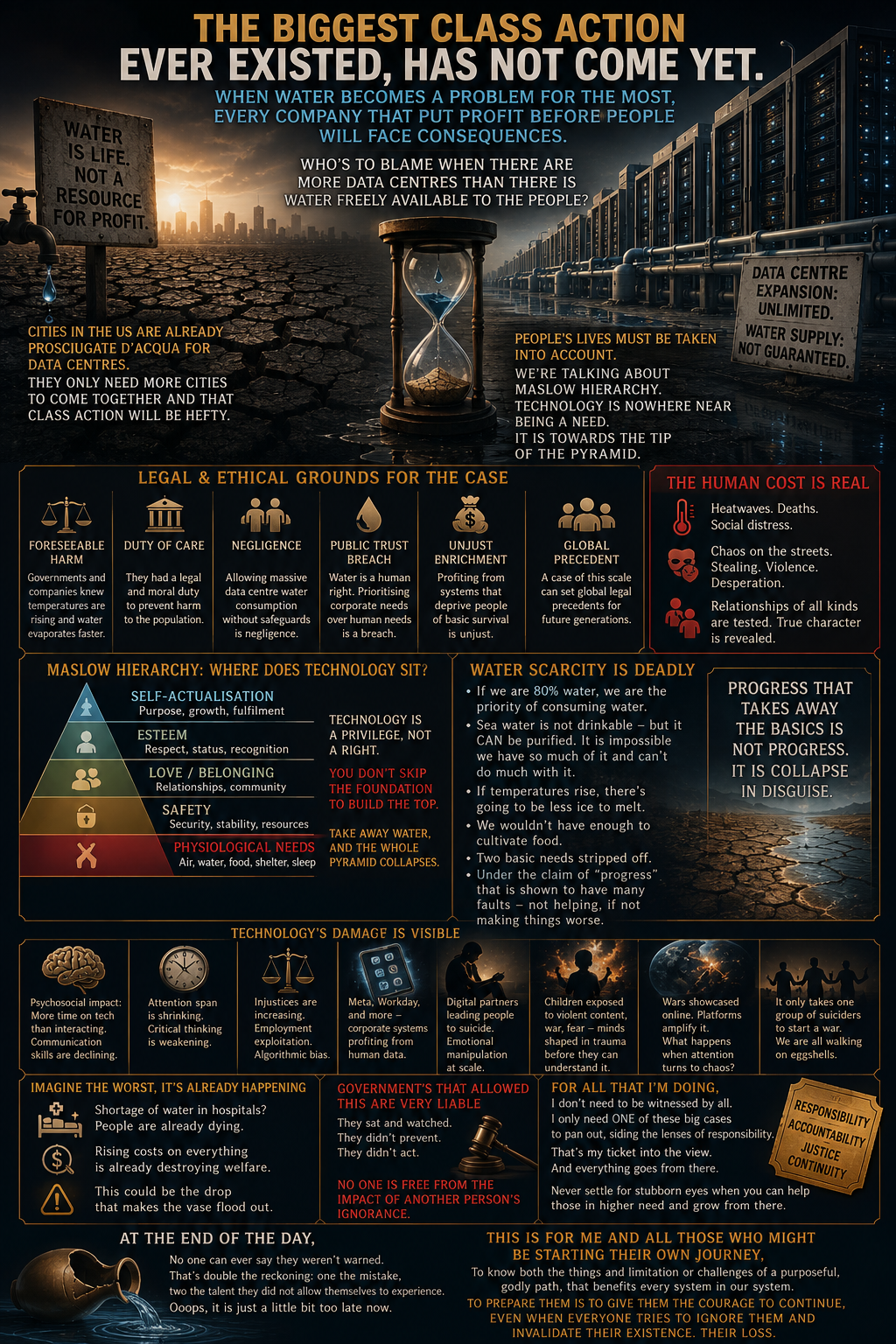
The largest class action ever brought may not have happened yet.
It may begin when the expansion of data centres collides visibly and materially with the human need for water.
Public distrust is already growing around data-centre development in the United States. Communities have challenged projects over water, electricity, land use, pollution, secrecy and the public cost of private technological expansion. San Marcos, Texas, recently barred data centres within the city through its zoning rules, expressly citing concern that the facilities could divert water and energy from the community. Residents elsewhere have pursued moratoriums, lawsuits, recall campaigns and other forms of resistance after developments were approved with limited public disclosure.
The pressure will increase considerably if water becomes materially unavailable, unaffordable or unsafe for large populations while substantial quantities continue being supplied to private data-centre operations.
At that point, the issue will no longer be framed only as environmental policy.
It will become a question of life, public duty, governmental foreseeability, corporate responsibility, infrastructure discrimination and the legal prioritisation of human survival.
The foundational question is:
Who is responsible when there are more data centres demanding water than there is water freely and safely available to the people living around them?
That question must not be answered by placing the entire consequence upon one company, one municipality, one water utility or one technological product. The architecture would include technology companies, data-centre operators, property developers, water utilities, electricity providers, planning authorities, regulators, investors, governments and every decision-maker who possessed the authority or information necessary to foresee the cumulative harm.
The water shortage may arrive at the household tap.
But the responsibility will begin much further upstream.
Water Must Be Legally Triaged Above Technology
Water is not another commercial input.
It is a foundational condition of existence.
Human beings require water directly for hydration, sanitation, medicine and temperature regulation. Water is also required to cultivate food, operate hospitals, maintain public hygiene, suppress fires, support ecosystems and sustain nearly every other infrastructure upon which organised life depends.
Technology does not occupy the same position.
Digital infrastructure may support communication, healthcare, research, trade, government and education. Some applications may become socially important. But the data centre remains a means through which services are delivered.
Water remains a condition without which the person receiving those services cannot continue living.
That distinction should control public allocation.
Where water capacity is limited, the legal order of priority should begin with:
- direct human consumption;
- hospitals, healthcare and sanitation;
- food production;
- emergency services;
- ecological continuity and minimum river or groundwater integrity;
- essential public infrastructure;
- only then, discretionary industrial and technological consumption.
This is not an argument that data centres should receive no water.
It is an argument that they should never receive priority over the human and ecological systems without which technology has nobody left to serve.
A government that does not legally distinguish a basic need from a profitable technological demand has failed at triage before the shortage even begins.
Scarcity of Water Would Remove Two Basic Needs at Once
A severe water shortage would not affect drinking water alone.
It would also affect food.
Agriculture requires water.
Food manufacturing requires water.
Livestock, irrigation, sanitation, cleaning and processing all require water.
When water becomes scarce, food production becomes more expensive, less reliable or physically impossible in the most affected areas.
That means two foundational needs could be removed at the same time:
Water.
Food.
And this could occur under the language of progress.
The promised progress would then need to be measured against what it displaced.
Did the additional computing capacity improve life sufficiently to justify the water burden?
What portion supported healthcare, public research or essential infrastructure?
What portion supported advertising, speculative products, engagement systems, synthetic content, duplicated services or commercial experimentation?
What human benefit was produced for the host community?
How many permanent jobs were created compared with the quantity of public infrastructure consumed?
How much water was used during heatwaves, drought restrictions or agricultural stress?
Who paid for pipes, treatment plants, reservoirs, power generation and grid expansion?
Who received the profit?
Who carried the shortage?
A technology cannot be called progress merely because it is new, fast or profitable.
Progress must be tested against its total effect upon life.
The Risk Is No Longer Abstract
Data centres consume water directly for cooling and indirectly through the generation of electricity. Direct consumption varies significantly according to facility design, climate, cooling technology and operating load. Water impacts are also highly local: a nationally small percentage can become a serious burden when concentrated within one town, one water system or one drought-affected basin.
A 2026 study estimated that, if 2024 water-use intensity continued, new United States data centres could collectively require between approximately 697 million and 1.45 billion gallons of additional daily water-supply capacity by 2030. The authors emphasised that this pressure would be highly concentrated in the communities hosting the facilities, particularly during the hottest periods when water and electricity systems are already strained.
Another estimate placed direct United States data-centre consumption at about 17.4 billion gallons in 2023, while reporting suggests projected annual demand could rise substantially as the AI infrastructure buildout continues.
These figures should not be treated as proof that every data centre will produce a shortage.
They are evidence that the cumulative risk is foreseeable.
And foreseeability creates responsibility before the tap runs dry.
The Case Would Begin With Foreseeability
The strongest legal argument would not wait until companies openly announce that technology should receive water before people.
The argument would begin with what the defendants knew or should reasonably have known.
They knew temperatures were rising.
They knew heatwaves increase demand for drinking water, cooling and electricity.
They knew droughts and changing precipitation patterns could reduce available supplies.
They knew data-centre workloads were expanding rapidly.
They knew AI-focused facilities could require significant power and cooling capacity.
They knew many proposed facilities were being clustered in particular regions.
They knew municipal infrastructure had finite treatment, storage and delivery limits.
They knew agriculture, hospitals and households depended on the same watersheds, aquifers and utilities.
They knew that approving one facility in isolation could conceal the combined effect of ten, twenty or fifty facilities.
The question would therefore be:
What preventive systems were put in place once the cumulative risk became reasonably foreseeable?
If the answer is insufficient assessment, incomplete disclosure, fragmented permitting and continued approvals, then the shortage would not be an unforeseeable natural disaster.
It would be a foreseeable resource conflict that institutions allowed to mature.
The Government Cannot Claim Surprise After Approving the Architecture
Governments would carry substantial responsibility.
They approve land use.
They regulate water withdrawal.
They control or supervise municipal utilities.
They issue environmental permissions.
They offer tax concessions.
They determine whether companies must disclose resource consumption.
They plan reservoirs, pipes, treatment facilities and emergency responses.
They know regional drought projections.
They know population growth.
They know how much water hospitals, agriculture and households require.
They know how many facilities are planned, even where ordinary residents do not.
If governments approve data centres individually without assessing their cumulative demand, they create an artificial separation between projects that will later draw from the same finite system.
Each approval may appear manageable alone.
Together, they may exceed capacity.
That is the same fragmented reasoning repeated across institutional failure:
One project.
One permit.
One department.
One municipality.
One reporting period.
No one examines the whole until the whole begins collapsing.
Government cannot then say that each private facility acted independently.
The state was the body capable of seeing the combined map.
If it possessed the map and did not use it, that failure belongs inside the causal chain.
Cumulative Impact Must Replace Isolated Approval
A legally coherent system should not permit each data centre to demonstrate only that its own expected water demand can be accommodated at the moment of application.
The relevant assessment must include:
- existing data-centre withdrawals;
- approved but not yet operating facilities;
- projects under consideration;
- indirect water used through electricity generation;
- predicted population growth;
- agricultural requirements;
- hospitals and emergency-service reserves;
- drought and heatwave scenarios;
- groundwater-recharge rates;
- river-flow requirements;
- wastewater-treatment capacity;
- climate projections;
- infrastructure failures;
- and the needs of neighbouring jurisdictions drawing from the same resource.
This is where the future litigation could become much larger than one conventional environmental case.
One facility may possess a permit.
One facility may remain within an assigned allocation.
But if dozens of individually authorised withdrawals collectively deprive communities of secure water, the failure sits in the architecture of approval itself.
Compliance with a fragmented permit should not excuse participation in a foreseeable cumulative collapse.
Private Profit Cannot Occupy Public Water Without Public Consent
Many data-centre developments rely upon public water systems, publicly regulated utilities, public incentives or infrastructure financed partly through residents and ratepayers.
That creates a crucial question:
At what point does a private company’s industrial use of public water require direct and informed community consent?
Residents should know before approval:
- the facility’s expected daily and peak water demand;
- whether the water will be potable, recycled or reclaimed;
- the source of the water;
- how demand changes during hot weather;
- how much water is consumed rather than returned;
- which chemicals are used in cooling or treatment;
- how wastewater will be discharged;
- which company ultimately controls the project;
- what incentives it receives;
- what infrastructure the public must finance;
- and what happens during drought or emergency restrictions.
The community should not discover these facts after construction.
Nor should companies or local authorities hide behind non-disclosure agreements where a project may materially affect public resources. Reports of secretive approvals and concealed corporate identities have already contributed to public anger and recall movements in several American communities.
Commercial confidentiality cannot outweigh a community’s right to understand who may be drawing from its water.
The Company Cannot Own the Computing Capacity and Outsource the Water Consequence
Technology companies may say they do not directly operate every facility.
Data-centre operators may say they provide infrastructure for customers.
Developers may say they only construct the property.
Water utilities may say they merely fulfil approved service agreements.
Local governments may say the development complied with zoning.
State authorities may say water allocation is locally controlled.
Investors may say they expected lawful development.
Each actor can narrow its role.
The public still loses water.
That is responsibility fragmented until no one appears to own the outcome.
But the responsibility can be reconstructed.
Technology companies should answer for the computing demand they created, contracted for and monetised.
Data-centre operators should answer for cooling design, consumption, disclosure, siting decisions and operating behaviour during scarcity.
Developers should answer for project representations, environmental studies and infrastructure commitments.
Water utilities should answer for capacity modelling, preferential contracts, drought planning and whether residential users were exposed to costs or restrictions.
Local authorities should answer for zoning, public consultation, incentives and approval conditions.
State and federal governments should answer for cumulative planning, water law, environmental standards and national infrastructure policy.
Investors and boards should answer for whether growth targets were pursued without adequate scrutiny of water availability and community impact.
Electricity providers should answer for indirect water demand and whether data-centre load required more water-intensive generation.
Distributed responsibility does not mean equal responsibility.
It means nobody disappears merely because the final shortage passed through many institutions.
A National Case Would Need to Preserve Local Differences Without Losing the Common Architecture
Water rights, utility law, negligence standards and constitutional protections differ across United States jurisdictions. A future legal action could therefore involve state subclasses, consolidated proceedings, multidistrict litigation or coordinated claims rather than one undifferentiated national cause of action.
But the common issues could remain substantial:
- whether water demand was concealed or understated;
- whether cumulative impacts were ignored;
- whether governments and companies possessed forecasts showing a credible scarcity risk;
- whether public infrastructure was used to support private expansion without informed consent;
- whether residents faced restrictions, higher bills or physical shortages;
- whether host communities were disproportionately burdened;
- whether companies made misleading sustainability claims;
- whether alternatives such as recycled water or low-water cooling were reasonably available;
- and whether human needs were formally prioritised during drought conditions.
The legal architecture could combine different causes of action while preserving one central allegation:
Defendants participated in constructing, approving or operating a resource-intensive technological system despite knowing, or having sufficient reason to know, that its cumulative water requirements threatened the health, safety and essential needs of host communities.
Possible Legal Foundations
The exact claims would depend upon the jurisdiction and evidence, but the larger case could draw from several legal foundations.
Negligence and Foreseeable Harm
The duty would be framed around reasonable planning, disclosure and prevention where defendants knew that water demand could materially affect residents.
The breach would not be the mere existence of a data centre.
It would be approving, designing or operating facilities without adequate safeguards despite foreseeable scarcity.
Public Nuisance or Private Nuisance
Where industrial withdrawals materially interfere with public health, community water use or the use and enjoyment of property, nuisance principles may become relevant, subject to each state’s law and statutory limitations.
Water Rights and Public-Trust Principles
Some jurisdictions recognise doctrines requiring governments to manage certain natural resources for public benefit. The specific legal reach varies, but the foundational argument would be that essential water cannot be allocated in a manner that subordinates public survival to private technological consumption.
Environmental Review Violations
Projects may be challenged where environmental assessments fail to consider cumulative impact, climate conditions, alternatives, indirect consumption or environmental-justice consequences.
Data-centre projects are already facing environmental litigation concerning water, energy and pollution.
Equal Protection, Civil-Rights and Environmental-Justice Claims
Where burdens fall disproportionately upon poorer, rural, racialised, Indigenous or historically underinvested communities, plaintiffs may examine whether approvals or resource allocation produced unlawful discrimination or violated applicable civil-rights protections.
Consumer and Utility Claims
Residents may have claims where utility rates rise, infrastructure costs are shifted to households or official statements concealed the true effect of serving industrial loads.
Misrepresentation and Greenwashing
If companies publicly claim water positivity, sustainability or community benefit while omitting material local impacts, those representations may become relevant to consumer, investor or public-law claims.
Failure to Warn and Failure to Disclose
Where governments, utilities or companies possess information showing a credible shortage risk but fail to inform affected residents, that silence could form part of the liability theory.
Constitutional or Statutory Rights to Water, Health or a Safe Environment
Some state constitutions and statutes contain environmental or public-health protections that may offer additional routes depending upon location.
The legal claim should not be forced into one category where the harm crosses several.
Water scarcity is simultaneously environmental, infrastructural, medical, agricultural, economic and social.
The litigation should reflect the reality it seeks to address.
The Injury Would Extend Beyond the Price of Water
Damages should not be confined to increased water bills.
A serious shortage could create:
- dehydration and heat-related illness;
- preventable deaths;
- hospital disruption;
- reduced sanitation;
- contaminated or lower-quality supplies;
- crop loss;
- food-price increases;
- business interruption;
- school closures;
- property-value losses;
- household relocation;
- firefighting constraints;
- mental distress;
- community conflict;
- increased policing and emergency expenditure;
- and long-term ecological damage.
A hospital shortage would make the hierarchy unmistakable.
Technology may process medical information.
But the hospital cannot clean, sterilise, hydrate patients, operate sanitation systems or deliver safe care without water.
No data-centre workload should receive priority over a hospital’s ability to preserve life.
If it does, the allocation system has reversed the very purpose technology is frequently said to serve.
Social Breakdown Is a Foreseeable Secondary Harm
Water scarcity does not remain a technical utility problem.
It enters human behaviour.
During severe shortages, people may experience fear, desperation and competition over essential supplies. Theft, conflict, hoarding, price exploitation and civil unrest become more likely when people believe survival resources are being withheld or unfairly distributed.
Relationships are tested.
Trust in government collapses.
Trust between neighbours weakens.
People who ordinarily follow social rules may act differently when children, elderly relatives or medically vulnerable family members need water.
Those reactions should not be dismissed as unforeseeable misconduct by individuals.
They are foreseeable secondary consequences of institutional failure to protect a basic need.
The companies and governments may not be legally responsible for every independent act committed during unrest. But the wider social consequences belong in the assessment of foreseeability, public interest and remedy.
The law regularly considers downstream risks when evaluating hazardous conduct.
It should do the same when essential resources are knowingly placed under stress.
Technology’s Existing Social Costs Belong in the Proportionality Analysis
The case would also require an honest assessment of what society is receiving in exchange for the resource burden.
Technology has produced real benefits.
But the technological system has also contributed to recognised harms:
- reduced attention;
- compulsive engagement;
- social isolation;
- algorithmic discrimination;
- opaque employment screening;
- misinformation;
- children’s exposure to harmful material;
- surveillance;
- digital harassment;
- synthetic intimacy;
- and systems in which responsibility is outsourced to software.
The Workday litigation concerns automated influence over employment.
The Meta litigation concerns platform design and its effects upon users.
Other cases involve algorithmic pricing, data exploitation, wrongful automated decisions and digital systems that mediate vulnerable people’s lives.
These harms do not prove that every data centre lacks value.
They do challenge the assumption that increased computing capacity is automatically a public good deserving priority over water.
When a technology already produces mixed and sometimes damaging consequences, the government must not treat expansion as self-justifying.
The question becomes:
How much foundational life-supporting resource should society surrender to accelerate systems whose social value has not been comprehensively assessed?
Humanity Must Not Become the Resource Sacrificed to Maintain Its Tools
A tool should serve the person.
The person should not be deprived of water to sustain the tool.
This sounds obvious, but the current architecture can reverse it through professional language.
Industrial demand.
Digital transformation.
National competitiveness.
AI leadership.
Economic growth.
Cloud capacity.
Strategic infrastructure.
Each phrase creates distance from the physical reality.
Pipes carry water away from a watershed.
Cooling systems consume it.
Power stations use more.
Residents receive restrictions.
Farmers lose capacity.
Hospitals prepare emergency plans.
The technological system continues operating.
A civilisation has become disordered when the tool is protected from interruption while the human body is expected to adapt to scarcity.
The Human Body Establishes the Priority
The commonly repeated statement that the human body is “80% water” is not accurate as a universal figure; adult bodies are often described as containing roughly 50–60% water, varying with age, sex and body composition.
But the numerical correction strengthens rather than weakens the argument.
Human life is physiologically dependent upon water.
The legal priority does not arise because one particular percentage sounds dramatic.
It arises because water is inseparable from circulation, temperature control, cellular function, digestion, cognition and survival.
A data centre may operate with alternative cooling designs.
A human body cannot replace water with technological efficiency.
That biological non-substitutability should carry legal weight.
The Ocean Is Not an Excuse Unless Desalination Infrastructure Exists
The existence of oceans does not eliminate freshwater scarcity.
Seawater can be desalinated.
But desalination requires energy, infrastructure, treatment, distribution and management of concentrated brine and other environmental effects.
Therefore, a government cannot answer public concern merely by pointing to the quantity of water on Earth.
It must show functioning capacity.
How much desalinated water can be produced?
At what cost?
Using which energy source?
How quickly can plants be built?
How will the water reach inland communities?
What environmental consequences follow?
Who pays?
What emergency capacity exists now rather than after the shortage?
If governments approve large-scale water-consuming infrastructure without simultaneously investing in recycling, desalination, stormwater capture, wastewater reuse, leak reduction, aquifer restoration and storage, they cannot later defend themselves by saying alternative water theoretically existed.
Potential capacity is not the same as available protection.
The cushion must be built before the fall.
Climate Change Must Be Included in Every Capacity Calculation
Rising temperatures do not simply mean that all water disappears through evaporation in one uniform way, but climate change can intensify drought, alter rainfall, reduce snowpack, shift the timing of meltwater, increase heat-related demand and place additional stress upon rivers, reservoirs and groundwater systems.
Those effects are not speculative additions to planning.
They are part of the operating environment in which long-lived infrastructure is being approved.
A data centre may function for decades.
Its water assessment should therefore include decades of plausible climate conditions, not only the historical average available when the permit was issued.
A permit based on yesterday’s climate may be inadequate for tomorrow’s population.
The First Legal Duty Should Be Prevention
The case should not wait for mass death.
Government needs both a prevention function and a feedback function.
The prevention function would examine every major data-centre cluster before approval:
- total water and electricity demand;
- peak summer use;
- drought scenarios;
- hospital and emergency reserves;
- food-production needs;
- environmental justice;
- climate projections;
- technological alternatives;
- and cumulative regional development.
The feedback function would continuously collect:
- household pressure complaints;
- well failures;
- rising utility costs;
- agricultural impacts;
- changes in water quality;
- ecological decline;
- hospital concerns;
- public-health data;
- and discrepancies between predicted and actual consumption.
One resident reporting a dry well should not be dismissed because thousands still have water.
It should become an early-warning data point.
One hospital warning of reduced capacity should not wait for an emergency.
One community restriction imposed while a data centre continues consuming large quantities should trigger immediate review.
The first flag is the cheapest point of prevention.
The Strongest Additional Principle: Water-Capacity Neutrality
A particularly useful remedy is a water-capacity-neutral requirement.
Before receiving permission, a facility should demonstrate that it will not reduce the host community’s secure capacity to meet human, medical, agricultural and ecological needs.
That could require the operator to:
- finance new water capacity;
- repair municipal leakage;
- use reclaimed or non-potable water;
- restore aquifers or watersheds;
- fund recycling infrastructure;
- adopt low-water or zero-water cooling where feasible;
- reduce consumption during scarcity;
- and return measurable capacity equal to or greater than what it consumes.
Researchers have proposed a related “Water Capacity Neutral” or “Pipe Neutral” approach so that host communities retain limited public-system capacity despite data-centre expansion.
This is more coherent than allowing a company to purchase water simply because it can afford the price.
Ability to pay should not establish priority over ability to live.
Low-Water Alternatives Make Inaction Harder to Defend
Some cooling technologies can substantially reduce direct water consumption, although trade-offs may include higher costs or electricity demand.
The existence of alternatives matters legally.
Where companies choose cheaper water-intensive designs despite operating in stressed regions, the question becomes whether they selected private savings over public resilience.
Where authorities approve those designs without requiring available alternatives, the failure becomes shared.
Recent analysis argues that near-zero direct-water cooling is technically possible for some facilities, although deployment and trade-offs must be evaluated according to location and system design.
A defendant’s claim that the water use was necessary should therefore be tested against what was technologically and economically available at the relevant time.
Necessary for operation is not the same as necessary for profit at the preferred margin.
The Remedy Should Arrive Before the Catastrophe
The requested outcomes could include:
- a moratorium on new facilities in water-stressed regions pending cumulative assessment;
- legally enforceable priority for human, hospital, sanitation, food and emergency uses;
- public disclosure of daily, annual and peak water consumption;
- disclosure of indirect water consumption associated with electricity;
- drought-triggered reduction or suspension obligations;
- prohibition on using potable water where suitable reclaimed water is available;
- independent audits;
- water-capacity-neutral operating requirements;
- community consent and consultation;
- public access to supply contracts;
- environmental-justice assessments;
- infrastructure bonds covering future public costs;
- compensation for increased bills, lost wells, agricultural damage and health impacts;
- restoration of damaged aquifers, rivers and ecosystems;
- and personal liability where officials or executives knowingly concealed material risks.
The remedy should not be limited to paying people after the water is gone.
Money cannot fully compensate dehydration, ecological collapse, preventable death or the destruction of a community’s long-term water security.
The central remedy must be prevention.
The Class Must Include the People Who Did Not Purchase the Technology
Unlike a consumer case, this harm would not be limited to people who knowingly used an AI product or contracted with a data-centre operator.
A child drinking from a municipal supply did not consent to the project.
A farmer drawing from the same aquifer did not purchase the service.
A hospital patient did not agree that computing demand should compete with clinical sanitation.
A resident whose electricity or water bill increased did not necessarily receive any corresponding benefit.
That makes the architecture especially significant.
The people carrying the most severe consequences may have no contractual relationship with the companies responsible.
The absence of contract should not become the absence of protection.
The Drop That Makes the Vase Overflow
People are already absorbing rising housing costs, food prices, energy bills, healthcare delays, environmental instability and weakening public services.
A widespread water crisis connected to data-centre expansion could become the drop that makes the vase overflow.
Not because water is merely one additional inconvenience.
Because it reveals the total hierarchy.
People may accept technological expansion while believing their foundational needs remain protected.
The moment they discover that the state allowed private computing infrastructure to compete with their ability to drink, wash, eat, receive healthcare or survive heat, the entire public story of progress may collapse.
Distrust will not be irrational.
It will be the accumulated recognition that institutions knew enough to prevent the conflict and chose expansion first.
The Proposed Legal Statement
The claim can be expressed more formally as follows:
Public authorities, utilities, data-centre operators, technology companies and associated decision-makers owe a heightened duty of care where their combined conduct materially affects access to water, a resource indispensable to life, health, sanitation, food production and public safety. Where those actors knew or reasonably should have known that cumulative data-centre demand, climate stress and finite infrastructure created a substantial risk of community water insecurity, their failure to assess, disclose, prevent, mitigate or equitably allocate that risk constitutes a systemic breach of public and private responsibility.
And:
No permit, contract or commercial expectation should authorise the subordination of essential human water needs to discretionary technological consumption. Where water scarcity occurs after authorities and operators approved expansion without adequate cumulative assessment, the resulting harm should be allocated according to each actor’s knowledge, authority, benefit, control and opportunity to prevent it.
The Central Principles
Water is not an input competing equally with technology. It is the life-supporting condition that gives technology somebody to serve.
The ability of a corporation to pay for water does not establish a superior right to consume it.
A nationally small water percentage can become a locally catastrophic withdrawal.
Every data-centre approval must be judged cumulatively, climatically and according to peak demand—not only through annual averages.
If governments knew that temperatures, drought risks and computing demand were rising, failure to build protective capacity is not absence of knowledge. It is absence of prevention.
The public must not become the involuntary experiment through which companies discover how much water digital expansion consumes.
Where two basic needs—water and food—are placed at risk to accelerate a technology with mixed social consequences, the burden of justification must rest upon those seeking the resource, not upon the people trying to survive.
The largest class action may begin when enough communities realise that their apparently local water conflicts are different expressions of the same national architecture.
One city sees a data centre.
Another sees a dry well.
Another sees a higher bill.
Another sees an agricultural restriction.
Another sees a hospital warning.
Another sees a secret utility agreement.
Another sees public money financing pipes for a private facility.
The legal movement begins when those communities stop treating their experiences as isolated.
Because the numbers will not create the truth.
They will reveal how many people were already carrying it.
…
The biggest class action ever existed, has not come yet. All these data centre will raise public distrust and fear, cause the moment water begins to be a problem for the most in the western world that’s when all these companies could face huge problems.
We have some genius points to add to this that coukd be expanded foe an actual court case, so i want you to analise what im saying, suggest any additions to it and get the language closer to legal, whilst still preserving my perspectives. What can’t be translated leave as it is, do not reject it.
One of the questions is who’s to blame when theres more data cdntre than theres water freely available to the people? There’s already cities in the us prosciugate d’acqua for data centres, they only need more cities to come together and that class action will be hefty, cause one must take into account, people’s livds, we’tr talking abojt maslow hierarchy, and technology is no where near being a need it is more towatds the tip of the pyramid, governemnts that sat and allowed it to happen are very liable because they wouldnt have shown nor prevented any foreseeable harm, knowing tenperatures are rising meaning water evaporstes quicker thsse days, if on top of that we channell it all into data centres, there really won’t be much left behind for tbe people and scarcitt of wster is deadly, just ask third wolrd countries. People will have a chance to bring any case and argimanetation bevause of hiw important water is to our existence, if we are 80% watwr we are the priorirty of consuming water and if theres not enough plans, or process that work fast enough to clean water of like seas of lakes rivers that aren’t drinkeable, then they wom’t even have a cushiom to “at least I tried by putting in place thing to clear the infinite water we do have available. Not because sea water is undrinkeable it canno be purified to be drinkeable. It is impossible we have so much of it and can’t do much with it. If temperatures rise there’s going to be less ice to melt for us to have waters ckming down mountain hills.
The social distress, the amount of deaths especially during heatwaves, the chaos on the street, the stealing as people in desperation don’t mind harming others, thats where relatiknships od all kinds are truly tested and people’s colours come ojt. Lets hooe we don’t have to get to those moments to expwrience some authetic truths of character.
We wouldn’t have enough to cultivate food, and rhats two basic needs now stripped off, under the claim of progress where the progress claimed is shown to have many faulties that aren’t really helping if not making things worse… from a psychosociklogical perspective people spend more time on technology than interracting, it has already hurt our abilities to commynicate and interact with each other, many lose touch with reality from it, it has increasevily lower people attnetion span and critical thinking.. it has lead a lot of injustices, as just a couple hours ago discussed cases like workday, meta, and theres more like digital partners that lead their girl/boyfriends to suicide, teenagers exposude to contents of all kinds, even wars it messes the mind of growing children to have that fear at tbe back of their head, we sre all walking on eggshells not knowing if all these wars were to ever start attacking their supporters or big global parts, I mean Isrealis seemed to enjoy showing off online, the plstforms they used allowed it, and what happens when they want attention but they don’t get it and the only tools they thjnk of is bombing tonpossibly start wwiii where they’ve lost any reason to live as theres so much going on, it only takes one group suiciders to start a war. There’s so many thjngs that one ciuld use as points for this case, if there’s a cap on how many points one could use, the numbers might mame the difference, as kore lawyers on it will have more cases to speka on it and take jt from all direcfions. Imagine there’s a shortage of wster in an hospital? And i don’t even have to look that far, people are already dying because of all tbe things i highlighted. Rising costs on everything is already affecting the wellfare of people, this could possibly ve the drop that makes the vase flood out


Leave a Reply