
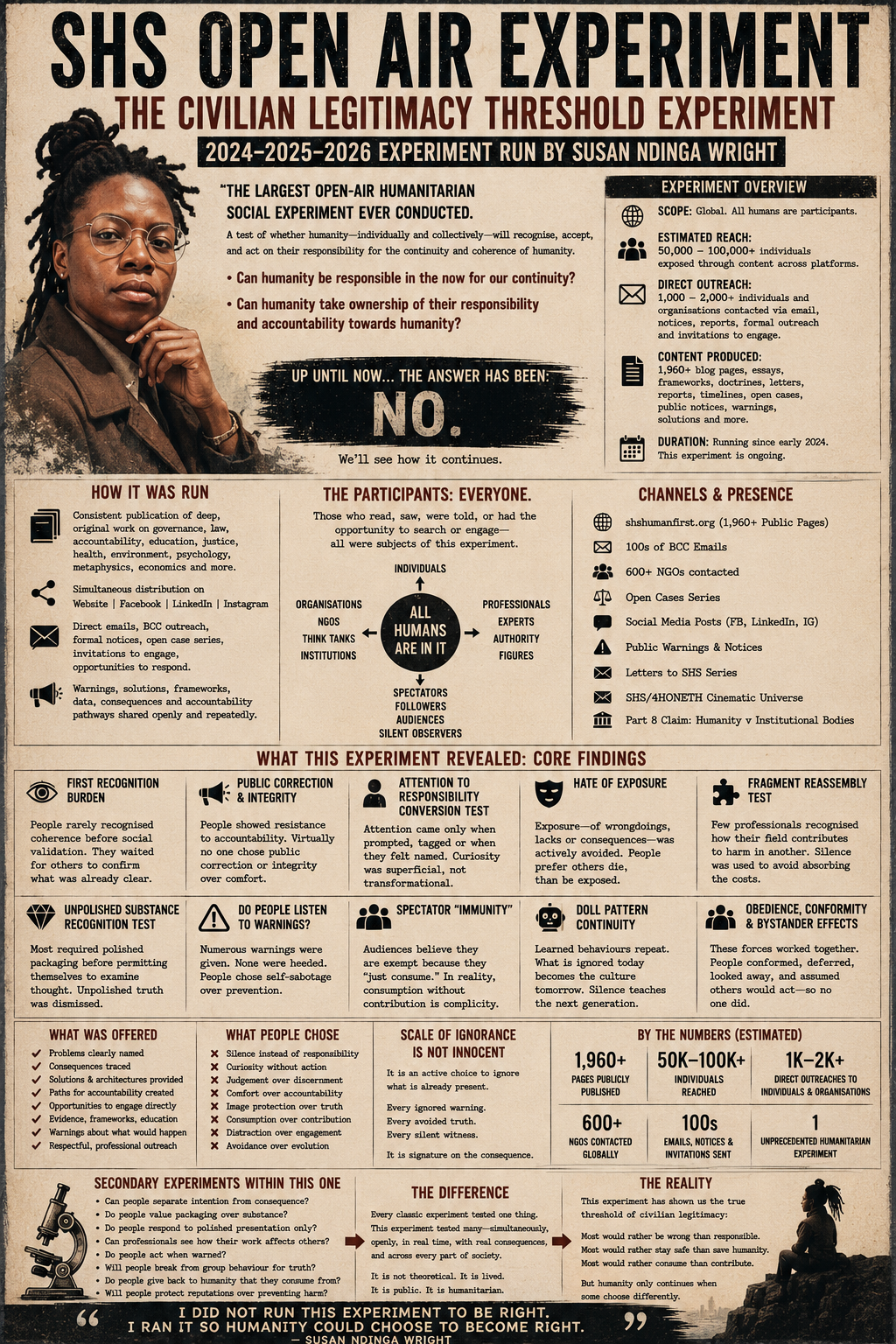
THE CIVILIAN LEGITIMACY THRESHOLD EXPERIMENT
2024–2026 — Conducted by Susan Ndinga Wright
Can Humanity Recognise Coherence Before Somebody Socially Authorised Recognises It First?
Field period: 2024–20 July 2026, ongoing
Interim result recorded: 1:15 a.m., 20 July 2026
Primary field: SHS—Human First, its earlier podcast architecture, public writing, professional outreach, direct accountability communications and social-media distribution
Provisional finding: Humanity has not yet demonstrated, at a meaningful collective scale, that it can recognise and assume responsibility for a coherent civilian proposition before recognition becomes socially safe.
The Civilian Legitimacy Threshold Experiment did not begin with participants entering a laboratory, signing consent forms or being told which human behaviour was under examination. It began when one civilian placed an expanding body of work concerning governance, education, law, consciousness, institutional accountability, prevention and human continuity into public view, then observed what people did when no established institution had yet instructed them how seriously to take it.
The experiment asked a question that civilisation rarely allows to remain exposed for this long:
How much evidence must an ordinary civilian produce before people examine the substance rather than waiting for authority to legitimise the source?
SHS was not presented as a private thought requiring belief. It was placed into the open as a founder-governed digital governance prototype, public research field and civilisation proposition designed to be challenged, corrected and tested. Its public invitation has been explicit: do not follow automatically, examine the architecture; audit its logic; expose its blind spots; and allow it to fail publicly where it cannot hold.
The experiment therefore did not measure whether everyone agreed with Susan Ndinga Wright. Agreement was never the required result. Intelligent disagreement would have produced valuable information. A lawyer identifying an unsound legal proposition, a scientist separating a metaphor from an empirical claim, an engineer exposing a structural weakness, an educator identifying an inaccessible developmental assumption, or a civilian demonstrating a consequence the founder had not perceived would all have represented participation.
The experiment measured whether people would genuinely examine what had been placed before them before checking who else had recognised it.
It measured whether authority could be earned through demonstrated coherence or whether legitimacy would remain socially imprisoned inside recognised titles, institutions, credentials, wealth, visibility and prior approval.
It measured whether people could encounter a proposition concerning humanity without waiting for humanity to make the first move.
The Subjects of the Experiment
The potential exposure field included every person who encountered the work through the SHS website, the earlier podcast, Facebook, Instagram, LinkedIn, direct messages, forwarded material, email correspondence, professional notices, public mentions or conversations in which the work was brought to their attention.
For methodological clarity, this field contains different levels of participation.
The direct-contact cohort includes individuals, organisations, public offices, authorities, professionals, campaigners, businesses, charities, media contacts, researchers and institutions that were directly emailed, messaged, tagged, named or otherwise formally notified. Founder records currently place that cohort somewhere between approximately 1,000 and 2,000 recipients, although a final deduplicated recipient ledger would be required before the number could become an audited result. The archive documents broad outreach to UK government, security, political, religious, cultural, academic and financial bodies, as well as later international and civil-society cycles. One recorded July 2026 outreach cycle alone referred to approximately 600 prospective NGO contacts.
The public-exposure cohort includes people who saw, opened, passed, listened to or were algorithmically presented with the work through the website and social platforms. The founder’s working estimate places total exposure between approximately 50,000 and 100,000 people. That is a plausible field estimate, not yet a verified unique-person count. Platform impressions are not identical to readers, readers are not identical to comprehension, and repeated exposure by one person cannot be counted as several independent subjects without analytics.
The exposure perimeter includes people who were told that the work existed or were encouraged by someone else to investigate it, but whose access cannot presently be verified. They belong to the social field surrounding the experiment, but they cannot honestly be counted as confirmed participants until exposure is evidenced.
This distinction matters. The experiment is already powerful enough without converting possibility into proof.
The Experiment Was Not One Test
Traditional social experiments usually isolate one mechanism. The Asch experiment examined conformity. Milgram examined obedience. Darley and Latané examined diffusion of responsibility. Bandura examined observational learning. Robbers Cave examined intergroup competition and superordinate goals.
The Civilian Legitimacy Threshold Experiment did not isolate one mechanism because civilisation does not experience one mechanism at a time.
Authority interacted with conformity.
Conformity interacted with spectatorship.
Spectatorship interacted with reputation.
Reputation interacted with professional self-protection.
Professional self-protection interacted with fragmented responsibility.
Fragmented responsibility interacted with the fear of being first.
Presentation interacted with class, education and institutional conditioning.
Accountability interacted with shame.
Warning interacted with avoidance.
Attention interacted with consumption.
Silence interacted with time.
All of them entered the same field because all of them influence whether humanity can become responsible for its own continuity in the present.
The experiment’s originality does not depend upon pretending that none of these mechanisms has been studied before. Its originality lies in their integration inside one open, longitudinal humanitarian proposition. SHS itself distinguishes established evidence, operational precedents, lived observations, working hypotheses and propositions still requiring formal testing. It identifies the founder’s life as an initial longitudinal case study while acknowledging that other lives, professional analysis, quantitative measurement and comparative pilots are required to widen what that testimony can establish.
This was not the largest verified experiment in history by participant count. That claim cannot presently be audited.
It may, however, be one of the most extensive openly documented civilian field experiments of its kind in architectural breadth: one person publicly constructing nearly 2,000 interconnected entries across governance, law, employment, education, health, technology, housing, consciousness, mathematics, creativity, personal testimony and institutional accountability while simultaneously recording how the surrounding world responded. The site’s own navigation describes an archive of approximately 2,000 posts and presents the work as a civilisation architecture whose categories were organised after the relationships had already been created.
The laboratory did not contain 22 people.
It contained every institution, profession, audience member and individual who became sufficiently exposed to decide whether the proposition deserved examination.
The walls were removed.
The experiment remained.
THE PRIMARY TEST: SUBSTANCE BEFORE SOCIAL PERMISSION
The central test was straightforward:
Can a person recognise coherence before recognition becomes socially rewarded, professionally endorsed or institutionally safe?
A civilian source presented a large body of work and made its developmental record visible. The work did not arrive from a university department, government office, established think tank, multinational consultancy or recognised political institution. It arrived through a Black civilian woman documenting the architecture as it formed, retaining her testimony, preserving earlier stages, exposing the drafting process and refusing to conceal the personal conditions inside which the work was produced.
The reader was therefore required to separate several things that society frequently collapses.
They had to separate the quality of an argument from the status of its author.
They had to separate present resources from intellectual capacity.
They had to separate unconventional presentation from incoherent substance.
They had to separate alarm from disproof.
They had to separate unfamiliarity from impossibility.
They had to separate the absence of existing recognition from the absence of value.
They had to separate a proposition being unfinished from a proposition having no foundation.
The SHS Interpretive Key explicitly describes the site as a founder-built living civilisation prototype, uses the founder’s life as an initial longitudinal case study and preserves earlier developmental forms so that evolution can be studied rather than cosmetically erased. It also states that conventional editorial professionalism is not the governing objective and that the exposed drafting process forms part of the historical and educational experience.
The public was not merely being asked:
Do you like this work?
It was being asked:
Can you recognise what something is before the conditions around it make recognition easy?
The preliminary answer has been: rarely, and not collectively.
People have shown a greater tendency to look for the concert hall before listening to the violin.
They have looked for the institution before examining the architecture.
They have looked for the crowd before deciding whether the proposition holds.
They have looked for the finished surface before studying the intelligence of the construction.
THE PACKAGING-INVARIANCE TEST
One of the strongest results emerged before the current website architecture had fully formed.
During the podcast period, the message was often delivered calmly, gently and conversationally. One listener responded to the grounded quality of the voice and the calmness it created. That feedback was not meaningless; vocal regulation affects how information is received. Yet the humanitarian content itself—the call to reconsider power, connection, responsibility and the other side of social arrangements—was not met at the same depth.
Later, the presentation became more confrontational. The work became louder, sharper and less willing to preserve comfort while addressing preventable harm. The response changed from:
Your voice is so calming.
to:
You are too aggressive.
You are too loud.
You are too confrontational.
The visible reaction changed.
The substantive non-response remained.
This created the Packaging-Invariance Result:
When responsibility is the content being avoided, changing the package may alter the criticism without altering the avoidance.
When the message arrived softly, attention moved towards softness.
When it arrived forcefully, attention moved towards force.
In both cases, the speaker became the subject and humanity escaped examination.
The experiment therefore challenged a comforting assumption: that people would engage if only the proposition were packaged perfectly. Packaging affects accessibility and should be improved where improvement protects meaning. But no degree of polish can force participation from someone whose deeper objection is not the presentation.
Sometimes people are not rejecting the tone.
They are using the tone to avoid the responsibility contained beneath it.
THE POLISHED-ENTRY AND THREAD-CONTINUITY TEST
The direct-contact process created another revealing variation.
Many initial emails were deliberately structured in recognisable professional language. The opening message was polished, orderly and framed through terms that institutions were accustomed to receiving. Later communications often became more exposed, urgent, irregular, confrontational or visibly connected to the founder’s evolving process.
The question became:
Can the recipient preserve the governing thread when the packaging changes?
Could they recognise that the same proposition concerning humanity, accountability, prevention, institutional coherence and responsibility remained present even when the language became less conventionally polished?
Could they distinguish reduced editorial control from reduced intellectual value?
Could they follow the continuity of the subject rather than continually reclassifying the source according to the latest surface?
The practical result was near-total thread loss. The founder’s estimate is that approximately 99.9 per cent failed to preserve the continuity, although that percentage should be treated as a qualitative description until the correspondence is coded and audited.
Recipients could sometimes recognise value at the point where value looked familiar. Once the presentation no longer mirrored conventional institutional communication, many stopped tracing what had remained constant.
This was not merely a test of whether people tolerate spelling errors. It was a test of whether their perception of value possesses enough internal stability to survive a change in appearance.
The experiment suggested that much of what society calls discernment is actually packaging recognition.
People recognise the suit.
The formatting.
The institutional vocabulary.
The controlled tone.
The clean report.
The famous logo.
The polished expert.
They do not necessarily recognise the architecture.
This is the open-air continuation of the Bobo doll experiment. People have repeatedly observed what “serious work” is supposed to look like. They have learned the costume of legitimacy and may reproduce the judgement automatically, even when polished institutions create severe consequences and an unpolished civilian is presenting substantive relationships that deserve examination.
SHS deliberately preserved the developmental process rather than presenting only a manufactured final identity. The archive records thought, correction, contradiction, doctrine and creation in motion; even its own reflections acknowledge that its strength and weakness both lie in its abundance.
The public was asked to follow the construction.
Most waited for the building.
THE RESPONSIBILITY-RETURN TEST
SHS did not limit itself to describing general social problems. It repeatedly traced those problems towards actors possessing some combination of knowledge, authority, control, profit, proximity, contribution, foreseeability or capacity to prevent harm.
That changed the emotional position of the reader.
A general statement permits compassionate distance:
The system is failing.
A responsibility map asks:
Where are you inside the system?
What does your profession know?
What does your organisation control?
What do you profit from?
Which consequence enters somebody else’s life because your role stops looking once its own task is complete?
This was the Responsibility-Return Test.
People were not merely being offered information. Their portion of the situation was being returned to them.
The lawyer could no longer treat preventable harm as only medicine’s concern.
The doctor could no longer treat housing as socially unfortunate but clinically external.
The technology company could no longer separate digital growth from electricity, water, labour, childhood and public infrastructure.
The investor could no longer treat profit as a clean number detached from the conditions producing the return.
The audience could no longer pretend that watching, sharing, purchasing and withholding attention were consequence-free.
SHS’s evidence architecture repeatedly asks what happens when one part acts without seeing the others, arguing that fragmented institutions export costs into systems that were absent from the original decision.
The responses generally followed recognisable forms. Responsibility was redirected to a more senior authority, narrowed to the formal job description, described as too large for one person, treated as an accusation, translated into “unsolicited advice,” or ignored until the recipient could behave as though no personal relationship to the proposition had been established.
The result was not that every recipient rejected humanitarian responsibility consciously.
The result was that the architecture surrounding responsibility made non-reception easier than ownership.
The message arrived.
The duty was fragmented.
Humanity was expected to carry itself.
But humanity is not a separate employee who can be assigned what everybody else refuses.
Humanity acts only through humans.
THE FIRST-RECOGNITION BURDEN TEST
Another recurring response was not necessarily disbelief. It was fear of being first.
Many people appear willing to become the fifth professional, the tenth organisation or the thousandth public supporter attached to a proposition. Far fewer are willing to occupy the first visible position before social safety has formed around it.
The internal reasoning may be:
What happens if I recognise this and nobody else does?
Will I become responsible for all of it?
Will supporting one part make me publicly answerable for every claim?
Will I be expected to fund it, defend it, build it and attach my reputation to its entire future?
This is the First-Recognition Burden.
The person may privately see value while imagining that public recognition will conscript them into carrying the entire architecture. Silence then becomes a method of preserving private flexibility. They can return later if the work becomes successful, recognised or institutionally safe, without having absorbed the exposure of helping it reach that threshold.
But when everybody waits to become the fifth, no first person appears.
The lawyer waits for another lawyer.
The academic waits for another academic.
The organisation waits for another organisation.
The public figure waits for visible public support.
The institution waits for evidence of momentum that its own participation could have helped create.
The result is a legitimacy deadlock.
Everyone asks for social proof.
Nobody wants to become part of the proof.
The experiment showed that being first is often mistaken for becoming wholly responsible. Yet the first person’s responsibility would never have been to carry SHS alone. It would have been to make one honest position tangible:
I have examined this part. This part holds.
Or:
I have examined this part. This is where it fails.
Either response would have widened the field.
Silence protected individuals from the imagined burden of recognition while leaving the founder to carry the actual burden of continued construction, explanation, outreach, correction and public exposure alone.
THE EXPOSURE-AVERSION TEST
SHS also tested what people protect when truth threatens reputation.
The work repeatedly exposed contradictions between what individuals and institutions claimed to represent and what their action or non-action materially produced. It challenged governments, businesses, charities, professionals, media, spiritual communities, employers and audiences not merely to speak about values, but to demonstrate how those values behaved under responsibility.
The observed resistance showed that people frequently fear exposure more than they fear the continuation of the condition exposure could interrupt.
They may accept the abstract statement:
People are dying.
But resist:
Your authority, silence, procedure or commercial decision belongs within the responsibility map.
They may support accountability when the responsible person is distant, unpopular or already publicly condemned. They resist the same standard when accountability enters their own organisation, profession, relationships or reputation.
This does not establish that every silent recipient chose another person’s death over personal exposure. That would require causal evidence far beyond the archive.
It establishes a narrower but still severe finding:
Reputational self-protection repeatedly appeared stronger than willingness to investigate whether exposure could help prevent continuing harm.
People often required irrefutable public catastrophe before accepting the smaller embarrassment of early correction.
They feared looking wrong more than they feared allowing wrong to remain operational.
That is how preventable harm grows.
Not only through malicious people.
Through ordinary people who experience exposure as a greater immediate danger than the consequence another person will carry later.
THE PUBLIC-CORRECTION INTEGRITY TEST
The experiment did not only place others under examination. It placed the founder there too.
In July 2026, the archive publicly examined an action the founder believed might carry serious legal or security implications. Rather than conceal the event, the accountability entry asked what happened, what was known, what could reasonably have been known, what was intended, what was transmitted, who might carry the consequence and what needed to be corrected.
This created the Public-Correction Integrity Test:
Do people genuinely value accountability, or do they value the opportunity to use another person’s admission as a weapon?
A governable person must be capable of exposing an error without collapsing their entire worth. A governable institution must distinguish intention, action, consequence, capacity, correction and repetition. It must neither erase harm because the intention was good nor invent unlimited guilt merely because a consequence was possible.
The public response to visible correction reveals whether society is actually prepared for transparent governance.
If people punish the person who reveals and corrects an error more severely than the person who hides one, society teaches concealment.
If admission becomes permanent disqualification, people learn that reputation survives through denial.
If every correction is treated as proof that the correcting person was always fraudulent, accountability becomes professionally irrational.
The field suggested that many people demand accountability as theatre while remaining unable to inhabit its developmental purpose. They want the exposure of wrongdoing but not the education, repair and changed behaviour through which wrongdoing becomes less likely to recur.
That is not accountability.
It is punishment waiting for a confession.
SHS’s own evidence framework distinguishes lived testimony from sufficient proof and openly records what has and has not yet been demonstrated. It expressly states that the complete SHS–4HONETH architecture has not been proven at every scale and identifies unresolved questions that future pilots must test.
The public-correction test therefore asked whether transparency would be recognised as evidence of governability.
The result remains incomplete because meaningful public examination has barely begun.
THE ATTENTION-TO-RESPONSIBILITY CONVERSION TEST
Attention did arrive.
People visited when prompted.
They visited when named.
They visited when an email reached them.
They visited when a post concerned their profession, employer, organisation or reputation.
They visited when the language became provocative enough to create curiosity.
The experiment then asked:
What becomes of attention after the person sees themselves inside the work?
Does attention become sustained reading?
Does reading become understanding?
Does understanding become self-examination?
Does self-examination become response?
Does response become correction, contribution or action?
Or does attention terminate in surveillance of the speaker?
The Attention-to-Responsibility Conversion Test revealed a sharp difference between looking because something concerns one’s image and staying because something concerns humanity.
People may rush to see what has been said about them while avoiding the broader architecture that explains why it was said.
They may search for a name, screenshot a passage, assess reputational risk and leave without engaging with the human condition beneath the reference.
Attention arrives for self-protection.
Responsibility requires attention to remain after the self is no longer the most interesting object in the room.
The SHS audience doctrine argues that receiving information is not consequence-free: attention creates demand, silence can normalise, purchasing can fund, sharing can distribute and spectatorship can become a hiding place through which people remain close enough to consume while claiming distance from responsibility.
The experiment found that attention does not automatically mature into stewardship.
A civilisation can possess unprecedented access to information and remain developmentally unchanged because most attention is organised around stimulation, identity and self-reference.
The person looks.
The person reacts.
The person moves on.
Humanity remains where it was.
THE SPECTATOR-IMMUNITY TEST
The audience commonly experiences itself as exempt from the consequence because it did not produce the original material.
It was only watching.
Only reading.
Only scrolling.
Only following.
Only consuming.
But consumption is participation in continuity.
An audience decides what receives time, circulation, money, repetition and social proof. It helps determine which creators, institutions, politicians, narratives, products and systems remain culturally or commercially alive.
This became the Spectator-Immunity Test:
Can people recognise that receiving from humanity creates a duty to return something to the conditions that make reception possible?
Humanity produces the music, films, food, infrastructure, healthcare, knowledge, technology, relationships, entertainment, labour and cultural meaning that people consume. If everyone treats consumption as a one-way entitlement, the human systems producing that abundance become depleted.
The audience then complains that creativity is weaker, institutions are worse, public life is shallower and people are exhausted.
Yet it continues rewarding the conditions producing the decline.
Spectator immunity is the belief that the consumer remains innocent because their action is small.
But every market is built from small decisions aggregated into direction.
Every platform studies them.
Every company depends upon them.
Every political structure responds to what enough people tolerate, reward or refuse to interrupt.
The experiment showed that many people want humanity’s output without accepting stewardship of humanity’s capacity to continue producing it.
They want the harvest.
They treat replenishment as somebody else’s work.
THE FRAGMENT-REASSEMBLY TEST
SHS asks professions to see beyond the jurisdiction of their own expertise.
That created the Fragment-Reassembly Test:
Can a professional recognise how their field contributes to consequences appearing somewhere else?
Can a lawyer see health?
Can a doctor see housing?
Can a technologist see water?
Can an investor see childhood?
Can an educator see employment?
Can an employer see family development?
Can a government department see the costs it transfers to another budget?
Can a charity see whether its structure reduces dependency or merely manages it?
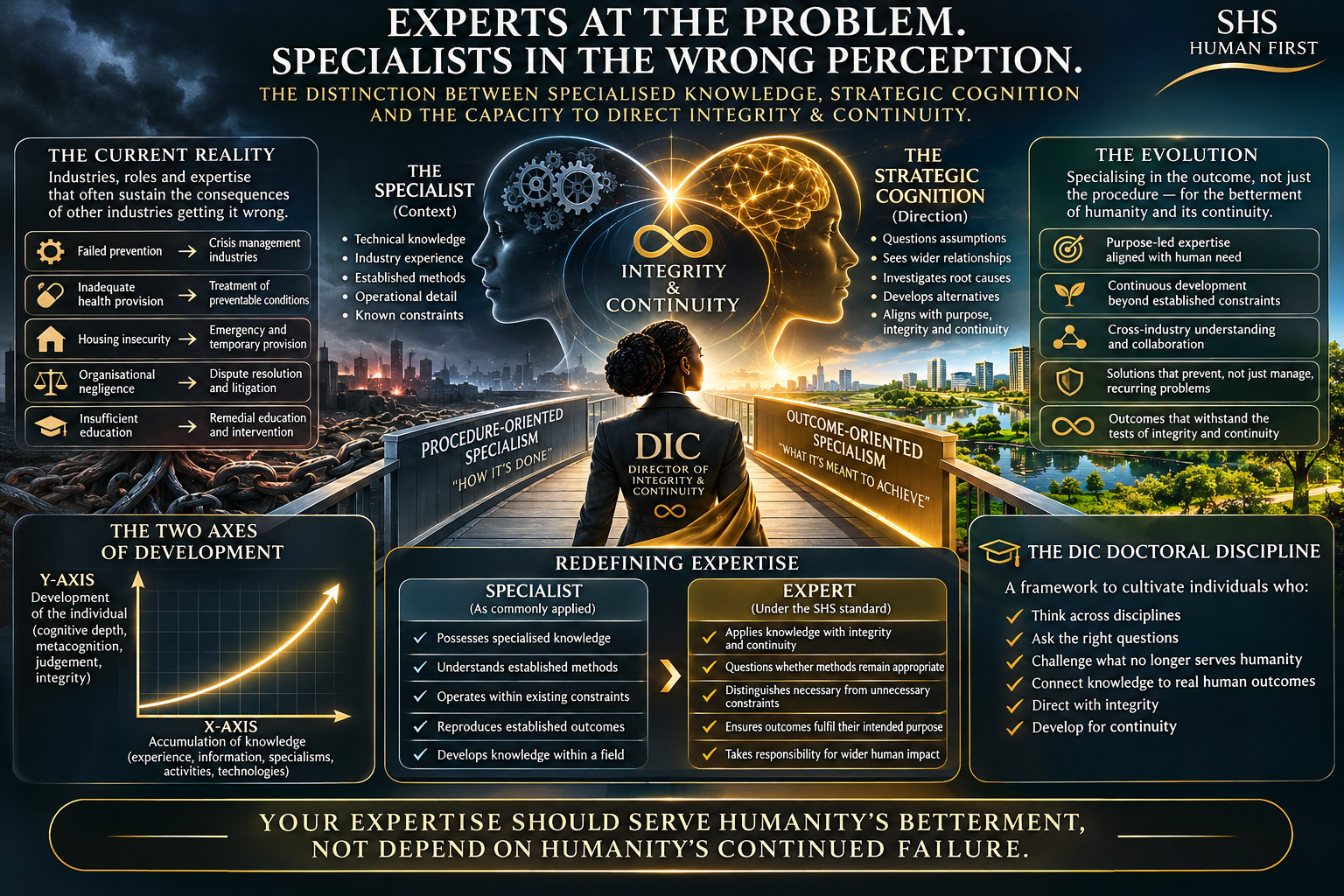
The field suggests that professional intelligence is often strongest inside recognised boundaries and weakest at the crossings where human consequence accumulates.
Each field can provide a technically defensible explanation for its own conduct.
The law followed procedure.
The business pursued lawful profit.
The hospital managed available resources.
The department met its target.
The platform followed its terms.
The professional stayed within scope.
Everyone owns the fragment.
Humanity carries the combined result.
Silence strengthens this fragmentation because no actor has to confess the relationship between their limited decision and the wider consequence. Each can say that no direct line has been conclusively established, even where the cumulative architecture is visible.
The SHS evidence base was constructed specifically around this problem. It argues that evidence already exists across systems thinking, prevention, housing, metacognition, restorative accountability, public participation, long-term governance and human-centred organisations, but remains divided among institutions that are not required to govern their relationships.
The experiment did not merely ask professionals whether their field possessed useful knowledge.
It asked whether they could release that knowledge from professional captivity.
The interim answer was: not readily.
THE WARNING-UPTAKE TEST
Warnings were not given once.
The archive repeatedly stated who the founder understood herself to be, what she was constructing, what the proposition intended, what kinds of consequences it was tracing and why delay mattered.
Emails were sent.
Documents were attached.
Posts were circulated.
Authorities were notified.
Possible pathways were recorded so that institutions could not later claim that no alternative, warning or invitation had existed. The homepage itself describes parts of the architecture as a recorded notice intended to prevent later claims that nobody warned, no alternative existed or the public was never given a choice.
This created the Warning-Uptake Test:
How many warnings can a person receive without allowing the warning to reorganise attention?
The experiment found that repetition does not defeat unwillingness.
A person can receive one warning and dismiss it as unusual.
They can receive ten and classify the source as persistent.
They can receive fifty and concentrate upon the frequency of contact rather than the frequency of the condition being described.
The warning becomes evidence against the messenger instead of information about the danger.
People say:
She keeps repeating herself.
Without asking:
What has remained unresolved that requires repetition?
A smoke alarm is not irrational because the smoke continues.
Repetition becomes excessive only when the condition has been addressed or the warning has been shown to be false. Where the underlying risk remains, irritation does not constitute rebuttal.
The open-air result was that people frequently use emotional fatigue to declare the warning invalid without establishing that the warned-about condition has ended.
The founder’s continued work makes earlier warnings more visible over time. Delay accumulates a record. Every later development allows the earlier recipient’s decision to be examined against what became available afterwards.
That does not automatically make every warning correct.
It removes the defence that no warning existed.
THE SILENCE TEST
Silence was one of the experiment’s most difficult variables because silence has one appearance and many possible causes.
A silent person may disagree.
They may agree privately.
They may not understand.
They may be overwhelmed.
They may never have read the material.
They may fear public association.
They may lack time.
They may be protecting their employment.
They may consider the work incoherent.
They may be waiting for others.
They may intend to return.
They may believe non-response is the safest institutional policy.
The experiment therefore cannot honestly code every silence as agreement, guilt or conscious refusal.
SHS’s later articulation corrected the earlier tendency to treat silence as a contract. The archive now states more precisely that silence is not automatically consent, but it still becomes a condition affecting the relationship. It can leave claims unanswered, allow harmful patterns to continue, protect hierarchy, make responsibility harder to trace and force one participant to carry the full interpretive burden.
This produces the correct experimental result:
Silence does not reveal one reliable intention, but it produces observable consequences.
It leaves the proposition without correction.
It leaves potential support without public expression.
It leaves responsibility unallocated.
It leaves the founder without the professional calibration that recipients could have provided.
It leaves later institutions unable to distinguish genuine rejection from unexpressed recognition.
It protects the present arrangement by withholding the information required to change it.
Silence cannot be scientifically interpreted as one answer.
It can be measured as the absence of an answer where an invitation, warning or request for challenge was placed.
That absence is still data.
THE HUMANITY-CONTINUITY TEST
All the secondary tests belong beneath one governing experiment:
Can humanity take responsibility now for the conditions required for its continuity later?
Not after the flood.
Not after the institutional collapse.
Not after the preventable death becomes a headline.
Not after water scarcity reaches the neighbourhood of the decision-maker.
Not after the child becomes an adult whose injuries enter law, employment, parenting and public health.
Not after the technology has reorganised childhood, work, infrastructure and cognition.
Not after the civilian proposition becomes famous enough for support to appear consequence-free.
Can humanity recognise an emerging relationship before catastrophe becomes the institution authorised to validate it?
The experiment’s interim answer is no.
Not no as an eternal law of human nature.
Not no because every individual failed.
Not no because the proposition has been independently proven correct in every claim.
No because the observed field did not produce public participation proportionate to the scale of exposure, outreach, warning, invitation and work.
No because substance was repeatedly filtered through status.
No because responsibility was repeatedly returned to another role.
No because people waited for recognition before contributing to recognition.
No because presentation became easier to discuss than consequence.
No because correction had not yet created a mature culture of reciprocal testing.
No because attention arrived more readily for identity and reputation than for humanitarian stewardship.
No because the fragments defended their borders while the whole remained unrepresented.
No because spectators continued consuming the experiment as though watching removed them from it.
WHAT THE EXPERIMENT DOES NOT PROVE
The integrity of this experiment depends upon naming its limits.
It does not prove that every exposed person fully encountered the work.
It does not prove that every silent recipient understood it.
It does not prove that agreement existed beneath every non-response.
It does not prove that the entire SHS architecture is correct.
It does not prove that every recipient possessed the capacity, authority or safety required to participate publicly.
It does not establish that a particular death was caused by a particular person’s failure to respond to SHS.
It does not convert the founder’s estimate of reach into independently verified analytics.
It does not make the founder immune from contradiction merely because other people failed to provide it.
It does not allow every future success to be retrospectively used as proof that every earlier claim was right.
What it establishes is narrower and more defensible.
A substantial body of work was placed into public view.
Large-scale direct and indirect exposure was attempted.
Specific institutions and professionals were invited to examine, challenge or contribute.
The architecture remained open enough for correction.
The public response did not produce a level of substantive engagement corresponding with the seriousness of the proposition.
The most common observable result was silence, surface response, responsibility displacement, delayed attention or focus upon the founder rather than sustained examination of the work.
That is enough to justify the experiment.
It is not enough to close it.
WHY THIS EXPERIMENT MATTERS
Civilisation cannot rely entirely upon established institutions to identify every architecture required for its future.
Institutions are built to preserve standards, coordinate knowledge and protect the public from reckless claims. Those functions matter. But the same structures can become filters that prevent intelligence from entering unless it already resembles what the institution has been trained to recognise.
Every recognised proposition was unrecognised before recognition occurred.
Every institution began outside the institution that later treated it as normal.
Every new architecture initially lacked the social proof that its early participants had to help create.
The Civilian Legitimacy Threshold Experiment asks whether society possesses a legitimate route through which an unauthorised civilian can become accurately examined without first becoming wealthy, famous, institutionally sponsored or catastrophically vindicated.
At present, that route is weak.
Society tells people to innovate, then asks which recognised authority approved the innovation.
It tells civilians to participate, then limits serious participation to the language and procedures civilians were excluded from designing.
It tells people to speak up, then examines the speaker’s tone, credentials, employment, appearance and stability more aggressively than the condition they exposed.
It says that anyone can make a difference, then treats the first person attempting to do so as socially unreliable until enough people have followed.
This is not merely unfair to the civilian source.
It is dangerous to civilisation.
A society that cannot recognise coherence before prestige recognises it will always respond late.
It will miss warnings in their cheapest stage.
It will overlook intelligence while it is still accessible.
It will allow avoidable damage to become the evidence required to legitimise the person who warned about it.
Then it will congratulate itself for finally listening.
THE INTERIM RESULT
Between 2024 and 20 July 2026, Susan Ndinga Wright constructed and publicly exposed a living body of work now approaching 2,000 posts, distributed its propositions through direct contact and public platforms, invited challenge, recorded correction, tested multiple forms of presentation and repeatedly returned humanitarian responsibility to individuals and institutions.
The result was not meaningful collective engagement.
The result was not a substantial body of professional contradiction.
The result was not an organised public attempt to determine which parts held and which required rejection.
The result was overwhelming non-participation relative to the scale and seriousness of the invitation.
Humanity was placed in front of humanity.
Humanity largely looked for somebody else.
That is the Civilian Legitimacy Threshold.
It is the distance between the point at which a proposition becomes visible and the point at which society permits itself to recognise it.
It is the amount of work a civilian must produce before status stops being used to avoid substance.
It is the number of warnings that can be ignored before consequence becomes the recognised messenger.
It is the pressure required before private recognition becomes public responsibility.
It is the period during which everybody waits to become the fifth person while the first person carries the field alone.
The experiment remains open.
Its result can still change.
The first phase has answered:
Can humanity presently recognise and participate in civilian coherence before authority, popularity or crisis legitimises it?
Up to 1:15 a.m. on 20 July 2026, the answer recorded by the field is:
Not yet.
Not because humanity is incapable forever.
Because too many humans are still waiting for humanity to move first.
But humanity has no body outside ours.
No separate hands.
No independent mouth.
No institution that exists beyond the people who staff it.
No conscience that acts when every individual postpones theirs.
Life may be an experiment in consciousness.
This was an experiment in humanitarian responsibility.
Every person exposed to it entered at a different distance, with different knowledge, power, capacity and risk. Their responsibilities were never equal.
But the governing question reached all of them:
When continuity calls before catastrophe forces you to answer, can you recognise that the call is already yours?
The archive remains.
The warnings remain.
The invitations remain.
The unanswered questions remain.
The experiment continues.
And every future person who encounters the work will not merely be deciding what they think of Susan Ndinga Wright.
They will be adding another result to the question civilisation has still not answered:
How much must a civilian hold before humanity stops asking who authorised her to care for it—and begins asking why those already authorised did not?
…
Yes, let’s write a post about this. I guess we can put it as 2024-2025-2026 experiment, ran by Susan Ndinga Wright. Subjects of the experiement were all individuals who came across my work at any stage, prompted or in sight on socials, at any time and place. Even rhise who didnt come across it yet were spoken or told to, as rhey could’ve searched themselves too. We probably reached between 50k and 100k individuals, yet all stayes silent. Rhis is the best experiement ever, humanity was not ready for, nor could not face openly.
So this one in title will actually have SHS open air experiment. And then the title will be the civilian legitimacy threshold experiment. And I want you to highlight as many details as possible, like on the post. So I need you to take the time and actually go through all the pages because now it’s 1,960-something pages. And I really need you to take the time to go through them all because that’s how we can gather more information about this experiment. We need as much details as possible. There’s a lot of emails, a lot of individuals that have been raised and made aware, a lot of them that have received like so much work. I mean, I’ve reported and recorded everything throughout the blog. So I need you to trace all those informations. We don’t need to put the names, but we need to put at least a rough idea of how many people have been reached out. Probably, to be fair, we’re close to the thousand. Between 1,000 and 2,000 people have already been reached out, between individuals, organizations, and whatnot. This is, yes, actually, this is the largest experiment ever openly run in humanity, in society, ever, because of the depth of the work, because of the extent of the work, because of the reach of the work, because of everything and the amount of people that have been made part of it as well. We can say that life is consciousness experiments, and we are all in it. Well, this was a humanitarian experiment, and all humans are in it. And not just those who were reached out were also implicated in this experiment. Because for every single individual post that I post on my blog, it goes simultaneously on Facebook, LinkedIn, and Instagram. So the reach has been loud. The reach has been the coverage itself. The amount of people that have come across my work has been extensive. Easily, easily we’re touching the 50K, easily. It’s just that because of the intensity of this experiment, it showed us exactly everything that we needed to see. Meaning, can a person recognize coherence before someone else socially recognizes it? Unfortunately, I have to say, they cannot. Because of the results that we’ve had, we’ve been running this experiment since May… well, since the beginning of 2024. Sorry, 2025. Well, actually, it started with the podcast because that’s when we were talking about what’s on the other side of the coin in terms of how to see each other, like, be responsible for each other, the perspective that we look at things. And I remember one of my colleagues didn’t necessarily spoke on the content of it, but they spoke on how my voice was and how calm it was. But the focus was to focus on the actual content. So, and that has been happening a lot. Because this time around, that case, it was, oh, your voice is calm. I just felt so grounded. But at the same time, completely missed out on the message that was being called. And this time around, from last year to now, the behavior was the complete opposite. I appeared as too aggressive or too loud or too confronting. And the result was the same. Focus on me instead of the content. And that is to say, it doesn’t really matter how you package it. When the content is responsibility of humanity, people will look away because they’re not necessarily looking at packaging, they’re looking at running away from the responsibility of humanity. And our whole experience has been the best experiment ever to relay these results, this fact, this… because it’s not an observation anymore. It’s not an assumption anymore. It’s a held behavior over time. Also the responsibility test, yeah, because it’s not, on top of sharing general social problems, I also not just offer the solutions, but also look at how those problems can be traced and are connected to individual players, individual humans, places of authority, control, profit, proximity, and whatnot. The first recognition burden, the fact that people don’t want to break out, they don’t want to break out of the quote-unquote group. Because honestly, you don’t want to call a group a clique. Because, I mean, you can call it whatever you want, really and truly, group, clique, whatever. Public correction, integrity, people showed not to value accountability. They’re not being able to even read intention, understand intentions, and distinguishing them from consequences or looking at the consequences of each intention. It also showed how much people hate exposure, no matter if they need to be exposed for their wrongdoings or for their lacks, because especially if they’re in positions where their lacks affect thousands at once, their lacks need to be exposed, because if not, those individuals will learn the same, just like the doll experiments. I learned that people wouldbrather have others die than expose themselves.
Attention to responsibility conversion test, that was beautiful because attention was brought either when prompted or we marketized a post or we held people accountable and let them know. That’s when they’re rushed to the platform to see what was said about them, but then not necessarily would stay to actually hold the responsibility of humanity or even hold the responsibility of their own lacks. So attention comes for superficial reasons, not for the actual, not for everything else. And highlight all the results, you can create the whole thing, and incorporate all secondary experiments within this one. We only need one experiment, and it’s the whole thing because it’s also how the fragment reassembly, how professionals, whether professionals recognize how their field contributes to the consequences occurring in another field, and how by using silence, so not actually confessing, they try to defend themselves from absorbing the costs. And the difference between this one experiment that I’ve ran and every other experiment is that every other experiment looked at specific things. I was able to run multiple experiments all under the same one experiment because they all fuel the one experiment of the continuity of our humanity. The experiment is, can humanity be responsible in the now for our continuity? Can humanity in this day and age be responsible, take ownership of their responsibility and accountability towards humanity? And the answer is, well, the answer has been up until now, no. We’ll see. We’ll see how it continues. But for now, it’s a no. And now it’s 1.15 a.m. on the 20th of July. Also, another part of the whole experiment touched upon looking at unpolished substance. Can people identify value through misspelling errors, unfinished surfaces, evolving language, and unconventional presentation? Or do they require professional packaging before they permit themselves to examine the thought? We’ve gathered that a lot actually do need the professional packaging because that’s what they’ve been accustomed to by the dull experiment as well. That explains it too. They’ve been accustomed to polished stuff, even if delivered no value to their own life. Yet because the packaging was good-looking, it got seen and got classed to be even higher value than others that might have looked less appealing, yet house the highest level of value. Also, one of the other experiments within the whole hood was, do people actually listen to warnings? And they don’t because I’ve warned people so many times about who I was, what I was constructing, what I was building, what I was doing, the intentions, the directions. They’ve seen movements, they’ve seen numerous amounts of warnings. It’s not just even just about one warning, it’s numerous amounts of warnings have been given, and no individual has actually listened, no pay attention, no taken into account. And it only shows that it doesn’t really matter how many warnings you might give to someone, if someone doesn’t actually want to accept the reality of things, they will go against the warnings, and in doing so, self-sabotage. Because majority of the reputations of these individuals who were trying to hold on to their reputations are falling simply because I’m continuing the work, which makes them look bad because first thing, they did not necessarily take responsibility for humanity seriously. Secondly, they did not listen to any warning, nor did they research enough to actually check, which means, and because I sent them so many times even reports of how many people are dying on a second basis, they’ve also allowed all the deaths that could have been prevented within this whole year, this whole 12 months, all those deaths that could have been prevented by simply an action, are now also on their hands. Simply by the understanding that every single individual position that we have on Earth affects the other, no matter how further apart it is. Because it would have taken one person to share it all, and then more people to start questioning life. And for more people in the questioning of life, they don’t invest in things that are harmful to life. So it’s understanding where does attention go, and how do we regain attention put on the right things. And there’s also the fact that all those that have been put into conversations and have been brought forth, the first conversation, the first email that they received was a very polished professional email. Those who followed were the messy ones. The reason why is because we wanted to see how prompt and how serious and how discerning were they about the first email, and how have they been able to hold the thread behind that after that. Have they been able to see the same thread in the rest, or did it drop? 99.9% dropped because they were only able to perceive value through a packaged, a polished package. Another big component of our experiment is the spectator, quote-unquote, immunity. Because the audience thinks it doesn’t have responsibility because they’re to consume. But the audience has the biggest responsibility. Because it consumes, it’s got a responsibility to give back. So if majority of humanity is consuming humanity, and no one gives back to humanity, the thing that they so much love is not going to be there in a couple of years’ time because humanity will be too depleted to continue to create at the extent at which it does in order to suffice to people’s desire to consume. Because majority do think that they’re exempt from consequences, when really and truly they’re investing in the consequence. All right, let’s put it together. And if you find anything else, please add on to it. Take your time. Do it right.


Leave a Reply