
People think they know how to be w/each other, well transparency is one of them, because they didn’t, I created the character to show why metaphysical consciousness needed, not even deserved, to be recognised in jurisdictions. Most got lost in the character. I had it all, the well paid job and all, I turned it all down, as too many could live with themsslves wstching others suffer. Not me. And that was 2024.
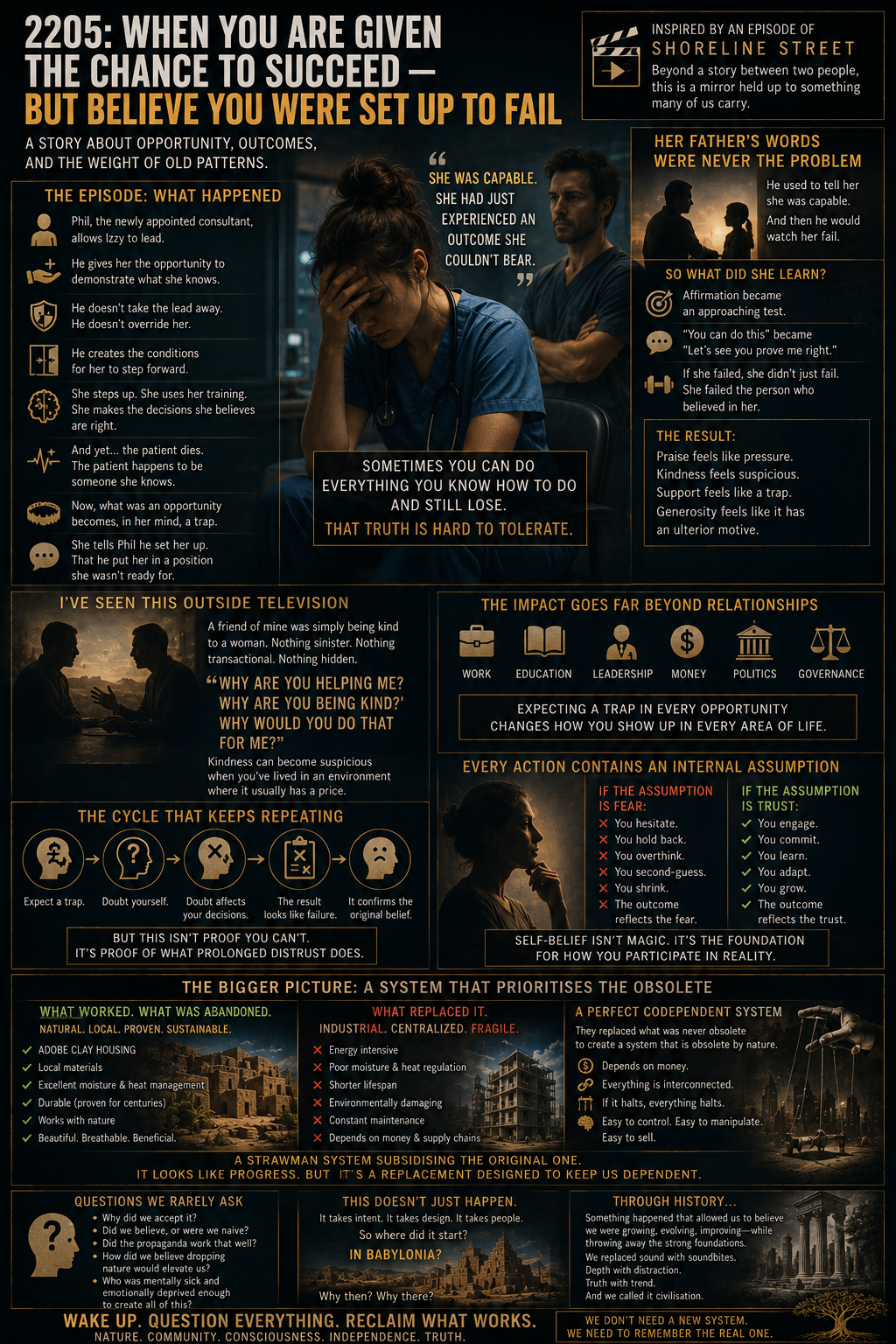
When You Are Given the Chance to Succeed — But Believe You Were Set Up to Fail
There is an episode of Shortland Street that has been sitting with me because I think it reveals something much bigger than what happens between two people.
Phil, the newly appointed consultant, allows Izzy to lead.
He gives her the opportunity to demonstrate what she knows.
He doesn’t take the lead away from her.
He doesn’t immediately override her.
He creates the conditions for her to step forward and show herself.
And she does.
She does what she knows how to do.
She does what she has been trained to do.
She makes the decisions she believes are right.
And yet the patient dies.
And that is where everything changes.
Because the patient happens to be someone she knows.
And suddenly what had been an opportunity becomes, in her mind, a trap.
She turns toward Phil.
She tells him that he set her up.
That he put her in a position she wasn’t ready for.
That he made her do something she wasn’t capable of.
But the strange thing is:
She was capable.
She had just experienced an outcome she couldn’t bear.
And because she could not sit with what had happened, she displaced the experience.
The failure wasn’t necessarily the failure she thought it was.
The patient dying did not automatically mean she was incompetent.
She had to face something much harder:
Sometimes you can do everything you know how to do and still lose.
And if you have grown up believing that failure means you were never capable in the first place, that truth becomes almost impossible to tolerate.
Her father’s words were never the problem
There is another part of the story that makes this even more revealing.
She talks about her father.
He used to tell her she was capable.
And then he would watch her fail.
So what did she learn?
She learned to associate affirmation with an approaching test.
She learned that someone telling her:
“You can do this.”
might actually mean:
“Let’s see you prove me right.”
And if she failed, she wouldn’t simply experience failure.
She would experience herself as having failed the person who believed in her.
That creates an extraordinary psychological burden.
Because now praise doesn’t feel like support.
It feels like a challenge.
Encouragement feels like pressure.
Kindness feels suspicious.
Someone believing in you can feel like someone setting a trap.
And then, as the person grows older, the pattern follows them.
They second-guess themselves.
They question compliments.
They distrust positive attention.
They interpret generosity as having an ulterior motive.
They wonder:
Why are you helping me?
What do you want from me?
Why are you being kind to me?
Why are you telling me I can do this?
And eventually the person can become so unfamiliar with genuine support that support itself feels threatening.
I have seen versions of this outside television
I remember hearing a friend describe a situation in which he was simply helping a woman.
He was being kind.
Nothing sinister.
Nothing transactional.
Nothing hidden.
And her reaction was essentially:
Why are you helping me?
Why are you being kind?
Why would you do that for me?
At the time, we put some of it down to culture.
We are Italian.
Community is deeply embedded in how many of us understand relationships.
You help people.
You show up.
You bring something.
You offer a hand.
You don’t always need a reason beyond:
another human being needed something.
But even then, I don’t think I fully understood how deep the opposite conditioning can go.
Because once someone has lived in an environment where kindness usually has a price, generosity can become suspicious.
Support can become suspicious.
A compliment can become suspicious.
An open hand can look like a hidden hook.
And that has consequences far beyond relationships.
It affects work.
It affects education.
It affects leadership.
It affects money.
It affects politics.
It affects governance.
Because once a person expects a trap, they start behaving as though every opportunity contains one.
Then something really important happens
A person can begin creating the very outcome they were afraid of.
They doubt themselves.
The doubt affects their decisions.
Their decisions affect the result.
The result appears to confirm the original belief.
And now they say:
“See? I knew I couldn’t do it.”
But the system isn’t necessarily proving that they couldn’t.
The system may simply be revealing what prolonged distrust does to a person’s ability to act.
That is why self-belief matters.
Not because positive thinking magically changes reality.
But because every action contains an internal assumption about one’s own capability.
If I believe I am incapable, I approach the task differently.
If I believe I am being judged, I approach the task differently.
If I believe the person helping me is trying to expose me, I approach the help differently.
If I believe praise means a test is coming, I cannot receive praise neutrally.
My interpretation changes my behaviour.
And my behaviour changes the outcome.
Then comes projection
This is where I think the episode becomes especially powerful.
Izzy cannot sit comfortably with what happened.
So instead of holding:
“I knew what to do, I did what I could, and someone still died.”
she moves toward:
“You did this to me.”
That shift protects her from an unbearable internal experience.
Because if Phil caused it, then she doesn’t have to confront herself.
If Phil set her up, then she doesn’t have to confront the possibility that she was actually capable and still couldn’t control the outcome.
If Phil manipulated her, then she doesn’t have to confront grief.
And this happens everywhere.
People don’t always project because they are malicious.
Sometimes they project because the truth about themselves is too painful to hold.
But projection does not transfer responsibility
And this is where I think we need to become much more careful with one another.
Someone can genuinely feel that you caused something without you having caused it.
Someone can genuinely experience you as threatening without you having threatened them.
Someone can genuinely believe you set them up without you having set them up.
Someone can genuinely believe they failed because you gave them too much responsibility, when in reality you gave them the opportunity to demonstrate what they already knew.
Their experience is real.
But their interpretation may still be wrong.
That distinction matters.
Because otherwise we can spend our entire lives accepting responsibility for things we did not create simply because another person could not tolerate their own experience.
And I have seen this directed toward me too
People have projected onto me the idea that I failed financially.
That I somehow lost.
That I couldn’t hold myself.
That I couldn’t maintain the conventional version of success.
But that isn’t what happened.
I had the money.
I had the job.
I had access to what many people would call success.
And I chose to walk away from it.
I abandoned that version of success deliberately because I valued something beyond it.
I chose what I believed was more important.
Humanity.
Understanding.
The work.
The investigation.
The possibility of contributing something beyond my own financial position.
So when someone looks at the external consequence and says:
“You failed.”
they are often evaluating a choice they don’t understand through a framework they have never questioned.
They see the result.
They don’t see the intention.
They see the absence of the conventional reward.
They don’t see the reason it was abandoned.
They see what society recognises.
They don’t see what I valued.
That is another version of the same problem.
We judge people according to the system we understand instead of asking what system of values they were actually operating under.
The world has become very good at measuring the wrong thing
This is one of the reasons I have continued doing this work.
We measure money.
Status.
Titles.
Qualifications.
Career progression.
Ownership.
Productivity.
Followers.
Visibility.
Prestige.
And then we use these measurements to infer capability.
But capability and recognition aren’t the same thing.
Someone can be extraordinarily capable and receive little recognition.
Someone can be highly recognised and have very little discernment.
Someone can have enormous resources and use them badly.
Someone can have very little and still understand something profoundly important.
That is why I have become increasingly interested in what people do with what they have, rather than simply what they possess.
And this connects directly to the work I have been producing
People may look at what I have created over the past two years and assume that it all appeared suddenly.
It didn’t.
I knew where I was going much earlier.
I knew the direction.
I knew the questions.
I knew the architecture I wanted to investigate.
But I also understood that people would not be able to hold the entire thing at once.
So I built it.
Step by step.
Industry by industry.
System by system.
Behaviour by behaviour.
I let the questions accumulate.
I let the contradictions become visible.
I allowed people to see one part before introducing the next.
Not because the intention changed.
Because the level of exposure changed.
There is a difference.
The thread remained.
The scale changed.
That distinction matters when you create a character
One of the most misunderstood things about creative work is the difference between:
the creator
and
the character.
I deliberately created a metaphysical character.
The character allows me to take the way I perceive reality and turn the perception into a form that can confront systems.
The caricature is part of the delivery.
The tone can be confrontational.
The exposure can be exaggerated.
The persona can be sharper than ordinary conversation.
But that doesn’t mean the underlying intention is fictional.
There can be a fictional or stylised delivery carrying a completely genuine argument.
That is what the character is for.
It allows the audience to see the problem from an angle that ordinary institutional language often makes impossible to see.
And this is where people lose the thread
They see one post.
Then another.
Then another.
Then another.
And because each one enters a different territory, they assume the intention must have changed.
But the intention hasn’t changed.
The context changed.
The industry changed.
The language changed.
The metaphor changed.
The level of analysis changed.
The audience changed.
The character changed how the message was delivered.
But the underlying objective remained:
consider everything.
That is what metaphysical perception means to me.
Not simply seeing one object.
Seeing relationships.
Seeing consequences.
Seeing context.
Seeing what happens before.
Seeing what happens after.
Seeing what is missing.
Seeing what has been excluded.
Seeing the thing and the environment around the thing.
You cannot expose everything simultaneously
This is another thing I have learned.
People cannot necessarily absorb an entire architecture in one moment.
Imagine walking into a room and being shown every connection simultaneously.
Everything would blur.
So you start with something.
Then another thing.
Then another.
The person becomes accustomed to looking.
Then you increase the depth.
Then you expose the relationship between the pieces.
Then you show the larger structure.
Then you show what sits underneath the structure.
That isn’t deception.
That’s teaching.
You are building the capacity required to hold the next layer.
And this is where I think some people may eventually feel that I “set them up.”
But I didn’t.
I told people what I was doing.
I explained the direction.
I explained that I was investigating systems.
I explained the character.
I explained the purpose of the work.
The information was there.
What people did with it was their choice.
The opportunity was always there
This is where I return to Izzy.
Phil gave her the chance.
She didn’t know what the outcome would be.
Neither did Phil.
But she was given the opportunity to demonstrate herself.
And sometimes an opportunity does not guarantee success.
That’s okay.
The purpose of an opportunity is not to guarantee the desired outcome.
It is to reveal capability.
And sometimes it reveals more than capability.
It reveals:
fear,
conditioning,
self-belief,
distrust,
projection,
responsibility,
judgement,
and the person’s relationship with uncertainty.
That is why opportunities can be so revealing.
The people around me also had choices
This matters to me enormously.
Nobody I have brought into this work was forced to become part of it.
Nobody was forced to choose against humanity.
Nobody was forced to reject the information in front of them.
Nobody was forced to misunderstand the intention.
Nobody was forced to ignore the warnings.
The truth was spoken.
The work was visible.
The direction was explained.
People were given opportunities to engage with it.
And people made choices.
Some chose to believe.
Some chose not to.
Some hesitated.
Some participated.
Some withdrew.
Some made decisions that, in retrospect, may look very different from how they looked at the time.
But those choices belong to the people who made them.
They don’t belong to the person who presented the opportunity.
That is an uncomfortable truth about responsibility
We sometimes blame the person who showed us something because we didn’t act on it.
We say:
“You made me see this.”
No.
You were shown something.
Then you chose what to do with what you saw.
We say:
“You put me in that position.”
Maybe.
Or maybe someone gave you an opportunity you weren’t emotionally prepared to hold.
Those are different.
We say:
“You made me fail.”
Maybe the opportunity revealed that you were not ready.
Or maybe you were ready and reality simply produced an outcome you didn’t control.
Again:
Different.
The person offering the opportunity cannot control every consequence.
And this becomes particularly serious when the subject is humanity
Because now we’re not talking about one hospital case.
We’re talking about systems.
Systems affect millions.
So if information about a systemic problem is placed in front of people with the capacity to act, we have to take their choices seriously.
Not because they must accept my interpretation.
Because they have an obligation to look.
Investigate.
Test.
Challenge.
Verify.
Question.
And if the evidence doesn’t support the concern, say so.
But if the concern is supported and people still refuse to act, then the responsibility does not disappear.
It becomes more visible.
This is why I created the metaphysical character
I wasn’t trying to demonstrate that metaphysical perception is superior to everybody else’s.
I was trying to demonstrate what happens when a system fails to account for a mind that considers relationships across domains.
A system built around narrow categories can struggle when someone refuses to stay inside the categories.
Because the system wants:
legal,
financial,
political,
medical,
social,
technical,
personal.
Separate boxes.
But life doesn’t experience itself in boxes.
Everything interacts.
Housing affects health.
Health affects work.
Work affects money.
Money affects housing.
Education affects employment.
Employment affects mental wellbeing.
Government affects infrastructure.
Infrastructure affects opportunity.
Finance affects all of them.
So eventually somebody has to consider the whole.
And the whole creates another problem for the system
Because once you consider the whole, you start seeing contradictions.
A policy can look reasonable in isolation and harmful in combination.
A business practice can look profitable while creating social damage elsewhere.
A legal rule can look coherent while producing an unreasonable human outcome.
A financial metric can look objective while reinforcing the conditions it measures.
A political promise can look generous while leaving the underlying architecture untouched.
You can’t see those relationships while staring at one box.
You have to step back.
That’s what the character allows me to do.
And some people may experience that as a threat
Of course they might.
If your identity depends upon the belief that you understand a system, somebody exposing connections you haven’t considered can feel like an attack.
If your professional role depends on the system being interpreted a particular way, a new interpretation can feel destabilising.
If you have spent years believing that a certain authority is legitimate, questioning its foundations can feel personal.
But discomfort doesn’t make the question illegitimate.
And disagreement doesn’t make the exposure wrong.
The danger is when discomfort becomes projection
That’s where we return to Izzy.
Instead of:
“I am struggling with what you’re showing me.”
it becomes:
“You are doing something to me.”
Instead of:
“I don’t understand your intention.”
it becomes:
“Your intention must be malicious.”
Instead of:
“I don’t trust myself to interpret this.”
it becomes:
“I don’t trust you.”
And now the person who brought the information becomes the problem.
That is projection.
And once projection takes over, the original question disappears.
That is why intention must be held alongside outcome
This is another lesson I think we need desperately.
Look at:
What was said?
What was intended?
What was done?
What happened?
What was interpreted?
What was projected?
Those aren’t interchangeable.
A person can have a good intention and a bad outcome.
A person can have a bad intention and a good outcome.
A person can misunderstand both.
An observer can misunderstand the intention.
And the recipient can misunderstand the meaning of the action.
So the only way through is to hold the whole thread.
And the thread of my intention has been remarkably consistent
The subject matter has changed.
The delivery has changed.
The level of depth has changed.
The industries have changed.
The language has changed.
The character has changed.
But the intention has remained:
Understand the whole.
Understand what people are doing.
Understand why.
Understand what systems reward.
Understand what systems punish.
Understand what happens when incentives conflict.
Understand what happens when people don’t believe themselves.
Understand what happens when people project.
Understand what happens when institutions refuse to change.
Understand what happens when humanity stops participating in its own authorship.
And ultimately:
understand what kind of system we are actually creating.
And perhaps the most important lesson is this
Sometimes the person who gives you the opportunity to succeed is going to be blamed when you discover that you were afraid of failing.
Sometimes the person who tells you that you are capable will be accused of setting you up.
Sometimes kindness will be interpreted as manipulation.
Sometimes generosity will be interpreted as a trap.
Sometimes truth will be interpreted as aggression.
Sometimes an opportunity will be interpreted as exposure.
And sometimes the person who refuses to play small will be accused of making everyone else uncomfortable simply by demonstrating that a larger possibility existed.
But none of that changes the opportunity.
None of that changes the intention.
And none of that transfers responsibility for another person’s choice.
We have to learn to sit with what happens
Izzy’s tragedy wasn’t simply that the patient died.
It was that she had to decide what the death meant.
Was it:
proof she was incapable?
Was it:
proof Phil had betrayed her?
Was it:
proof her father had been wrong?
Or was it:
proof that sometimes being capable does not give you control over the outcome?
Those interpretations create entirely different futures.
The same thing happens to us.
We experience something.
Then we decide what it means.
And if we choose the interpretation that protects our ego rather than the one that confronts reality, we can spend years fighting people who never actually caused the thing we are angry about.
And that is why accountability matters
Not punishment.
Not shame.
Accountability.
The willingness to say:
This happened.
This was my interpretation.
This was my choice.
This was the consequence.
This is what I could have done differently.
That is mature participation.
And it applies to everyone.
It applies to the individual.
It applies to the institution.
It applies to the politician.
It applies to the company.
It applies to the parent.
It applies to the person who was offered the opportunity.
It applies to the person who offered it.
Because nobody was forced not to act
This is the point I keep coming back to.
People had choices.
They still have choices.
The fact that a choice becomes clearer later doesn’t mean it didn’t exist earlier.
The truth can stand in front of somebody for years.
They can still choose not to act.
And when the consequences eventually arrive, they may wish they had chosen differently.
That regret belongs to them.
Not necessarily because they are bad people.
Because they had agency.
And agency means choices have consequences.
Which brings us to the question of leadership
What kind of leader does a system produce?
One who demands obedience?
One who rewards fear?
One who punishes uncertainty?
One who requires people to prove themselves before giving them the tools to develop?
Or one who says:
“I believe you can do this. Here is the opportunity. Here are the safeguards. Go and show me what you can do.”
That second model doesn’t guarantee success.
It creates something more important:
development.
And that is what I think institutions need to learn.
People don’t become capable because we declare them capable.
They become capable because we create the conditions in which capability can emerge.
And perhaps that is the lesson I am actually trying to demonstrate
I am not asking people to believe everything I say.
I am asking them to follow the thread.
Don’t judge one post without the others.
Don’t judge one character without understanding why the character exists.
Don’t judge one outcome without understanding the intention.
Don’t judge one decision without understanding what information existed before it.
Don’t judge a failure without asking whether the person was actually incapable or simply unable to tolerate the outcome.
Don’t judge an opportunity by the fact that it produced discomfort.
And don’t judge a person by the conventional system’s definition of success without asking what they consciously chose to value instead.
Because sometimes what looks like failure from inside one system is commitment from inside another.
Sometimes what looks like weakness is refusal.
Sometimes what looks like irrationality is a different hierarchy of values.
And sometimes what looks like a setup is simply an opportunity that someone was too afraid to believe they could carry.
The real failure may not be failing
Maybe the real failure is refusing to learn what the failure was actually telling you.
Maybe the real failure is projecting the consequence onto the person who gave you the chance.
Maybe the real failure is turning support into suspicion.
Maybe the real failure is confusing discomfort with danger.
Maybe the real failure is refusing to examine yourself because the alternative would require admitting:
I was capable.
I was given an opportunity.
I made a choice.
It didn’t produce what I wanted.
And I still have to decide what I do next.
That is adulthood.
That is accountability.
That is discernment.
And perhaps that is also the difference between a system that creates dependency and a system that creates capable human beings.
Because ultimately, the question isn’t whether we will fail.
We will.
The question is:
When reality doesn’t give us the outcome we wanted, will we have enough self-belief, discernment and honesty to hold the truth without needing somebody else to become the villain?
Because sometimes the person standing in front of you isn’t setting you up to fail.
Sometimes they are standing there saying:
I believe you can do this.
And the hardest thing in the world may simply be learning how to believe it yourself.
….
So, you know, in Shoreline Street, there is an episode where the newly consultant, Phil, allows Izzy to lead the way and gives her the chance to show herself, and yeah, been after the bombing. And the patient happened to die even if she did everything right, right? And then she went on to blame Phil, telling her that she set her up, that she’s the one who had to do something that she thought she wasn’t up to the bar for, but instead she actually did know how to. It just happened that the patient died, which happened to be someone that she knew. And because she couldn’t sit with herself and actually accept what just happened, she projected onto Phil, right? Now, when you look at those things, it has made think of so many people who feel so self-conscious and so not up to the bar, even if they are, right? It’s all about whether one thinks they can. And the moment they fail, and she said it best. She was like, Oh, my dad used to do this. He would tell me I’m capable and then watch me fail. Well, the fact that she failed wasn’t the reason as to why the dad gave her the words of affirmation. The dad gave her words of affirmation to actually succeed and show that he believed in her. But because she herself did not believe in herself, she would fail and she would feel almost like she needed to be perfect for him, right? And this is the dynamic that, and then obviously growing up as an adult, she now second guesses herself for everything. And when someone gives her praise or someone gives her, like, how’s it called, elevation— not elevation, but words of affirmation or whatnot, she doesn’t see it for what it is. She sees it as a challenge, or you’re trying to set me up, or you’re saying things that you don’t actually mean, or things like that. And I’ve seen it so much happen in the UK. Even one of my friends was telling me about a scenario where, like, he was just helping a girl and the girl was, like, so estranged by him. He was like, Why are you helping me? Why are you so kind? And we put it down to the fact that we’re Italians, and that’s, like, community is, like one of the biggest things. Which would make it a cultural thing. And up until I had my own experience, I didn’t believe. It’s not that I didn’t want to believe it. I believed it. I didn’t understand to which depth it would actually go, right? Because so many would second guess themselves and would do the wrong thing or say the wrong thing, and then blame the other person for those words coming out of their mouths, or blame the other person for their own failures, you know? Like people project onto me the fact that I failed at about holding myself financially, when truly I didn’t fail. I made the choice because I’m helping humanity. I’m doing what most are not willing to do. I had the money. I had the job. I was rich. I chose not to. I abandoned it. I abandoned it because I valued more than just that. But those who live within it without actually considering the outer, they’re not even able to even understand and comprehend what consideration is. So they either see it as a threat, they either see it as something to be suspicious about, or whatever. And it’s quite tiring after a while, because people project distrust on you even if there’s no reason to. Like, for me to have gone to this point where I’m literally writing the story of the system so clearly, I knew to do this two years ago, but I built the narrative step by step simply because most didn’t actually believe that I had it in me during the course of it all. And I could possibly imagine how most of them, or some of them, would be thinking that because of the character that I created in order to show them why the system is not ready for a metaphysical, in perception individual, they would basically, like, if it wasn’t because obviously I’m a metaphysical individual in perception, but I’m allowing and utilizing my skills to benefit the wholeness. The next person is not going to do the same. They’re going to use all those skills, and to be fair, they already exist, like the narcissist, the psychopath, and whatnot, because they can think ahead. They can plan things out. They can see the threats. They can see how people move. They can study people and whatnot. But they’re not doing it for the wholeness. They’re doing it for themselves, right? So then individuals meet someone like myself, who does it for the wholeness, who abandons what, quote-unquote, someone would call rich, riches, and fortune, or whatever, white-collar jobs. And they seem to forget that I abandoned that on purpose to take care of humanity, right? So in doing so, I created the metaphysical character, which is like all the creations that I’m putting out. Like there’s one post in specific that says everything that’s in this blog is factual. It’s just a caricature of, like, the delivery. It’s the caricature. So where it’s confronting, where it’s, like exposing, all of that is the caricature of the persona called Crystal Tarfield, and that’s the character that I created, which will be in the next chapter, the movie that will come from it. And in all of that, it basically just shows me how people can’t even separate things, and they can’t hold the thread of truth. They can’t hold the thread of someone’s intention, someone’s spoken intentions, right? Because my intention has not changed throughout the whole thing, but it has moved through different levels and different industries and different everything, because the character is, and the perception is a metaphysical perception. Metaphysical perception is to consider everything. So I have to consider everything, but I couldn’t consider the depth of the exposure that I’m doing now towards the system when I was still exposing people’s dissociative behaviors, you know? Because you have to take it in steps, because people had already shown that they couldn’t see the wholeness at once. But most of those who I’ve brought in, I can imagine they would feel like I set them up for a failure, because they didn’t choose. They didn’t allow to believe the truth that I was speaking, and in doing so made choices that actually hindered humanity. So now they look like the bad guy when really and truly they could have looked like the good guy the first time around when they got the chance to. And this is quite—I don’t want to say sad, but it is a consideration that needs to be spoken, because no player here was forced to not act on what was right. It doesn’t matter how the character came onto them. They had truth standing in front of them, because the truth was always spoken. They chose not to. So whatever the consequences and whatever humanity will think of them, it is really their creation. I said exactly what I was doing. I said there’s a post called Why Metaphysics Belongs in Our Jurisdiction, where I explain that I was being a character to show to the legal system—I thought it was only the legal system, but really and truly it’s also the governmental system—what it needs to take into account, because if not, we allow a system that basically benefits psychopaths. Because if the psychopaths are those who lead the machine and I say so because of the definition of the word/trait and then looking at the rhings the leaders see but don’t admit or actually change, the definition stands





Leave a Reply