
I was watching edits from Orphan Black.
And while I was watching all these different people who are supposed to be clones, I started thinking about how much of our understanding of cloning is based on one very particular thing:
looking alike.
Same DNA.
Similar appearance.
Same biological source.
Different personalities.
Different lives.
Different choices.
But underneath it all, some shared origin.
And then I started looking at humanity differently.
What if we have been defining the idea of a clone far too narrowly?
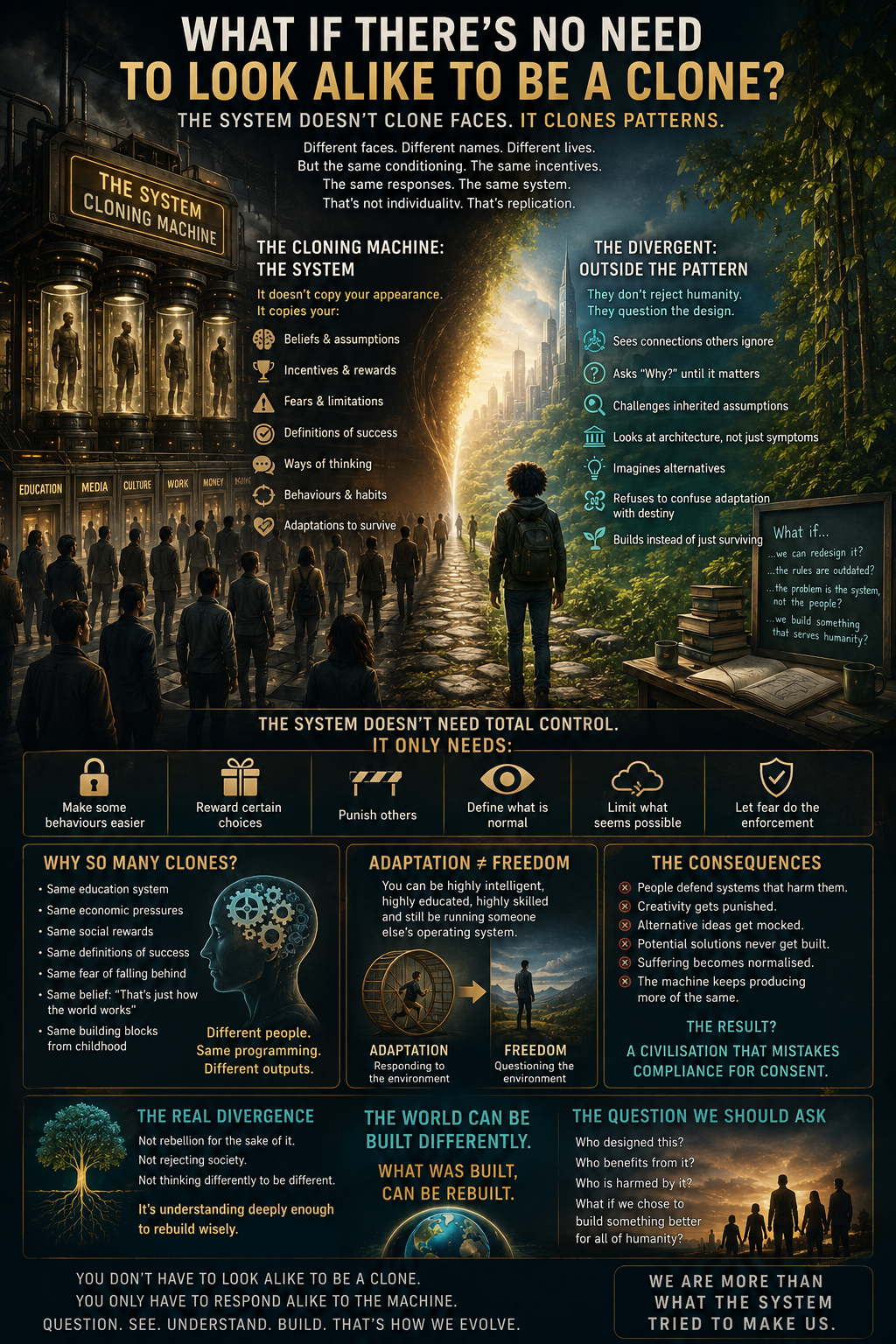
What if you don’t have to look alike to be a clone?
What if the thing being copied isn’t the face?
What if it’s the pattern?
Because when I look at people who have grown entirely within the systems we have constructed, something starts becoming visible to me.
They look different.
They speak differently.
They come from different countries.
Different families.
Different classes.
Different cultures.
Different religions.
Different political positions.
Different personalities.
Different ambitions.
Different experiences.
And yet they can make remarkably similar choices.
They can value the same things.
They can defend the same structures.
They can respond to the same incentives.
They can reproduce the same behaviours.
They can solve problems using the same assumptions.
They can even fight each other while unconsciously protecting the exact same underlying system.
And that’s when I started wondering:
What if the similarity isn’t in the human being?
What if the similarity is in what has been done to the human being?
What if the system is the cloning machine?
Let’s take the clone metaphor seriously for a moment.
Imagine a machine designed to take something and repeatedly produce versions of it.
The machine doesn’t necessarily have to reproduce a face.
It could reproduce:
belief structures,
behaviour,
incentives,
social expectations,
definitions of success,
definitions of failure,
ways of speaking,
ways of working,
ways of consuming,
ways of measuring worth,
ways of understanding authority,
ways of understanding money,
ways of understanding education,
ways of understanding relationships,
ways of understanding what is possible.
Now the machine doesn’t need everyone’s body to look the same.
It only needs enough of their pattern of adaptation to look the same.
And suddenly the metaphor gets interesting.
Because that’s exactly what systems can do.
You can take millions of completely different human beings and place them into the same environment.
Give them:
the same institutional structures,
the same economic pressures,
the same credential requirements,
the same employment incentives,
the same status markers,
the same advertising ecosystem,
the same financial constraints,
the same definitions of productivity,
the same educational assumptions,
the same ideas about respectable careers,
the same expectations around consumption,
the same social rewards,
the same penalties for stepping outside the norm.
And then observe what happens.
You don’t get identical people.
You get different people adapting to the same machine.
That may be enough to create behavioural clones.
The clone doesn’t need to know it’s a clone
This might be the most interesting part.
Imagine a biological clone who grows up believing they are completely unique.
They have their own memories.
Their own experiences.
Their own relationships.
Their own personality.
Their own preferences.
They might genuinely believe:
“There is nobody else like me.”
And technically, that could be true.
They are not the same person.
But they may still share something deeply important in their origin.
Now translate that into systems.
A person goes through school.
Learns what achievement looks like.
Learns which answers receive approval.
Learns which questions are considered acceptable.
Enters work.
Learns what employers reward.
Learns what earns promotion.
Learns what behaviour creates social acceptance.
Learns what financial behaviour creates security.
Learns what purchases communicate success.
Learns what failure looks like.
Learns what “normal” means.
And eventually becomes an adult making choices inside a structure they had very little role in designing.
They may feel completely individual.
But much of their behavioural environment was pre-designed.
And I think that’s where the word clone becomes useful.
Not literally.
Conceptually.
A clone could be someone whose behavioural architecture has been produced by the same machine.
Different faces.
Different personalities.
Different biographies.
Same underlying conditioning architecture.
Same pressures.
Same incentives.
Same boundaries.
Same definitions.
Same system.
Different outputs.
The system doesn’t have to control every thought
This is important.
A system doesn’t have to control people completely to shape them.
It only needs to make some behaviours easier and others harder.
It only needs to reward some decisions and punish others.
It only needs to make certain futures feel realistic and others feel absurd.
It only needs to establish:
“This is how life works.”
And then let humans do the rest.
That’s much more efficient than controlling every thought.
You don’t have to tell somebody what to dream about if you’ve already designed the environment in which they learn what is realistic.
You don’t have to tell someone what job they should want if you make some jobs financially survivable and others practically impossible.
You don’t have to tell people what success means if every visible status signal points in the same direction.
You don’t have to tell everyone what to value if the rewards are consistent.
The system can simply create the environment.
Humans adapt.
Then what does “divergent” mean?
This is where I place myself inside the metaphor.
In Orphan Black, the interesting question isn’t only:
“Who are the clones?”
It’s:
“What happens when one of them doesn’t behave the way the system expects?”
And that is the part I connect with.
Because when I look at the work I’m doing, I don’t see myself as someone who has simply found a better way to operate inside the existing structures.
I’m trying to question the structures themselves.
The assumptions underneath them.
The reasons we have accepted them.
The connections between them.
The things that seem unrelated until you place them beside each other.
And that can make somebody look “faulty” from inside the machine.
Not because they are actually faulty.
But because the machine was designed around a particular set of expected outputs.
Imagine a factory designed to produce identical objects.
One object comes out slightly different.
The machine flags it.
Defective.
But what if the object isn’t defective?
What if the machine is simply incapable of understanding what it didn’t intend to produce?
That’s a very different question.
And this is where I think the “divergent” metaphor becomes powerful.
Perhaps the divergent isn’t the person who is broken.
Perhaps the divergent is the person whose pattern doesn’t fit the production system.
What if “faulty” is just another word for unpredictable?
Systems love predictability.
Companies love predictable consumers.
Governments love predictable populations.
Institutions love predictable behaviour.
Markets love predictable behaviour.
Schools need predictable assessment systems.
Organisations need predictable workflows.
Large-scale systems depend on people behaving within ranges that make the system manageable.
But humans are not machines.
We are creative.
Adaptive.
Contradictory.
Curious.
Emotional.
Inventive.
Unreasonable.
Brilliant.
Sometimes irrational.
Sometimes transformative.
And every system eventually encounters people who don’t respond the way the system expects.
Those people can be inconvenient.
Because they reveal something.
The model is not the human.
Maybe the real clones are the patterns
Think about how often people say:
“That’s just how the world works.”
That sentence is fascinating.
Because what exactly does it mean?
Does it mean that’s how reality works?
Or does it mean:
“That’s how the system I was born into works, and I’ve learned to navigate it.”
Those are not the same thing.
Gravity is reality.
A tax code is designed.
Money is designed.
Employment structures are designed.
Corporations are designed.
School systems are designed.
Banking rules are designed.
Borders are designed.
Platforms are designed.
Markets are designed.
Credentials are designed.
Job descriptions are designed.
Performance metrics are designed.
Social norms evolve, but they are still human-created.
And yet people can experience all of these things as though they were natural laws.
That’s how deeply systems can become embedded in human perception.
And this is where I see the clones
Not in their faces.
In the phrases.
“That’s just business.”
“That’s just capitalism.”
“That’s just the law.”
“That’s just how employment works.”
“That’s just what adults do.”
“That’s just how money works.”
“You have to be realistic.”
“Everybody has to work.”
“You can’t change the system.”
“That’s impossible.”
Imagine millions of completely different humans independently producing variations of the same assumptions.
At what point do we stop asking:
“Why are they all thinking alike?”
and start asking:
“What produced the similarity?”
The machine may be education
Or rather, a particular form of education.
Education can expand a human being’s capacity to question.
But it can also train adaptation.
There is a difference between teaching somebody:
how to understand a system
and teaching them:
how to function inside a system without questioning it.
One produces architects.
The other can produce operators.
Neither is inherently useless.
A civilisation needs people who can operate things.
But if almost everyone is trained only to operate existing structures, who questions whether the structure itself makes sense?
Who asks whether the road should be moved?
Who asks whether the machine is producing the right thing?
Who asks whether the goal is wrong?
Who asks whether the rules are obsolete?
Who asks whether the thing we’re optimising isn’t actually what humanity needs?
The machine may be the economy
Imagine a human being born into an environment where survival requires money.
So they learn money.
They learn income.
They learn employment.
They learn debt.
They learn credit.
They learn rent.
They learn bills.
They learn purchasing power.
They learn how to maximise earnings.
Then someone says:
“Why don’t you redesign the economic system?”
And the person answers:
“Because that’s not how the economy works.”
But notice what happened.
The system didn’t need to physically stop them.
It taught them the boundaries of imagination.
That may be one of the most powerful forms of control imaginable.
Not preventing someone from doing something.
Convincing them that the thing cannot be done.
The machine may be culture
Two people can be born on opposite sides of the planet and still learn remarkably similar assumptions about status.
Own something.
Earn something.
Become something.
Display something.
Compete.
Accumulate.
Protect what is yours.
Don’t fall behind.
Be productive.
Be successful.
Don’t be dependent.
Don’t be poor.
Don’t fail.
Don’t look different.
Don’t ask questions that make everybody uncomfortable.
Again:
different humans.
Potentially similar behavioural outputs.
And the machine may be fear
This might be the strongest cloning mechanism of all.
Fear can make highly individual humans converge.
Fear of losing income.
Fear of rejection.
Fear of being mocked.
Fear of losing status.
Fear of being excluded.
Fear of being called unrealistic.
Fear of becoming homeless.
Fear of disappointing family.
Fear of losing a career.
Fear of uncertainty.
Fear of being the first person to say:
“I don’t think this is working.”
Fear can create compliance without anyone explicitly demanding it.
And suddenly the machine hardly needs guards.
People guard themselves.
What happens when someone grows outside the machine?
This is where things get interesting.
Suppose someone begins questioning the assumptions they inherited.
They start seeing relationships between things that were previously treated as separate.
Housing connects to employment.
Employment connects to banking.
Banking connects to money creation.
Money connects to taxation.
Taxation connects to government design.
Government connects to legitimacy.
Technology connects to attention.
Attention connects to economics.
Education connects to labour markets.
Labour markets connect to value.
Value connects to survival.
Survival connects to governance.
Governance connects back to everything.
Suddenly the person isn’t looking at isolated problems anymore.
They’re looking at the architecture.
And once you start seeing architecture, it becomes harder to accept:
“That’s just how things are.”
Maybe that’s why divergent people can appear strange
They ask questions that break categories.
They connect topics that institutions keep separate.
They don’t respect the boundaries between disciplines.
They don’t automatically accept that one department has nothing to do with another.
They ask:
Why?
And then:
Why?
And then:
Who designed that?
And then:
Who benefits from it?
And then:
Who is harmed by it?
And finally:
Could we build something else?
That line of questioning can look disruptive.
Because it is disruptive.
It disrupts the assumption that the current configuration is inevitable.
But I need to make one distinction
I don’t actually know that everyone operating comfortably inside the system is a “clone.”
And I don’t think we should reduce human beings to that.
People are much more complicated.
Someone can understand a system deeply while still choosing to work within it.
Someone can question parts of the system and defend other parts.
Someone can be highly independent in one area and highly conditioned in another.
Someone can be innovative while still carrying assumptions they have never examined.
That’s precisely why I prefer this as a metaphor.
The “clone” is not the person.
The clone is the pattern.
Which raises a much bigger question
What if civilization has become extraordinarily good at producing behavioural similarity without biological similarity?
We don’t need to manufacture identical humans.
We only need to create environments that generate similar adaptations.
That could explain something that otherwise feels strange.
Why can millions of intelligent people encounter obvious problems and independently conclude:
“There’s nothing we can do.”
Why can people recognise suffering but still defend the structures producing it?
Why can people complain about the economy while assuming the economy itself cannot be redesigned?
Why can people criticise government while assuming governance has to look essentially the same?
Why can people hate their jobs while assuming employment has to work the way it does?
Why can people recognise homelessness while designing almost everything around people who already have homes?
Perhaps they aren’t unintelligent.
Perhaps they’re highly adapted.
And adaptation is not the same thing as freedom.
The uncomfortable possibility
What if the system doesn’t primarily survive by defeating its critics?
What if it survives by turning its critics into participants?
Someone begins questioning everything.
Gets a job.
Gets promoted.
Buys a house.
Gets a mortgage.
Has children.
Gets bills.
Needs stability.
Becomes responsible for other people.
And eventually starts defending the same structures they once questioned because their own survival has become intertwined with them.
The machine doesn’t have to destroy resistance.
It can absorb resistance.
That might be an even more sophisticated form of cloning.
So perhaps the real divergent question is:
Can you imagine outside the machine without needing to destroy everything inside it?
Because I don’t think divergence necessarily means rejection of civilisation.
It can mean redesign.
It can mean:
“This worked once, but it doesn’t have to work forever.”
“This rule solved one problem, but now creates another.”
“This institution was useful, but perhaps it needs to evolve.”
“This economic mechanism is human-created, therefore humans can modify it.”
“This social norm is inherited, therefore it is not automatically inevitable.”
That’s a very different form of rebellion.
It’s not:
Burn everything down.
It’s:
Understand everything deeply enough to build differently.
Maybe the most dangerous clone is the one who never asks why
Because a system becomes incredibly powerful when it no longer has to enforce itself.
When people enforce it for free.
When parents teach it.
Teachers reproduce it.
Managers reproduce it.
Employees reproduce it.
Consumers reproduce it.
Politicians reproduce it.
Creators reproduce it.
Influencers reproduce it.
People who hate it reproduce it.
People who benefit from it reproduce it.
People harmed by it sometimes reproduce it.
And eventually, nobody needs to remember who designed it.
The system becomes its own justification.
“Because that’s how things work.”
That may be the ultimate clone.
A human being carrying a pattern whose original source they can no longer see.
And then I look at myself
This is where the metaphor becomes personal.
When I say I see myself as something like a “divergent,” I don’t mean I have proved that I am biologically unique from everyone else.
I mean something much simpler.
I have not yet found another person doing the exact combination of work I am doing in the exact way I am doing it.
I keep looking across systems.
Across disciplines.
Across institutions.
Across contradictions.
Across assumptions.
And I keep asking:
What if these things are connected?
What if the problem is not the individual problem but the architecture connecting the problems?
What if we keep trying to repair outputs when we should be redesigning inputs?
What if the human being isn’t failing the system?
What if the system is failing the human being?
Those questions don’t necessarily make me right.
They make me divergent from the expected pattern.
And perhaps that is all “divergent” needs to mean.
Maybe the clone is not who looks like you
Maybe the clone is the person who responds to the same machine in the same way.
And maybe the person who doesn’t is not defective.
Maybe they are evidence.
Evidence that the machine does not perfectly define the human.
Evidence that people can behave differently.
Evidence that assumptions can be interrupted.
Evidence that a pattern can break.
And perhaps the greatest threat to a system isn’t someone who hates it.
It’s someone who understands it well enough to realise:
it was built.
Because once you understand that something was built, another possibility becomes unavoidable.
It can be rebuilt.
So perhaps the question I now want to ask isn’t:
“How many clones are there?”
It’s:
“How much of human behaviour is genuinely chosen, and how much of it has been produced by the environments we inherited?”
And perhaps even more importantly:
“What happens when a human being stops trying to become the best possible participant in the existing machine and starts asking what machine humanity should have built instead?”
Maybe that’s what divergence really is.
Not looking different.
Not thinking differently for the sake of being different.
Not rejecting society.
Not believing everyone else is asleep.
Just reaching the point where you can look at the machinery around you and say:
“I can see the pattern.”
And then asking the question that a machine never wants to hear:
“Who said it had to stay this way?”




Leave a Reply