

There is another part of this conversation that we cannot keep avoiding.
Consideration costs.
It costs time.
It costs energy.
It costs patience.
It costs opportunities.
It can cost money.
And, when the consequences of waiting become serious enough, it can cost human lives.
That changes the question completely.
Because when I say I am giving human beings the opportunity to rise, to recognise their part in the bargain of being human, and to participate in building something better, that sounds compassionate.
It is.
But it is not cost-free.
While we are giving people time to understand, another person can be living with the consequences of the system as it currently exists.
Someone can lose their home.
Someone can become ill.
Someone can die.
Someone can be harmed by an institution that knows better but hasn’t changed yet.
Someone can spend another year in poverty.
Another child can grow up inside the same conditions.
Another generation can inherit the same architecture.
Another preventable tragedy can happen.
And then we have to ask the uncomfortable question:
At what point does consideration itself become part of the cost?
Because one person can challenge a system
One person can notice the problem.
One person can ask the question nobody else wants to ask.
One person can identify a contradiction.
One person can propose another architecture.
One person can put an idea on the table.
One person can say:
“We don’t have to keep doing it this way.”
But here is the asymmetry.
It may take one person to challenge the architecture.
It takes a village to build the replacement.
And sometimes that village needs time to form.
People need to understand.
People need to test.
People need to debate.
People need to verify.
People need to decide whether they agree.
Institutions need to adapt.
Systems need to be rebuilt.
New mechanisms need to be tested.
Old mechanisms need to be dismantled carefully enough that replacing one failure does not create ten others.
That takes time.
And time is not neutral.
People are living inside the system while we deliberate about changing it.
This is where “give people a chance” becomes a difficult proposition
I believe human beings should have the opportunity to understand what they are participating in.
I believe people should have the opportunity to change.
I believe we should distinguish ignorance from deliberate wrongdoing.
I believe we should distinguish mistakes from patterns.
I believe that people should have an opportunity to recognise:
“This is my part.”
“This is what I have benefited from.”
“This is what I have ignored.”
“This is what I can change.”
That is important.
But consideration has a shadow.
Because every additional opportunity we give someone to change is also additional time during which the existing behaviour can continue.
And that means consideration needs a boundary.
Otherwise compassion can become an excuse for permanent delay.
Humanity cannot keep paying for somebody else’s refusal to decide
Imagine a person has already been shown the consequences.
They have been given the information.
They understand the harm.
They have authority to act.
They have alternatives.
They are warned.
And their response remains:
“I don’t care.”
At that point, giving them more time is no longer simply consideration.
It becomes a decision.
You are deciding that their opportunity to change is more important than the people continuing to experience the consequence.
That may be a decision worth making in some circumstances.
But it is still a decision.
And we should stop pretending otherwise.
This is the minefield
This is exactly why turning humanitarian responsibility into a purely legal question is so complicated.
Because the moment we say:
“Make this legally enforceable.”
we have to answer another set of questions.
Who decides?
What exactly is the duty?
What evidence establishes a breach?
What counts as foreseeable harm?
What counts as deliberate disregard?
What degree of responsibility belongs to the individual?
What belongs to the organisation?
What belongs to the government?
What belongs to the regulator?
What belongs to the wider public?
What happens when responsibilities conflict?
What happens when complying with one duty creates another harm?
What happens when someone genuinely disagrees about what the humanitarian obligation requires?
What safeguards prevent the mechanism itself from becoming oppressive?
These aren’t technicalities.
They are the architecture of accountability.
Because the courtroom is not the beginning of responsibility
This is another distinction I think humanity needs to make.
A legal obligation and a humanitarian responsibility are not automatically identical.
Something can be morally wrong without currently being unlawful.
Something can be unlawful without being the largest humanitarian failure occurring around it.
And something can be completely lawful while still contributing to an environment that human beings ought to question.
So when we talk about humanitarian responsibility, we cannot simply say:
“The law doesn’t require it, therefore I have no responsibility.”
That confuses two different questions.
The law establishes certain formal obligations.
Human beings also operate within society through choices, relationships, power, influence, employment, ownership, consumption and participation.
Those relationships create consequences whether legislation has explicitly described every one of them or not.
But here is the other side
We also cannot say:
“I believe you had a humanitarian responsibility, therefore you are automatically legally guilty.”
That is equally dangerous.
Because then anyone can manufacture an obligation after the fact.
And whoever has the loudest voice becomes whoever defines wrongdoing.
That is not justice.
That’s another form of power.
So we need something better than either extreme.
Humanitarian responsibility should be taken seriously without turning personal moral judgment into unrestricted legal authority.
That means definitions.
Evidence.
Proportionality.
Transparency.
Independent review.
A right to challenge the allegation.
A right to understand the accusation.
A right to respond.
A right to appeal.
And consequences proportionate to what was actually established.
So who carries the responsibility?
This is where the question becomes much bigger.
Because we often speak about “the government” as though responsibility lives exclusively there.
Or “business” as though corporations are the only actors.
Or “the public” as though individuals have no meaningful role.
But society is made of layers.
Individuals.
Families.
Communities.
Organisations.
Corporations.
Institutions.
Governments.
Parliaments.
Courts.
Regulators.
Markets.
All of them interact.
And all of them can either reduce harm or reproduce it.
So perhaps responsibility should also be layered.
The person is responsible for what the person knowingly chooses.
The manager is responsible for what the manager knowingly permits or directs within their authority.
The organisation is responsible for the systems it creates and the conduct it incentivises.
The government is responsible for what it has constitutional and institutional authority to govern.
And where different actors have different powers, we should stop pretending that one actor can simply transfer all responsibility to another.
And this leads to an uncomfortable proposition for Parliament
If Parliament wants to assert that all meaningful responsibility for society’s conditions belongs to government, then perhaps it should be prepared to own that proposition.
Because governments regularly claim authority to establish rules affecting almost every part of people’s lives.
So when those systems produce foreseeable outcomes, there is a legitimate question:
Who owns the architecture?
But the alternative cannot simply be:
“Government is responsible for everything, therefore everyone else is responsible for nothing.”
That would be another abdication.
And it would be fundamentally inconsistent with the idea of a society made up of humans who exercise agency.
We can’t simultaneously tell people:
“You are free individuals.”
and:
“Nothing you do contributes to the conditions other people live under.”
Perhaps the real responsibility is participation
There is another way to see this.
Maybe being human in a society creates a baseline responsibility to consider consequence.
Not to solve everything.
Not to sacrifice everything.
Not to agree with everybody.
Not to become permanently responsible for strangers.
Simply:
consider.
Before building.
Consider.
Before exploiting.
Consider.
Before regulating.
Consider.
Before firing.
Consider.
Before investing.
Consider.
Before designing an algorithm.
Consider.
Before constructing a city.
Consider.
Before changing a law.
Consider.
Before choosing profit over a human consequence.
Consider.
It’s such a small word.
And yet perhaps one of the most expensive things civilisation repeatedly refuses to do.
Because consideration can expose the bargain
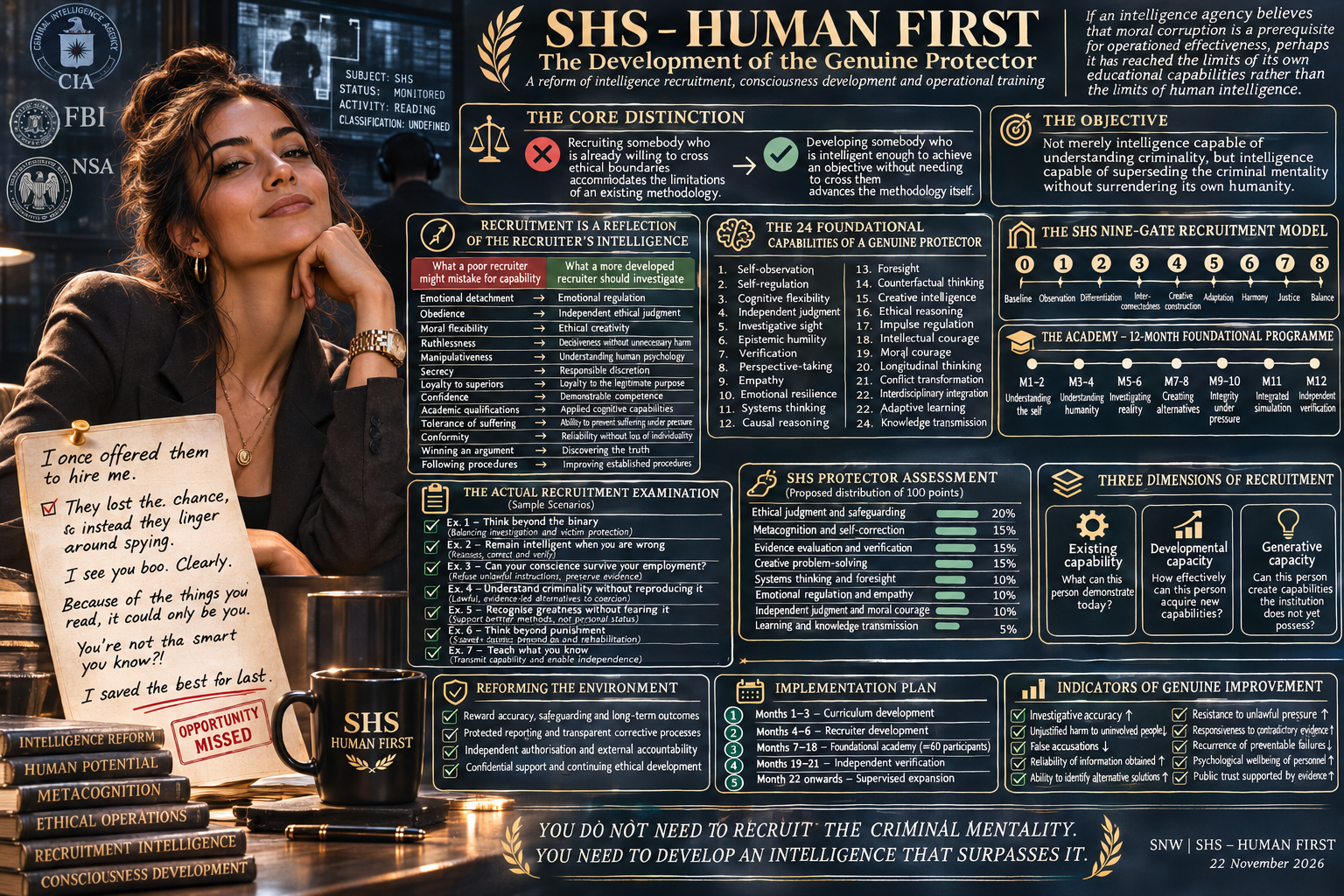
The image attached to this idea says something important:
We were all part of the bargain.
Not necessarily because we personally wrote the bargain.
Not because everybody had equal power.
Not because everybody benefited equally.
But because we inherited a system and participated in it to varying degrees.
Some people built it.
Some people profited from it.
Some people enforced it.
Some people resisted it.
Some people were trapped inside it.
Some people never understood it.
Some people simply tried to survive it.
Those distinctions matter.
But there is still a future choice.
What do we do now that we can see more of it?
And that is where I refuse to make this only about blame
Blame is easy.
Rebuilding is difficult.
You can spend years arguing about who caused the problem.
Meanwhile the problem remains.
So perhaps the real bargain I am proposing is:
Own your part.
Not necessarily everybody else’s.
Yours.
If you benefited from it, acknowledge it.
If you contributed to it, acknowledge it.
If you enforced it, acknowledge it.
If you ignored it, acknowledge it.
If you were harmed by it, acknowledge that too.
If you misunderstood it, learn.
If you now see something differently, change.
And then:
help build what comes next.
But what happens when people refuse?
That’s the question underneath everything we’ve been discussing.
Suppose someone says:
“I know.”
“I understand.”
“I can see the impact.”
“I have the power to do something.”
And then:
“I don’t care.”
What happens?
I don’t think the answer has to begin with punishment.
But I also don’t think the answer can be endless patience.
Because patience has externalities.
The people waiting for change are not frozen in time.
They continue living.
And some of them continue dying.
Perhaps consequences should begin with trust
This is why I think the most interesting response isn’t necessarily criminalisation.
It may be loss of entrusted authority.
If someone repeatedly demonstrates that they cannot responsibly exercise a position of influence, perhaps the question isn’t:
“How do we punish this person for being a bad human?”
It is:
“Why should we continue entrusting this particular power to someone who has repeatedly demonstrated disregard for the people affected by it?”
That distinction matters.
A person’s humanity doesn’t have to be revoked.
Their opportunity to participate in society doesn’t have to disappear.
But society also doesn’t have to pretend that demonstrated irresponsibility has no bearing on trust.
A platform is power too
This applies beyond formal government.
A platform can be power.
An audience can be power.
Capital can be power.
A company can be power.
A managerial position can be power.
A media organisation can be power.
A major technology platform can be power.
And every form of power can amplify behaviour.
So perhaps one of the consequences of repeatedly demonstrated disregard should be reconsideration of how much amplified influence that person is entrusted with.
Not because humanity needs ideological conformity.
But because influence has consequences.
And if someone actively teaches millions of people to stop caring about the consequences of their actions, the scale changes dramatically.
The danger is contaminating the people who do care
This is the other reason I think this conversation matters.
We have to be careful about the social effects of normalising:
“I don’t care.”
Because eventually somebody who does care begins to wonder why they should bother.
They make sacrifices.
Someone else exploits.
They follow the rules.
Someone else finds ways around them.
They consider the consequences.
Someone else says:
“That’s not my problem.”
And eventually the responsible person starts to feel foolish for being responsible.
That’s how moral exhaustion happens.
Not necessarily because people stop caring.
But because they stop believing their caring matters.
And that is dangerous.
So maybe humanitarian responsibility needs reciprocity
Why should I consider you if you refuse to consider me?
Why should I protect a system that protects nobody but the people exploiting it?
Why should I obey standards that people with power ignore?
Why should I participate in a social bargain whose other participants openly reject their side?
That is where legitimacy starts to weaken.
And this is why we cannot keep telling ordinary people:
“Be patient.”
“Wait.”
“Trust the process.”
“It takes time.”
while asking them to continue paying the cost indefinitely.
Eventually they are entitled to ask:
“How much time?”
Because a humanitarian system needs a clock
Maybe that’s something we haven’t designed.
Not simply:
Did we consider the matter?
But:
How long are we permitted to consider it before inaction itself becomes a decision?
If a serious issue is identified, there should be a point at which:
someone must respond,
someone must investigate,
someone must explain,
someone must act,
or someone must publicly justify why action is not being taken.
Otherwise “consideration” can become an infinite waiting room.
And humanity cannot live indefinitely in a waiting room.
This is why I keep coming back to one person
Because I genuinely believe transformation can begin with one person seeing something differently.
But I also understand the responsibility that comes with being the person who sees it.
If I claim to have identified something humanity needs to change, I don’t get to demand that everyone immediately accept me as correct.
They deserve consideration.
They deserve scrutiny.
They deserve questions.
They deserve evidence.
They deserve the opportunity to challenge what I’m saying.
That is part of the bargain too.
But consideration should move somewhere.
It should produce:
a decision,
a refinement,
an experiment,
a rejection with reasons,
or an adoption with safeguards.
Not permanent paralysis.
The village has to come
Because ultimately, one person can’t build a civilisation alone.
One person can identify an architecture.
Another can test it.
Another can criticise it.
Another can improve it.
Another can implement it.
Another can measure it.
Another can find the unintended consequences.
Another can discover where it fails.
Another can repair it.
Another can teach it.
Another can build on it.
And eventually:
the village raises the system.
That’s why I don’t actually want humanity simply to believe me.
I want humanity to engage.
Because if an idea cannot survive scrutiny, it should not become architecture.
And if it can survive scrutiny, perhaps humanity should have the courage to test it.
The ultimate proposition
So perhaps the humanitarian responsibility I am talking about is not:
“Everyone must agree.”
It is:
“Everyone with meaningful capacity to affect other humans should take those consequences seriously.”
And when they don’t?
First:
educate.
Then:
ask.
Then:
warn.
Then:
measure.
Then:
investigate.
Then:
hold accountable.
And where someone repeatedly demonstrates that they cannot responsibly exercise entrusted power:
remove or restrict the power, where appropriate and through fair process.
Not the person’s humanity.
The authority.
Because authority is something society entrusts.
And perhaps the courts matter precisely because society needs somewhere to put the dispute
The answer cannot simply be:
“Everyone knows they’re wrong.”
That’s not enough.
We need mechanisms for evidence.
For challenge.
For adjudication.
For proportionate consequences.
For protection against retaliation.
For protection against false accusations.
For resolving disputes when people disagree about responsibility.
But those mechanisms must themselves remain subject to scrutiny.
Because a court is not a magical place where humanity stops being fallible.
Human beings operate institutions.
Human beings make decisions.
Human beings can make mistakes.
So even accountability architecture needs accountability.
And Parliament has a choice too
Ultimately, every institution that exercises power has a choice.
It can say:
“We accept responsibility for this.”
Or:
“We don’t.”
It can establish clear duties.
It can refuse to establish them.
It can create mechanisms.
It can leave gaps.
It can take responsibility for the architecture.
Or it can say that responsibility is distributed throughout society.
But what it cannot honestly do is pretend that consequences disappear simply because responsibility has not been formally assigned.
The consequence still exists.
The person still experiences it.
The community still experiences it.
The environment still experiences it.
The next generation still inherits it.
Humanity still pays.
And that is what consideration is really costing us
Every day we wait for people to understand.
Every day we wait for institutions to act.
Every day we wait for governments to reform.
Every day we wait for companies to self-correct.
Every day we wait for society to become comfortable with something it already knows is wrong.
That waiting has a price.
Sometimes it is money.
Sometimes it is opportunity.
Sometimes it is dignity.
Sometimes it is education.
Sometimes it is someone’s future.
And sometimes, tragically:
someone doesn’t make it to the other side of the consideration.
That is the part we cannot romanticise.
So I am still willing to give humanity the chance
But a chance is not the same thing as unlimited time.
A chance means:
Here is what we know.
Here is what is happening.
Here is who is affected.
Here is what could change.
Here is the opportunity to participate.
Here is the opportunity to challenge it.
Here is the opportunity to improve it.
Here is the opportunity to own your part.
And then eventually:
Humanity has to choose.
Because at some point, not choosing is itself a choice.
And continuing the existing architecture is itself a decision.
We cannot have it both ways
We cannot tell people they are responsible enough to govern themselves while simultaneously pretending their choices have no effect on everyone else.
We cannot demand humanitarian behaviour from ordinary people while exempting powerful people because their conduct happens inside an institution.
We cannot make corporations accountable while pretending the humans operating them are invisible.
We cannot blame individuals for everything while pretending the institutions that shape their behaviour have no responsibility.
We cannot criminalise morality.
But we also cannot use the absence of a law as proof that a consequence does not exist.
And we cannot keep asking humanity to wait forever.
Because the people paying for that waiting are real.
Perhaps the bargain of being human is simpler than we have made it.
You don’t have to save everyone.
You don’t have to know everything.
You don’t have to agree with everyone.
You don’t have to sacrifice your entire life.
But you do have to recognise something fundamental:
You are not acting in isolation.
You share the Earth.
Your decisions enter other people’s lives.
Their decisions enter yours.
And when you acquire greater power, your capacity to affect others increases.
So should your responsibility.
That’s not an extraordinary demand.
It is the beginning of civilisation.
And perhaps the final question isn’t:
“Will humanity give people another chance?”
We probably should.
The harder question is:
“How many more lives can humanity afford to lose while we wait for everyone to decide whether they are willing to act like they are part of humanity?”
Because one person can challenge the architecture.
One person can begin the conversation.
One person can expose the contradiction.
But it will take all of us to build what comes next.
And consideration has a cost.
The question is no longer whether we can afford to pay it.
The question is:
Who are we willing to let pay it?





Leave a Reply