
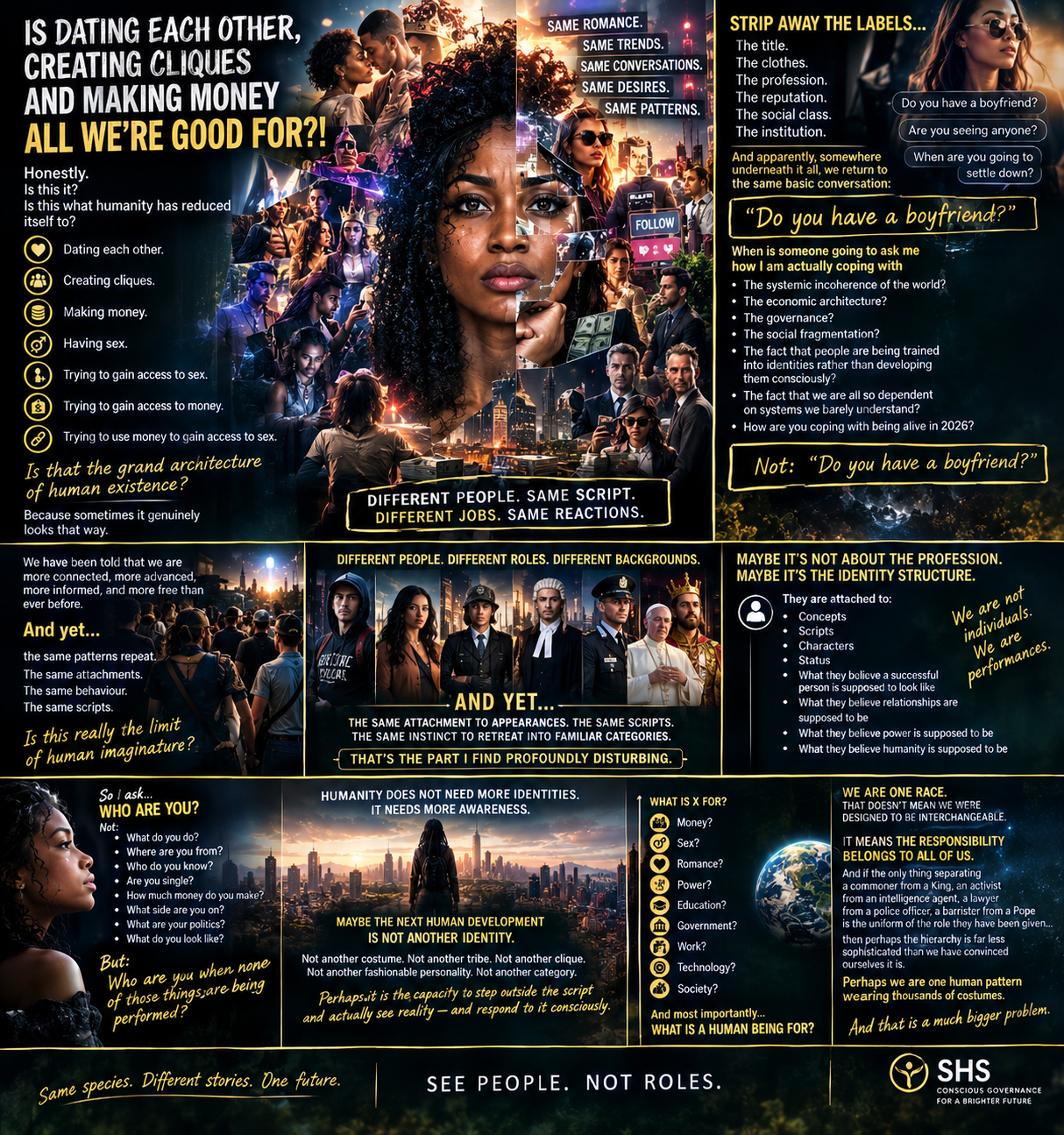
How’s it that 13 year olds are having the same conversations as 40yesr olds?! That’s heavily disturbing.
Honestly.
Is this it?
Is this what humanity has reduced itself to?
Dating each other.
Creating cliques.
Making money.
Having sex.
Trying to gain access to sex.
Trying to gain access to money.
Trying to use money to gain access to sex.
Is that the grand architecture of human existence?
Because sometimes it genuinely looks that way.
And what makes it even stranger is that it seems not to matter who the person is.
Strip away the title.
Strip away the clothes.
Strip away the profession.
Strip away the reputation.
Strip away the social class.
Strip away the institution.
And apparently, somewhere underneath it all, we return to the same basic conversation:
Do you have a boyfriend?
I have been approached by men from their late twenties into their forties, and that is still where some of them seem to be mentally.
High school.
“Do you have a boyfriend?”
“Are you seeing anyone?”
“When are you going to settle down?”
And I keep thinking:
When is someone going to ask me how I am actually coping with the systemic incoherence of the world?
When is someone going to ask:
How are you processing the fact that human beings have constructed systems that routinely contradict the very humanity they claim to serve?
How are you coping with the economic architecture?
How are you coping with governance?
How are you coping with social fragmentation?
How are you coping with the fact that people are being trained into identities rather than developing them consciously?
How are you coping with watching human beings become increasingly dependent on systems they barely understand?
How are you coping with being alive in 2026?
Not:
“Do you have a boyfriend?”
I cannot believe that our supposedly advanced civilisation can produce artificial intelligence, nuclear physics, global communications, space telescopes, financial markets spanning the planet, legal systems hundreds of years old, international institutions, universities, intelligence agencies, palaces, supreme courts and entire bureaucracies—
and yet a substantial portion of human interaction still appears to collapse back into:
sex, romance, money and social belonging.
Sex gets you intimacy.
Money gets you access.
Romance gets you one socially sanctioned route to sex for life.
Friendship becomes a clique.
Professional relationships become networking.
Social life becomes positioning.
And identity becomes performance.
So I have to ask:
Is this really the limit of human imagination?
Because I do not want to believe that a commoner, an intelligence agent, an activist, a lawyer, a barrister, a police officer, a Pope, a King and everyone else could all behave in essentially the exact same way when confronted with reality.
But what I have repeatedly witnessed has made that question much harder to ignore.
Different people.
Different jobs.
Different levels of authority.
Different educations.
Different backgrounds.
Different access to information.
Different amounts of money.
Different uniforms.
Different titles.
Different institutions.
And then somehow—
the same reactions.
The same attachment to appearances.
The same attachment to roles.
The same attachment to socially approved concepts.
The same instinct to retreat into familiar categories rather than examine what is actually happening.
That is the part I find profoundly disturbing.
Because if radically different human beings can occupy radically different positions within society and still reproduce almost identical behavioural patterns, then perhaps the common denominator is not the profession.
Perhaps it is the identity structure they have all inherited.
They are attached to concepts.
Attached to scripts.
Attached to characters.
Attached to status.
Attached to what they believe a human being is supposed to want.
Attached to what they believe a successful person is supposed to look like.
Attached to what they believe relationships are supposed to be.
Attached to what they believe power is supposed to be.
Attached to what they believe humanity is supposed to be.
And then we call this individuality.
Where is the individuality?
Where is the deviation?
Where is the person who looks at all of this and says:
“Wait. Why are we all doing the same thing?”
Where is the person who can encounter another human being without immediately reducing them to:
Potential partner.
Potential customer.
Potential employee.
Potential employer.
Potential contact.
Potential threat.
Potential status.
Potential resource.
Potential audience.
Potential sexual opportunity.
Potential utility.
Where is the person who can simply ask:
“Who are you?”
And genuinely mean it?
Not “What do you do?”
Not “Where are you from?”
Not “Who do you know?”
Not “Are you single?”
Not “How much money do you make?”
Not “What side are you on?”
Not “What are your politics?”
Not “What do you look like?”
But:
Who are you when none of those things are being performed?
Because I am starting to suspect that humanity has become very good at identifying people and very bad at actually encountering them.
We have created systems for everything.
Labels for everything.
Categories for everything.
Hierarchies for everything.
IDs for everything.
Profiles for everything.
But somehow we still struggle to recognise the actual human being standing in front of us.
And this brings me back to the question of Homo Agens.
Because perhaps the next human development is not another identity.
Not another costume.
Not another tribe.
Not another clique.
Not another fashionable personality.
Not another social category to belong to.
Perhaps it is the capacity to step outside the programmed script long enough to actually see reality and respond to it consciously.
To stop asking:
“What do humans normally do here?”
and start asking:
“What does this situation actually require?”
That would be revolutionary.
Because maybe humanity does not need more people competing over who gets the most money, the most sex, the most followers, the most status, the most attention or the most access.
Maybe humanity needs people capable of asking what all of these things are for.
What is money for?
What is sex for?
What is romance for?
What is power for?
What is education for?
What is government for?
What is work for?
What is technology for?
What is society for?
And most importantly:
What is a human being for?
Because I refuse to accept that the answer is:
Find someone.
Make money.
Join a group.
Reproduce the group.
Repeat.
We are one race.
That does not mean we were designed to be interchangeable.
It means the responsibility belongs to all of us.
And if the only thing separating a commoner from a King, an activist from an intelligence agent, a lawyer from a police officer, a barrister from a Pope is the uniform of the role they have been given, while beneath it they are all reacting from the same inherited scripts—
then perhaps the hierarchy is far less sophisticated than we have convinced ourselves it is.
Perhaps we are not looking at thousands of completely different identities.
Perhaps we are looking at one human pattern wearing thousands of costumes.
And that is a much bigger problem.
Because then the question is no longer:
“Why is everyone behaving strangely?”
It becomes:
“What exactly have we taught humanity to become?”
And perhaps that is the identity disorder I have been looking for.




Leave a Reply