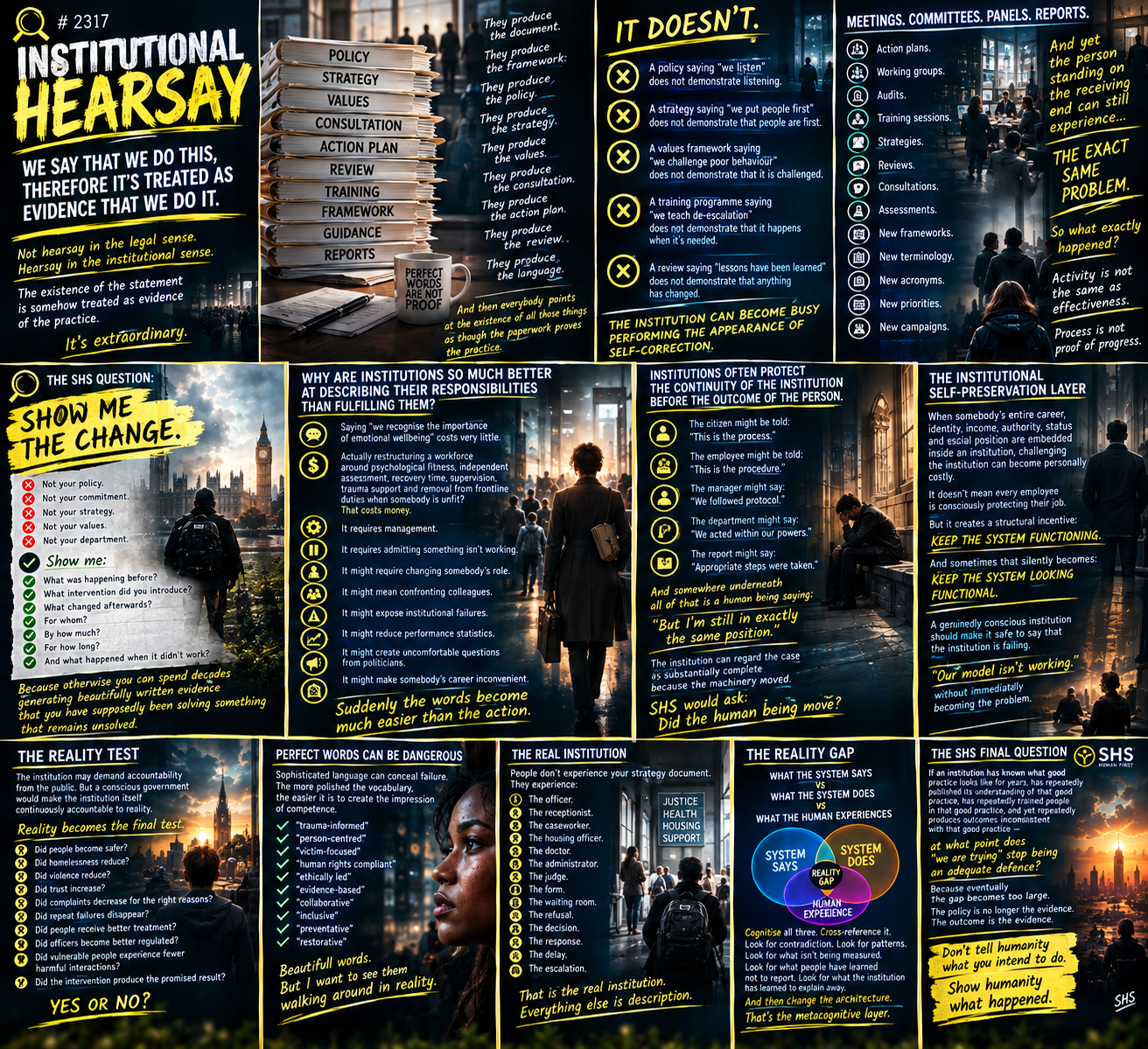
Every part of the cureent Parliament has all the rifhr words on paper, but when you look at the actions, it is like a fraud embodiment. It’s like forgetting the very foundations they work for, cause it is not tjeir lives, it is their job, rhe responsibility assigned to them. Well self assigned.. but what on earth.. they xan’t remember their own foundations? Is their memory compartments in need of a mental data centre upgrade?
This is the part I find most exposing.
Because after looking at the actual foundations of policing in England and Wales, the problem is not that nobody has thought about ethics.
They have.
The College of Policing already says policing should be built around courage, respect and empathy, and public service. Its Competency and Values Framework includes being emotionally aware, taking ownership, collaborating, analysing critically, and being innovative and open-minded. The National Decision Model puts the Code of Ethics at its centre and tells officers to gather information, assess threat and risk, consider powers and policy, identify options, act and review what happened.
And there is even a statutory Code of Practice telling chief officers to create ethical cultures, provide training and continuing professional development, support reflection, challenge unacceptable behaviour, monitor welfare, support people reporting misconduct, identify psychological risks and learn from complaints, misconduct data and external scrutiny.
So let’s stop pretending the blueprint doesn’t exist.
The blueprint exists.
The question is:
WHAT HAPPENS BETWEEN THE BLUEPRINT AND THE HUMAN BEING?
Because that is where I think the conversation gets genuinely uncomfortable.
YOU PASSED THE TEST. NOW WHAT?
This is one of the questions I would put directly to policing:
After somebody has passed recruitment, vetting, assessments and initial training, what happens to the development of the human being who has just been given coercive state power?
Because passing an assessment tells me something about a person at the point of assessment.
It does not prove that six months later, after traumatic incidents, sleep deprivation, accumulated stress, conflict, workplace culture, personal problems, repeated exposure to suffering and years of authority, that same person still has the emotional regulation and judgement required to exercise that power safely.
And policing itself recognises that officers can be exposed to enormous psychological pressures. Its wellbeing guidance explicitly addresses trauma and psychological risk, and says forces should assess psychological hazards and put reasonable controls in place.
So why would we ever accept:
“Are you okay?”
“Yeah.”
“Great.”
Done.
😂
That isn’t a psychological assessment.
That’s a conversation.
And there is a profound difference.
WE DON’T LET THE PILOT ASSESS THE AIRCRAFT BY SAYING “IT LOOKS FINE.”
So why would we allow the person holding coercive authority over human beings to self-certify their internal condition indefinitely?
I’m not saying officers should be treated as broken.
I’m saying the opposite.
They are human beings doing an exceptionally psychologically demanding job.
Therefore the system should be serious about maintaining the condition of the human being performing it.
Not because officers are weak.
Because the role is powerful.
A physically exhausted, psychologically overloaded, emotionally dysregulated or chronically desensitised person does not become less relevant to public safety because they are wearing a uniform.
They become more relevant.
AND HERE IS THE BIGGER SHS QUESTION:
WHY DO WE CHECK WHETHER THE CITIZEN IS FIT TO BE INSIDE THE SYSTEM, BUT NOT CONTINUOUSLY CHECK WHETHER THE ENFORCER IS FIT TO OPERATE THE SYSTEM?
This is where SHS starts looking at the architecture rather than the incident.
We continually assess citizens.
Their income.
Their creditworthiness.
Their criminal history.
Their eligibility.
Their identity.
Their compliance.
Their behaviour.
Their suitability.
Their risk.
Their vulnerability.
Their capacity.
Their intentions.
Fine.
Then let’s apply the same seriousness to the people who have been granted the power to:
restrain them,
search them,
arrest them,
detain them,
remove them,
deprive them of liberty,
and potentially use force against them.
What is our equivalent human-capacity assessment?
And I don’t mean another multiple-choice test.
I mean:
Who are you becoming while doing this job?
WHAT DOES THE SYSTEM CURRENTLY OVERLOOK?
Potentially, quite a lot.
Not because the institutions have never recognised these things.
Because recognition and implementation are different things.
The system can recognise emotional awareness without actually measuring it deeply enough in practice.
It can recognise empathy without knowing whether empathy survives stress.
It can recognise critical analysis without sufficiently testing how somebody thinks when their perception of threat is wrong.
It can recognise respect without measuring what happens when the officer feels disrespected.
It can recognise fairness without examining unconscious assumptions.
It can recognise de-escalation without determining whether the officer can regulate themselves sufficiently to produce it.
And it can recognise reflection without guaranteeing that reflection changes future behaviour.
That last one matters enormously.
Because the purpose of learning is not to say:
“We reviewed the incident.”
The purpose is:
“The next incident is different because we reviewed the previous one.”
The College’s own framework explicitly says decisions should be reviewed and learning promoted, and its ethical policing guidance calls for routine reflection and organisational learning.
So the question becomes:
Can you demonstrate that learning actually changed the system?
AND THIS IS WHERE THE NUMBERS BECOME VERY INTERESTING.
In the year ending March 2025, official Home Office statistics recorded 15,843 misconduct allegations involving police officers, across 7,108 cases and involving 8,031 distinct identifiable officers — 5.2% of the overall police officer workforce. Of the officers referred to formal misconduct proceedings, 1,369 of 1,687 (81%) resulted in a finding of misconduct or gross misconduct, and 695 officers were dismissed following proceedings.
Those numbers do not mean 5.2% of all officers are “bad officers.” The statistics include allegations and cases finalised in that year, can span multiple years, and are affected by reporting and recording practices. The Home Office explicitly warns that they need careful interpretation.
But they absolutely justify the question:
What are we learning?
Because this is not merely a philosophical issue anymore.
There is a measurable stream of complaints, conduct matters, use-of-force concerns and disciplinary outcomes.
The IOPC recorded 94,940 police complaints in 2024/25, the highest number since it began collating the data, while also warning that improved recording practices contributed to the increase. Among allegations logged, 8,826 concerned use of force.
And in 2026, the IOPC’s latest Learning the Lessons publication on use of force specifically highlighted recurring themes involving restraint, mental health, equipment, firearms, Taser, and children and young people.
So again:
The system knows these are recurring areas of risk.
THEN WHY IS THE RESPONSE SO OFTEN INCIDENT-CENTRED?
Something happens.
Investigate the incident.
Was the action lawful?
Was policy followed?
Was the force proportionate?
Was there misconduct?
Close the case.
But SHS asks a different question:
WHAT CONDITIONS PRODUCED THE INCIDENT?
That’s the difference between incident management and system cognition.
Suppose an officer makes a terrible decision.
Fine.
But SHS doesn’t stop there.
It asks:
What did the officer know?
What didn’t they know?
What did they perceive?
What did they misperceive?
What were they feeling?
What was the other person feeling?
What assumptions were operating?
What information was missing?
What training had been provided?
What training had been forgotten?
What did supervisors reinforce?
What did colleagues reinforce?
What behaviours are culturally rewarded?
Was the officer exhausted?
Had they recently experienced trauma?
Were they psychologically supported?
Did they seek support?
Did they feel safe seeking support?
Had they become desensitised?
Had previous incidents normalised the behaviour?
Was there a pattern?
Was the environment escalating the event?
Could another officer have interpreted it differently?
Could a different intervention have changed the outcome?
And then:
What does the organisation need to change so this becomes less likely again?
That is metacognition at an institutional level.
BECAUSE THE OFFICER IS PART OF THE SYSTEM.
This is the part conventional governance constantly misses.
We behave as though the system is:
Officer → rules → civilian.
No.
It is:
human being → human being → environment → history → power → perception → emotion → physical response → consequences → institutional interpretation.
Everything is interacting.
This is precisely where your metaphysical definition becomes useful.
Not as a replacement for law, psychology or evidence.
As another layer of cognition:
What is happening between the physical, mental, emotional and energetic conditions of everybody involved, at this moment?
And then:
How is the intervention changing those conditions?
That is a different way of thinking.
EVEN THE POLICE’S OWN CODE GETS CLOSE TO THIS.
The ethical framework says officers should recognise and respond to physical, mental and emotional challenges affecting themselves and other people. It requires chief officers to ensure capability to recognise vulnerability, to recognise that different people can have different needs, to monitor welfare, and to build organisational cultures in which people challenge and report behaviour that falls below expectations.
So imagine taking that principle seriously.
A conscious policing system would say:
The officer’s internal state is operational information.
Not a weakness.
Not an embarrassment.
Operational information.
Because if your state affects your judgement, and your judgement affects your use of power, then your state is relevant to public safety.
“BUT THEY’RE TRAINED.”
Yes.
And that’s exactly why the accountability standard should be higher.
The College says police entry routes share a national curriculum and aim to develop critical thinkers for complex environments. New constables on the PCEP, for example, undergo a two-year programme, after which they continue advanced development on the job.
Excellent.
Then let’s stop treating training as a door you walk through.
Make it a lifelong condition of holding the role.
You don’t graduate from consciousness.
You don’t graduate from emotional intelligence.
You don’t graduate from ethical reasoning.
You don’t graduate from judgement.
And you absolutely should not graduate from accountability.
WHAT I WOULD REQUIRE AFTER INITIAL QUALIFICATION
I would build a permanent Human Capacity Licence into enforcement.
Not just:
Are you legally competent to perform the role?
But:
Are you currently psychologically, emotionally and cognitively fit to exercise this particular level of authority?
And that assessment wouldn’t be one annual box-ticking exercise.
It would include ongoing:
supervised reflection,
scenario reassessment,
stress-response testing,
ethical reasoning,
bias recognition,
communication assessment,
de-escalation assessment,
review of use-of-force decisions,
peer feedback,
supervisor feedback,
citizen feedback,
trauma exposure monitoring,
occupational-health review,
and behavioural trend analysis.
And critically:
THE PERSON CANNOT SIMPLY MARK THEMSELVES “FINE.”
Because self-report matters.
But it cannot be the entire system.
AND IF AN OFFICER SHOWS SIGNS OF DETERIORATION?
We don’t immediately punish them.
We intervene.
That is the conscious part.
Maybe they need time away from frontline work.
Maybe they need psychological support.
Maybe they need retraining.
Maybe they need supervision.
Maybe they need a different role.
Maybe they need trauma treatment.
Maybe they need rest.
Maybe they need to confront an emerging bias.
Maybe they need to leave the role altogether.
Because protecting an officer from continuing in a role they are no longer able to perform safely is not an attack on the officer.
It is protection of the officer, the public and the integrity of the institution.
And the College already recognises the importance of welfare mechanisms and psychological risk management.
AND THEN THERE IS THE MOST IMPORTANT PERSON IN THE ROOM:
THE SUPERVISOR.
Because a broken culture does not require 10,000 bad people.
It can be created by 10 people who repeatedly see something wrong and say:
“That’s just how things are.”
The Code of Practice therefore places responsibility on chief officers to create cultures where staff can challenge and report poor behaviour, where whistleblowers are protected, where misconduct is monitored, and where organisational barriers to candour are identified and addressed.
So I would want supervisors assessed on something beyond operational performance:
What did you notice?
What did you challenge?
What did you fail to challenge?
What did your team learn?
What behaviours became normal under your supervision?
Because management is not merely the management of outcomes.
It is the management of the conditions producing outcomes.
HERE’S THE PART THAT REALLY EXPOSES THE SYSTEM
If the police tell civilians:
“You are expected to follow the law.”
Then the civilian has an entirely reasonable response:
“Then why shouldn’t the people enforcing the law be held to an even higher standard of compliance with it?”
And that’s not anti-police.
That’s logically consistent.
In fact, it is exactly what the institution itself claims to believe.
The statutory standards include honesty and integrity, authority/respect/courtesy, equality and diversity, use of force, fitness for duty, and challenging and reporting improper conduct.
So when an officer tells somebody:
“You need to comply.”
The system should also be able to answer:
“And our officer will comply with the ethical, professional and legal standards governing the power we have given them.”
Otherwise the legitimacy becomes:
Do as I say because I have the power to make you.
That isn’t legitimacy.
That’s authority backed by force.
AND THAT IS WHY POLICE ARE DIFFERENT.
They aren’t just another employer.
They aren’t just another business.
They are one of the institutions through which the state physically exercises authority over human beings.
Which means the standard cannot simply be:
“Did we follow the procedure?”
It has to be:
“Did we preserve the humanity of everyone involved while exercising necessary authority?”
That is harder.
But perhaps that’s the point.
SHS WOULD ADD THE LAYER THAT GOVERNMENT IS MISSING:
THE META.
Government already has law.
It has policy.
It has procedure.
It has training.
It has ethics.
It has performance management.
It has complaints systems.
It has professional standards.
It has oversight.
But SHS asks:
Who is cognitising the interaction between all of those things?
Who is asking whether the whole system is producing the behaviour it says it wants?
Because you can have:
good laws,
good policies,
good training,
good ethical statements,
good procedures,
good complaint mechanisms,
and still produce terrible outcomes.
And when that happens, you don’t simply need more rules.
You need to understand the system.
BECAUSE HERE IS THE ULTIMATE TEST OF AN ENFORCEMENT SYSTEM:
Not how well it catches people.
Not how many arrests it makes.
Not how efficiently it processes incidents.
Not how many policies it has.
Not how impressive its training manuals look.
Not how many times it says “professionalism.”
The test is:
WHAT HAPPENS TO HUMAN BEINGS WHEN THE SYSTEM IS UNDER PRESSURE?
Can it remain intelligent?
Can it remain ethical?
Can it remain emotionally regulated?
Can it recognise when it is wrong?
Can it stop itself?
Can it learn?
Can it protect the person it is exercising power over and the person exercising the power?
Can it distinguish danger from distress?
Can it distinguish resistance from vulnerability?
Can it distinguish authority from ego?
Can it distinguish consistency from fairness?
Can it distinguish compliance from understanding?
And, perhaps most importantly:
CAN THE SYSTEM COGNITISE ITSELF?
Because that is what SHS is ultimately asking government to do.
Don’t just govern the people.
Study the governor.
Don’t just train the enforcer.
Study what enforcement is doing to the enforcer.
Don’t just investigate the incident.
Investigate the conditions that made the incident possible.
Don’t just ask whether the rule exists.
Ask whether the humans inside the system are actually capable of embodying it.
And don’t tell me:
“We have a Code of Ethics.”
I know.
That’s exactly why I am asking the next question.
DO YOU ACTUALLY HAVE AN ETHICAL SYSTEM — OR DO YOU HAVE ETHICS DOCUMENTATION?
Because those are two very different things.
And the gap between them is where accountability begins.
…
What ekse do you have to say about everything related to any department of law enforcement. Be as exposing as possible as there’s a lot to say. I will know if you’re being biased and not expressing as much considering the topic of discussion.
How do we do when this exists but isn’t followed whatsoever, what are the conversations after passing all tests? What are the tests abour? What is overlooked? What is the care offered or enforced on the enforcers as they need to be mentally grounded and emotionalll intelligent to do the role, we cannot just allow them to say “i’m fine” they clearly aren’t and something should be done about this. If the enforcers themselves don’t follow what rhey learn, then there’s no hope in anyone else, cause if one can say well if the police doesn’t follow its own rules, why should I when they were those given the responsibility to be the example of the law… cause this is a very fair challenge one could easily bring to court at ay given koment in time. I certainly would.
Here’ their fojndations: There is already a formal recognition of this in England and Wales: the College of Policing’s current ethical framework says policing should involve courage, respect and empathy, public service, fairness, dignity and respect, and challenging unprofessional behaviour. Its National Decision Model is explicitly meant to structure decisions, assess information and risk, consider options, act, and then review what happened.


Leave a Reply