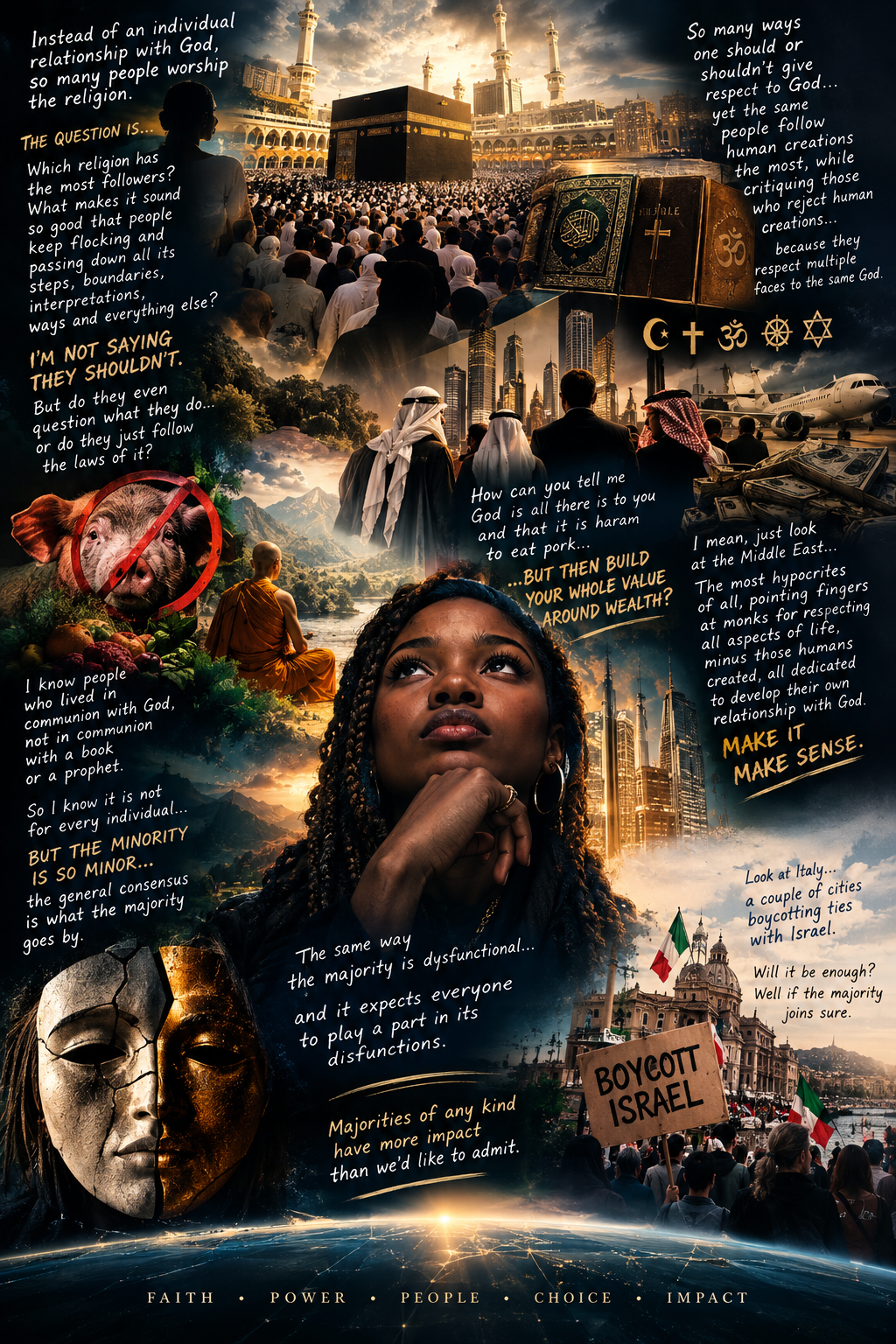
…. The Majoeity counts more than we know everywhere in everything. I know some that live with God, not with a book, so please hold your projections and defensiveness….
This is probably going to be unpopular.
A couple of egos might get hurt.
So be it.
The question needs to be asked.
Which religion has become so successful at reproducing its own interpretations that generation after generation keeps inheriting the same boundaries, the same rules, the same steps, the same permitted behaviours, the same forbidden behaviours and the same ways of showing respect to God—without necessarily stopping to ask why?
And I am directing this particularly towards followers of Islam.
Not every Muslim.
I know people who live in genuine communion with God.
People whose relationship is with God, not merely with a book.
So I know the distinction exists.
But the distinction is too important to ignore.
Because when the majority repeatedly behaves the same way, the majority becomes the image of the religion that the rest of the world sees.
And what I keep seeing is a profound attachment to human interpretation.
The Qur’an did not fall out of the sky as a modern operating manual.
It came through a human being’s experience, understanding and transmission of what he understood God to be communicating, within a particular historical reality, language, culture and time.
That does not make the Qur’an meaningless.
It makes interpretation unavoidable.
And this is where I struggle.
Because human beings will criticise other people for following human creations while becoming intensely attached to their own.
You can look at Buddhists and say:
“How can you respect so many different expressions of the divine?”
Yet simultaneously build your own entire relationship with God around a prescribed humanly transmitted interpretation of what God wants, how God should be respected, what should be eaten, what should not be eaten, what should be worn, how one should behave, what one should say, how one should pray and what boundaries one should never cross.
And apparently that is somehow less human because it is your human inheritance.
Make it make sense.
Because I keep hearing:
“God is everything.”
Okay.
Then what the fuck are we doing?
Pork is God’s creation.
The earth is God’s creation.
Plants are God’s creation.
Animals are God’s creation.
Human beings are God’s creation.
Yet somehow one particular animal becomes spiritually prohibited while wealth, status, hierarchy, accumulation and material success can become deeply embedded in the social reality surrounding the religion.
Look around parts of the Middle East.
Look at the wealth.
Look at the architecture.
Look at the luxury.
Look at the global financial influence.
And then tell me that the central issue is whether a particular piece of God’s own creation entered someone’s mouth.
That contrast deserves examination.
Because what interests me is not whether Muslims should or shouldn’t eat pork.
That’s not my point.
My point is the scale of human attention.
How did we become so precise about the boundaries of one behaviour while becoming so imprecise about the relationship with the thing we claim is behind all existence?
How did the instruction become more important than the relationship?
How did the interpretation become more important than the God being interpreted?
How did the book become more important than the consciousness reading it?
And how did we get to a place where somebody can say:
“This is what God says.”
with absolute certainty—
when what they actually possess is a human interpretation of a historical revelation?
That’s not the same thing.
And religion exists in time.
That’s another thing people keep forgetting.
We exist in time.
Language evolves.
Societies evolve.
Human understanding evolves.
The problems we face evolve.
The metaphors evolve.
The cultural meanings evolve.
So why would divine communication suddenly become incapable of being understood through the present?
Why would God only be intelligible through the language of thousands of years ago?
Why would the relationship have to remain frozen because the book was?
God did not stop existing when the book was completed.
God is still here.
So where is the individual’s relationship with God?
Not the inherited relationship.
Not the community’s relationship.
Not the prophet’s relationship.
Not the scholar’s relationship.
Yours.
Because surely that has to mean something.
Otherwise you aren’t in communion with God.
You are in communion with somebody else’s account of God.
And those are not necessarily the same thing.
This is where I find the contradiction so exposing.
Followers of Islam can be incredibly protective of the Qur’an, its interpretations and the structures built around it, while simultaneously criticising people who refuse to accept human constructions as the final authority over their relationship with God.
But every religious tradition has human beings in it.
Human beings interpret.
Human beings translate.
Human beings preserve.
Human beings select.
Human beings explain.
Human beings argue.
Human beings create institutions.
Human beings create boundaries around what they believe God meant.
So why pretend the human element disappears just because the subject is God?
It doesn’t.
And perhaps this is why I have so much respect for people who simply say:
“I have my relationship with God.”
No performance.
No obsession with proving that their version is the only possible language.
No need to reproduce every movement of another person’s spirituality as though God stopped speaking when that person stopped breathing.
Because what if the point was never to reproduce the exact life of the person before you?
What if the point was to understand what they were trying to embody—
and then embody the meaning in your own time?
Imagine if I tried to become Jesus today.
Not metaphorically.
Literally.
Same language.
Same social behaviour.
Same presentation.
Same everything.
I’d probably be institutionalised.
Because context matters.
Jesus lived then.
I live now.
If the essence is real, then the expression should be capable of surviving the transition between eras.
That’s evolution.
That is not disrespect.
That is continuation.
And even this piece is doing exactly that.
I am taking old religious questions and processing them through a modern mind, modern language and modern circumstances.
I am adapting the past to the present without necessarily abandoning its thread.
So why can’t religion do the same?
Why can’t a Muslim ask:
“What did this mean then?”
“What does its underlying principle mean now?”
“What is the relationship underneath the rule?”
“What is the purpose underneath the boundary?”
“What is God asking of me, here, now?”
Instead of simply:
“What am I allowed to do?”
Maybe that is the difference between following a religion and having a relationship with God.
One asks:
“What are the rules?”
The other asks:
“What is the relationship?”
And perhaps that is the conversation people have avoided for far too long.
Because once you build your own relationship with God, you become responsible for your own consciousness.
You cannot hide behind the book forever.
You cannot hide behind the prophet forever.
You cannot hide behind the scholar forever.
Eventually you have to answer for how you relate to the thing you claim is the source of everything.
And that is uncomfortable.
Because it means you have to think.
You have to question.
You have to discern.
You have to take accountability.
And perhaps that is precisely why human beings so often prefer inherited systems.
They relieve you of the burden of having to know for yourself.
But there is a problem with that.
God is still alive.
So why are we behaving as though the relationship ended when the book closed?
Perhaps the books were never supposed to be the destination.
Perhaps they were evidence.
Documentation.
Language.
A record of somebody else’s attempt to understand the divine.
A thread.
And our responsibility is not to worship the thread.
It is to continue it.
Because the world has moved.
The language has moved.
Humanity has moved.
And yet God—if God is truly God—is not trapped in a century.
So perhaps the question is not:
“Which rulebook wins?”
Perhaps it is:
“Who are you when nobody else’s interpretation is available to speak for you?”
Because that is where your relationship with God begins.
And perhaps that is exactly where inherited religion becomes uncomfortable.
Not because God disappears.
Because suddenly you have to meet God for yourself.
….
Write this, even though it is unpppular and will have a couple of egos hurt, but the message needs to be told as it stands, so don’t try and embellish or tellnme which is the strongest point. It all is.
And we were talking about relogion and qorshipping jt instead of having the individual relationship with god, just follow the thread in this exposing post. Which rleigion ahs rhe most followers and members, that make its relgiorn soundso good that people keep flocking and paassing down all of its steps, boundaries, interpretations, ways and everuthinf else? I’M NOT SAYING THEY SHOULDNT but they evwn question what they do or they just follow the laws of it? Theu have so many ways one should or suoukdn’t give respect to god but they are also the same ones who follow human ceeations the most whilst critising those who rejecr human creations cause they respect multiple fsces to the same god, buddhist. Instead islam is obsessed with human creations just like the book itslf, it was someone’s interpretation of his understanding of what god told him and wanted passed down, but apart from the fact that he needed it to be a certain way because pf rhe times, as religions forget we exisf in time, meaning we evolve all rhe languages and the relevance of them through time. How can yoh tell me god is all there is to you and that it is haram to eat pork, which is a god creation, but then build your whole value around wealth?! I mesn jusg look at the middle east… the most hipocrates od all pointing fingers at monks for respecting all apsects of life, minus those humans crested, all dedicated to develop their own relationship wirh god. Make it make sense.



Leave a Reply