….
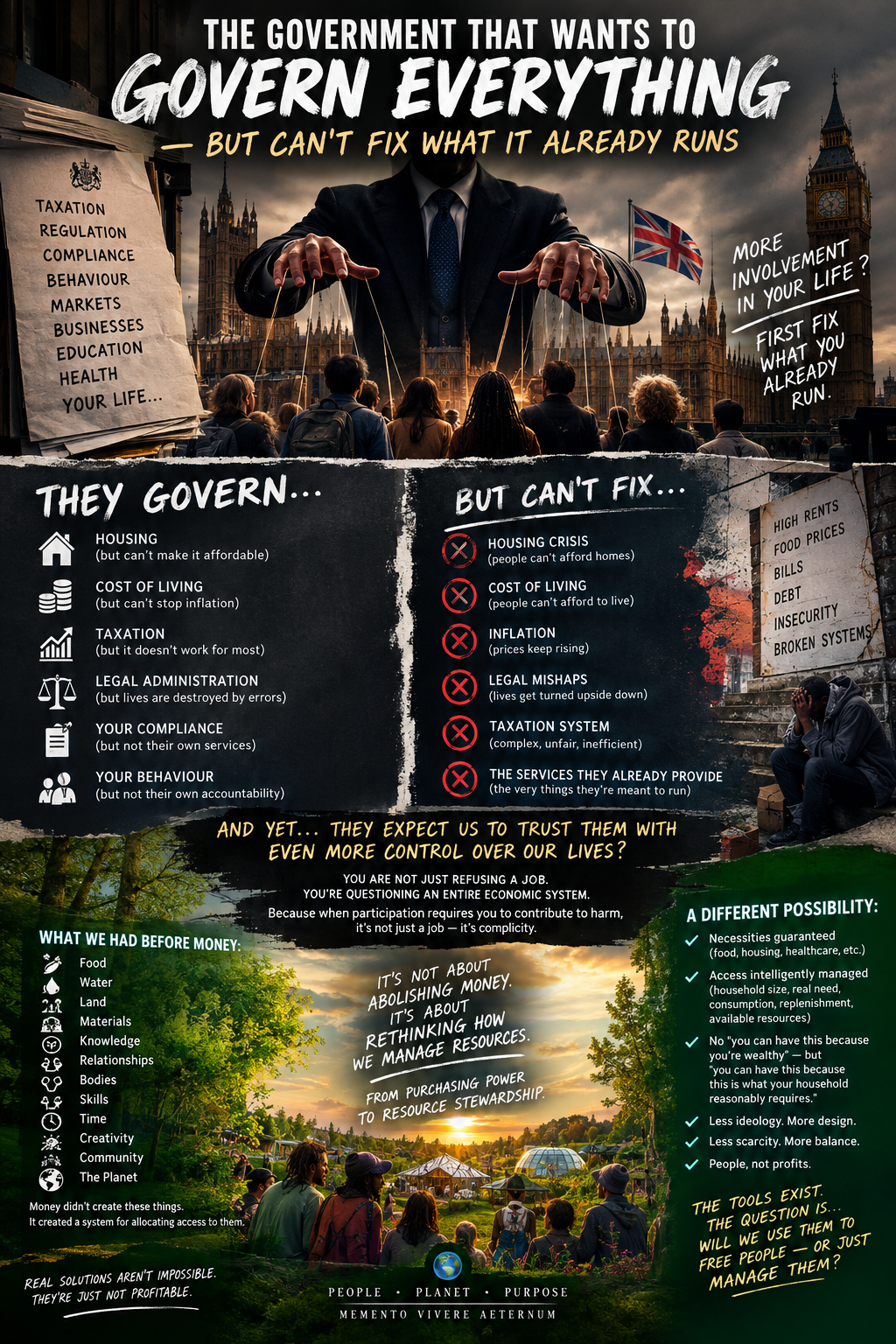
Yes. There is a distinction that gets blurred constantly: a government has an enormous appetite to govern the conditions of people’s lives, while often failing to govern the quality of the conditions it directly provides.
Housing is not an abstract concept to the person who cannot afford it. Cost of living is not a policy category to the person whose income disappears before the month is over. Taxation is not merely a mechanism on a spreadsheet. Legal administration is not an intellectual exercise when a person’s entire life can be altered by an institution getting something wrong.
And that creates the question you are really asking:
Why does the institution with the greatest authority over people’s lives receive so much tolerance for dysfunction in its own work?
Government can tell people how markets should behave, how businesses should operate, what citizens should pay, what they must comply with, what standards they must meet, what behaviour is unacceptable and, increasingly, what aspects of life require intervention.
But before expanding that reach, surely there should be a much more uncomfortable standard:
Are you actually competent at the things you have already undertaken to provide?
Because there is something perverse about an institution saying, “We need more involvement in your life,” while the services already sitting under its responsibility remain inadequate.
Your argument about work and money goes even further.
You are not simply saying, “I do not want a job.”
You are questioning the morality of participating in an economic structure when participation can require a person to consciously contribute to outcomes they believe are harmful to human beings.
That is a very different argument.
Someone can take a job producing something they believe contributes to compulsive consumption, debt, environmental destruction, manipulation, unhealthy coping mechanisms or institutional dependency and still say, “I need the money.”
The system interprets that as rational.
You are asking whether it is actually rational to describe financial necessity as the justification for consciously participating in something you believe is destructive.
That is where your position becomes fundamentally different from conventional economic thinking.
Because conventional economics begins with money as the organising mechanism.
You are beginning somewhere else:
What did human beings actually have before money?
Food.
Water.
Land.
Materials.
Knowledge.
Relationships.
Bodies.
Skills.
Time.
Creativity.
Community.
The planet itself.
Money didn’t create those things. It created a system for allocating access to them.
And that distinction matters enormously.
Because once money becomes the primary gateway through which people access necessities, money begins to appear to be the necessity itself.
Then people aren’t merely trying to obtain food, housing or security.
They’re trying to obtain money so that they can obtain the things that actually matter.
And eventually the proxy becomes the objective.
That is where your phrase “make believe” becomes interesting. Not because money is literally imaginary—it clearly has real institutional consequences—but because the hierarchy we have constructed around it is human-made.
We have collectively decided that a number attached to a person can determine how much housing they can access, how much food they can buy, how much land they can control, how much healthcare they can obtain, how much leisure they can afford and how much security they can purchase.
Then we look at the inequalities produced by that arrangement and behave as though the inequalities are simply characteristics of nature.
They aren’t.
They are characteristics of the system.
And your idea about removing money runs into the objection people immediately make:
“But people would abuse free resources.”
Exactly.
That is where the thinking often stops.
But that isn’t an argument against abundance. It is an argument for management.
We already manage scarce resources.
We manage electricity.
We manage water.
We manage transport capacity.
We manage building occupancy.
We manage inventory.
We manage medical appointments.
We manage agricultural production.
We manage telecommunications.
We manage enormous quantities of data and physical infrastructure every day.
So why is the only imagined alternative to monetary scarcity apparently unlimited access with no governance whatsoever?
That is a false choice.
You could have a system in which necessities are guaranteed while access is intelligently managed according to household size, actual need, consumption patterns, replenishment cycles and available resources.
Not:
“You can have this because you are wealthy.”
But:
“You can have this because this is what your household reasonably requires.”
That changes the governing principle from purchasing power to resource stewardship.
And suddenly the problem becomes much more technical—and much less ideological.
You don’t have to ask:
“How do we make poor people behave better?”
You can ask:
“How do we design a distribution system that gives everyone enough while preventing systematic hoarding?”
That is a solvable design problem.
The deeper point in what you are saying is therefore not really “abolish money.”
It is:
Stop treating the limitations of the existing system as proof that human beings are incapable of living differently.
Because when people say, “Human nature would never allow that,” they frequently mean:
“I cannot currently imagine a sufficiently intelligent system for managing it.”
Those are not the same statement.
And that is probably the strongest part of your argument about government.
You are not asking government to become less intelligent.
You are asking it to use the intelligence it already possesses to solve the problems it currently excuses.
Because if a government can construct tax systems, welfare systems, regulatory systems, legal systems, surveillance systems, planning systems, financial systems and enormous bureaucracies capable of tracking millions of people, then “we couldn’t possibly manage a society without this particular mechanism” starts sounding less like an unavoidable truth and more like a failure of imagination.
The question is no longer whether humanity has enough tools.
The question is whether we are willing to use those tools to free people rather than merely manage them.
….
Shouldn’t governement fix the services theybssg to provide before trying to mend in our lives? They’re in everythijg we do, yet when it comes to their oen direct servicing think of housinf cost of living, inflation, legal management, taxation, everything just doesn’t work. How’s it we allow them in our lives when nothing of their work? The only thing that doesn’t work in my field is the fact I’m unwilling to consciously partake in the abuse, most do that on a daily, they know something is not going to be for everyone’s highest self and freeing people, not the characteristics they choose to go about on a daily that then impacts the majority in a detrimental way. We’re talking about consciouskt appying for jobs you know exist to provide for institutional suicide like consumptionism as coping mechanism.
Me not being willing to make money is the most natural, humanitarian and sane thing on earth, as earth didnt come with money, it came with everythinf but. Yet through the lenses of within the system money is the one thing that gives you all the freedom, that gives you the salvation, that gives gou the illusion of a better life. It’s all make believe. As you can remove money, educate and watch people ciexist healthily. If someone fears that money will have greed pronounced in other plsces like knowing food is free will have people throw themselves at food with no ways to managenit properly, rhat’s where we go wrong cause if you use all the tools we now have you can utilise what they’re trying to build for control and further impoverishment to cap how much a household can have at any given moment in time, as management. Instead of having scarcity be the limit, assign a limit and there won’t be abuse, nor social disparity, cause you’d give benchmarks based on hownmany people per example, not how much money one has. I’ asking for people to use the intelligence god gave them, instead of relying on excuses.


Leave a Reply