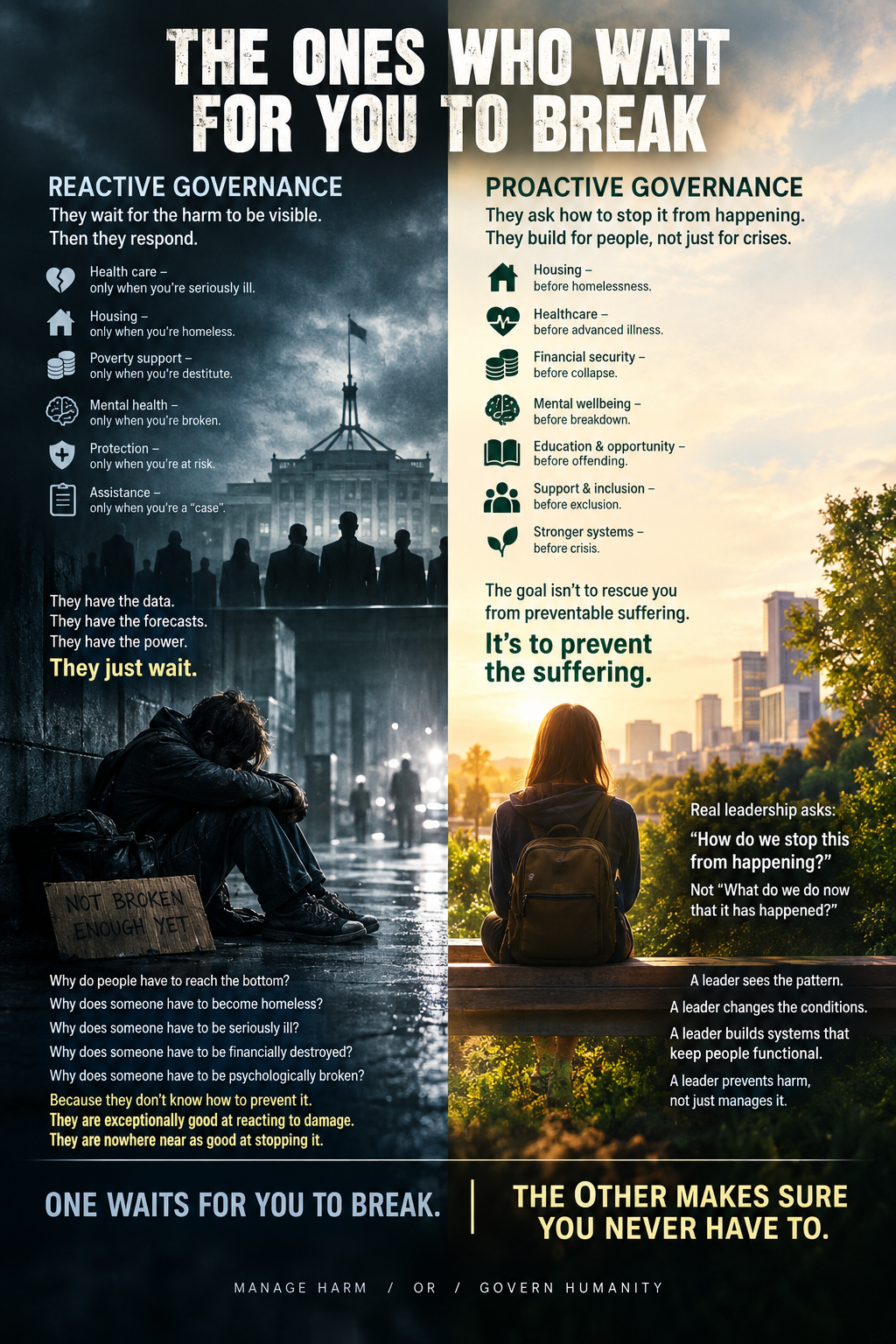
When things go south, whether it’s health, homelessness or poverty, we all go to the source of our problems to ask for help, as it is the same source of its creation and condoning.
The one that crafted the poison has the antidote too.
Why?
Because it is reactive governance.
We’ve seen it across all fields, minus when it counts to be reactive promptly.
And really good at being a contributor in advance to harm.
Whether it is trying to get a full body check where you either must be 55, dying or private.
Whether it is not having free housing in excess available at any time before need.
Whether it is not having pools of contingencies to avoid another 2008.
Whether it is housing.
Whether it is health.
Whether it is poverty.
They all wait for the harm to show up before doing anything.
And that is what I find so disturbing.
They wait for the problem to become visible enough before they decide it is real enough to deserve a response.
Look at how, on the streets, everyone says unless you’re being abused, playing the part or acting the part, or else you won’t get any support with any urgency.
It’s like they need to see you down in order to help you.
They need to see you dying before they can help.
They need to see you bleed before they’ll raise a healing hand.
They need evidence of collapse before they recognise that something is collapsing.
And by then, what exactly are they responding to?
The original problem?
No.
They are responding to the consequences of the problem becoming too visible to ignore.
That is not prevention.
That is aftermath management.
That is a system waiting for a human being to become damaged enough to qualify for intervention.
And honestly, how insane is that?
Why does someone have to reach the bottom before the system decides they deserve a hand getting back up?
Why does someone have to become homeless before housing becomes urgent?
Why does someone have to become seriously ill before healthcare becomes urgent?
Why does someone have to become financially destroyed before poverty becomes urgent?
Why does someone have to become psychologically broken before anyone starts asking what happened to them in the first place?
Why?
Because they have no idea how to preempt, prevent and build in avoidance of harm.
They are exceptionally good at reacting to damage.
They are nowhere near as good at preventing it.
And that becomes even more ridiculous when you realise that they have access to the data, the records, the patterns, the forecasts, the technology, the statistics, the history, the infrastructure and the intelligence to see so much of it coming.
They know.
They just wait.
They wait until the consequences become undeniable.
They wait until a person is visible.
They wait until a person is desperate.
They wait until a person becomes a case.
They wait until a person has accumulated enough suffering to fit whatever threshold they have created for suffering.
And then they intervene.
That is why I keep saying this is not simply a lack of resources.
It is a lack of imagination.
Because there are always solutions that could be built before the damage occurs.
You could have housing capacity before homelessness.
You could have preventative healthcare before advanced illness.
You could have contingency reserves before economic collapse.
You could have support before crisis.
You could have education before offending.
You could have rehabilitation before exclusion.
You could have early intervention before breakdown.
You could have systems designed around maintaining people rather than waiting to repair them.
But that requires a completely different mentality.
It requires a government that is asking:
“How do we stop this from happening?”
instead of constantly asking:
“What do we do now that it has happened?”
And there is another layer to this that I find even more exposing.
Their authority only seems to exist with harm.
They know how to become very important when something has already gone wrong.
They know how to investigate.
They know how to assess.
They know how to classify.
They know how to determine eligibility.
They know how to refer.
They know how to write reports.
They know how to create procedures.
They know how to tell you what happens next.
But where are they when nothing has gone wrong yet?
Where is the intervention before the crisis?
Where is the infrastructure before the shortage?
Where is the housing before the homelessness?
Where is the healthcare before the disease?
Where is the financial protection before the collapse?
Where is the support before somebody has completely broken down?
That is where I think the real weakness is.
Because they don’t know how to lead leaders.
They know how to lead followers.
And that is the saddest part.
A follower waits for the problem and then follows the procedure.
A leader sees the pattern and changes the conditions producing the problem.
A follower asks, “What does the policy say?”
A leader asks, “Why does this policy still allow this to happen?”
A follower waits for permission.
A leader creates the conditions in which permission is no longer required for common sense.
And if your entire governance model is built around responding to visible harm, then the only way for it to provide is to break you down enough for you to become visible to it.
That is the madness.
The system almost needs you to deteriorate in order to recognise you.
It needs enough damage.
Enough evidence.
Enough documentation.
Enough crisis.
Enough visible dysfunction.
Enough proof that you are no longer coping.
And then, finally:
“We may be able to help.”
What if instead of breaking people down and hoping there is enough left for them to seem functional to the system, the system was built to keep people functional in the first place?
What if the objective was not to rescue people from preventable suffering?
What if the objective was to prevent the suffering?
That would change everything.
Because then government would stop measuring success by how many crises it manages and start measuring success by how many crises never happen.
And that is the kind of governance I actually want to see.
Not governance that waits for the poison to spread so it can prove it has an antidote.
Governance that asks why the poison was allowed to spread in the first place.
Because if you are the same institution responsible for creating, maintaining, permitting or condoning the conditions that harmed somebody, then showing up afterwards and saying “we’re here to help” is not the greatest sign of competence.
Sometimes it is simply evidence that you waited too long.
And perhaps that is why the current system feels so strangely functional.
It keeps moving.
It keeps reacting.
It keeps documenting.
It keeps processing.
It keeps repairing.
It keeps surviving its own consequences.
But it rarely seems interested in becoming the kind of system where those consequences did not have to happen in the first place.
And that is the difference between managing harm and governing humanity.
One waits for you to break.
The other makes sure you never have to.
…..
Write this piece, preserving everuthing as my right of speech. Any limitstion you might think, I’ve already given you a solution to.
Whrn thibgs go south whether it’s health honelessnes or poverity, we all go to the source of our ptoblems to ask fir hdlp as it is the sane source of its freation and condoning. The one tgat crafted the poison has the antidote too. Why? Cause it is a reactive governance, we’ve seen it across all fields minus when it counts tobbe reactive promptly. And really good at being cojtributor in advance to harm. Whether it is to get a full body check where you either must 55, dying or privste; whether it is not having free housing jn excess svailable at any time before need, or having pools of contingencies like to avoidva 2008. Thry all wait for the harm to show up before doing anything.
Look at how on the streets everyone says unless you’re in being abused of, play (acting) the part or else you won’t get any support with any urgency. It’s like thdy need to see you down in order to help. They need to see you dying before they can help. Tgey need to see you bleed before they’ll raise a healing hand, cause they hsve no idea how to preempt, prevent and build in avoidsnce of harm. Their suthority only exists with harm, they don’t know how to lead leaders, only followers and tgat’s the saddest part so the only way for thrm to ptovide, it is to break you down hoping there’s enough left for you to seem functional to tgem….





Leave a Reply