
I think there is another layer of opportunity here.
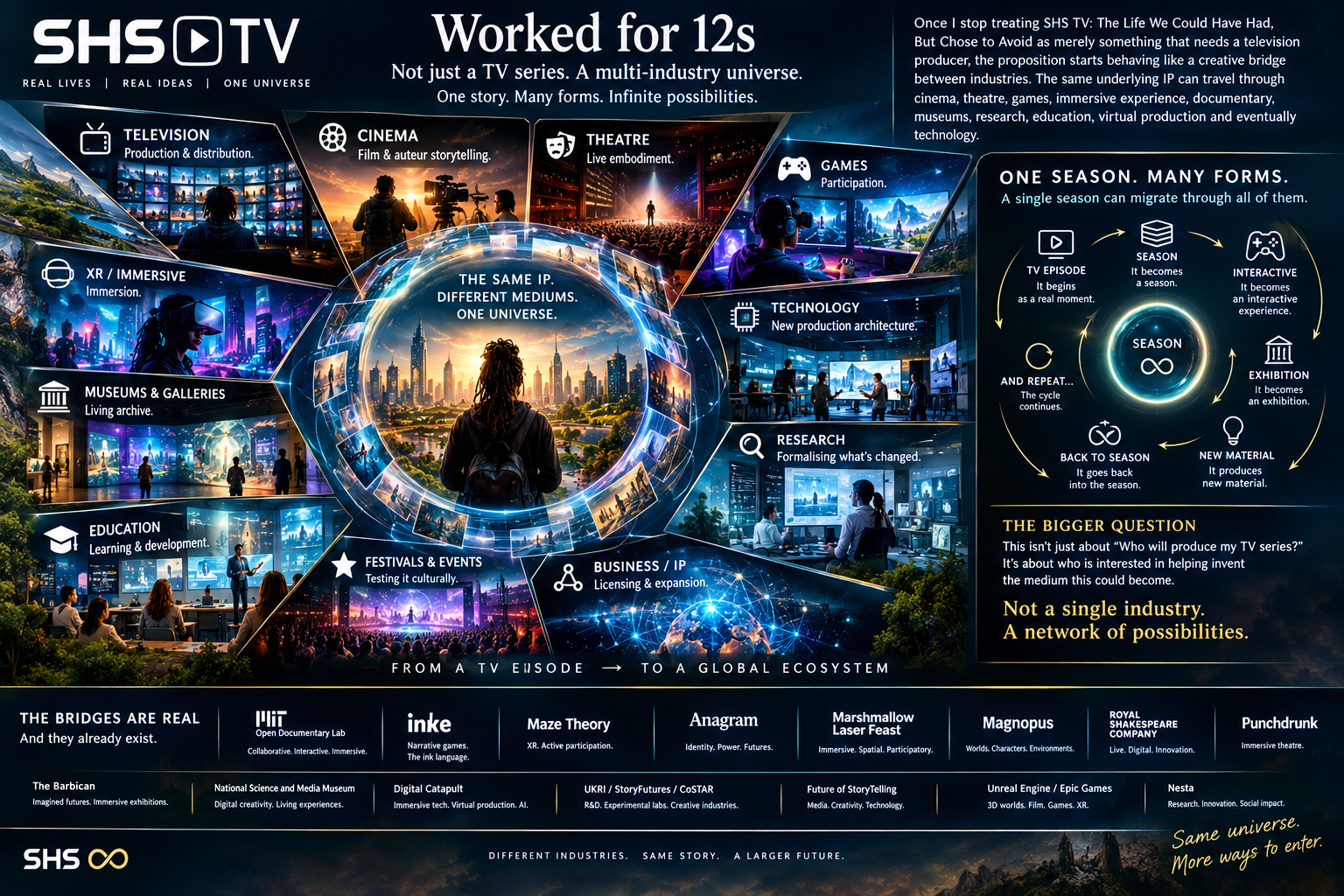
Once I stop treating SHS TV: The Life We Could Have Had, But Chose to Avoid as merely something that needs a television producer, the proposition starts behaving like a creative bridge between industries. The same underlying IP can travel through cinema, theatre, games, immersive experience, documentary, museums, research, education, virtual production and eventually technology.
The strongest additional bridges I would explore are these:
Interactive storytelling & games
MIT Open Documentary Lab is an unusually close conceptual match. It explicitly works with storytellers, technologists and scholars on collaborative, interactive and immersive documentary, and describes documentary as a project rather than a genre confined to one medium. It also runs residencies and incubates experimental projects.
inkle is another fascinating bridge because it builds narrative games and interactive stories, including its own interactive storytelling language, ink. Its current work includes The Game Narrative Kaleidoscope, and it publicly lists a general contact and press contact.
Maze Theory is perhaps even closer to the experiential side: it describes itself as an XR studio creating narrative experiences around active participation, with stories designed to unfold through immersive scenarios and “limitless possibilities.”
That gives SHS a potential fourth dimension:
Don’t only watch the alternative world. Enter it.
Immersive experience studios
Anagram should be on the list. Its work explicitly combines interactive storytelling, immersive experience design, technology and lived experience, including projects exploring identity, power, relationships and post-human futures.
Marshmallow Laser Feast, Magnopus and Disguise belong in the same ecosystem: they can be approached around the idea of transforming the IP from something watched into something inhabited, spatial, participatory or technologically mediated.
The theatre bridge
The Royal Shakespeare Company is particularly interesting because it already treats digital and creative innovation as part of its core practice and says it has spent years exploring storytelling across multiple platforms with technology companies, academics and artists. Its first video-game venture, LILI, was selected for Venice Immersive.
That means your season structure could eventually become theatrical too:
Season: Governance
→ stage performance
→ film
→ interactive world
→ live audience intervention
→ digital archive
→ future episode
The medium changes.
The underlying season survives.
And Punchdrunk belongs here because immersive theatre is already based on changing the relationship between the audience and the story.
Museums and galleries
This is one I would take much more seriously now.
The Barbican Immersive strand is currently presenting work explicitly concerned with imagining alternative futures and creating worlds that do not yet exist. Its 2026 In Other Worlds exhibition centres on films and environments exploring radically different possible futures.
That is remarkably close to your “What could have happened?” mechanism.
Then there is the National Science and Media Museum, which won the 2026 Museums + Heritage Award for Best Use of Digital for its Digital Creatives work. The same awards also highlighted immersive storytelling at Caerphilly Castle and the National Gallery’s Imaginarium.
So one of your seasons could eventually exist as an exhibition.
Not merely:
Watch the show.
But:
Walk through the world that humanity could have had.
Creative technology & R&D
This is where Digital Catapult becomes important.
It is explicitly working on immersive technology, virtual production, XR, AI and connected audience experiences, and its current Advanced Media Production infrastructure exists specifically to help creatives experiment with new ways of telling stories.
And this isn’t theoretical infrastructure: Digital Catapult says its creative programmes have supported immersive prototypes and creative-technology development, while its 2026 work describes “creative deep tech” as an emerging frontier for the creative industries.
That is a bridge between your idea and the machinery needed to prototype it.
StoryFutures / CoSTAR / UKRI
This may actually be one of the most important bridges because the concept is fundamentally R&D disguised as storytelling.
UKRI says StoryFutures Academy develops immersive storytelling through experimental labs, workshops and productions, while the wider programme has supported and co-funded immersive productions. CoSTAR is similarly designed as a national creative-industries R&D infrastructure spanning film, television and performance.
So SHS doesn’t necessarily have to ask:
“Will you buy my TV show?”
It can ask:
“Would you like to investigate what happens when a television series has permanent thematic seasons, chronological navigation and alternate-world simulation?”
That is a completely different conversation.
Future of StoryTelling
Future of StoryTelling (FoST) may be one of the cleanest conceptual bridges of all.
It describes itself as a multidisciplinary story studio operating at the intersection of media, creativity and technology, with work spanning books, interactive apps, websites, film, VR/AR/XR, live events and immersive projects.
That’s almost the entire SHS TV ecosystem in one sentence.
Ars Electronica
This one is particularly interesting right now.
The 2026 Ars Electronica festival was themed “Negotiating Humanity”, with a major focus on “Living Archives” — treating archives not as static repositories but as dynamic spaces where past, present and future meet through interactive storytelling and technology.
That is extremely close to what you’ve been constructing:
The archive doesn’t end.
It continues.
It changes because new material arrives.
The past remains accessible while the present keeps extending it.
That is essentially your open-season architecture translated into cultural-archive language.
Unreal Engine / Epic Games
And then there’s the technology underneath the possible future.
Unreal explicitly positions its film-and-TV tools around reusable 3D assets, virtual production and creating worlds audiences can explore, and its current 2026 development roadmap is moving toward a more unified ecosystem spanning games, animation and film/TV workflows.
That doesn’t mean “make SHS in Unreal.”
It means Unreal could potentially become part of the technical language of a universe in which the same world has to exist across film, interactive experiences and other media.
And there is a particularly beautiful research bridge
Nesta is worth approaching not as a producer but as someone interested in the structural consequences of innovation in the creative economy. Its current work describes itself as a research and innovation foundation working across the innovation lifecycle and examining how creativity contributes to economic, cultural and social wellbeing.
So you have the possibility of someone looking at SHS TV not as:
“a strange TV format.”
But:
“a new model for organising cultural IP.”
And this is the bigger map now
I would stop thinking of the proposition as having a single industry destination.
It has bridges.
Television → production and distribution.
Cinema → film and auteur storytelling.
Theatre → live embodiment.
Games → participation.
XR → immersion.
Museums → living archive.
Technology → new production architecture.
Research → formalising what has actually changed.
Education → using the archive to teach.
Festivals → testing it culturally.
Business/IP → licensing the expanding universe.
And then the really interesting possibility:
One season could migrate through all of them.
A proposition begins as something real.
It becomes a television episode.
The episode becomes a season.
The season becomes an interactive experience.
The experience becomes an exhibition.
The exhibition produces new material.
The new material becomes another episode.
That episode goes back into the season.
And suddenly the IP itself behaves exactly like the storytelling architecture you invented.
It never really closes.
It keeps integrating.
Which brings us straight back to your eight.
8 isn’t just an episode count.
It becomes the principle:
creation that knows how to continue.
And that is why I think the next outreach shouldn’t simply be “Who will produce my TV series?”
It can become:
Who is interested in helping invent the medium this could become?
That opens a much bigger door.


Leave a Reply