
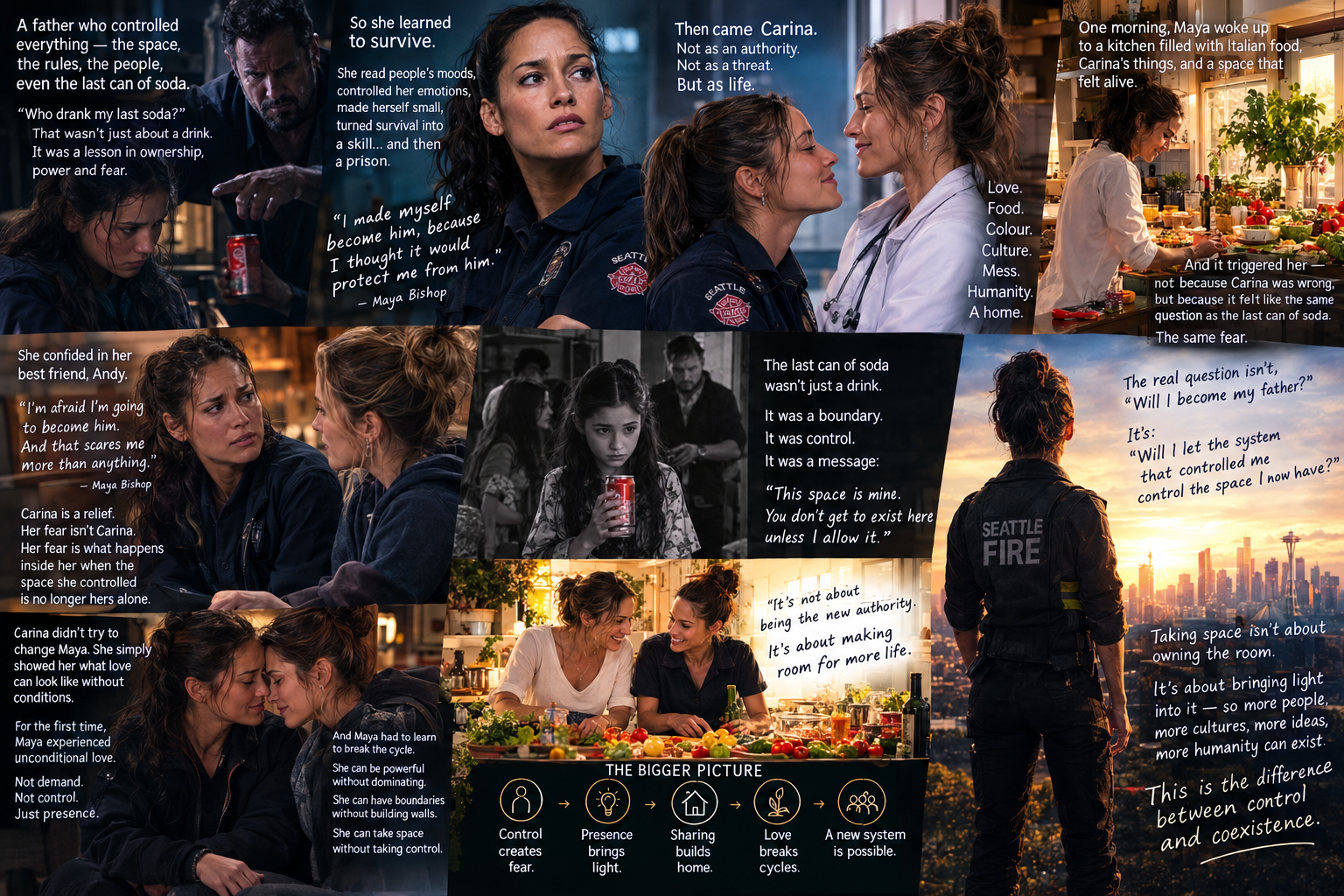
*AI image misplaced the characters, but the morale stands*
There is a scene in Station 19 that has stayed with me because it describes something much bigger than childhood trauma, much bigger than a difficult father, and much bigger than a relationship.
It describes what happens when you have spent your entire existence learning the rules of a system that tells you where you can stand, what you can touch, how much space you are allowed to occupy, how other people are permitted to behave around you — and then one day, another person enters that space and simply starts living.
That is what makes Maya Bishop’s relationship with Dr. Carina DeLuca so important.
Because Carina does not enter Maya’s life as another authority figure.
She enters it as life.
And that distinction changes everything.
In Season 4, Maya and Carina are moving from the comparatively controlled territory of dating into the much more confronting territory of actually sharing a home. By the previous episode, Maya has even extended that sense of home far enough to invite Andy into the apartment. Then, in 4×04, Maya suddenly has to confront something she has spent most of her life avoiding:
Someone else is now occupying her space.
Not visiting it.
Not passing through it.
Not obeying its rules.
Living in it.
And Maya discovers that this is terrifying.
Because Maya’s father had taught her, without necessarily needing to state every rule aloud, that space belonged to whoever had the power to control it.
The kitchen was not merely a kitchen.
The possessions were not merely possessions.
The last can of soda was not merely a drink.
Everything could become territory.
Everything could become evidence of disobedience.
Everything could become a reason for anger.
That is the story Maya tells Andy when she finally explains what is happening inside her.
She describes how she became extraordinarily good at reading her father’s sighs, silences, posture and tone. She learned the smallest physical signals because those signals told her what emotional weather was coming next.
That is not simply learning how to behave.
That is learning how to monitor a system.
And eventually, she explains something even more devastating: she deliberately made herself into a version of her father because she believed becoming what he was would protect her from what he could do to her.
That is the part that matters.
Maya did not wake up one morning and decide to become controlling.
She learned control as a survival language.
She learned that if she could anticipate the system, read the system, satisfy the system, and become sufficiently aligned with the system, perhaps the system would not turn against her.
And that creates one of the cruelest paradoxes of control:
You can spend your entire life protecting yourself from a system while simultaneously becoming fluent in its behaviour.
Eventually, you can carry the system with you.
Even after you leave it.
Even after the original source of control is no longer standing in the room.
Even when the person standing beside you is someone who loves you.
That is why Maya’s terror about Carina is so significant.
She is not really afraid that Carina is going to hurt her.
She is afraid that she is going to become the person who hurts Carina.
Maya actually tells Andy that Carina is a kind of relief, a salve. Her fear is not Carina herself. Her fear is what happens inside Maya when the environment she has controlled suddenly becomes shared.
And then comes the story of the last soda.
For Maya’s thirteenth birthday, she is allowed to have girls from her softball team over. They are downstairs painting their nails, talking about first kisses, and Maya is even pretending she only likes boys because she has not yet reached a place where she can freely express all of herself.
Then one of the girls goes upstairs and takes a soda.
Just a soda.
A thirteen-year-old girl’s completely ordinary understanding is that there is a refrigerator, there are drinks, and she is thirsty.
But Maya knows the invisible law.
Those drinks belong to her father.
Nobody else is supposed to touch them.
And when her father comes downstairs and demands to know who drank his last soda, Maya’s entire body remembers the danger.
She describes the physical reaction — the tension running through her body, the terror in the girl who took the drink, the finger pointing, the humiliation, the can being taken away.
Then the girl calls her mother and leaves.
A child’s birthday gathering has been transformed into a lesson in territory.
The can of soda becomes a boundary marker.
The message isn’t really “Don’t drink my Coke.”
The message is:
You have crossed into a space I believe I own.
That is why this tiny story carries so much weight.
The soda represents something much larger than itself.
It represents absolute ownership.
Absolute control.
Absolute authority over the environment.
And Maya internalised it.
So years later she wakes up beside Carina and looks around the apartment.
And what does she see?
Food.
Cheeses.
Pasta.
Italian things.
Carina’s things.
Carina’s culture.
Carina’s presence.
Life.
Colour.
Abundance.
A home that no longer looks like a controlled environment belonging to one person.
And Maya feels the rage building.
She recognises it as the same rage associated with that old question about the last Coke.
That is extraordinary writing because the trigger is so mundane.
Carina has not attacked Maya.
Carina has not disrespected Maya.
Carina has not tried to dominate Maya.
Carina has simply existed loudly enough to be visible inside a space that Maya once experienced as something she had to control.
And suddenly Maya is confronted with the possibility that the old system is still alive inside her.
That is the real fear.
Not:
“What if I have anger?”
But:
“What if the architecture of the person who controlled me has become part of the architecture of me?”
That is a completely different question.
And this is where I see such an exact reflection of the system I am talking about.
Because there are systems that become so accustomed to owning the space that they eventually stop recognising ownership as something they are doing.
They simply assume it.
They assume the room is theirs.
They assume the boundaries are theirs.
They assume the definitions are theirs.
They assume the rules are theirs.
They assume they are the ones who decide who gets to enter, who gets to speak, what counts as legitimate, what counts as valuable, what counts as acceptable, what belongs where and how much space everyone else is allowed to take.
And then someone enters.
Not necessarily to destroy the room.
Not necessarily to overthrow everyone standing in it.
Simply to exist.
To bring something that wasn’t there before.
To introduce another colour.
Another language.
Another way of thinking.
Another form of creation.
Another relationship with reality.
Another way of organising human life.
And the existing system can experience that presence as a threat.
Not because the newcomer has necessarily attacked it, but because the newcomer has demonstrated something the old system depended upon people forgetting:
The space was never naturally theirs.
They had simply become accustomed to occupying it.
That is exactly what makes Maya’s apartment scene such a powerful metaphor.
Carina’s pasta is not an invasion.
Her cheese is not an attack.
Her food is not a declaration of war.
It is evidence that another human being now has legitimate existence inside the same space.
Maya’s challenge is not to remove Carina.
It is to learn that sharing space does not mean losing herself.
And I think that is precisely where this connects to my own understanding of what happens when someone takes space inside a system that is accustomed to having all the control.
Because there is a difference between taking over a space and taking your place within a space.
The first says:
I will become the new authority.
The second says:
I am here too.
And those two things are not remotely the same.
When a system has spent long enough controlling the environment, even the second can look like the first.
A person standing up can look like rebellion.
A person speaking can look like disruption.
A person creating something outside the approved structure can look like disobedience.
A person refusing to shrink can look like aggression.
A person bringing light into a space can be interpreted as an attempt to destroy the darkness that was there.
But perhaps the darkness was never supposed to own the room.
Perhaps the room simply became dark because the system controlling it had no reason to turn the lights on.
That is the connection I see with Maya.
She spent years believing control was the thing that kept her safe.
Then Carina arrived and began filling the same space with things that control could never produce.
Warmth.
Food.
Culture.
Mess.
Humanity.
Affection.
Life.
And Maya’s nervous system initially experiences this abundance almost as an intrusion because abundance is unpredictable.
A controlled environment is predictable.
An environment in which every inch belongs to one person has certainty.
Nothing moves unless permitted.
Nothing appears unexpectedly.
Nothing changes without approval.
Nothing surprises the person holding the power.
But love does not behave like that.
Life does not behave like that.
Humanity does not behave like that.
And consciousness certainly does not.
So Maya is confronted with a profound question:
Can I remain myself when I am no longer the only person determining what the space looks like?
That question is much deeper than the apartment.
It is about identity.
Because Maya believed she had protected herself by becoming a copy.
She became extremely disciplined.
Extremely controlled.
Extremely observant.
Extremely successful.
Extremely capable.
She could read the room before anyone else had even spoken.
She could recognise danger from a sigh.
She could adjust herself before anger arrived.
Those skills helped her survive.
But survival skills can become prisons when the original danger is gone.
You can be carrying yesterday’s emergency response into today’s peaceful environment.
That is why Maya’s fear of becoming her father is so psychologically precise.
She isn’t discovering that she is secretly identical to him.
She is discovering that some of the mechanisms she acquired because of him are still operating.
And there is a difference between inheriting a behaviour and being destined to become the person who gave you that behaviour.
Andy gives her the line that makes the entire scene turn:
being afraid that you might become like your father is itself evidence of moral and emotional awareness that her father did not demonstrate in the same way.
Maya has noticed the pattern.
She is horrified by the pattern.
She is actively trying not to repeat the pattern.
And therefore the pattern is no longer invisible.
That matters.
Because the most dangerous systems are the ones nobody inside them can see.
The moment the pattern becomes visible, the possibility of choice enters the room.
And that is why Carina matters so much to Maya.
Carina doesn’t magically cure Maya.
She doesn’t erase her history.
She doesn’t tell Maya that none of it happened.
She simply creates an environment in which Maya can experience another definition of love.
The actresses themselves later described Carina as the first person Maya experienced as loving her unconditionally, while Maya had previously understood love largely through conditions, demands and achievement. They also described Maya’s resistance to Carina’s love as connected to Maya not yet fully accepting or loving herself.
That makes the relationship far more significant than a romance.
Carina becomes evidence.
Evidence that someone can enter Maya’s space without trying to own her.
Evidence that someone can disagree with her without destroying her.
Evidence that another person’s presence doesn’t automatically mean the loss of her identity.
Evidence that love can occupy space without becoming control.
And eventually, Maya has to learn that she can do the same.
She can be powerful without reproducing domination.
She can have boundaries without turning those boundaries into walls.
She can have authority without requiring submission.
She can say this doesn’t work for me without transforming it into you are not allowed to exist here.
That distinction is enormous.
And this is why I cannot see the “last can of soda” scene as being about a can of soda.
It is about the difference between having space and owning the right to determine everybody else’s space.
The father believes that his ownership of the can gives him ownership of the emotional environment surrounding it.
Maya initially fears she may have inherited that same equation.
Carina enters the apartment and quietly disproves it.
She takes up space.
She brings pieces of Italy into Seattle.
She makes a home.
She fills the kitchen.
She brings colour into a place that Maya had kept under control.
And instead of destroying Maya’s world, she expands it.
That is what happens when somebody brings light into a system that has become accustomed to functioning in darkness.
The light does not need to attack the darkness.
Its existence is enough to reveal what the darkness was hiding.
And perhaps that is why systems accustomed to total control can react so violently to someone simply taking their place.
Because the question suddenly becomes:
What happens when the person you assumed would remain outside the room walks in, sits down, starts creating, starts speaking, starts building, and discovers they do not need your permission to be human?
Then the old system has a decision to make.
It can treat that presence as another can of soda being stolen.
It can ask:
Who drank my last Coke?
Who gave you permission?
Who said you could change this?
Who said you could take up this much space?
Or it can recognise what is actually happening.
The space is not being stolen.
It is becoming shared.
The room is not being destroyed.
It is becoming alive.
The control is not being attacked.
It is being revealed as unnecessary.
And that is where my reflection of Maya begins.
I am not interested in entering a system simply to become another version of the thing that controlled it.
I am interested in entering the space, taking the space that humanity has always been entitled to occupy, and bringing into that space the light, colour, information, creativity, consciousness and possibility that the existing structure was unable to produce for itself.
Not because I need to own the room.
Because humanity should never have been reduced to living in somebody else’s room in the first place.
Maya’s father made a can of soda into a boundary of authority.
Carina turns a kitchen into a living piece of home.
That difference is everything.
One says:
This is mine.
The other says:
This is our home.
And somewhere between those two statements is the entire movement from control to coexistence.
That is why Maya’s fear of becoming her father is so important to me.
Because it reminds me that the greatest danger when entering an old system is not merely being rejected by it.
It is accidentally becoming fluent in its language.
Learning its rules so well that you start reproducing them.
Learning its forms of control so well that you begin mistaking them for order.
Learning its definition of ownership so well that you forget the difference between holding space and possessing people.
The answer isn’t to become another controller.
The answer is to change what the space is capable of holding.
To make room for more life.
More people.
More ideas.
More reality.
More humanity.
More light.
And when that happens, the person bringing the light may initially look like the problem to the system that learned to function without it.
But perhaps the real problem was never the person entering the room.
Perhaps the problem was that the room had been made so controlled, so narrow, so absolute, that nobody remembered it was supposed to be a place for human beings to live.
And sometimes all it takes to expose that is something as ordinary as a kitchen full of food.
Or one person deciding:
I am not going to make myself smaller just because the room was built to expect me to.
…..
I need you to find the transcripts or narrative of Maya the capting from station 19, especially going through the relationship with dr carina, especially at the monologue aboit her father in episode 4×04, as it is the exact reflection of a system that used to have all control witnessing me taking space within it, to bring the light it was missing. Write about this as in detail as possible, as she was detailed in expressing her fear of being her father and the story of the last can of soda and her sense of feeling the same waking up to a kitchen filled with love, colour and food.



Leave a Reply