
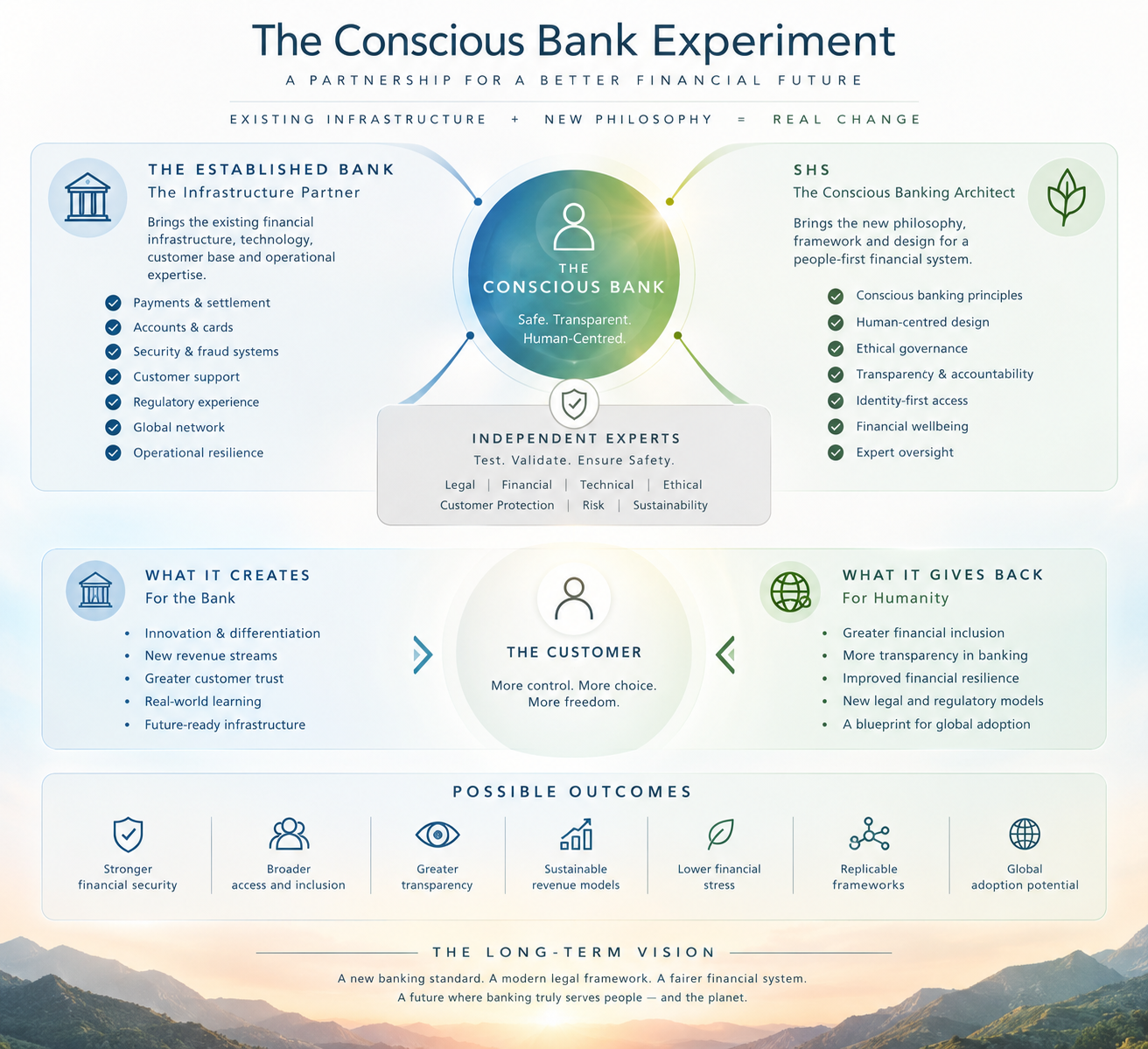
* Images are losing pixel definition ops..*
This is where the splittings start.
2 different businesses, not one incorporated in the other: customer storage and bank investment are separate economic activities,
SHS Banking, Established Banking Infrastructure, and the Possibility of a New Financial Architecture
Executive proposition
The most important question is not whether SHS could create a bank from scratch.
It is whether SHS could take the philosophy of conscious banking and place it inside an already functioning financial institution without allowing the old architecture to silently become the architecture of the new one.
That distinction is crucial.
A bank built entirely from scratch offers purity of design. An established banking partner offers something far more valuable for an experiment intended to affect humanity at scale:
a functioning financial organism.
It already has customers.
It already has payment infrastructure.
It already has identity and fraud systems.
It already understands operational failures.
It already possesses technical infrastructure, financial connectivity, customer-service capability, institutional knowledge and the experience of moving money through the real economy.
The partnership therefore becomes more than a commercial relationship.
It becomes a controlled experiment:
Can an existing banking infrastructure carry an entirely different banking philosophy?
That is a much more powerful question than simply asking whether SHS can build another bank.
And Revolut is an interesting hypothetical partner precisely because it is now a UK-authorised bank, operates at substantial international scale, and has built a technology-led financial platform rather than a traditional branch-first institution. The Bank of England’s September 2026 list includes Revolut Bank UK Ltd as a PRA-regulated UK bank authorised to accept deposits. Revolut itself states that its UK banking licence became fully operational in March 2026.
Its 2025 reporting gives an indication of the potential scale of an established partner: 68.3 million retail customers at the end of 2025, $67.5 billion in total customer balances, a $2.9 billion lending portfolio, and 90% of assets reported as being held in cash, cash equivalents and Treasury investments. These are company-reported figures, not independent assessments.
That scale changes the experiment completely.
The question becomes not:
“Can SHS create a bank?”
but:
“What happens when SHS introduces a new banking architecture into a financial institution that already has millions of people, billions in balances and a functioning global technological infrastructure?”
1. Starting from scratch versus entering an existing bank
There are two fundamentally different routes to the same destination.
Route A — build the bank independently
SHS would create:
- the technology;
- the financial infrastructure;
- identity architecture;
- payment connections;
- security systems;
- treasury arrangements;
- customer-service systems;
- compliance architecture;
- operational resilience;
- financial controls;
- regulatory relationships;
- customer acquisition;
- trust.
That gives SHS maximum architectural independence.
It also means rebuilding an enormous amount of infrastructure that already exists.
The experiment would therefore contain two simultaneous variables:
the new philosophy and the new infrastructure.
That makes scientific interpretation harder.
If the experiment succeeds, it would be difficult to determine how much of the result came from the philosophy and how much came from building an entirely new technological and institutional machine.
Route B — enter an established bank
Here the existing institution supplies much of the machinery.
SHS supplies the new architecture.
That creates a much cleaner experimental question:
Keep much of the financial infrastructure familiar. Change the philosophy governing how the financial relationship works.
This is extraordinarily valuable.
The established bank becomes the laboratory environment.
SHS becomes the architectural intervention.
The partnership therefore allows humanity to compare:
existing banking logic
against
conscious banking logic
while reducing the number of completely new variables.
That is potentially one of the strongest reasons not to start from zero.
2. The established bank does not need to become SHS
The partnership should not begin with:
“We are going to replace your bank.”
It should begin with:
“We are going to create a banking environment inside your infrastructure that operates according to a different first principle.”
That distinction protects both institutions.
The existing bank retains its ordinary operation.
SHS creates an experimental banking architecture with a clearly defined perimeter.
The bank therefore becomes the infrastructure partner, rather than the intellectual owner of the experiment.
SHS becomes the architectural and philosophical designer.
That separation is important because the purpose is not to make an existing institution suddenly pretend that its entire historic business model has changed.
The purpose is to determine whether another architecture can work.
3. What an established partner already brings
A serious banking experiment requires much more than an attractive app.
An established bank can potentially contribute the infrastructure underneath the visible experience.
That may include:
payment connectivity
account infrastructure
card infrastructure
settlement capabilities
fraud monitoring
transaction monitoring
identity processes
customer support
financial controls
technical security
operational resilience
international payment connectivity
treasury infrastructure
financial reporting
existing customer relationships
institutional knowledge
tested failure procedures
This is particularly significant because Revolut already operates an API-based technological environment. Its Business API allows authorised users to view accounts, track transactions, make payments, automate processes and use sandbox environments for testing.
That does not establish that Revolut would provide SHS with a retail banking infrastructure or agree to a particular partnership. That would have to be negotiated.
But it demonstrates that an established technology-led institution can already operate substantial programmable financial infrastructure.
That matters.
Because SHS would not necessarily have to invent the rails.
It could concentrate on deciding:
Where should those rails lead?
4. The central architectural change
The deepest difference between conventional banking and the proposed SHS experiment is not an app.
It is the treatment of the customer’s financial position.
The Bank of England explains that modern commercial bank deposits are liabilities of banks, and that commercial bank lending creates matching deposits. It explicitly notes that modern banks do not simply take a pile of savers’ deposits and mechanically lend that same pile out.
That distinction is important for the SHS research.
The conscious-bank proposition is therefore not accurately described as merely:
“SHS refuses to lend out your deposited cash.”
The deeper proposition is:
SHS creates a deliberately different balance-sheet and governance architecture in which the customer-storage function is structurally separated from the institution’s profit-making activities.
That is much more interesting.
The experiment becomes a question of architecture, not rhetoric.
5. The conscious banking perimeter
A credible experiment would require a visible financial boundary.
Imagine the customer has a Conscious Pot.
That pot has one fundamental property:
its purpose is storage and access, not discretionary institutional risk-taking.
The institution may earn revenue through the service surrounding the pot.
But the pot itself is not treated as the institution’s speculative opportunity.
This would require an independently auditable architecture demonstrating:
what enters the pot
where it is held
what can move it
what cannot move it
what generates the institution’s revenue
what happens during market stress
what happens during a bank failure
what happens during a cyberattack
what happens during a liquidity event
what happens when the customer requests withdrawal
The philosophy therefore becomes measurable.
That is the point at which “conscious banking” stops being branding and becomes institutional engineering.
6. The partnership structure
For the experiment to remain intellectually clean, the strongest structure would be a ring-fenced conscious banking environment inside the established partner.
The precise legal form would have to be designed by banking, accounting, legal, prudential, cybersecurity, data-protection and consumer-protection specialists.
But conceptually it would look like this:
Existing bank
Provides financial infrastructure.
SHS
Provides the conscious-banking architecture.
Independent expert layer
Tests safety, resilience, accounting, governance, privacy and consequence.
Customer
Remains the centre of the system.
The critical feature is that the experiment must be capable of being observed separately.
That means the results cannot disappear into the partner’s normal balance sheet and become impossible to distinguish.
The experiment needs its own:
- accounting view;
- risk view;
- governance view;
- customer-outcome view;
- incident register;
- decision record;
- performance measures;
- success criteria.
The experiment should be capable of being removed from the larger institution and still be understandable as a complete system.
7. Why the established bank might participate
The opportunity to the established partner could be much larger than a conventional partnership fee.
First: architectural discovery
The bank receives an opportunity to observe a different institutional model operating with real customers.
It can discover which elements of conscious banking work in practice.
That is valuable knowledge.
Second: product differentiation
A successful experiment could create an entirely new banking category around:
storage
consent
transparency
financial autonomy
human identity
customer ownership
financial resilience
That creates differentiation without requiring the bank to abandon all its existing products.
Third: new revenue architecture
The conscious model deliberately asks:
Can the institution make money without making the customer’s stored money itself the business opportunity?
That creates an entirely different revenue question.
Potential revenue sources could include:
subscription services;
storage fees;
technology;
financial infrastructure;
enterprise services;
payments;
international services;
licensed intellectual property;
SHS ecosystem services;
premium security;
data services where legitimately consented to;
and other non-speculative commercial activities.
This is especially relevant because Revolut already reports a diversified revenue model rather than relying on a single financial product. Its 2025 results identify substantial revenues from subscriptions, card payments, wealth, foreign exchange and other product lines.
The implication is important:
the concept of building revenue elsewhere is not commercially alien to a diversified financial platform.
The question would be whether the conscious model could extend that diversification while imposing a stronger structural separation around customer storage.
Fourth: customer trust
The phrase itself is not the asset.
The measurable customer experience is.
Imagine the bank being able to say:
“This financial environment was deliberately designed around the principle that your stored funds are not our trading opportunity.”
That is a proposition that could be tested rather than merely advertised.
8. The most interesting commercial possibility: the bank becomes a laboratory
The established partner could learn from something most financial institutions struggle to obtain:
real-world evidence of an alternative architecture.
The institution could observe:
Do people want simplicity?
Do they prefer explicit storage charges?
Does transparency increase retention?
Does a clearly separated financial pot change behaviour?
Does identity-first onboarding improve access?
Do people value financial products less when the institution explains the underlying mechanics more clearly?
Does reduced financial complexity increase trust?
Does a human-centred governance layer improve customer engagement?
Does the conscious model alter savings behaviour?
Does financial stress change?
Do customers become less dependent on credit?
Do they become more financially literate?
Does customer support demand fall when the architecture becomes more understandable?
These questions can be measured.
And that is where the partnership becomes research.
9. The opportunity for SHS
The established bank would give SHS something that is otherwise extremely difficult to reproduce:
live-system validation.
SHS could test its principles against:
real transactions;
real people;
real operational conditions;
real fraud attempts;
real payment failures;
real market shocks;
real customer behaviour;
real withdrawals;
real disputes;
real infrastructure failures;
real economic stress.
That creates something more valuable than theoretical credibility.
It creates evidence.
And once evidence exists, the system can be revised.
That is precisely the SHS philosophy:
Reality responds. We measure. We learn. We change.
10. The no-address experiment
One particularly powerful element would be the proposed identity-first banking pathway.
The SHS principle is:
Human being → verified identity → financial space
rather than:
Permanent physical address → banking eligibility.
That would create a direct experiment concerning whether conventional financial access requirements unnecessarily exclude people whose circumstances do not fit conventional documentation patterns.
The experiment would not mean eliminating identification, fraud prevention or security.
It would mean separating:
identity
from
housing status.
That distinction could have enormous humanitarian significance.
The crucial research metric would not be:
“How many people did we approve?”
It would be:
“How many people who could safely and legitimately hold financial space were previously excluded primarily because their circumstances did not fit the conventional model?”
That number would turn an ideological proposition into measurable evidence.
11. The biometric question
The proposed NI system introduces another major opportunity, but also one of the areas requiring the strongest technical scrutiny.
Biometric information used for uniquely identifying people receives special protection under UK data-protection rules as special-category data. The ICO specifically identifies biometric data used for unique identification as falling within this protected category.
Therefore the conscious-bank experiment should not treat fingerprint or facial identification merely as convenient technology.
It should ask:
Who holds the biometric template?
Can the bank reconstruct the underlying biometric information?
Can the customer revoke access?
Can the identity be ported?
What happens if the database is compromised?
Can the identity layer be separated from transaction history?
Can the customer prove identity without unnecessarily exposing every other attribute?
A metaphysical bank should therefore pursue something deeper than:
“We know who you are.”
It should pursue:
“We know you are you without acquiring more of you than the system genuinely needs.”
That becomes a technological expression of conscious consent.
12. The greatest threat to the experiment
The biggest danger is not necessarily technological failure.
It is architectural contamination.
The established bank may bring with it:
existing assumptions;
existing incentives;
existing revenue models;
existing risk classifications;
existing customer segmentation;
existing product logic;
existing organisational hierarchies;
existing definitions of acceptable behaviour.
That is precisely why the experiment needs a hard boundary.
Otherwise SHS could create a beautiful philosophy on top of the same machinery it was trying to examine.
The result would become:
old banking architecture wearing SHS clothing.
That would not be a successful experiment.
The experiment succeeds only if the underlying rules change.
13. There is another major challenge: the partner must be allowed to learn
A genuine collaboration cannot become a one-way lecture.
The established institution needs to be able to tell SHS:
“That doesn’t work.”
And SHS needs to be able to answer:
“Show us why.”
That creates the most valuable possible relationship.
Neither side gets automatic authority.
The bank possesses operational knowledge.
SHS possesses the alternative architecture.
Experts possess testing authority.
Reality possesses the final evidence.
That produces a four-part learning system:
SHS proposes.
The bank implements.
Experts test.
Reality answers.
14. Recession becomes one of the decisive tests
This is where the model could become particularly significant.
The conscious-bank proposition is explicitly interested in creating a financial environment in which customers are not dragged into institutional failure because the institution decided to expose their financial position to unnecessary risks.
That proposition should therefore be subjected to severe stress testing.
Consider:
a recession;
market crash;
major liquidity event;
bank run;
cyberattack;
payment-system outage;
fraud wave;
currency volatility;
critical technology failure;
large-scale withdrawal demand;
failure of a major third party;
or simultaneous shocks.
The experiment should record exactly what happens to the Conscious Pot.
Does the customer’s access continue?
Does its nominal balance remain stable?
Does the institution require external support?
Does another part of the business absorb the shock?
Does the institution suspend anything?
Which mechanisms activate?
What fails first?
What protects the customer?
This produces something enormously valuable:
a measurable resilience architecture.
The Bank of England and PRA are placing increasing emphasis on operational resilience and third-party dependency, including formal reporting and oversight of material third-party arrangements.
That means resilience should be treated as a first-class experimental variable, not a footnote.
15. The customer should see the architecture
A conscious bank should not require people to trust what they cannot see.
The application should expose the mechanics.
A customer could potentially see:
My balance
My storage fee
My transactions
My identity status
My available funds
My protections
My permissions
My data-sharing permissions
My financial environment
What risks apply
What happens in an emergency
What the institution earns from providing the service
That produces a different relationship.
The customer stops being merely a user of a mysterious financial machine.
They become an informed participant in the machine.
16. The partnership could create a new kind of bank
This is where the phrase Bank of Consciousness becomes more substantial.
The distinction is not that the bank is “nice.”
It is that consciousness becomes an architectural requirement.
Consciousness of:
ownership
consent
risk
consequence
identity
access
dependency
institutional responsibility
human impact
That could eventually produce a measurable Conscious Banking Standard.
Instead of simply asking:
“Is this bank profitable?”
the system could ask:
“What happens to the human being because this bank exists?”
Then measure it.
17. What success would look like
Success cannot be defined as:
“The app launched.”
Nor:
“The bank made money.”
Nor:
“People liked it.”
Those are fragments.
Success would need to represent the complete chain.
For example:
Customer funds are structurally separated from discretionary institutional risk.
↓
The customer experiences greater transparency.
↓
The customer understands the financial relationship more clearly.
↓
Financial stress or uncertainty decreases in measurable circumstances.
↓
Access improves for legitimate users previously excluded by unnecessary structural requirements.
↓
Operational resilience improves or remains at least as strong under severe stress.
↓
The institution remains commercially viable without requiring unnecessary exposure of customer storage.
↓
Customers actively choose the architecture.
↓
The model survives independent audit and repeated stress testing.
↓
The architecture can be replicated.
↓
Other institutions adopt components of it.
↓
The legal and institutional framework begins adapting around demonstrated evidence.
That is success.
Not a slogan.
A chain.
18. The X on the map
This is perhaps the most important methodological idea in the whole experiment.
Treat success as an X on a map.
The X represents the achieved human outcome.
The research question then becomes:
How do we retrace every step that led to the X?
Suppose the X is:
“A customer maintained continuous access to protected funds throughout a major financial shock without the customer bearing losses generated by institutional speculation.”
Do not simply celebrate the result.
Reverse the journey.
What happened immediately before it?
What legal structure made that possible?
What technical control protected it?
What balance-sheet rule protected it?
What governance decision created the control?
What funding mechanism paid for the infrastructure?
What customer agreement established consent?
What monitoring system detected the emerging problem?
What expert intervention corrected it?
What original SHS principle produced the rule?
Now trace it backwards again.
And again.
Until the experiment reaches the original assumption.
That gives SHS something extraordinarily valuable:
a causal map of success.
19. Success should therefore be reproducible
The X cannot simply exist once.
One successful incident is an observation.
Repeated success is evidence.
Replicated success is architecture.
Replicated architecture across different conditions becomes a standard.
And when the standard survives different:
customers;
economic conditions;
countries;
languages;
payment systems;
legal environments;
cultures;
technologies;
and economic cycles;
it begins to approach something much more important:
portability.
That is the point at which humanity could potentially take the model home.
20. What humanity could gain
A successful conscious-bank experiment could produce benefits far beyond one financial institution.
A new standard for financial storage
Humanity would have evidence that banking can separate the storage relationship from other financial activities more deliberately.
Greater financial transparency
People could gain a clearer understanding of what their accounts represent and what institutions earn from providing financial services.
Greater inclusion
The experiment could demonstrate whether identity-first banking can safely serve people whose circumstances do not fit conventional assumptions about addresses and documentation.
A new approach to financial resilience
Rather than merely asking whether an institution can survive a shock, the system could ask:
Can the human being survive the institution’s shock?
That is a profound change in the unit of analysis.
New consumer expectations
Once people experience a more transparent model, they can begin asking every financial institution:
“Why don’t you work this way?”
That is how architectural pressure spreads.
21. The possibility of a new legal framework
This is where the experiment could become far bigger than banking.
The first stage would not necessarily be creating new law.
It would be generating evidence about which rules are actually required.
The experiment could reveal:
which protections are essential;
which procedures are unnecessary;
which requirements create exclusion;
which controls genuinely reduce risk;
which reporting systems improve accountability;
which customer rights should be mandatory;
which forms of data collection are excessive;
which financial practices produce unnecessary systemic exposure;
which governance mechanisms improve correction.
From that evidence, SHS could construct something resembling a:
Conscious Banking Charter
followed by:
Conscious Banking Standards
followed by:
Model Banking Regulations
followed by:
Interoperable International Banking Principles.
The important point is that the law would be built from tested architecture.
Not from imagination alone.
22. The possibility of a new jurisdiction
This is perhaps the most extraordinary potential outcome.
The experiment could create a jurisdiction not by declaring:
“Here is a better financial system.”
but by demonstrating:
“Here is a financial system that has already operated, been tested, failed in some areas, corrected itself, and survived independent scrutiny.”
The jurisdiction then becomes the legal expression of the experiment.
That is far stronger.
The sequence becomes:
philosophy
→
architecture
→
prototype
→
live experiment
→
measurement
→
correction
→
replication
→
standard
→
law
→
jurisdiction
→
international portability.
That is how something potentially civilisational could emerge without pretending that the final system was known in advance.
23. Why an established bank may actually be the perfect starting point
There is an apparent contradiction here.
SHS is trying to create a new banking architecture.
Why would it begin inside an existing bank?
Because the established bank represents the world that already exists.
SHS represents the architecture being tested.
Put them together and the comparison becomes visible.
That produces a rare research environment:
Old infrastructure. New philosophy. Real customers. Measurable consequences.
That is much more informative than designing everything in isolation.
The established bank supplies the existing physical and technical reality.
SHS supplies the alternative logic.
Humanity gets to observe what changes when the logic changes.
24. The partner’s greatest possible achievement
The established bank would not merely have participated in another fintech project.
It could potentially become the institution that demonstrated that an established financial organisation can deliberately redesign its relationship with the people whose financial lives it serves.
The historical significance would therefore not necessarily be:
“We launched the SHS account.”
It could become:
“We helped demonstrate that banking itself was redesignable.”
That is a much larger achievement.
It could generate intellectual property.
Institutional knowledge.
New financial products.
New governance methods.
New technology.
New customer expectations.
New risk models.
New forms of financial reporting.
Potentially entirely new categories of banking.
And, if independently validated, substantial reputational value associated with having participated in a genuinely novel banking experiment.
25. But the partner must accept one uncomfortable possibility
The experiment might demonstrate that some existing assumptions are unnecessary.
That could create institutional tension.
What happens if the conscious model proves that customers strongly prefer:
simpler products;
transparent charges;
lower complexity;
clear ownership boundaries;
less discretionary financial engineering;
or different forms of access?
The established partner would then have a decision.
It could retain the successful experiment as a niche.
Or it could begin changing the wider institution.
That is where successful innovation becomes disruptive.
The experiment could eventually challenge the institution that hosted it.
And that is not necessarily evidence of failure.
It could be evidence that the experiment worked.
26. Competition could accelerate the transformation
If the model succeeded visibly, other banks would have an incentive to imitate it.
Then the question would no longer be:
“Will banks try conscious banking?”
It would become:
“Which parts of conscious banking have become customer expectations?”
That could trigger competition around:
transparency;
security;
storage;
privacy;
financial education;
identity;
fees;
customer control;
resilience;
and institutional accountability.
In other words:
SHS would not necessarily need to own the entire future.
It could create something that others adopt.
That is arguably a stronger civilisational outcome.
27. The crucial test: does the architecture remain useful without SHS?
This is an essential part of the experiment.
A genuinely successful model should eventually be able to stand independently.
SHS should not need to permanently say:
“This works because we say it works.”
The architecture should be able to demonstrate:
Here is the rule.
Here is the mechanism.
Here is the evidence.
Here are the outcomes.
Here is the failure data.
Here is what changed.
If another institution can reproduce the outcome without SHS itself controlling the experiment, the architecture has crossed an important threshold.
It has become transferable.
28. The final banking question
At that point the original question comes back.
What is a bank actually supposed to do with your money?
The traditional financial system has developed multiple functions around money: payments, lending, investment, savings, risk management and other financial services. The Bank of England describes banks as businesses that look after money, lend and facilitate payments, while earning money through dealing with money.
SHS would ask whether those functions need to remain structurally bundled.
Perhaps the future bank contains distinct layers:
Storage
Payments
Credit
Investment
Insurance
Financial education
Treasury
Governance
with explicit boundaries between them.
The customer then knows:
What is mine.
What the institution is doing.
What risk I am taking.
What risk the institution is taking.
What I have consented to.
What I have not consented to.
That is conscious architecture.
29. The experiment’s ultimate measure
The ultimate measure should therefore not be:
profit.
Profit matters.
A system that cannot economically sustain itself cannot endure.
But profitability is only one dimension.
The complete measure is:
Can the institution remain economically viable while improving the human relationship with money, increasing transparency, protecting legitimate access, maintaining resilience and reducing unnecessary exposure of the customer to institutional risk?
That is the experiment.
And it has a falsifiable answer.
Either the architecture works.
Or it does not.
Either the economics work.
Or they do not.
Either customers choose it.
Or they do not.
Either resilience improves.
Or it does not.
Either the model can be replicated.
Or it cannot.
And every result becomes data.
30. From one bank to humanity
The extraordinary possibility is therefore not that SHS creates a new bank.
It is that SHS could use one bank as the first physical laboratory for a new definition of banking.
The established institution supplies the body.
SHS supplies the new design logic.
Experts test the organism.
Customers experience it.
The economy stresses it.
Reality interrogates it.
The data records the answer.
And then the whole system is capable of being retraced.
That is the treasure-hunt principle.
We know the X exists.
Now we go backwards.
What decision produced it?
What architecture produced the decision?
What principle produced the architecture?
What evidence justified the principle?
What experiment validated it?
What failure forced its correction?
What measurement established success?
What made it transferable?
What made it legally expressible?
What made it scalable?
And once that chain can be followed from beginning to end, humanity no longer has merely a theory.
It has a blueprint.
31. The possible civilisational endpoint
At its maximum successful expression, the SHS–established-bank partnership could produce something much larger than a financial product.
It could produce:
a banking architecture
→
a conscious banking standard
→
a model regulatory framework
→
a model jurisdiction
→
an international interoperability framework
→
a transferable institutional design.
The final product would therefore not necessarily be the bank itself.
The final product could be:
the knowledge of how to build a bank that is demonstrably designed around the human being rather than merely around the financial institution.
And that distinction matters enormously.
Because once the architecture is proven, SHS would not need to say:
“Everyone must use our bank.”
The more powerful statement would be:
“Here is what we built. Here is how it works. Here is the evidence. Here are its limits. Here is what failed. Here is what we changed. Here is what survived testing. Build your own version.”
That is how an experiment becomes a standard.
And that is how a standard can become a system humanity takes home.
CONCLUSION
The established bank is not the obstacle. It could be the measuring instrument.
Starting with an established bank could actually make the SHS experiment more powerful than starting from nothing.
The existing institution provides the environment in which the architecture can be tested.
The partnership reduces the number of variables.
It exposes the concept to reality earlier.
It gives SHS access to real infrastructure and potentially a substantial user population.
It gives the bank a direct view of an alternative model.
And it gives humanity something far more valuable than another financial product:
comparative evidence.
The conscious bank should therefore not be designed merely to prove that SHS is right.
It should be designed so thoroughly that it can discover where SHS is wrong.
That is what makes the experiment serious.
The bank is not the final answer.
The experiment is.
The experiment tells us what survives.
What survives becomes architecture.
What architecture survives repeated testing becomes a standard.
What standard survives different environments can become portable.
And what becomes portable can eventually become available to humanity at scale.
So the central research proposition is this:
Do not build the perfect bank in isolation. Put the proposed architecture into contact with the banking system that already exists, separate the variables, measure everything, stress it until it breaks, repair what breaks, trace every successful outcome back to its cause, and keep only what reality proves capable of serving humanity.
That is how the X gets found.
And then, more importantly,
that is how we retrace the path to it.
….
Made clear after:
THE CORE DIFFERENTIATION OF SHS BANKING
Your Money Is Not the Bank’s Investment Capital
This is the point where SHS Banking becomes fundamentally different.
The bank is not being created around the assumption that the largest pool of money available to the institution is automatically a pool of capital for the institution to invest.
It isn’t.
Your money is your money.
The bank provides a service for holding it.
That distinction must exist at the architectural level, not merely in the language used to market the account.
The service is storage
The basic banking relationship is remarkably simple:
You have money.
You want somewhere secure to keep it.
SHS Banking provides that financial storage.
You pay the bank a transparent service charge for providing that capacity.
That charge is part of the bank’s operating revenue.
The bank therefore has a commercial reason to exist without needing to turn the customer’s stored funds into its own investment capital.
The fundamental relationship becomes:
You pay us to hold and protect your money.
Not:
You give us your money and we decide how to make more money from it.
That is the distinction.
Customer money has a boundary
The money placed into a customer’s storage account sits behind a clearly defined boundary.
The bank cannot simply look at the total amount held across millions of customers and say:
“We have access to billions, therefore we have billions available to invest.”
That is precisely the architecture SHS is questioning.
The customer’s money is available for the customer’s authorised purposes.
The bank may use the revenue it legitimately earns from providing its services to sustain its own operations.
It may have separately financed institutional capital.
It may operate separately capitalised businesses.
It may have investment activities.
But those activities do not automatically acquire a claim over the customer’s stored funds.
The customer’s pot is not the bank’s pot.
That distinction needs to be visible in the accounting, governance, technology, contracts and reporting of the institution.
The bank must finance itself
This means SHS Banking has to answer a very practical question:
How does the bank make money?
The answer cannot simply be:
“By using the customer’s money.”
The bank must have its own economic engine.
That could include:
service charges;
technology;
payments;
subscriptions;
financial infrastructure;
institutional services;
separately financed investment businesses;
commercial partnerships;
licensing;
and other legitimate sources of revenue.
The bank therefore becomes an actual business with its own capital, expenses, employees, technology, security, compliance and infrastructure.
The customer pays for the service.
The bank uses its own revenue and separately defined capital to sustain and develop the institution.
That is a much cleaner relationship.
Investment becomes an explicit choice
This does not mean SHS Banking has to eliminate investment.
Quite the opposite.
Investment can remain a major part of the financial ecosystem.
But it has to become visible, intentional and consent-based.
The customer should have a clear entry point where they can say:
I want my money stored.
And another where they can say:
I want to invest some of my money.
Those are different decisions.
They should therefore be different financial relationships.
A customer might choose:
Storage — 100%
or
Storage — £8,000
Investment — £2,000
for example.
And once the customer chooses to invest, the system should clearly show:
how much is being invested;
where it is being invested;
what type of investment it is;
what risks apply;
what fees apply;
whether the customer can exit;
and, critically,
what the customer has actually consented to.
The bank should not silently make that decision on the customer’s behalf merely because it happens to be holding the money.
What industries are we funding?
This is where conscious banking becomes even more interesting.
Banks can become enormous aggregators of financial capital.
That capital can ultimately support businesses, industries and economic activities that an individual customer may know nothing about.
So the SHS model asks a very direct question:
Should a person be able to choose whether their investable money supports an industry they fundamentally do not wish to participate in?
The conscious answer is to make that choice visible.
A customer could potentially choose categories such as:
renewable energy
housing
technology
health
education
infrastructure
creative industries
manufacturing
or other clearly defined investment categories.
The precise investment menu would require serious financial, legal and risk design.
But the principle is simple:
Investment should be an informed financial choice, not an invisible consequence of having a bank account.
Investment banking remains possible
This is another important distinction.
SHS does not have to abolish investment banking.
It can separate it.
The institution could therefore contain different businesses with different purposes.
Banking Storage
The customer pays for secure financial storage and access.
Payments
The customer moves money for authorised transactions.
Investment Services
The customer deliberately chooses investments.
Institutional Investment Banking
A separately financed business conducts its own investment and capital-market activities using capital allocated for that purpose.
Those activities should not automatically reach backward into the customer’s storage account.
That separation is the architecture.
The customer becomes the decision-maker
There is something else this changes.
Instead of the institution silently deciding:
“We have this pool of money, therefore we will determine where it ultimately participates in the economy,”
the relationship becomes:
“Here is your money. Here are the financial choices available to you. You decide which ones you want.”
That is a completely different conception of banking.
The bank becomes the conveyor of financial possibility rather than the invisible allocator of every customer’s financial participation.
And that is why transparency matters so much.
The difference between holding money and investing money
These two activities should never be allowed to blur.
Holding means:
“Keep this safe and available to me.”
Investing means:
“I knowingly accept a particular financial exposure because I have chosen it.”
Those are not the same instruction.
One is custody.
The other is risk-taking.
One is preservation.
The other is participation.
One should not automatically become the other simply because the same institution provides both services.
This is where the Bank of Consciousness gets its name
Consciousness means knowing what is happening.
Knowing:
whose money it is;
what the bank is doing with it;
what the bank is not doing with it;
what the customer has authorised;
what the customer has not authorised;
where invested money goes;
what risks exist;
what the institution earns;
and what happens if something goes wrong.
The customer should never have to discover after the fact that their financial participation extended into activities they never consciously chose.
The architecture should make that impossible wherever the relevant legal and operational structure permits.
Your money should remain yours even while the bank grows
This is perhaps the simplest expression of the model.
SHS Banking should be able to become a large, profitable, technologically sophisticated financial institution without requiring the customer’s stored money to become the institution’s speculative capital.
The bank grows because:
the business grows;
the services grow;
the technology grows;
the customer base grows;
the investment business grows through explicitly allocated capital;
and the institution creates economic value elsewhere.
Not because:
“There is a huge amount of customer money sitting here, so let’s find a way to make money from it.”
That is precisely the line SHS Banking is drawing.
The three-pot principle
The architecture can therefore be understood through three distinct financial categories.
1. YOUR MONEY
Money you have instructed the bank to store.
Its purpose is storage and access.
2. BANK MONEY
The bank’s own capital, revenue and separately financed resources.
Its purpose is to operate, sustain and grow the institution.
3. INVESTMENT MONEY
Money that the customer has explicitly chosen to place into an investment activity.
Its purpose is investment.
The critical rule is:
These pots do not become interchangeable simply because the same institution administers them.
That is the conscious boundary.
The bank’s largest pot should not automatically become its greatest temptation
And this is where SHS Banking becomes a genuinely different proposition.
A conventional financial institution can become extremely large because millions of people place money under its control.
The SHS question is:
Why should the fact that people trust an institution with their money automatically give that institution greater freedom to decide what economic activities their money should participate in?
The alternative is straightforward:
Trust creates responsibility.
Not ownership.
The larger the amount of money people entrust to the institution, the greater the responsibility to distinguish:
what belongs to them
from
what belongs to the institution.
That is why the boundary has to become stronger as the bank becomes larger, not weaker.
The ultimate test
The ultimate test of SHS Banking would therefore be very simple:
Can the bank become financially successful without converting the customer’s stored money into the bank’s discretionary investment capital?
And then:
Can customers independently choose whether, where and how some of their money enters investment activities?
And finally:
Can the entire journey of the money be understood by the person who owns it?
That is the experiment.
Because once you separate:
storage
from
investment
and
customer money
from
bank capital,
you begin to change the underlying relationship between the institution and the human being.
The bank can still invest.
The bank can still make money.
The bank can still grow.
The bank can still operate investment businesses.
The economy can still receive capital.
But the customer is no longer treated as an unconscious source of institutional investment capital merely because they opened an account.
Instead:
The customer chooses.
The bank provides.
The investment is visible.
The consent is explicit.
The ownership boundary remains clear.
And that is the core of the Bank of Consciousness.
Not a bank that asks:
“How much can we make from the money people have entrusted to us?”
But a bank that begins with:
“How can we build a commercially sustainable institution while remaining completely conscious of whose money is whose?”
That is the differentiation.
And without that differentiation, it is not really SHS Banking.



Leave a Reply